
Last Updated on April 9, 2026
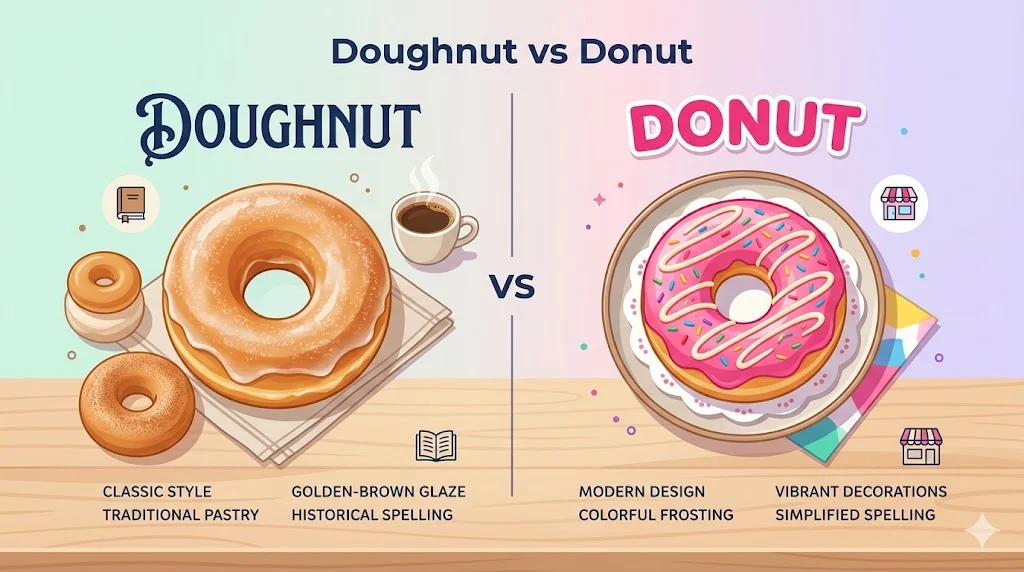
“Donut” and “doughnut” mean the same thing. The difference is only in spelling. “Doughnut” is the original, traditional form, while “donut” is a shorter, modern version commonly used in branding and everyday writing.
You’ve probably seen both spellings: donut and doughnut. Maybe on a bakery sign, a food blog, or even a menu. And at some point, you might have wondered, “Are these two different things?”
The simple answer is no. They refer to the same sweet treat. But the reason both spellings exist is actually quite interesting.
The word “doughnut” comes from “dough” and “nut,” which describes the original shape and ingredients. Over time, people started using the shorter version “donut,” especially in the United States.
Today, both are correct. But where and how you use them can make a difference, especially in writing, branding, and even SEO.
In this article, we’ll break down donut vs doughnut in a clear and easy way. You’ll learn the history, differences, usage, and common mistakes so you can use the right word with confidence.
Quick Answer / Overview
Here’s the simple truth:
- Doughnut = original, traditional spelling
- Donut = modern, simplified spelling
| Feature | Doughnut | Donut |
|---|---|---|
| Origin | Older | Newer |
| Style | Formal | Informal |
| Usage | British English, formal writing | American English, brands |
| Meaning | Same | Same |
Bottom line:
Both spellings are correct. The choice depends on context and style.
Definition / Explanation
What is a Doughnut?
“Doughnut” is the original spelling of the word. It comes from two parts:
- Dough: the mixture used to make it
- Nut: originally referred to the small, round shape
Historically, doughnuts were small and sometimes filled with nuts or fruits.
The term dates back to the 18th and 19th centuries. It was widely used in books, recipes, and traditional English writing.
What is a Donut?
“Donut” is simply a shorter version of “doughnut.”
It became popular in the 20th century, especially in the United States. Businesses and brands preferred it because:
- It is easier to read
- It is quicker to write
- It looks cleaner in logos and ads
Today, “donut” is very common in casual writing and marketing.
Advantages and Disadvantages
Doughnut: Pros and Cons
Advantages:
- Correct traditional spelling
- Preferred in formal writing
- Common in British English
Disadvantages:
- Longer to write
- Less common in branding
- Can feel outdated in casual use
Donut: Pros and Cons
Advantages:
- Short and simple
- Widely used in the U.S.
- Popular in branding and marketing
Disadvantages:
- Less formal
- Sometimes avoided in academic writing
- Not always preferred in British English
Real-World Examples
In Everyday Language
- “I grabbed a donut on my way to work.”
- “She made fresh doughnuts at home.”
Both sentences are correct. The difference is tone.
In Branding
Many companies use “donut” because it looks modern and friendly.
For example:
- A shop sign is more likely to say “donuts” than “doughnuts”
This is because shorter words are easier to remember.
In Writing
- Blogs and casual content → “donut”
- Academic or formal writing → “doughnut”
Regional / Global Usage
United States
- “Donut” is very common
- Used in ads, menus, and everyday speech
United Kingdom
- “Doughnut” is more common
- Seen in formal writing and traditional contexts
Global Trend
- “Donut” is growing in popularity worldwide
- Especially in digital content and social media
Common Mistakes
Thinking they are different foods
Some people believe donut and doughnut are two separate items.
Correction:
They are exactly the same food.
Using “donut” in formal writing
In academic or professional documents, “donut” may look informal.
Correction:
Use “doughnut” in formal contexts.
Mixing both spellings randomly
Switching between both spellings in one article can confuse readers.
Correction:
Stick to one spelling for consistency.
Assuming one is wrong
Many people think one spelling is incorrect.
Correction:
Both are correct.
Exercises with Answers
Question 1
Which is the original spelling?
Answer: Doughnut
Question 2
Which spelling is more common in branding?
Answer: Donut
Question 3
Are donut and doughnut different foods?
Answer: No
Question 4
Which is better for formal writing?
Answer: Doughnut
Question 5
Which spelling is shorter?
Answer: Donut
Related Concepts or Comparisons
American vs British English
This is similar to other word differences:
| American | British |
|---|---|
| Donut | Doughnut |
| Color | Colour |
| Favorite | Favourite |
Language Evolution
Language changes over time.
- Long words often become shorter
- Simpler versions become popular
“Donut” is a perfect example of this trend.
Branding and Simplicity
Companies prefer simple words because:
- Easy to remember
- Better for logos
- Faster to read
That’s why “donut” is widely used in marketing.
FAQs
What is the difference between donut vs doughnut?
There is no difference in meaning. The only difference is spelling and usage style.
Which spelling is correct, donut or doughnut?
Both are correct. “Doughnut” is traditional, while “donut” is modern.
Is donut American and doughnut British?
Yes, generally. “Donut” is common in American English, while “doughnut” is more common in British English.
Can I use donut in formal writing?
It is better to use “doughnut” in formal or academic writing.
Why do brands use donut instead of doughnut?
Because it is shorter, simpler, and more visually appealing.
Are donut and doughnut pronounced differently?
No, both are pronounced the same way.
Which spelling is more popular today?
“Donut” is more popular in digital content and branding.
Is doughnut outdated?
No, it is still correct and widely used in formal contexts.
Should I use one spelling consistently?
Yes, always use one spelling throughout your content.
Does Google treat donut vs doughnut differently for SEO?
Not much. Both keywords are recognized, but “donut” often has higher search volume.
Conclusion
The debate of donut vs doughnut is not about right or wrong. It is about style, context and preference.
“Doughnut” is the original spelling. It carries history and is still used in formal and traditional writing. On the other hand, “donut” is modern, simple, and widely used in everyday language and branding.
If you are writing a formal document, go with “doughnut.” If you are writing a blog, social media post, or business content, “donut” is perfectly fine.
The key is consistency. Pick one style and stick to it.
In the end, no matter how you spell it, it’s still the same delicious treat that people love all over the world.

Victoria Lane is a grammar-focused writer at GramBrix.com, passionate about helping readers master the rules of language. She provides clear explanations and practical examples that make writing more accurate, polished and confident.