
Last Updated on April 6, 2026
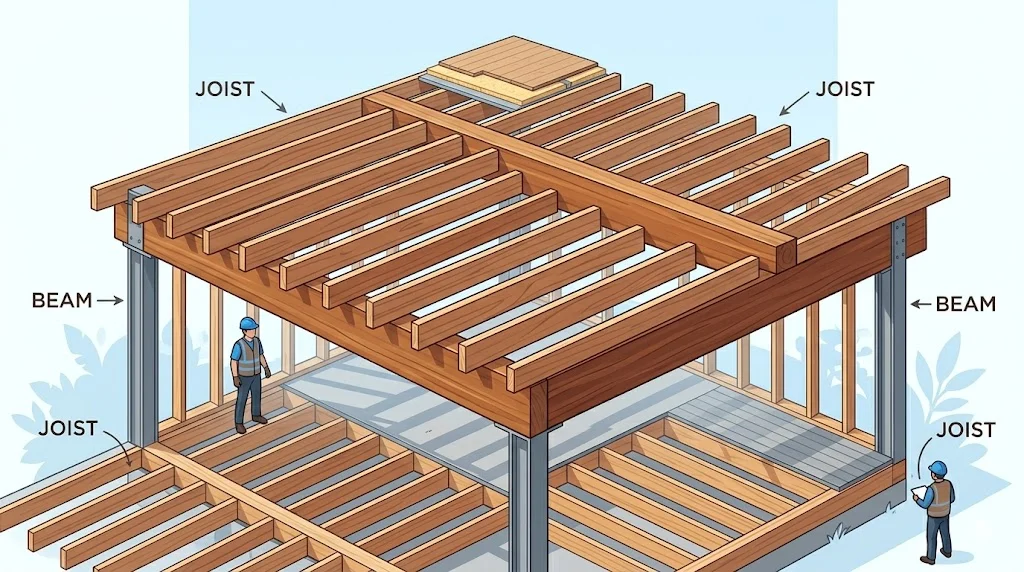
Joist vs Beam refers to two essential structural elements used in building construction. A beam supports heavy loads and transfers weight to columns or walls, while a joist is a smaller horizontal member that supports floors or ceilings. Beams carry the load; joists distribute it.
If you are learning about construction or planning a building project, you will likely hear the terms joist and beam. At first, they may sound similar. Both are horizontal supports. Both carry weight. But they are not the same.
Understanding joist vs beam is important because each plays a different role in keeping a structure strong and safe. If you mix them up, it can lead to poor design or even structural failure.
Think of it this way. A building is like a team. Every part has a job. Beams are like the main support players. Joists are like helpers that spread the load evenly.
In this article, we will explain everything in simple language. You will learn what joists and beams are, how they work together, and when each one is used. Whether you are a student, contractor, or homeowner, this guide will make the concept clear and easy to understand.
Quick Answer / Overview
Here’s the simplest way to understand joist vs beam:
- Beam = main support structure
- Joist = smaller support that rests on beams
| Feature | Joist | Beam |
|---|---|---|
| Role | Supports floors/ceilings | Supports joists and heavy loads |
| Size | Smaller | Larger and stronger |
| Placement | Repeated closely | Spaced further apart |
| Load Type | Light to medium | Heavy load |
| Direction | Parallel series | Supports across span |
In short:
Joists sit on beams. Beams carry the main weight of the structure.
Definition / Explanation
What is a Joist?
A joist is a horizontal structural member used to support floors or ceilings. Joists are usually placed in a series, evenly spaced.
They are not designed to carry extremely heavy loads alone. Instead, they distribute weight across a surface.
Common materials:
- Wood
- Steel
- Engineered lumber
Where joists are used:
- Floor framing
- Ceiling support
- Decking structures
Think of joists like the ribs in your body. They are many, evenly spaced, and help support the structure.
What is a Beam?
A beam is a strong horizontal structural element that supports loads from joists, slabs, or walls.
Beams transfer weight to vertical supports like:
- Columns
- Walls
They are designed to handle heavy loads over longer distances.
Common materials:
- Steel
- Concrete
- Wood (in smaller structures)
Think of a beam like the spine of the structure. It holds everything together.
Advantages and Disadvantages
Joist: Pros and Cons
Advantages:
- Lightweight and easy to install
- Cost-effective
- Ideal for distributing loads
- Flexible for different layouts
Disadvantages:
- Cannot carry heavy loads alone
- Requires support from beams
- Limited span capacity
Beam: Pros and Cons
Advantages:
- Strong load-bearing capacity
- Supports large spans
- Essential for structural stability
Disadvantages:
- Expensive
- Heavier and harder to install
- Requires precise engineering
Real-World Examples
Example 1: House Floor System
In a typical house:
- Beams are installed first
- Joists are placed across the beams
- Flooring is installed on top of joists
This creates a stable and even floor.
Example 2: Wooden Deck
When building a deck:
- Beams support the structure from below
- Joists are placed on top
- Deck boards sit on joists
Without beams, the deck would collapse under weight.
Example 3: Large Building
In commercial buildings:
- Steel or concrete beams carry heavy loads
- Joists distribute weight across floors
This ensures safety and durability.
Regional / Global Usage
Residential Construction
- Wood joists and beams are common
- Used in houses and small buildings
Commercial Construction
- Steel beams are widely used
- Joists may be metal or engineered wood
Developing Regions
- Simpler wooden structures
- Joists and beams often made from timber
Advanced Construction
- Engineered beams and prefabricated joists
- Used in modern buildings and skyscrapers
Common Mistakes
Thinking joists and beams are interchangeable
They are not the same.
Correction:
Beams support joists, not the other way around.
Using joists for heavy loads
Joists are not designed for heavy structural loads.
Correction:
Always use beams for main load-bearing support.
Incorrect spacing
Improper spacing can weaken the structure.
Correction:
Follow proper engineering guidelines.
Ignoring material strength
Not all wood or steel is the same.
Correction:
Choose materials based on load requirements.
Exercises with Answers
Question 1
Which element carries the main load?
Answer: Beam
Question 2
Which is smaller and placed repeatedly?
Answer: Joist
Question 3
What do joists support?
Answer: Floors and ceilings
Question 4
Can joists replace beams?
Answer: No
Question 5
Where do beams transfer load?
Answer: To columns or walls
Related Concepts or Comparisons
Joist vs Beam vs Rafter
| Feature | Joist | Beam | Rafter |
|---|---|---|---|
| Function | Supports floors | Supports loads | Supports roof |
| Position | Horizontal | Horizontal | Sloped |
| Load | Medium | Heavy | Roof load |
Joist vs Beam in Load Distribution
- Joists spread load across a surface
- Beams concentrate and transfer load downward
Simple Analogy
- Beam = backbone
- Joist = ribs
- Floor = skin
All work together to support the structure.
FAQs
What is the main difference between joist vs beam?
A beam carries heavy loads, while a joist supports floors and distributes weight.
Can a joist act as a beam?
No. Joists are not designed to handle heavy structural loads like beams.
Which is stronger, joist or beam?
A beam is stronger because it supports more weight.
Where are joists used?
Joists are used in floors, ceilings, and decks.
Where are beams used?
Beams are used as main structural supports in buildings.
Do joists sit on beams?
Yes. Joists are typically placed on top of beams.
What materials are used for beams?
Beams are commonly made from steel, concrete, or wood.
Are joists necessary in construction?
Yes. They help distribute load and support surfaces.
Can beams span long distances?
Yes. Beams are designed to support long spans.
Why is joist vs beam important?
Understanding the difference helps ensure safe and proper construction.
Conclusion
Understanding joist vs beam is essential for anyone involved in construction, whether you are a student, builder, or homeowner. These two elements may look similar at first, but their roles are very different.
Joists are smaller and work together to support floors and ceilings. They distribute weight evenly and create a stable surface. Beams, on the other hand, are the main support structures. They carry heavy loads and transfer that weight to columns or walls.
A strong building depends on both working together. Using the wrong element in the wrong place can lead to serious problems.
The key takeaway is simple.
Joists support surfaces.
Beams support the structure.
If you are planning a project, always follow proper design guidelines and consult a professional when needed. Choosing the right materials and understanding their purpose will ensure safety, durability, and long-term success.

Justin Powell is a writer at GramBrix.com who focuses on grammar, clarity and effective communication, helping readers strengthen their language skills.