
Last Updated on February 28, 2026
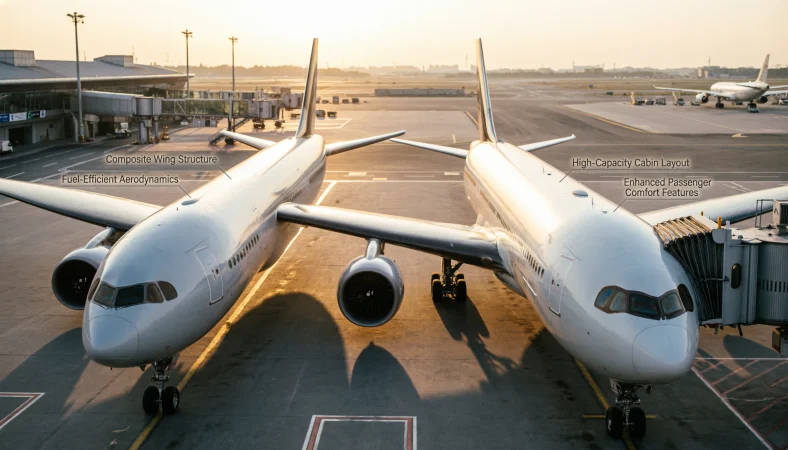
The a350 vs 777 comparison refers to two long haul wide body aircraft families built for high capacity intercontinental travel, with the A350 designed as a newer generation carbon composite jet focused on efficiency and passenger comfort, while the 777 is a proven high capacity workhorse known for range, power, and operational reliability.
The exact search query many travelers and aviation enthusiasts ask is simple: how do these two aircraft actually differ, and which one is better for airlines and passengers?
Both aircraft are twin engine wide body jets used for long distance international routes. The confusion arises because they often fly the same routes, carry similar passenger numbers, and are marketed toward the same airline missions. Misunderstanding their roles can lead to incorrect assumptions about efficiency, comfort, and airline strategy.
This article breaks down the differences clearly, using real world examples, operational data, and linguistic precision to explain not just what separates them, but why the distinction matters.
A350 vs 777: What’s the Difference?
At a fundamental level, this is a comparison between two aircraft families built in different technological eras with different design philosophies.
| Feature | A350 | 777 |
|---|---|---|
| Manufacturer | Airbus | Boeing |
| First Entry Into Service | 2015 | 1995 |
| Construction | Carbon fiber composite structure | Primarily aluminum alloy |
| Engine Generation | Latest high bypass turbofans | Earlier generation with later upgrades |
| Cabin Pressure | Lower altitude feel for passengers | Traditional wide body cabin environment |
| Fuel Efficiency Focus | Designed for modern efficiency standards | Designed for capacity and durability |
| Typical Role | Ultra long haul efficiency | High demand long haul routes |
Mini Recap
The newer aircraft emphasizes advanced materials, reduced fuel burn, and passenger experience improvements.
The older platform focuses on proven reliability, larger capacity options, and strong performance in dense travel markets.
They overlap in mission but differ in philosophy, age, and optimization strategy.
Is This a Design, Technology, or Usage Issue?
This comparison is not about interchangeable aircraft. It is primarily a technological generation difference combined with operational philosophy.
They are not substitutes in a strict sense. Airlines select between them based on economics, route demand, and fleet strategy.
In formal aviation usage, analysts describe one as a next generation efficiency aircraft and the other as a high capacity legacy platform that has evolved through upgrades.
In casual travel conversation, passengers often treat them as equivalent simply because both are large twin aisle jets. That simplification hides meaningful differences in materials, maintenance models, and cabin experience.
Academically and operationally, they represent two stages of wide body evolution rather than direct copies of each other.
Understanding the A350 in Practical Use
The aircraft was conceived during an era when fuel cost volatility and environmental regulation pushed manufacturers toward radical efficiency improvements.
Workplace Example
Airline fleet planners evaluating new long haul routes often select this aircraft when demand is steady but not extremely dense. Its economics allow profitable service on routes that would be risky with heavier jets.
Academic Example
In aviation management programs, the aircraft is used as a case study of composite airframe adoption. Researchers analyze how lighter structures reduce lifecycle fuel consumption while also affecting maintenance training requirements.
Technology Example
The aircraft integrates advanced aerodynamics, digital monitoring systems, and next generation engines that continuously transmit performance data to ground teams, allowing predictive maintenance.
Usage Recap
This platform is best understood as a precision tool. It enables airlines to open new routes, reduce operating cost per seat, and meet stricter emissions goals without sacrificing range.
Understanding the 777 in Practical Use
This aircraft emerged in the 1990s when airlines needed a powerful replacement for aging four engine jets but still required large passenger volumes.
Workplace Example
On trunk routes such as major global hubs, airlines deploy it to move large numbers of passengers efficiently where demand is guaranteed and frequency matters less than capacity.
Academic Example
It is frequently analyzed in engineering programs as one of the most successful examples of extended twin engine operations approval, proving that two engines could safely handle missions once reserved for four.
Technology Example
While earlier variants relied on conventional materials, later upgrades incorporated avionics modernization, improved aerodynamics, and more efficient engines to extend relevance.
Usage Recap
This aircraft excels when volume and robustness outweigh the need for cutting edge materials. It remains a backbone asset for airlines with heavy traffic corridors.
When You Should NOT Treat Them as Equivalent
Many comparisons oversimplify their roles. Here are common scenarios where assuming similarity leads to errors.
- When evaluating environmental performance metrics for sustainability reporting
- When analyzing lifecycle maintenance cost structures
- When planning thin long haul routes with uncertain demand
- When comparing passenger cabin humidity and pressurization experience
- When calculating fuel burn per available seat mile for modern fleets
- When discussing structural materials in aerospace engineering contexts
- When examining airline fleet renewal strategies
- When predicting resale value over long service horizons
Each scenario highlights that generational design differences create real operational consequences.
Common Mistakes and Decision Rules
| Correct Understanding | Incorrect Assumption | Explanation |
|---|---|---|
| The newer jet prioritizes efficiency and comfort | Both aircraft were designed with identical goals | They reflect different economic eras |
| The older jet can carry more passengers in many layouts | The newer model always replaces it | Airlines often operate both together |
| Composite construction changes maintenance philosophy | Materials do not affect operations | Structural design influences lifecycle cost |
| Route structure determines selection | Airlines choose randomly | Fleet planning is data driven |
Decision Rule Box
If you mean next generation efficiency and advanced materials, think of the newer aircraft family.
If you mean proven capacity and long standing operational reliability, think of the earlier platform.
These Aircraft in Modern Technology and AI Tools
Modern airline analytics platforms use artificial intelligence to determine which aircraft should operate specific routes. Algorithms evaluate passenger demand, fuel pricing, weather patterns, and maintenance cycles.
The newer aircraft often appears in optimization models for experimental or expanding routes, while the older one dominates simulations involving high density global corridors.
This demonstrates how digital aviation planning recognizes their complementary strengths rather than treating them as rivals.
A Short Historical Perspective
The earlier aircraft emerged during a time when reliability and scale defined success. Airlines wanted fewer flights carrying more people across oceans.
Two decades later, market conditions shifted. Fuel efficiency, environmental pressure, and flexible routing became dominant concerns. The newer aircraft was designed specifically for that reality.
As one aviation analyst noted:
“Wide body evolution is not about replacement. It is about specialization shaped by economics, not just engineering.”
Real World Case Studies
Case Study 1: Fleet Modernization Strategy
Singapore Airlines adopted both aircraft families simultaneously. The airline uses the newer jet on ultra long haul services where efficiency and passenger comfort directly influence profitability, while maintaining the older type on dense regional long haul markets.
Result: Increased route flexibility and improved fuel performance without sacrificing capacity where it was needed most.
Case Study 2: High Demand Hub Operations
Emirates continues to rely heavily on the earlier aircraft for routes linking major global hubs. The large seating capacity supports its hub and spoke model, where maximizing passenger flow through a single airport is essential.
Result: High traffic efficiency and strong return on high demand city pairs.
Why Airlines Rarely Choose Only One
Fleet diversity reduces risk. Airlines must adapt to changing fuel prices, seasonal demand, and evolving regulations. Having both aircraft types allows planners to match capacity precisely to market conditions.
Think of them less as competitors and more as complementary tools within a global transportation system.
Error Prevention Checklist
Always associate the newer aircraft with modern efficiency goals and advanced materials.
Always connect the earlier aircraft with proven scale and operational endurance.
Never assume newer automatically means larger.
Never assume older automatically means obsolete.
Always evaluate mission profile before comparing performance.
Never compare them without considering airline strategy.
Related Aviation Confusions You Should Understand
Travelers and analysts often mix up several other aviation distinctions that follow a similar pattern of generational change versus mission design.
Understanding differences between narrow body and wide body aircraft
Learning how range differs from endurance
Knowing why composite materials changed aircraft manufacturing
Understanding extended twin engine certification concepts
Recognizing how cabin pressure affects passenger fatigue
Distinguishing seat capacity from route economics
Understanding why airlines retain older aircraft alongside newer ones
Learning how fuel burn metrics are calculated
Recognizing the role of predictive maintenance in modern fleets
Understanding hub and spoke versus point to point network planning
Mastering these ideas provides deeper clarity when evaluating any aircraft comparison.
FAQs
Why do airlines still buy the 777 if the A350 is newer?
Because capacity and mission requirements differ. Some routes demand maximum passenger volume rather than maximum efficiency.
Is one aircraft safer than the other?
Both meet the same rigorous international safety standards and have excellent operational records.
Which aircraft is more comfortable for passengers?
The newer aircraft typically offers improved cabin pressure, humidity, and quieter operation, though airline configuration matters more than the airframe itself.
Do they fly the same distances?
Yes, both are capable of ultra long haul travel, but they achieve it through different design approaches.
Why do aviation analysts call the A350 a next generation jet?
Its composite structure, advanced aerodynamics, and digital systems represent a major technological shift compared with earlier wide bodies.
Does the 777 still have a future?
Absolutely. Updated variants continue to serve high demand markets where size and power remain advantageous.
Which aircraft is better for new airlines launching long haul service?
Many choose the newer aircraft because its economics reduce financial risk on developing routes.
Are maintenance costs different?
Yes. Composite structures and modern monitoring systems change inspection cycles and long term servicing models.
Conclusion
The a350 vs 777 comparison is not about choosing a winner. It is about understanding two aircraft built for different economic realities. One reflects modern priorities of efficiency, sustainability, and flexibility. The other represents unmatched capacity, durability, and decades of proven performance.
Airlines that understand this distinction use both strategically, matching aircraft strengths to route demands rather than forcing a one size solution.
In aviation, progress rarely erases the past. Instead, it adds another tool to the fleet.

Kevin Brooks is a grammar specialist at GramBrix.com, dedicated to helping readers understand language rules with clarity and confidence. He simplifies complex grammar concepts through practical examples and easy explanations.