Last Updated on June 30, 2026
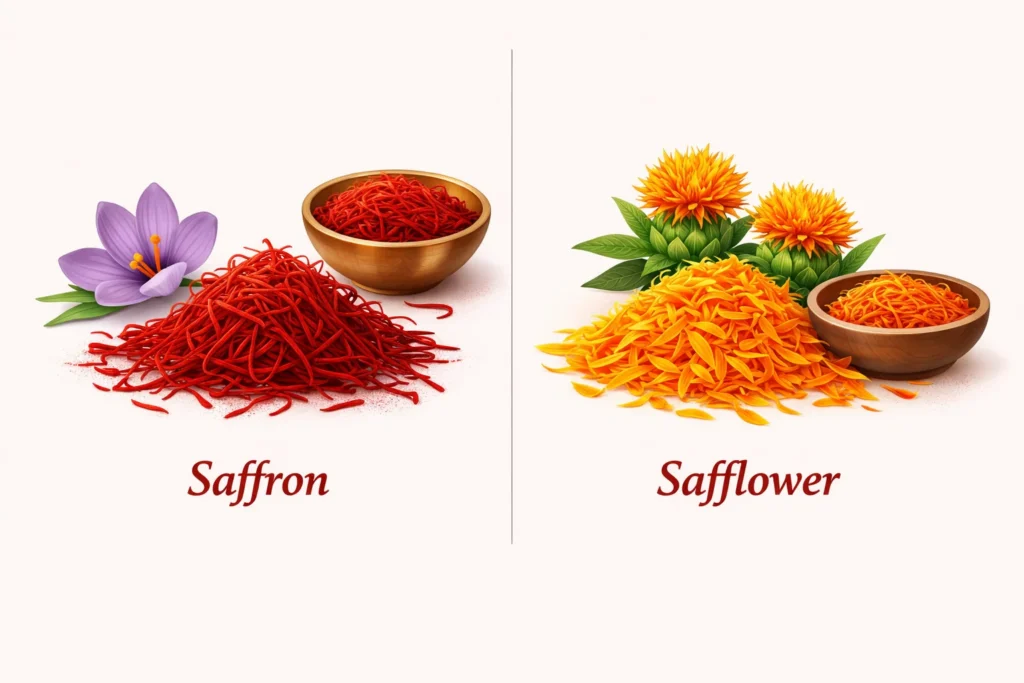
Safflower and saffron may look similar, but they are completely different. Saffron is a rare and expensive spice from crocus flowers, while safflower is a cheaper plant often used as a substitute. They differ in taste, value, color strength, and health benefits.
Have you ever paid for saffron but accidentally bought safflower instead? You’re not alone. Every year, thousands of people mistake these two ingredients because they look surprisingly similar. Some sellers even market safflower as a cheaper alternative to saffron, leaving buyers confused about what they’re actually getting.
Although safflower and saffron share a similar red orange appearance and are both used in cooking, they are completely different plants with distinct flavors, colors, health benefits, and prices. Choosing the wrong one can affect the taste of your recipes, the nutritional value, and even your budget.
Saffron is known as “red gold” because it is one of the world’s most valuable spices. It is hand harvested from the delicate stigmas of the Crocus sativus flower, making it rare, highly aromatic, and expensive. Safflower, by contrast, comes from the Carthamus tinctorius plant and is a much more affordable ingredient commonly used as a natural food coloring, herbal tea, and cooking oil source.
In this comprehensive guide, you’ll discover the key differences between safflower vs saffron, including their appearance, taste, aroma, culinary uses, health benefits, cost, and how to identify genuine saffron before you buy. The information is based on established botanical knowledge, traditional culinary uses, and reliable scientific research, helping you make an informed choice with confidence.
Quick Answer / Overview
Let’s keep it simple:
- Saffron = premium spice, strong flavor, expensive
- Safflower = budget alternative, mild flavor, affordable
Here’s a quick comparison:
| Feature | Saffron | Safflower |
|---|---|---|
| Source | Crocus flower | Safflower plant |
| Price | Very expensive | Cheap |
| Flavor | Strong, unique | Mild, almost none |
| Color | Deep golden | Light yellow/orange |
| Use | Luxury dishes | Coloring or oil |
| Aroma | Rich | Very light |
In short:
If you want flavor and authenticity, choose saffron.
If you just need color on a budget, safflower works.
What is Saffron?
Saffron comes from the flower Crocus sativus. The spice is made from tiny red threads called stigmas.
Each flower produces only three threads, which makes saffron very rare. That’s why it’s so expensive.
Harvesting saffron is done by hand. It takes thousands of flowers to make just a small amount.
Saffron is known for:
- Its strong aroma
- Rich golden color
- Unique taste
It is commonly used in:
- Biryani
- Rice dishes
- Desserts
- Traditional medicines
What is Safflower?
Safflower comes from a different plant called Carthamus tinctorius.
It looks somewhat similar to saffron when dried, but that’s where the similarity mostly ends.
Safflower is:
- Much cheaper
- Easier to grow
- Widely available
It is often used for:
- Cooking oil
- Food coloring
- Herbal uses
Some sellers even label it as “fake saffron” or “Mexican saffron,” which can confuse buyers.
Advantages and Disadvantages
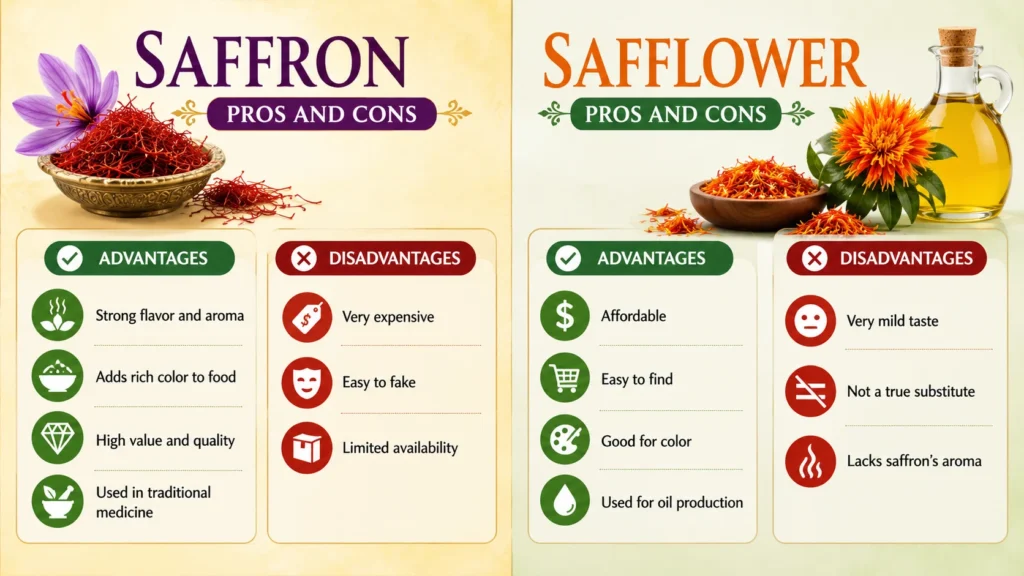
Saffron: Pros and Cons
Advantages:
- Strong flavor and aroma
- Adds rich color to food
- High value and quality
- Used in traditional medicine
Disadvantages:
- Very expensive
- Easy to fake
- Limited availability
Safflower: Pros and Cons
Advantages:
- Affordable
- Easy to find
- Good for color
- Used for oil production
Disadvantages:
- Very mild taste
- Not a true substitute
- Lacks saffron’s aroma
Real-World Examples
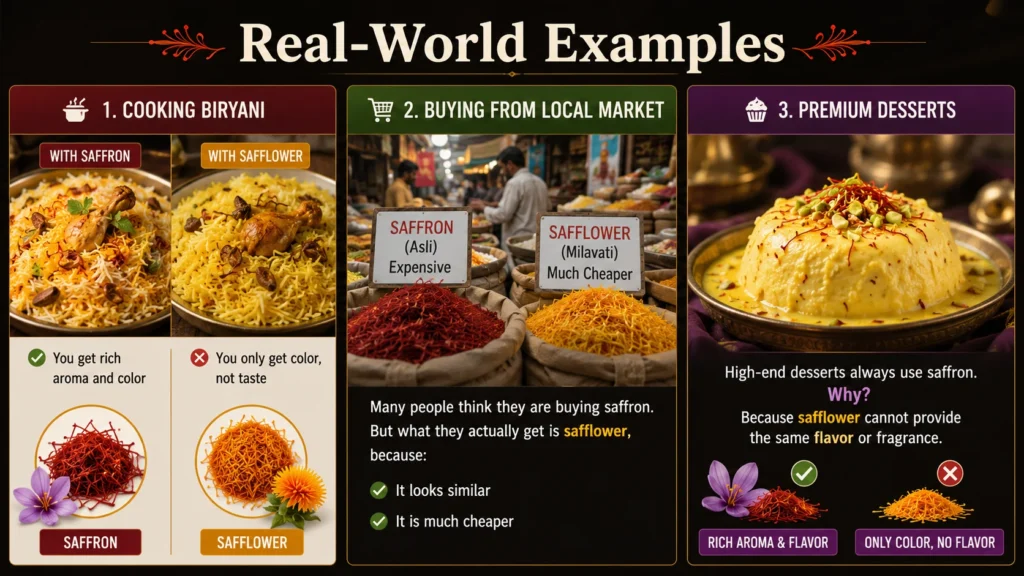
Cooking Biryani
If you use saffron:
- You get rich aroma and color
If you use safflower:
- You only get color, not taste
Buying from Local Market
Many people think they are buying saffron.
But what they actually get is safflower, because:
- It looks similar
- It is much cheaper
Premium Desserts
High-end desserts always use saffron.
Why?
Because safflower cannot provide the same flavor or fragrance.
Regional / Global Usage
In South Asia
Saffron is widely used in:
- Pakistan
- India
- Iran
It is common in:
- Biryani
- Kheer
- Sweets
Safflower is sometimes used as a cheaper alternative.
In Western Countries
Safflower is more commonly used for:
- Cooking oil
- Health products
Saffron is used in:
- Gourmet cooking
- Fine dining
Common Mistakes
Thinking safflower is real saffron
This is the most common mistake.
Correction:
Always check the source and price.
Buying cheap “saffron”
Real saffron is never very cheap.
Correction:
If the price is too low, it’s probably safflower.
Expecting same flavor
Safflower does not taste like saffron.
Correction:
Use saffron when flavor matters.
Ignoring appearance details
Saffron threads are thin and deep red.
Safflower looks more like dried petals.
Exercises with Answers
Question 1
Which is more expensive?
Answer: Saffron
Question 2
Which is used mainly for color?
Answer: Safflower
Question 3
Which has a strong aroma?
Answer: Saffron
Question 4
Which plant produces saffron?
Answer: Crocus sativus
Question 5
Is safflower a true substitute?
Answer: No
Related Concepts or Comparisons
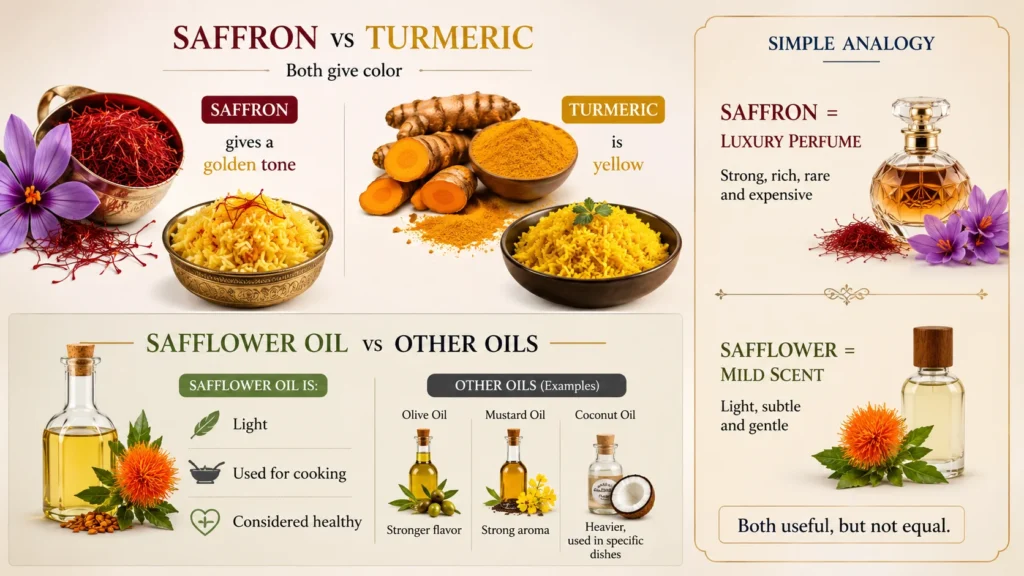
Saffron vs Turmeric
- Both give color
- Turmeric is yellow
- Saffron gives golden tone
Safflower Oil vs Other Oils
Safflower oil is:
- Light
- Used for cooking
- Considered healthy
Simple Analogy
- Saffron = luxury perfume
- Safflower = mild scent
Both useful, but not equal.
FAQs
What is the difference between safflower vs saffron?
Saffron is a premium spice with strong flavor, while safflower is a cheaper plant mainly used for color.
Is safflower fake saffron?
Not exactly fake, but it is often used as a substitute and sold misleadingly.
Why is saffron so expensive?
Because it is hand-harvested and requires thousands of flowers to produce small amounts.
Can safflower replace saffron in cooking?
Only for color, not for taste or aroma.
How can I identify real saffron?
Look for deep red threads with strong smell and higher price.
Is safflower healthy?
Yes, especially its oil, but it does not have the same properties as saffron.
Which is better, safflower vs saffron?
It depends on use. Saffron is better for flavor, safflower for budget.
Does safflower taste like saffron?
No, safflower has very little taste.
Where is saffron commonly used?
In rice dishes, desserts, and traditional medicine.
Can saffron expire?
Yes, over time it loses flavor and aroma.
Conclusion
Understanding safflower vs saffron can save you money and help you make better choices in the kitchen.
Saffron is rare, expensive, and full of flavor. It adds depth, aroma, and richness to dishes. That’s why it is used in premium cooking.
Safflower, on the other hand, is practical and affordable. It works well when you only need color, but it cannot match saffron in taste or quality.
The key is knowing what you need.
If you’re cooking something special, go for saffron. If you’re on a budget and only need color, safflower can do the job.
Always check what you’re buying, especially in markets where labeling may not be clear.
In simple terms:
- Saffron = quality and flavor
- Safflower = affordability and color
That’s the real difference.

Victoria Lane is a grammar-focused writer at GramBrix.com, passionate about helping readers master the rules of language. She provides clear explanations and practical examples that make writing more accurate, polished and confident.