
Last Updated on March 24, 2026
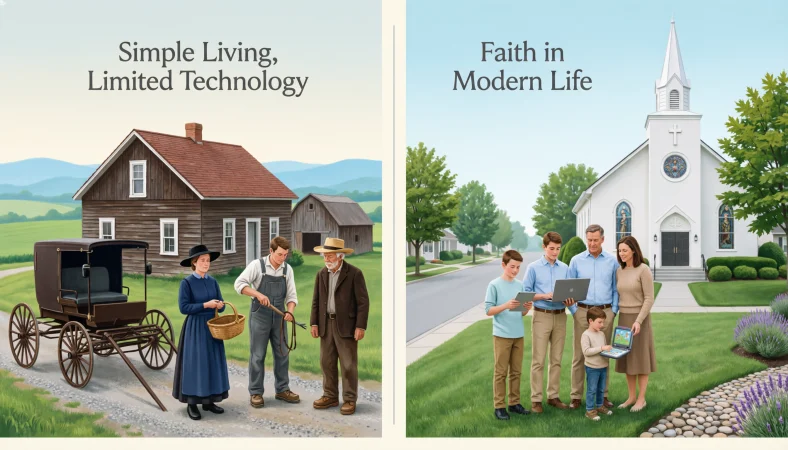
The main difference in amish vs mormon lies in how each group practices religion and engages with modern life. Amish communities avoid most technology and live simply, while members of The Church of Jesus Christ of Latter-day Saints actively participate in modern society while following their faith. Both are Christian-rooted traditions, but their lifestyles, beliefs, and cultural practices differ greatly.
Many people confuse Amish and Mormon communities. Both are religious. Both value family, faith, and tradition. Both are often seen as separate from mainstream culture. Because of this, people think they are similar.
But they are very different.
The amish vs mormon comparison is not just about religion. It is about lifestyle. It is about how people live every day. One group limits technology and focuses on simple living. The other embraces education, careers, and modern tools while staying devoted to faith.
Understanding these differences helps avoid stereotypes. It also helps us see how religion can shape life in very different ways. Some people want to learn for school. Others want to understand neighbors, culture, or history. This guide explains everything clearly, from beliefs to daily routines, using simple examples anyone can understand.
Quick Answer Overview
Here is the simplest way to understand amish vs mormon:
| Feature | Amish | Mormon |
|---|---|---|
| Approach to Technology | Mostly avoid it | Use it normally |
| Worship Style | Small local communities | Organized global church |
| Education | Usually ends after eighth grade | Encourages higher education |
| Missionary Work | Rare | Strong focus on missions |
| Lifestyle | Rural, simple, traditional | Modern, integrated |
| Church Structure | Independent districts | Central leadership |
| Dress | Plain clothing | Modern clothing standards |
| Transportation | Horse and buggy | Cars, planes, public transit |
In short, Amish life is about separation from the modern world. Mormon life is about faith within the modern world.
Definition and Explanation
Who Are the Amish?
The Amish are a Christian group that began in Europe in the late 1600s. They follow the teachings of Anabaptism, which stresses adult baptism, humility, and community life.
They believe faith should shape every action. To protect their values, they limit contact with modern culture. This includes avoiding cars, television, and often electricity.
Their goal is not to reject progress. Their goal is to protect family, faith, and equality.
Who Are the Mormons?
“Mormon” is an informal name for members of The Church of Jesus Christ of Latter-day Saints. The church was founded in 1830 in the United States.
Members believe in Jesus Christ and also follow additional scripture called the Book of Mormon. They see modern revelation, missionary service, and education as important parts of faith.
Unlike the Amish, they believe they can live fully in today’s world while staying spiritually committed.
Core Beliefs Compared
Although both groups are Christian-influenced, their theology and practice differ.
| Belief Area | Amish | Mormon |
|---|---|---|
| Authority | Local church leaders | Global church leadership |
| Scripture | Bible only | Bible plus Book of Mormon |
| Baptism | Adult choice | Usually at age eight |
| Community | Separation from society | Engagement with society |
| Salvation View | Faith shown through humility | Faith, ordinances, and service |
Lifestyle Differences in Daily Life
Amish Daily Life
Amish life centers on:
- Farming and manual labor
- Strong neighbor relationships
- Simple homes without modern entertainment
- Shared work such as barn raising
- Limited formal education
Life moves slowly. This is intentional. Slowness builds connection.
Mormon Daily Life
Mormon families often live like other modern families, but with strong religious routines:
- Weekly church attendance
- Family prayer and scripture study
- Professional careers and education
- Volunteer service
- Missionary work for young adults
They aim to balance faith and modern responsibility.
Technology and Modern Living
Technology shows one of the clearest amish vs mormon differences.
Amish View of Technology
Technology is evaluated carefully. They ask:
Does this help family life?
Does this create pride or independence?
Does this weaken community?
If the answer is yes, they may avoid it.
For example:
- No personal cars because cars allow people to leave community easily.
- No television because it brings outside values into the home.
Mormon View of Technology
Technology is seen as a tool. It can spread faith and improve life.
Examples:
- Missionaries use smartphones for teaching.
- Church services are streamed online.
- Members work in science, business, and technology fields.
Education and Career Paths
Education also highlights major differences.
| Area | Amish | Mormon |
|---|---|---|
| Schooling | Ends early | Encouraged lifelong learning |
| Career Type | Skilled trades, farming | Wide range of professions |
| Higher Education | Rare | Strongly encouraged |
| Purpose of Work | Support family and community | Personal growth and service |
Family Structure and Community Values
Both groups value family deeply, but express it differently.
Amish Families
- Large families are common.
- Children learn practical skills early.
- Community helps raise children together.
- Social life centers on church and neighbors.
Mormon Families
- Families are considered eternal spiritual units.
- Emphasis on parenting, education, and shared faith activities.
- Families often participate in structured church programs.
Worship Style and Religious Practice
Amish Worship
- Held in homes, not churches.
- Services rotate between families.
- Conducted in traditional languages or simple English.
- Singing without instruments.
This creates humility and equality.
Mormon Worship
- Services held in meetinghouses worldwide.
- Organized lessons, music, and sermons.
- Clear leadership roles.
- Programs for children, youth, and adults.
Advantages and Disadvantages
Understanding amish vs mormon also means looking at strengths and challenges.
Amish Advantages
- Strong sense of belonging
- Low exposure to modern stress
- Deep family bonds
- Sustainable lifestyle
Amish Challenges
- Limited career options
- Less access to higher education
- Healthcare and modernization debates
Mormon Advantages
- Balance of faith and opportunity
- Global support network
- Access to education and careers
- Strong missionary identity
Mormon Challenges
- Busy schedules balancing church and work
- Misunderstandings from outsiders
- Cultural expectations can feel demanding
Real World Examples
Amish Communities
One well known Amish settlement is located in Lancaster, where farms, horse drawn buggies, and handmade goods reflect traditional life.
Another large population lives in Holmes County, where agriculture and craftsmanship remain central.
Mormon Influence
The headquarters of the LDS Church is in Salt Lake City, located in Utah, which serves as a global hub for administration, education, and missionary training.
Both traditions developed largely within the United States, yet their influence now extends worldwide in different ways.
Regional and Global Usage
The Amish remain concentrated in rural North America. Their growth happens through family expansion, not conversion.
Mormons, by contrast, are a global church. Missionaries serve in many countries. Congregations exist across cultures, languages, and economies.
This difference explains why Amish communities look similar wherever they exist, while Mormon congregations adapt to local culture.
Common Mistakes People Make
Many misunderstandings happen when comparing amish vs mormon.
Mistake One
Assuming both groups avoid technology.
Correction: Only Amish limit it intentionally.
Mistake Two
Thinking both are culturally isolated.
Correction: Mormon members live fully in modern society.
Mistake Three
Believing they share identical theology.
Correction: Their scriptures, leadership, and doctrines differ significantly.
Mistake Four
Assuming Amish life is “anti progress.”
Correction: It is selective adoption, not rejection.
Related Concepts or Comparisons
To better understand amish vs mormon, it helps to compare them with other traditions:
| Group | Relationship to Modern Culture |
|---|---|
| Amish | Separation |
| Mormon | Engagement |
| Mennonites | Middle ground |
| Monastic Orders | Structured withdrawal |
| Evangelicals | Cultural participation |
This spectrum shows how religious groups choose different relationships with society.
Practical Exercises With Answers
These exercises help reinforce understanding.
Exercise One
Which group limits technology to preserve community life?
Answer: Amish.
Exercise Two
Which group sends missionaries worldwide?
Answer: Mormon.
Exercise Three
Which lifestyle is more integrated into modern education and careers?
Answer: Mormon.
Exercise Four
Why do Amish avoid cars?
Answer: To prevent independence from community structure.
Exercise Five
What is the main difference in worldview?
Answer: Amish prioritize separation. Mormons prioritize participation.
Deep Cultural Insights
The amish vs mormon comparison reveals something bigger than religion. It shows two answers to the same question:
How should faith relate to the modern world?
The Amish answer: Protect faith by limiting outside influence.
The Mormon answer: Bring faith into the world and shape it from within.
Neither approach is accidental. Each developed from historical experiences, migration patterns, and theological interpretation.
FAQs
Are Amish and Mormon the same religion?
No. The amish vs mormon comparison shows two distinct traditions with different histories, scriptures, and lifestyles.
Do Amish believe in Jesus Christ like Mormons do?
Yes, both are Christian influenced, but their theological interpretations differ.
Why do Amish avoid technology while Mormons use it?
Amish see technology as a threat to community equality, while Mormon teachings encourage using tools to spread faith and improve life.
Can Amish people become Mormon or vice versa?
Conversion is possible, but rare due to major lifestyle differences.
Do Mormons live like typical Americans?
Generally yes. They work modern jobs, attend universities, and participate in society while maintaining religious practices.
Do Amish people vote or join politics?
They usually avoid political involvement to maintain separation from worldly systems.
Is missionary work part of Amish tradition?
No. Unlike Mormon missions, Amish communities grow mostly through family life.
Which group has stricter lifestyle rules?
Amish communities enforce visible lifestyle boundaries more strictly than Mormon congregations.
Are Amish communities growing faster than Mormon communities?
Amish populations grow through large families, while Mormon growth often comes through conversion and global expansion.
Why is the amish vs mormon comparison so commonly searched?
People notice surface similarities like modesty and faith focus, but want clarity on the deeper cultural differences.
Conclusion
The comparison of amish vs mormon is not simply about religion. It is about two different visions of faithful living.
The Amish choose simplicity, separation, and close knit community. Their way of life protects tradition and limits outside influence. Every decision supports humility, equality, and shared responsibility.
Mormons choose engagement, education, and global outreach. They believe faith should function inside modern society, not apart from it. Their structure encourages learning, service, and participation in the world.
Both paths require commitment. Both create strong families and values. But they answer modern challenges in opposite ways.
Understanding these differences helps replace stereotypes with respect. It also shows that faith can shape culture in more than one meaningful direction. Whether studying religion, sociology, or history, this comparison offers a powerful example of how belief influences everyday life.

Victoria Lane is a grammar-focused writer at GramBrix.com, passionate about helping readers master the rules of language. She provides clear explanations and practical examples that make writing more accurate, polished and confident.