Last Updated on March 24, 2026
A bolt is a threaded fastener designed to work with a nut to clamp materials together, while a nut is the internally threaded partner that tightens onto the bolt. In simple terms, the bolt provides the shaft and head, and the nut provides the locking grip. Together, they create strong, removable joints used in construction, machinery, automotive systems, and everyday hardware.
When you build a table, fix a car, or install a machine, you need parts that hold things tight. Two common parts are bolts and nuts. Many people mix them up. They look similar. They work together. But they are not the same.
Understanding bolt vs nut is important for safety and strength. If you choose the wrong fastener, parts can loosen. Machines can fail. Structures can become unsafe.
This guide explains everything in simple words. You will learn what a bolt is. You will learn what a nut is. You will see how they work together. You will also learn about types, materials, advantages, mistakes, and real-world uses.
Whether you are a beginner, student, DIY worker, or engineer, this article will help you understand bolt vs nut clearly and confidently.
Quick Answer About Bolt vs Nut
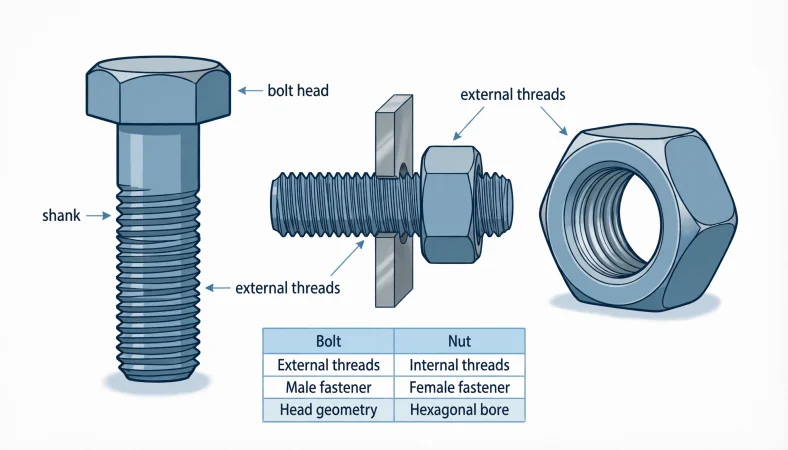
A bolt is a metal rod with external threads and a head on one end. A nut is a small metal block with internal threads that screw onto the bolt.
Here is a simple table:
| Feature | Bolt | Nut |
|---|---|---|
| Threads | External | Internal |
| Shape | Long shaft with head | Small block, often hexagonal |
| Function | Passes through materials | Screws onto bolt to tighten |
| Used Alone | Rarely | Never |
| Works With | Nut or threaded hole | Bolt only |
In bolt vs nut comparison, remember this:
- The bolt holds the structure.
- The nut locks the bolt in place.
They are a team.
What Is a Bolt
A bolt is a cylindrical fastener with threads cut on the outside. It usually has a head on one end. The head allows you to tighten it using a wrench or spanner.
Main Parts of a Bolt
- Head
- Shank
- Threads
- Tip
The head can be hex, square, round, or socket style. The threaded part grips the nut.
Common Types of Bolts
- Hex bolt
- Carriage bolt
- Anchor bolt
- Eye bolt
- U bolt
- Flange bolt
Each type serves a different purpose. For example:
- Hex bolts are common in construction.
- Carriage bolts are used in wood.
- Anchor bolts fix structures to concrete.
Materials Used for Bolts
- Carbon steel
- Stainless steel
- Alloy steel
- Brass
- Titanium
Strong bolts are used in bridges and heavy machinery. Stainless bolts resist rust in outdoor areas.
What Is a Nut
A nut is a small metal piece with internal threads. It screws onto a bolt. When tightened, it clamps materials between the bolt head and the nut.
Main Parts of a Nut
- Body
- Internal threads
- Faces for gripping
Most nuts are hex shaped. This makes them easy to hold with tools.
Common Types of Nuts
- Hex nut
- Lock nut
- Wing nut
- Cap nut
- Flange nut
- Nylon insert nut
Each nut type has a special purpose.
For example:
- Lock nuts prevent loosening from vibration.
- Wing nuts can be tightened by hand.
- Cap nuts protect the bolt tip.
In bolt vs nut comparison, the nut provides the holding force.
How Bolt and Nut Work Together
Imagine a sandwich.
The bolt is like a long stick going through bread slices.
The nut is like your hand pressing the slices tight.
When you tighten the nut, tension forms in the bolt. This creates clamping force between the materials.
The strength depends on:
- Bolt grade
- Nut grade
- Thread quality
- Torque applied
If torque is too low, the joint is loose.
If torque is too high, the bolt can break.
Advantages and Disadvantages of Bolt vs Nut
Advantages of Bolts
- Strong fastening
- Reusable
- Available in many sizes
- Easy to remove and replace
Disadvantages of Bolts
- Require matching nuts
- Can loosen under vibration
- May corrode without coating
Advantages of Nuts
- Provide strong locking
- Easy to install
- Available in lock types
- Cheap and widely available
Disadvantages of Nuts
- Cannot function alone
- Can strip if over-tightened
- May loosen if wrong type is used
In the bolt vs nut debate, neither is better alone. They depend on each other.
Bolt vs Nut Comparison Table
| Criteria | Bolt | Nut |
|---|---|---|
| Thread Type | External | Internal |
| Mechanical Role | Provides tension | Provides clamping force |
| Installation | Inserted through hole | Screwed onto bolt |
| Replacement | Can be reused | Can be reused |
| Common Shapes | Hex head, round head | Hex, wing, cap |
Real World Examples of Bolt vs Nut
Construction Industry
In buildings and bridges, structural bolts and nuts hold steel beams together. High strength bolts ensure stability.
Automotive Industry
Cars use thousands of bolt and nut connections:
- Engine mounting
- Wheel fastening
- Suspension systems
Wheel lug nuts secure wheels to wheel studs, which are bolts fixed to the hub.
Furniture Assembly
Flat pack furniture uses bolts and nuts for easy assembly and disassembly.
Machinery
Heavy machines use bolt and nut combinations to hold vibrating components securely.
Regional and Global Usage
Bolt vs nut systems are used worldwide. However, standards vary.
Metric System
Used in Europe, Asia, and most of the world.
Example sizes:
- M6
- M8
- M10
Imperial System
Used mainly in the United States.
Example sizes:
- 1/4 inch
- 1/2 inch
- 3/8 inch
Using the wrong system can damage threads.
Always match:
- Thread size
- Thread pitch
- Grade
Bolt Grades and Strength
Bolts have strength ratings.
Metric Bolt Grades
- 8.8
- 10.9
- 12.9
Higher numbers mean stronger bolts.
SAE Grades
- Grade 2
- Grade 5
- Grade 8
Grade 8 bolts are very strong.
Nuts also have grades. Always match nut grade with bolt grade. A weak nut can fail even if the bolt is strong.
Common Mistakes in Bolt vs Nut Usage
Using Wrong Thread Size
A metric nut on an imperial bolt will not fit correctly.
Over Tightening
Too much torque can strip threads or break the bolt.
Under Tightening
Loose joints can cause vibration failure.
Mixing Grades
Using a low grade nut on a high grade bolt reduces joint strength.
Ignoring Corrosion
Outdoor use requires galvanized or stainless fasteners.
Exercises With Answers
Exercise 1
What is the main difference in thread placement in bolt vs nut?
Answer: A bolt has external threads. A nut has internal threads.
Exercise 2
Can a nut function without a bolt?
Answer: No. A nut must be used with a bolt or threaded rod.
Exercise 3
Why should bolt and nut grades match?
Answer: To ensure equal strength and prevent failure.
Exercise 4
Which is better for vibration: regular nut or lock nut?
Answer: Lock nut.
Related Concepts and Comparisons
Bolt vs Screw
Many confuse bolts and screws.
- Bolts require nuts.
- Screws usually thread directly into material.
Bolt vs Stud
A stud has threads on both ends. It does not have a head like a bolt.
Nut vs Washer
A washer is a flat disc placed under a nut or bolt head to distribute load.
Advanced Topics in Bolt vs Nut Mechanics
Torque and Tension
When tightening a nut:
- Torque creates tension in bolt.
- Tension creates clamping force.
This is critical in engineering.
Friction
Thread friction affects tightening force. Lubrication changes torque requirements.
Preload
Preload is the tension created when tightening. Proper preload prevents loosening.
Failure Modes
- Thread stripping
- Bolt shear
- Tensile fracture
- Fatigue failure
Understanding these helps prevent accidents.
How to Choose the Right Bolt and Nut
Consider:
- Load type
- Environment
- Material compatibility
- Required strength
- Vibration exposure
For outdoor use:
- Choose stainless steel or galvanized bolts and nuts.
For heavy loads:
- Choose high grade bolts and matching nuts.
FAQs
What is the main difference between bolt vs nut?
The bolt has external threads and passes through materials, while the nut has internal threads and tightens onto the bolt.
Can you use a bolt without a nut?
Usually no. In bolt vs nut systems, both are required unless the bolt threads into a tapped hole.
Are bolt and nut sizes universal?
No. Bolt vs nut sizes follow metric or imperial standards and must match exactly.
Which is stronger, a bolt or a nut?
Strength depends on grade. In bolt vs nut comparison, both must have matching strength ratings.
Why do nuts loosen over time?
Vibration and thermal changes reduce preload in bolt vs nut connections.
What is a lock nut used for?
A lock nut prevents loosening in vibrating bolt vs nut assemblies.
How do I know if a bolt and nut match?
Check thread size, pitch, and grade markings.
Can I reuse bolts and nuts?
Yes, if threads are undamaged and not stretched.
What happens if I over tighten a bolt and nut?
Threads may strip or the bolt may break.
Are stainless steel bolts better than regular steel?
For corrosion resistance, yes. For high strength, alloy steel may be better.
Conclusion
Understanding bolt vs nut is essential for safe and strong fastening. A bolt provides the external threaded shaft and structure. A nut provides the internal threaded grip that locks everything together. They work as a team to create tension and clamping force.
From construction and automotive use to furniture and machinery, bolt and nut systems are everywhere. Choosing the correct size, grade, and material ensures safety and durability. Always match thread type, strength rating, and environmental needs.
Avoid common mistakes like mixing metric and imperial sizes or over tightening. Use lock nuts where vibration exists. Select corrosion resistant materials for outdoor use.
For professional results, follow torque specifications and match grades carefully. When used correctly, bolt and nut connections provide one of the strongest and most reliable fastening solutions in engineering and everyday applications.

Kevin Brooks is a grammar specialist at GramBrix.com, dedicated to helping readers understand language rules with clarity and confidence. He simplifies complex grammar concepts through practical examples and easy explanations.