
Last Updated on March 25, 2026
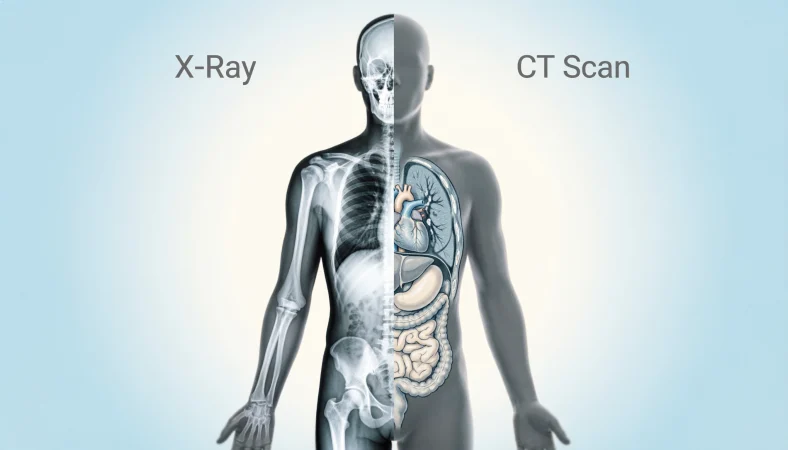
A CT scan and an X-ray are both imaging tests, but they serve different purposes. X-rays are quick and simple, mainly used for bones, while CT scans create detailed 3D images that help doctors see organs, injuries, and internal problems more clearly.
If you’ve ever visited a hospital, you’ve probably heard a doctor say, “We’ll do an X-ray” or “You need a CT scan.” For most people, these terms sound similar. Both involve machines, both take images, and both help doctors figure out what’s wrong.
But here’s the truth. They are not the same.
An X-ray is fast and basic. A CT scan is more detailed and advanced. Knowing the difference between CT vs X-ray can actually help you understand your treatment better and avoid unnecessary tests.
For example, if you break your arm, an X-ray is usually enough. But if there’s a head injury or internal bleeding, doctors often choose a CT scan.
In this article, we’ll break everything down in simple words. No complex medical language. Just clear, practical explanations so you can understand when each test is used and why it matters.
Quick Answer / Overview
Let’s keep it simple.
- X-ray = quick snapshot
- CT scan = detailed 3D view
Here’s a quick comparison:
| Feature | X-Ray | CT Scan |
|---|---|---|
| Image Type | 2D | 3D |
| Speed | Very fast | Takes a few minutes |
| Detail | Basic | Very detailed |
| Cost | Cheap | Expensive |
| Radiation | Low | Higher |
| Best Use | Bones, chest | Organs, brain, injuries |
In short:
If the problem is simple, go with X-ray.
If it’s complex, CT scan gives better answers.
What is an X-Ray?
An X-ray is one of the oldest and most common medical tests. It uses a small amount of radiation to take a picture of what’s inside your body.
Think of it like shining a light through your body and capturing the shadow.
- Bones block radiation → appear white
- Soft tissues → appear gray
- Air → appears black
That’s why X-rays are great for:
- Broken bones
- Chest infections
- Dental problems
Doctors like X-rays because they are:
- Fast
- Cheap
- Easy to access
What is a CT Scan?
A CT scan is more advanced. The full name is Computed Tomography.
Instead of taking just one image, it takes multiple X-rays from different angles. Then a computer combines them into detailed images.
Imagine slicing a cake:
Each slice shows a different layer.
Together, you see the full inside.
That’s what a CT scan does.
It helps doctors see:
- Organs
- Blood vessels
- Brain
- Tumors
- Internal bleeding
Advantages and Disadvantages
X-Ray: Pros and Cons
Advantages:
- Very quick (often done in minutes)
- Affordable
- Available almost everywhere
- Good for bone injuries
Disadvantages:
- Limited detail
- Not useful for soft tissues
- Can miss serious internal problems
CT Scan: Pros and Cons
Advantages:
- Highly detailed images
- Shows soft tissues clearly
- Helps diagnose serious conditions
- Useful in emergencies
Disadvantages:
- More expensive
- Higher radiation exposure
- Not always necessary
- Takes more time than X-ray
Real-World Examples
Broken Leg
Someone falls and can’t walk.
- Doctor orders an X-ray
- It shows the fracture clearly
No need for CT here. Simple problem, simple test.
Head Injury After Accident
A person hits their head in a car accident.
- Doctor orders a CT scan
- It checks for brain bleeding
An X-ray would miss this completely.
Severe Abdominal Pain
Patient has strong stomach pain.
- X-ray might not show much
- CT scan helps find the cause
This could include:
- Infection
- Internal injury
- Tumor
Regional / Global Usage
In many countries, especially developing ones, X-rays are used more often. Why?
Because they are cheaper and easier to access.
CT scans require:
- Advanced machines
- Skilled technicians
- Higher cost
In developed countries, CT scans are more common, especially in emergency rooms.
Doctors there rely on CT scans for quick and accurate diagnosis.
Common Mistakes People Make
“CT scan is always better”
Not true.
Many people think more advanced means better. But that’s not always the case.
If you just need to confirm a fracture, an X-ray is enough.
Ignoring radiation risk
CT scans use more radiation.
That doesn’t mean they are unsafe, but unnecessary scans should be avoided.
Expecting X-ray to show everything
X-rays are limited.
They cannot clearly show:
- Brain
- Organs
- Internal bleeding
Asking for CT without need
Some patients demand CT scans.
Doctors decide based on need, not preference.
Exercises with Answers
Question 1
Which test is best for a broken bone?
Answer: X-ray
Question 2
Which gives a 3D image?
Answer: CT scan
Question 3
Which uses more radiation?
Answer: CT scan
Question 4
Which is cheaper?
Answer: X-ray
Question 5
Which is better for brain injuries?
Answer: CT scan
Related Concepts
CT vs X-Ray vs MRI
| Feature | X-Ray | CT Scan | MRI |
|---|---|---|---|
| Radiation | Yes | Yes | No |
| Detail | Low | High | Very High |
| Best For | Bones | Organs | Soft tissues |
| Cost | Low | Medium | High |
Simple Analogy
- X-ray = photo
- CT scan = video with layers
- MRI = super detailed scan
FAQs
What is the difference between CT vs X-ray?
X-ray gives simple images, while CT scan gives detailed 3D images of the body.
Is CT scan safer than X-ray?
No. X-ray uses less radiation, so it is generally safer for routine use.
When do doctors prefer CT vs X-ray?
Doctors prefer CT scans for serious or complex conditions like internal injuries.
Can X-ray detect internal bleeding?
No. CT scan is needed for detecting internal bleeding.
Why is CT scan more expensive?
Because it uses advanced technology and produces detailed images.
Is CT scan painful?
No, it is completely painless.
How long does each test take?
X-ray takes a few seconds. CT scan takes a few minutes.
Can CT replace X-ray?
No. X-ray is still important for simple and quick diagnosis.
Which is better for lungs, CT vs X-ray?
X-ray is used first, but CT gives more detailed lung images.
Do both CT and X-ray use radiation?
Yes, but CT scan uses more radiation than X-ray.
Conclusion
Understanding the difference between CT vs X-ray is not just for doctors. It helps you make better decisions about your health.
X-rays are simple, fast, and effective for basic problems like fractures. CT scans go deeper. They help doctors see what’s happening inside your body in much more detail.
The important thing is balance.
Not every situation needs a CT scan. And not every problem can be solved with an X-ray.
Doctors choose based on what they need to find. Trust that process, and don’t push for advanced tests unless necessary.
If you remember one thing, remember this:
Use X-ray for simple issues.
Use CT scan for complex ones.
That’s the real difference.

Victoria Lane is a grammar-focused writer at GramBrix.com, passionate about helping readers master the rules of language. She provides clear explanations and practical examples that make writing more accurate, polished and confident.