
Last Updated on March 24, 2026
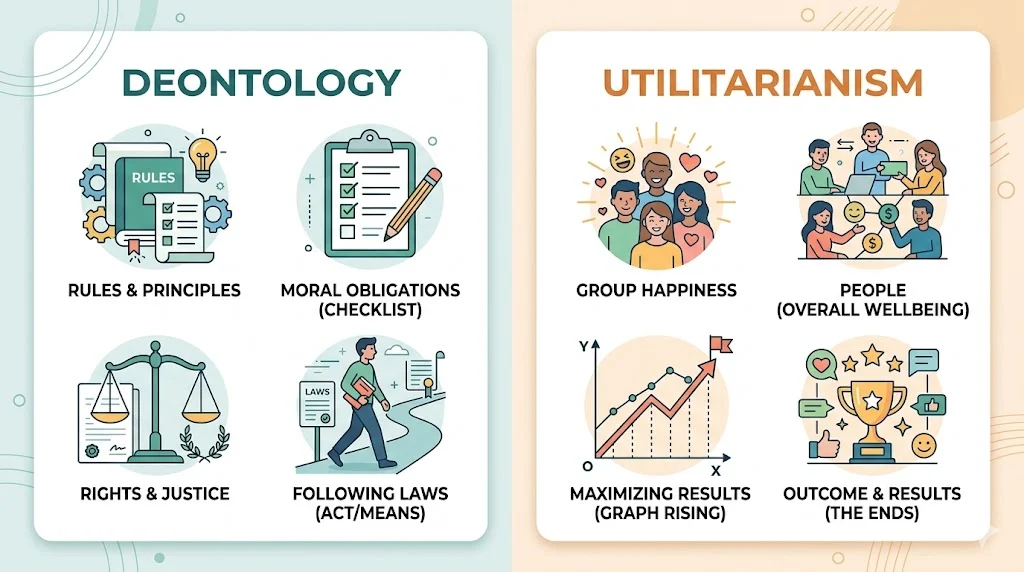
Deontology and utilitarianism are two major ethical approaches. Deontology focuses on following rules and duties, while utilitarianism focuses on outcomes and overall happiness. The key difference is whether actions are judged by principles or results.
Every day, we make decisions. Some are simple, like choosing what to eat. Others are harder, like deciding whether to tell the truth when it might hurt someone.
This is where the debate of deontology vs utilitarianism becomes important.
These two ethical approaches help us understand what makes an action right or wrong. But they often give different answers. One tells you to follow rules no matter what. The other tells you to focus on results, even if it means bending the rules.
This can feel confusing, especially in real-life situations where there is no perfect choice.
Understanding these ideas is useful for students, professionals, and anyone who wants to make better decisions. In this guide, we will break everything down in a simple and practical way, using real-world examples and easy explanations.
Quick Answer / Overview
If you want a quick understanding of deontology vs utilitarianism, here it is:
| Aspect | Deontology | Utilitarianism |
|---|---|---|
| Focus | Rules and duties | Results and outcomes |
| Goal | Do what is right | Create the best outcome |
| Decision style | Principle-based | Outcome-based |
| Flexibility | Low | High |
Simple way to remember:
- Deontology = Follow the rules
- Utilitarianism = Focus on results
What is Deontology?
Deontology is based on the idea that some actions are always right or wrong, regardless of the outcome.
This theory is strongly associated with Immanuel Kant, who argued that moral rules should guide our actions.
Key Ideas of Deontology
- Rules matter more than outcomes
- Intentions are important
- People should be treated with respect
- Some actions are never acceptable
Simple Example
Imagine your friend shares a secret with you.
Even if telling that secret could benefit you, deontology says:
👉 You should not tell it, because breaking trust is wrong.
The result does not matter. The rule does.
What is Utilitarianism?
Utilitarianism takes a different approach. It focuses on outcomes rather than rules.
It suggests that the best action is the one that creates the greatest happiness for the greatest number of people.
This theory was developed by Jeremy Bentham and later refined by John Stuart Mill.
Key Ideas of Utilitarianism
- Outcomes are more important than intentions
- The goal is maximum happiness
- Decisions should benefit the majority
- Sacrifice may be acceptable for greater good
Simple Example
If telling a small lie could save many people from harm, utilitarianism would support lying.
👉 The focus is on the result, not the rule.
Deontology vs Utilitarianism: Detailed Comparison
| Factor | Deontology | Utilitarianism |
|---|---|---|
| Basis | Moral rules | Consequences |
| Priority | Duty | Happiness |
| Strength | Protects rights | Maximizes benefit |
| Weakness | Can be rigid | Can be unfair |
Advantages and Disadvantages
Advantages of Deontology
- Provides clear moral guidelines
- Protects individual rights
- Builds trust in society
- Encourages fairness
Disadvantages of Deontology
- Can be too rigid
- Ignores outcomes
- Difficult in complex situations
Advantages of Utilitarianism
- Focuses on overall good
- Flexible and practical
- Useful for large-scale decisions
- Encourages helping more people
Disadvantages of Utilitarianism
- May ignore individual rights
- Hard to measure happiness
- Can justify harmful actions
Real-World Examples
Healthcare Decisions
Doctors often face ethical dilemmas.
- Deontology: Always follow patient rights and consent
- Utilitarianism: Choose treatments that save the most lives
Business Decisions
Companies must make tough choices.
- Deontology: Follow rules and fairness strictly
- Utilitarianism: Make decisions that benefit the majority
Everyday Life
Consider this situation:
You find a lost wallet.
- Deontology: Return it because it is the right thing to do
- Utilitarianism: Consider whether keeping it benefits more people
Regional / Global Usage
The discussion of deontology vs utilitarianism is global.
- Western legal systems often follow deontological principles
- Public policy and economics often use utilitarian thinking
- Many cultures combine both approaches
In practice, most modern systems use a mix of both to balance fairness and outcomes.
Common Mistakes
Mistake 1: Thinking rules always lead to good results
Reality: Rules can sometimes create negative outcomes
Mistake 2: Believing utilitarianism is always fair
Reality: It can harm minority groups
Mistake 3: Using only one theory
Reality: Real-life decisions often require a combination
Exercises with Answers
Exercise 1
You refuse to lie, even to protect someone
👉 Answer: Deontology
Exercise 2
You lie to save multiple lives
👉 Answer: Utilitarianism
Exercise 3
You follow a rule even when it seems unfair
👉 Answer: Deontology
Exercise 4
You choose an action that helps the most people
👉 Answer: Utilitarianism
Related Concepts or Comparisons
Virtue Ethics
Focuses on character rather than rules or outcomes
Consequentialism
Utilitarianism is a type of this approach
Justice Theory
Focuses on fairness and equality
Comparison Table
| Approach | Focus | Question |
|---|---|---|
| Deontology | Rules | Is it right? |
| Utilitarianism | Results | Is it beneficial? |
| Virtue Ethics | Character | Is it good? |
FAQs
What is the main difference between deontology vs utilitarianism?
Deontology focuses on rules and duties, while utilitarianism focuses on outcomes and overall happiness.
Which is better, deontology or utilitarianism?
Neither is always better. The best choice depends on the situation.
Can both theories be used together?
Yes, many real-world decisions combine both approaches.
Why is utilitarianism criticized?
It may ignore individual rights in favor of the majority.
Why is deontology criticized?
It can be too strict and ignore consequences.
Where is deontology used?
In law, human rights, and professional ethics.
Where is utilitarianism used?
In public policy, economics, and healthcare.
Is utilitarianism practical?
Yes, but measuring happiness can be difficult.
Does deontology ignore outcomes completely?
Mostly yes, it prioritizes moral rules.
Which theory is more modern?
Both are still widely used today.
Conclusion
The debate of deontology vs utilitarianism is at the heart of ethical thinking. It shapes how we make decisions in everyday life and in professional settings.
Deontology reminds us to follow rules and respect others. It creates a strong moral foundation and protects individual rights. However, it can be rigid and may ignore real-world outcomes.
Utilitarianism encourages us to think about the bigger picture. It helps us consider how our actions affect others and aims to create the greatest good. But it can sometimes overlook fairness and individual rights.
In reality, the best approach is often a balance. Use deontological principles to set boundaries, and utilitarian thinking to evaluate outcomes.
When making decisions, ask yourself:
- Is this action morally right?
- Does it create the best result?
This balanced mindset leads to better and more responsible choices.

Kevin Brooks is a grammar specialist at GramBrix.com, dedicated to helping readers understand language rules with clarity and confidence. He simplifies complex grammar concepts through practical examples and easy explanations.