
Last Updated on March 15, 2026
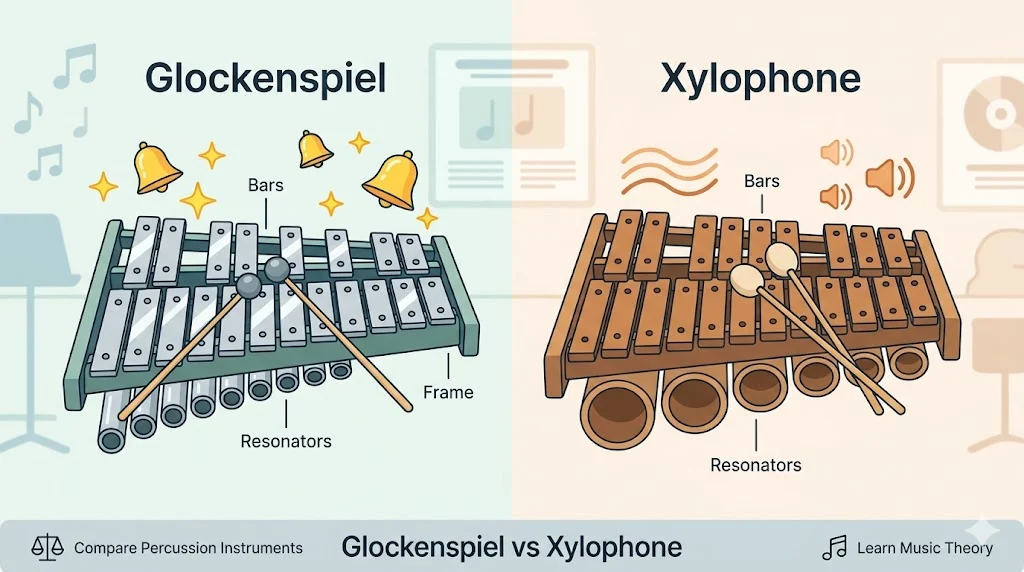
The main difference in glockenspiel vs xylophone lies in the material and sound. A glockenspiel uses metal bars and produces a bright, bell like tone, while a xylophone uses wooden bars and produces a warmer, deeper sound. Both are percussion instruments played with mallets but are used differently in orchestras, bands, and music education.
They look almost identical. They’re played the same way. But hit one and you hear church bells hit the other and you hear a rainforest. Same instrument family. Completely different soul.
Most people spend their entire lives calling them both “that xylophone thing.” Music teachers wince. Orchestra musicians quietly sigh. And beginners keep making the same swap without ever realizing the difference — until they’re in a rehearsal, handed the wrong mallet instrument, and suddenly very aware that something sounds off.
Here’s the truth: the glockenspiel and xylophone are built from different materials, tuned to different ranges, and designed to create completely different emotional effects. One shimmers and sparkles at the top of an orchestra. The other drives rhythm and melody with a woody, earthy punch.
Confuse them in conversation and people will smile politely. Confuse them in a composition or a music exam and the gap in knowledge shows immediately.
Whether you’re a beginner picking your first percussion instrument, a composer scoring for an ensemble, a music student preparing for exams, or simply someone who wants to finally settle this once and for all — this guide gives you the full picture.
Everything you need to know about glockenspiel vs xylophone sound, structure, musical role, and which one actually belongs in your hands.
Quick Answer: Glockenspiel vs Xylophone
| Feature | Glockenspiel | Xylophone |
|---|---|---|
| Bar Material | Metal | Wood |
| Sound | Bright, bell like | Warm, sharp, woody |
| Pitch Range | Higher | Lower |
| Size | Smaller | Larger |
| Common Use | Orchestras, marching bands | Orchestras, solo percussion |
| Mallets | Hard plastic or metal | Rubber or yarn |
Simple rule to remember
- Metal bars = Glockenspiel
- Wood bars = Xylophone
What Is a Glockenspiel
A glockenspiel is a percussion instrument made of metal bars arranged like a piano keyboard.
Each bar produces a musical note when struck with a mallet.
The word glockenspiel comes from German and means “bell play.”
This name makes sense because the instrument sounds similar to small bells.
Key Features
- Metal bars
- High pitched tone
- Bright and sparkling sound
- Usually played with hard mallets
- Common in orchestras and marching bands
Where It Is Used
Glockenspiel is popular in:
- orchestras
- marching bands
- film music
- orchestral percussion sections
- music education
- Christmas music and festive compositions
Many famous classical pieces use glockenspiel for magical or sparkling sounds.
What Is a Xylophone
A xylophone is another percussion instrument. It uses wooden bars instead of metal bars.
The bars are arranged like a piano keyboard. Each bar produces a specific note.
The word xylophone comes from Greek words:
- Xylo = wood
- Phone = sound
So the name literally means “wood sound.”
Key Features
- Wooden bars
- Warm, dry sound
- Sharp attack
- Larger instrument
- Played with rubber or yarn mallets
Where It Is Used
The xylophone appears in:
- orchestras
- African traditional music
- solo percussion performances
- music education
- percussion ensembles
- jazz arrangements
It is often used for fast rhythmic passages.
Key Differences Between Glockenspiel vs Xylophone
Although they look similar, several important differences exist.
Material
The biggest difference is the bar material.
| Instrument | Material |
|---|---|
| Glockenspiel | Metal bars |
| Xylophone | Wooden bars |
Material affects the tone and resonance.
Sound Quality
The sound of these instruments is very different.
| Instrument | Sound Description |
|---|---|
| Glockenspiel | Bright, bell like |
| Xylophone | Warm, woody |
Glockenspiel sounds almost like tiny bells.
Xylophone sounds more percussive and natural.
Pitch Range
Glockenspiels play much higher notes.
| Instrument | Pitch Range |
|---|---|
| Glockenspiel | Very high |
| Xylophone | Medium high |
This is why glockenspiel melodies sparkle above an orchestra.
Instrument Size
| Instrument | Size |
|---|---|
| Glockenspiel | Smaller |
| Xylophone | Larger |
Xylophones often include resonator tubes underneath to amplify sound.
Mallets
Different mallets create different tones.
| Instrument | Mallet Type |
|---|---|
| Glockenspiel | Hard plastic or metal |
| Xylophone | Rubber or yarn |
Hard mallets help glockenspiel produce clear bell tones.
Advantages and Disadvantages
Understanding glockenspiel vs xylophone also means understanding their strengths and weaknesses.
Glockenspiel Advantages
- Extremely bright sound
- Excellent for melody
- Easy to hear in large ensembles
- Portable in marching versions
Glockenspiel Disadvantages
- Limited pitch range
- Sound can be too sharp in some music
- Not ideal for warm musical passages
Xylophone Advantages
- Rich wooden tone
- Good for rhythm and melody
- Wide musical use
- Dynamic control
Xylophone Disadvantages
- Larger and heavier
- Not as bright as glockenspiel
- Requires more space
Real World Examples of Glockenspiel vs Xylophone
Seeing how these instruments are used in real music helps understand their differences.
Glockenspiel in Music
Famous uses include:
- Christmas music
- orchestral fairy scenes
- marching band melodies
- film soundtracks
Example effect:
Sparkling magical sounds often come from the glockenspiel.
Xylophone in Music
Common uses include:
- orchestral percussion solos
- African traditional ensembles
- cartoon music
- rhythmic passages
Example effect:
Fast wooden clicking patterns often come from the xylophone.
Regional and Global Usage
Different cultures use these instruments differently.
Glockenspiel Around the World
Common in:
- European orchestras
- American marching bands
- military bands
- school music programs
Marching glockenspiels are often worn with straps.
Xylophone Around the World
Xylophones exist in many cultures.
Examples include:
- African balafon
- Asian wooden percussion
- Western orchestral xylophone
These instruments share the same basic idea of wooden bars producing notes.
Common Mistakes When Comparing Glockenspiel vs Xylophone
Beginners often misunderstand these instruments.
Mistake 1: Thinking They Are the Same
They look similar but sound very different.
Correction:
- Check bar material.
Metal = glockenspiel
Wood = xylophone
Mistake 2: Using Wrong Mallets
Wrong mallets change the sound.
Correction:
Use proper mallets designed for each instrument.
Mistake 3: Confusing Them With Other Instruments
They are often confused with:
- marimba
- vibraphone
- bells
Correction:
Understand the unique features of each percussion instrument.
Related Instruments and Comparisons
To fully understand glockenspiel vs xylophone, it helps to compare related instruments.
Glockenspiel vs Vibraphone
| Feature | Glockenspiel | Vibraphone |
|---|---|---|
| Bars | Metal | Metal |
| Sound | Bell like | Smooth vibrating |
| Motor | No | Yes |
Xylophone vs Marimba
| Feature | Xylophone | Marimba |
|---|---|---|
| Bars | Wood | Wood |
| Sound | Bright woody | Deep warm |
| Size | Smaller | Large |
Beginner Exercises
These exercises help students recognize the difference between glockenspiel vs xylophone.
Exercise 1: Identify the Instrument
Which instrument has metal bars?
Answer: Glockenspiel
Exercise 2: Sound Identification
Which instrument sounds more bell like?
Answer: Glockenspiel
Exercise 3: Material Recognition
Which instrument uses wooden bars?
Answer: Xylophone
Exercise 4: Orchestra Placement
Which instrument usually plays higher notes?
Answer: Glockenspiel
Exercise 5: Tone Description
Which instrument produces a woody tone?
Answer: Xylophone
Teaching Glockenspiel vs Xylophone to Students
Music teachers often start with simple comparisons.
Simple classroom explanation
Think of it like this:
- Glockenspiel is metal bells in a keyboard shape
- Xylophone is wooden blocks in a keyboard shape
This visual analogy helps students remember the difference.
Choosing Between Glockenspiel and Xylophone
Musicians choose based on sound and musical need.
Choose Glockenspiel If You Want
- sparkling melodies
- bright orchestral accents
- high pitched sound
- marching band portability
Choose Xylophone If You Want
- rhythmic wooden tone
- strong articulation
- traditional percussion sound
- broader musical roles
FAQs
What is the main difference between glockenspiel vs xylophone?
The biggest difference between glockenspiel vs xylophone is the material of the bars. Glockenspiel uses metal bars, while xylophone uses wooden bars.
Is glockenspiel higher pitched than xylophone?
Yes. In most cases the glockenspiel produces much higher notes than the xylophone, giving it a bright bell like tone.
Can beginners learn glockenspiel or xylophone first?
Both instruments are beginner friendly. Many music schools start students with glockenspiel because its notes are clear and easy to hear.
Are glockenspiel and xylophone both percussion instruments?
Yes. Both belong to the percussion family and are played by striking bars with mallets.
Why does the glockenspiel sound like bells?
The metal bars resonate strongly and produce a bell like tone, which is why the instrument name means “bell play.”
Is the xylophone used in orchestras?
Yes. The xylophone is commonly used in orchestras for rhythmic passages and melodic percussion parts.
Do glockenspiel and xylophone use the same mallets?
No. Glockenspiel usually uses harder mallets, while xylophone uses softer rubber or yarn mallets.
Which instrument is bigger, glockenspiel or xylophone?
The xylophone is generally larger because it has wooden bars and resonators.
Is a glockenspiel the same as orchestra bells?
Yes. In orchestras, the glockenspiel is often called orchestra bells.
Is the xylophone older than the glockenspiel?
Yes. Wooden xylophone type instruments have existed in African and Asian cultures for centuries.
Conclusion
Understanding glockenspiel vs xylophone becomes simple once you focus on the key differences.
The most important difference is material. Glockenspiel uses metal bars, while xylophone uses wooden bars. This change in material creates completely different sounds.
The glockenspiel produces a bright, bell like tone that stands out in orchestras and marching bands. It often plays high melodic lines that sparkle above other instruments.
The xylophone produces a warm wooden sound with strong rhythmic articulation. It is widely used in orchestras, percussion ensembles, and traditional music.
Both instruments play an important role in percussion music education. Beginners often start learning melodies on these instruments because the layout is similar to a piano keyboard.
For musicians, the choice between glockenspiel and xylophone depends on the sound needed in the music.
If you want bright, magical melodies, choose the glockenspiel.
If you want warm rhythmic percussion, choose the xylophone.
Learning their differences will help musicians, teachers, and students understand percussion instruments more clearly and perform music with greater confidence.

Justin Powell is a writer at GramBrix.com who focuses on grammar, clarity and effective communication, helping readers strengthen their language skills.