
Last Updated on March 20, 2026
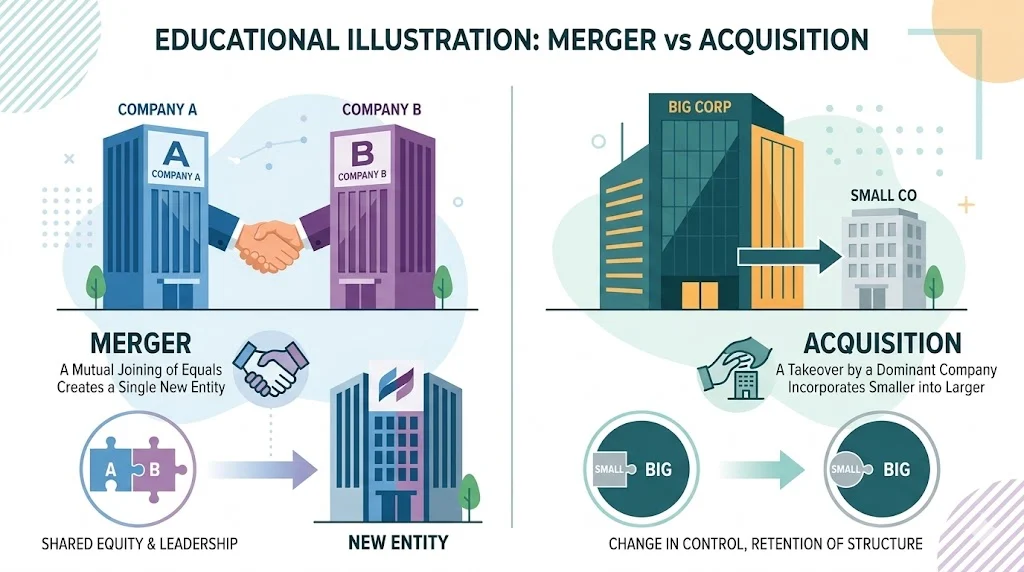
A merger vs acquisition refers to two ways companies combine, but they differ in structure and intent. A merger blends two firms into one new entity, while an acquisition occurs when one company takes control of another. Both strategies help businesses grow, expand markets, and gain competitive advantage.
Businesses do not grow only by selling more products. Many grow by joining with other companies. This is where merger vs acquisition becomes important.
Many people confuse these two terms. They sound similar. Both involve companies coming together. But they are not the same. The way they work, the results they create, and the control they give are different.
Understanding the difference helps business owners, students, and investors make better decisions. It also helps you understand news about big companies. For example, when two tech companies join, is it a merger or an acquisition? The answer matters.
In this article, you will learn everything about merger vs acquisition. We will explain the meaning, key differences, advantages, disadvantages, and real-world examples. We will also cover mistakes people make and give exercises to test your understanding.
Let us begin with a quick overview.
Quick Answer Overview
The difference between merger vs acquisition can be explained simply:
| Feature | Merger | Acquisition |
|---|---|---|
| Meaning | Two companies combine to form one new company | One company buys another |
| Control | Shared between both companies | Buyer gains full control |
| Structure | New entity is created | Existing company continues |
| Size | Usually similar-sized companies | Often larger company buys smaller one |
| Tone | Friendly agreement | Can be friendly or hostile |
In short, a merger is a partnership, while an acquisition is a takeover.
Definition and Explanation of Merger vs Acquisition
What is a Merger
A merger happens when two companies agree to join and form a new company. Both companies stop existing separately.
Think of it like two rivers joining to form one larger river.
Key points about mergers:
- Both companies usually have equal power
- A new company name may be created
- Shares are often exchanged
- It is usually friendly
Example:
Company A and Company B merge to create Company AB.
What is an Acquisition
An acquisition happens when one company buys another company. The buyer takes control.
Think of it like one person buying another person’s house.
Key points about acquisitions:
- One company is stronger or larger
- The buyer controls decisions
- The acquired company may keep its name or not
- It can be friendly or hostile
Example:
Company A buys Company B. Company B becomes part of Company A.
Key Differences Between Merger vs Acquisition
Here is a deeper comparison to help you understand clearly:
| Aspect | Merger | Acquisition |
|---|---|---|
| Ownership | Shared | Buyer owns target |
| Decision-making | Joint | Controlled by buyer |
| Legal structure | New entity formed | No new entity needed |
| Risk level | Shared risk | Buyer carries most risk |
| Culture integration | Balanced | Buyer’s culture dominates |
| Payment method | Stock exchange | Cash, stock, or both |
Advantages and Disadvantages
Advantages of Mergers
- Shared resources and knowledge
- Reduced competition
- Better market reach
- Cost savings through efficiency
Disadvantages of Mergers
- Cultural clashes
- Complex integration
- Slow decision-making
- Risk of failure if goals are unclear
Advantages of Acquisitions
- Quick expansion
- Full control over decisions
- Access to new technology or talent
- Immediate market entry
Disadvantages of Acquisitions
- Expensive
- High risk if integration fails
- Employee resistance
- Possible legal issues
Real World Examples of Merger vs Acquisition
Example of a Merger
- Exxon and Mobil merged to form ExxonMobil
- Both companies combined to become a stronger energy company
Example of an Acquisition
- Facebook acquired Instagram
- Facebook gained full control of Instagram
Simple Analogy
- Merger: Two schools join to create a new school
- Acquisition: One school buys another and takes over
Regional and Global Usage
The concept of merger vs acquisition is used worldwide.
In Developed Markets
- Common in the United States and Europe
- Used for expansion and innovation
- Strong legal frameworks support deals
In Emerging Markets
- Used for growth and market entry
- Often involves foreign investment
- Regulations may vary
In Asia
- Many acquisitions happen for technology and startups
- Large corporations acquire smaller innovative companies
Common Mistakes in Understanding Merger vs Acquisition
Many people misunderstand these terms. Here are common mistakes:
Mistake 1: Thinking They Are the Same
Correction:
They are different in structure and control.
Mistake 2: Assuming All Deals Are Friendly
Correction:
Acquisitions can be hostile.
Mistake 3: Ignoring Cultural Differences
Correction:
Culture plays a big role in success.
Mistake 4: Believing Bigger Always Wins
Correction:
Even large companies can fail after acquisitions.
Real World Use Cases
Business Growth
Companies use mergers and acquisitions to grow quickly.
Market Expansion
A company enters a new country by acquiring a local business.
Technology Gain
A large firm buys a startup to access new technology.
Cost Reduction
Two companies merge to reduce expenses.
Exercises with Answers
Exercise 1
A company buys another company and takes control.
Is this a merger or acquisition?
Answer: Acquisition
Exercise 2
Two companies join and form a new company.
What is this called?
Answer: Merger
Exercise 3
Which involves shared control?
A. Acquisition
B. Merger
Answer: Merger
Exercise 4
Which is usually faster for expansion?
A. Merger
B. Acquisition
Answer: Acquisition
Exercise 5
True or False:
A merger always creates a new company.
Answer: True
Related Concepts and Comparisons
Merger vs Acquisition vs Takeover
- Merger: Equal partnership
- Acquisition: Purchase of one company by another
- Takeover: Often hostile acquisition
Horizontal vs Vertical Integration
- Horizontal: Same industry
- Vertical: Different stages of supply chain
Friendly vs Hostile Acquisition
- Friendly: Agreed by both sides
- Hostile: Target company resists
FAQs
What is the main difference between merger vs acquisition?
A merger combines two companies into one new entity, while an acquisition involves one company buying another.
Which is better: merger or acquisition?
It depends on goals. Mergers are better for collaboration, while acquisitions are better for control.
Can a merger turn into an acquisition?
Yes, if one company gains more control during the process.
Why do companies prefer acquisitions?
Acquisitions allow faster growth and full decision-making power.
Are mergers always equal?
Most are intended to be equal, but power imbalance can exist.
What is a hostile acquisition?
It is when a company buys another without approval from its management.
Do employees lose jobs after mergers or acquisitions?
Sometimes, due to restructuring and cost-cutting.
Is a merger less risky than an acquisition?
Not always. Both carry risks, but mergers share the risk between companies.
How do companies pay for acquisitions?
They use cash, stock, or a mix of both.
What industries use merger vs acquisition the most?
Technology, banking, healthcare, and energy sectors use them frequently.
Conclusion
Understanding merger vs acquisition is essential in today’s business world. While both involve companies coming together, their structure and purpose are different. A merger focuses on partnership and shared growth, while an acquisition focuses on control and expansion.
Each approach has its own advantages and risks. Mergers can create strong partnerships but may face cultural challenges. Acquisitions offer quick growth but require careful integration.
For business leaders and investors, the right choice depends on goals, resources, and strategy. It is important to plan carefully, study the market, and understand the long-term impact.
If you are learning business or planning to enter the corporate world, mastering the concept of merger vs acquisition will give you a strong advantage. It helps you understand how companies grow, compete, and succeed in a global market.

Victoria Lane is a grammar-focused writer at GramBrix.com, passionate about helping readers master the rules of language. She provides clear explanations and practical examples that make writing more accurate, polished and confident.