Last Updated on March 25, 2026
Sofwave vs Ultherapy refers to a comparison between two non surgical ultrasound based skin tightening treatments used to lift and firm aging skin. Both stimulate collagen beneath the surface without surgery, but they differ in technology depth, comfort level, treatment areas, and recovery experience.
When people search for sofwave vs ultherapy, they usually want to understand which treatment works better for lifting and tightening the skin without surgery. Both procedures are ultrasound based aesthetic treatments designed to stimulate collagen and improve skin firmness.
Sofwave and Ultherapy are often confused because they both rely on energy delivered below the skin surface to trigger natural collagen production. However, their mechanisms, treatment depth, and comfort profiles differ in ways that can influence results.
This confusion can lead to real mistakes. Patients sometimes choose the wrong procedure for their skin concerns, leading to underwhelming results or unnecessary discomfort. Understanding how these technologies differ helps patients and practitioners select the most appropriate option for lifting and rejuvenation.
In this comprehensive guide, we will break down the technology, benefits, ideal use cases, and key differences between Sofwave and Ultherapy.
Sofwave vs Ultherapy: What Is the Difference?
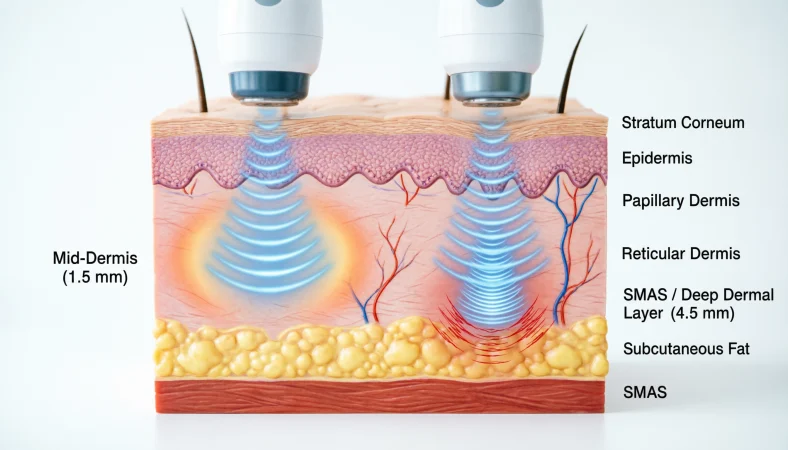
Both treatments use ultrasound energy to stimulate collagen. However, they operate at different depths and use different ultrasound delivery systems.
| Feature | Sofwave | Ultherapy |
|---|---|---|
| Technology | Synchronous ultrasound parallel beam | Microfocused ultrasound |
| Depth of energy | Mid dermis layer | Deeper layers including SMAS |
| Main purpose | Skin tightening and wrinkle reduction | Skin lifting and structural tightening |
| Pain level | Generally mild to moderate | Often moderate to high |
| Downtime | Minimal | Minimal but may include tenderness |
| Typical treatment time | 30 to 45 minutes | 60 to 90 minutes |
| FDA clearance | Wrinkles and skin tightening | Non surgical lift for face and neck |
Quick Recap
Sofwave focuses on improving skin texture and fine lines by stimulating collagen in the mid dermis. Ultherapy targets deeper tissue layers responsible for structural lifting.
In simple terms, Sofwave is often preferred for surface level rejuvenation and comfort, while Ultherapy is commonly chosen for deeper lifting effects.
Is Sofwave vs Ultherapy a Technology, Vocabulary, or Usage Issue?
Unlike many common confusions that involve grammar or vocabulary, sofwave vs ultherapy is primarily a technology and treatment selection issue.
However, misunderstanding the terminology can still cause problems.
Are They Interchangeable?
No. Sofwave and Ultherapy are not interchangeable treatments.
They use different ultrasound delivery methods and target different tissue depths. Choosing one over the other should depend on skin condition, age related concerns, and treatment goals.
Formal vs Informal Usage
In clinical and dermatology settings, practitioners refer to these procedures by their device names. In casual conversation, patients might describe them simply as ultrasound facelifts.
Academic vs Casual Context
In medical literature and dermatology journals, the treatments are discussed as energy based devices for non invasive skin tightening. In everyday discussions, patients usually compare them when deciding between cosmetic procedures.
Understanding the technological distinction is essential for proper treatment selection.
Sofwave in Practical Use
Sofwave treatments focus on collagen stimulation in the mid dermis layer. The technology delivers parallel ultrasound beams that heat tissue precisely at a depth that improves skin texture and elasticity.
Workplace Example
A professional in their early forties may choose Sofwave to reduce early signs of aging such as forehead lines or mild sagging before an important career milestone or public speaking role.
The goal is subtle rejuvenation without visible downtime.
Academic or Research Example
Clinical dermatology studies have shown that Sofwave can significantly improve facial wrinkles after a single treatment session through controlled thermal injury that stimulates new collagen formation.
Technology Context
The device uses advanced ultrasound beam technology to create uniform heating zones within the dermis. This helps trigger collagen remodeling without affecting deeper structural layers.
Sofwave Usage Recap
Sofwave works best for patients with mild to moderate skin laxity who want smoother skin and subtle tightening without aggressive energy delivery.
Ultherapy in Practical Use
Ultherapy focuses on deeper lifting by targeting the SMAS layer, the same structural tissue surgeons tighten during a surgical facelift.
Workplace Example
A patient in their early fifties preparing for a leadership role or media appearance may choose Ultherapy to achieve visible lifting around the jawline and neck.
Academic or Clinical Example
Dermatology studies have documented improvements in brow lifting and jawline contour after Ultherapy treatment due to energy delivered into deeper connective tissue layers.
Technology Context
Ultherapy uses microfocused ultrasound combined with real time imaging. This allows practitioners to visualize tissue layers and deliver energy precisely where lifting support structures exist.
Ultherapy Usage Recap
Ultherapy is typically recommended for individuals with moderate skin laxity who want structural lifting rather than just wrinkle smoothing.
When You Should NOT Choose Sofwave or Ultherapy
Despite their popularity, these treatments are not appropriate for every situation.
Here are common scenarios where they may not be ideal.
- Severe skin laxity that requires surgical lifting
- Patients expecting instant dramatic facelift results
- Individuals with certain implanted medical devices
- Extremely thin skin where energy delivery could cause discomfort
- Patients with active skin infections or inflammation
- People who expect multiple problem areas treated in one short session
- Individuals unwilling to wait several months for collagen development
- Patients seeking fat reduction rather than skin tightening
Consultation with a qualified dermatologist or aesthetic physician is essential before choosing either treatment.
Common Mistakes and Decision Rules
| Correct Understanding | Incorrect Assumption | Explanation |
|---|---|---|
| Sofwave targets mid dermis collagen | Sofwave lifts deep facial structures | It mainly improves skin quality |
| Ultherapy targets deeper layers | Ultherapy only treats wrinkles | It focuses on lifting support structures |
| Sofwave is typically more comfortable | Both treatments feel identical | Ultherapy usually involves stronger sensations |
| Ultherapy results may take months | Results appear immediately | Collagen remodeling requires time |
Decision Rule
If your main goal is improving wrinkles and skin texture, Sofwave may be the better option.
If your goal is lifting sagging tissue in deeper facial layers, Ultherapy is usually the more suitable choice.
Sofwave and Ultherapy in Modern Technology and AI Tools
Modern aesthetic clinics increasingly use digital imaging and AI powered skin analysis systems to recommend the best treatment.
These systems evaluate factors such as skin elasticity, wrinkle depth, and tissue laxity. The software can help determine whether a patient would benefit more from Sofwave or Ultherapy based on structural skin measurements.
AI assisted diagnostics are improving treatment personalization and helping practitioners achieve more predictable outcomes.
Origins and Technology Background
Ultherapy was introduced earlier and became one of the first widely recognized ultrasound based lifting technologies in aesthetic medicine.
Sofwave entered the market later with a different engineering approach focused on comfort and controlled dermal heating.
Both technologies represent the broader scientific concept of thermally induced collagen remodeling, where controlled heat stimulates the body to produce new structural proteins.
Expert Perspective
Dr Lisa Chen, a cosmetic dermatologist specializing in energy based devices, explains:
“Ultrasound technology changed non surgical skin rejuvenation. The choice between Sofwave and Ultherapy is less about which is better and more about which layer of the skin needs treatment.”
Case Studies
Case Study One: Wrinkle Reduction
A dermatology clinic in Los Angeles treated 60 patients with Sofwave for moderate facial wrinkles.
After three months:
Average wrinkle reduction improved by 40 percent.
Patient satisfaction reached 87 percent.
Most patients reported minimal discomfort during treatment.
Case Study Two: Jawline Lifting
A clinical trial using Ultherapy on patients aged 45 to 60 evaluated jawline lifting.
Results showed:
Visible lifting in 70 percent of patients.
Improved jawline contour after four to six months.
Long lasting collagen stimulation for up to one year.
These findings highlight how the treatments serve different aesthetic goals.
Error Prevention Checklist
Always consider Sofwave when:
- The main concern is wrinkles or mild skin laxity
- The patient prefers a more comfortable treatment
- Skin texture improvement is the priority
Never assume Ultherapy is ideal when:
- The goal is only wrinkle smoothing
- The patient has very mild skin laxity
- Comfort is a major concern for the patient
Choosing the correct treatment depends on treatment depth and patient expectations.
Related Skin Rejuvenation Confusions You Should Understand
Understanding Sofwave vs Ultherapy becomes easier when you also learn about other aesthetic treatment comparisons.
Important related topics include:
- Laser resurfacing vs radiofrequency treatments
- Microneedling vs fractional laser therapy
- Radiofrequency vs ultrasound skin tightening
- Chemical peels vs laser rejuvenation
- Thread lifts vs energy based lifting
- Botox vs dermal fillers
- Non surgical facelift vs surgical facelift
- Collagen induction therapy vs skin resurfacing
- Skin tightening vs skin resurfacing procedures
- Preventative aesthetic treatments vs corrective treatments
Mastering these comparisons helps patients choose appropriate cosmetic treatments.
FAQs
What is the difference between Sofwave and Ultherapy?
Sofwave primarily treats the mid dermis to improve wrinkles and skin texture, while Ultherapy targets deeper connective tissue layers responsible for lifting and structural support.
Is Sofwave better than Ultherapy for skin tightening?
It depends on the goal. Sofwave is often better for wrinkle reduction and mild tightening, while Ultherapy is usually more effective for lifting sagging tissue in deeper layers.
Which treatment is more painful, Sofwave or Ultherapy?
Most patients report that Ultherapy causes stronger sensations during treatment. Sofwave is generally considered more comfortable because it targets a shallower tissue depth.
How long do Sofwave results last?
Results typically develop over three months as collagen production increases. Improvements may last about one year depending on skin condition and aging factors.
How long do Ultherapy results last?
Ultherapy results usually appear gradually over three to six months and can last up to one year or longer depending on the patient.
Can Sofwave and Ultherapy be combined?
Some dermatologists combine treatments by using Sofwave for surface texture improvement and Ultherapy for deeper lifting. However, treatment planning must be individualized.
Who is the best candidate for Sofwave?
Individuals with early signs of aging, mild skin laxity, and fine wrinkles often benefit most from Sofwave treatments.
Who should consider Ultherapy?
Patients with moderate sagging in the jawline, neck, or brow area may achieve better results with Ultherapy.
Conclusion
Understanding sofwave vs ultherapy is essential for anyone considering non surgical skin tightening treatments. Although both use ultrasound energy to stimulate collagen, they target different tissue depths and serve different aesthetic purposes.
Sofwave is typically ideal for improving wrinkles and skin quality in the dermis. Ultherapy focuses on deeper lifting by stimulating connective tissue layers responsible for structural support.
The best choice depends on skin condition, treatment goals, and comfort preferences. Consulting an experienced aesthetic specialist ensures that the technology selected aligns with the specific needs of the patient.

Justin Powell is a writer at GramBrix.com who focuses on grammar, clarity and effective communication, helping readers strengthen their language skills.