
Last Updated on March 24, 2026
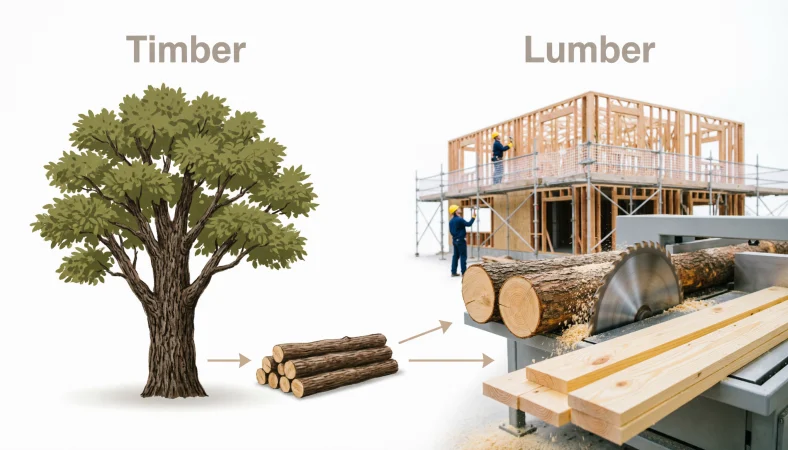
Timber and lumber refer to the same wood material but are used differently depending on region and stage of processing. In most countries, timber means standing or raw wood, while lumber refers to processed wood ready for construction. Understanding the difference helps avoid confusion in building, woodworking, and global trade.
Many people think timber and lumber mean the same thing. They both describe wood. They both are used to build homes, furniture, and tools. But the words are not always used the same way.
The meaning can change based on where you live. In some places, timber means wood that is still in the forest. In other places, timber means wood that is already cut and shaped. This creates confusion for builders, students, and buyers. A person ordering wood from another country may get the wrong product simply because of language differences.
Understanding timber vs lumber is important for construction, woodworking, and global trade. If you know the difference, you can choose the right material, follow building rules, and communicate clearly with suppliers. This guide explains everything in simple terms, from definitions to real world uses, so anyone can understand the topic with ease.
Quick Answer Overview
Timber vs lumber can be explained in one simple idea.
- Timber usually refers to wood in its natural or structural state.
- Lumber refers to wood that has been processed into boards and ready for use.
However, the meaning depends on region.
| Region | Meaning of Timber | Meaning of Lumber |
|---|---|---|
| United States | Standing trees or large structural wood | Processed boards used in construction |
| United Kingdom | Processed wood ready for use | Rarely used term |
| Canada | Similar to US usage | Standard term for building wood |
| Australia | Similar to UK usage | Less commonly used |
So the difference is not just about wood. It is about geography and usage.
Definition and Explanation
What Is Timber
Timber is wood in its more natural state. It often refers to trees that are still standing or logs that have just been cut. It can also mean large structural wood used in heavy construction.
Timber is usually:
- Raw or minimally processed
- Cut into large beams or logs
- Used for structural framing
- Associated with forestry and harvesting
Think of timber as wood closer to nature.
What Is Lumber
Lumber is wood that has been processed in a sawmill. It is cut into planks, boards, and standardized sizes. Lumber is ready for construction or manufacturing.
Lumber is usually:
- Sawed and shaped
- Measured into standard dimensions
- Dried to control moisture
- Sold in hardware stores
Think of lumber as wood ready to use.
Simple Analogy
Imagine a wheat farm.
- Wheat growing in the field is like timber.
- Flour packaged in a bag is like lumber.
Both come from the same source. The difference is processing.
How Wood Becomes Lumber
To better understand timber vs lumber, it helps to see the journey of wood.
Step One Tree Harvesting
Trees are selected and cut. At this stage, the material is called timber or logs.
Step Two Transport to Sawmill
Logs are moved to a mill. They are still considered timber.
Step Three Sawing and Processing
Logs are cut into boards. Now the material becomes lumber.
Step Four Drying
Lumber is kiln dried or air dried. This removes moisture and prevents warping.
Step Five Finishing
The wood is planed, sized, and graded. It is now ready for construction.
Types of Timber
Timber can be classified based on its source and purpose.
Softwood Timber
Comes from conifer trees.
Examples of uses:
- House framing
- Roof structures
- Interior work
Features:
- Lightweight
- Easy to cut
- Grows quickly
Hardwood Timber
Comes from broad leaf trees.
Examples of uses:
- Furniture
- Flooring
- Decorative structures
Features:
- Dense and strong
- Long lasting
- More expensive
Engineered Timber
Modern construction uses engineered timber made by bonding wood layers.
Examples:
- Glulam beams
- Cross laminated timber
- Laminated veneer lumber
These products are strong and stable.
Types of Lumber
Lumber is categorized by how it is cut and used.
Dimensional Lumber
This is the most common type used in homes.
Examples:
- 2×4 boards
- 2×6 framing pieces
Used for:
- Walls
- Floors
- Roof framing
Appearance Lumber
Used where looks matter.
Examples:
- Trim
- Cabinets
- Furniture
Structural Lumber
Graded for strength.
Used in:
- Load bearing beams
- Bridges
- Heavy construction
Timber vs Lumber Comparison Table
| Feature | Timber | Lumber |
|---|---|---|
| Stage | Raw or structural | Processed and finished |
| Processing | Minimal | Fully milled |
| Usage | Heavy structures or natural form | Construction boards |
| Terminology | Forestry term | Manufacturing term |
| Moisture Control | Usually high | Dried and treated |
| Standard Sizes | Not always standardized | Standard dimensions |
| Common Context | Logging and export | Building and carpentry |
Advantages and Disadvantages
Advantages of Timber
- Strong natural structure
- Suitable for large scale construction
- Requires less early processing
- Sustainable when harvested responsibly
Disadvantages of Timber
- Needs further processing
- Can contain moisture
- Harder to transport and standardize
Advantages of Lumber
- Ready to use immediately
- Available in uniform sizes
- Easier for builders and carpenters
- Treated for durability
Disadvantages of Lumber
- Requires energy intensive processing
- Slightly higher cost due to manufacturing
- Less flexible in natural form applications
Real World Examples
Building a House
When constructing a home:
- Timber may be used for heavy beams or log structures.
- Lumber is used for framing, flooring, and paneling.
Furniture Making
A furniture maker buys lumber because it is smooth and sized correctly. Using raw timber would require extra milling work.
Large Wooden Structures
Bridges and exposed wooden frames often use structural timber because of its natural strength and size.
Export Industry
Countries exporting logs refer to them as timber. Countries importing processed boards refer to them as lumber.
Regional and Global Usage
Language differences create confusion in timber vs lumber discussions.
United States
The word lumber dominates the construction industry. Timber usually refers to unprocessed logs or very large beams.
United Kingdom
Timber refers to processed wood used in building. The word lumber is rarely used.
Australia and New Zealand
Timber commonly describes construction wood. Builders may never use the term lumber.
Why This Matters
Misunderstanding terminology can cause:
- Incorrect orders
- Contract disputes
- Costly shipping errors
Global businesses must clarify definitions before transactions.
Moisture Content and Wood Quality
One major difference between timber and lumber is moisture control.
Fresh timber contains a lot of water. This can cause:
- Shrinkage
- Warping
- Cracking
Lumber is dried before sale. This improves:
- Stability
- Strength
- Longevity
Drying Methods
Air Drying
Slow but natural.
Kiln Drying
Fast and controlled.
Builders prefer dried lumber because it behaves predictably.
Grading and Standards
Lumber follows strict grading systems to ensure quality.
Grades consider:
- Strength
- Appearance
- Knots
- Moisture level
Timber may not be graded until processing.
This makes lumber safer for engineered construction.
Environmental Considerations
Both timber and lumber can be sustainable if managed properly.
Benefits of wood materials:
- Renewable resource
- Stores carbon
- Requires less energy than steel or concrete
- Biodegradable
Responsible forestry ensures forests are replanted and protected.
Common Mistakes People Make
Thinking the Terms Always Mean the Same Thing
They may be interchangeable in casual talk, but not in professional settings.
Ignoring Regional Differences
Always confirm definitions when working internationally.
Assuming Lumber Is Stronger Than Timber
Strength depends on species, treatment, and design, not just the name.
Using Wet Wood for Construction
Fresh timber must be dried before being used indoors.
Not Checking Grades
Ungraded wood can fail in structural applications.
Related Concepts and Comparisons
Hardwood vs Softwood
Hardwood comes from slow growing trees and is dense. Softwood grows faster and is widely used in construction lumber.
Engineered Wood vs Solid Wood
Engineered wood is manufactured for stability. Solid wood is cut directly from trees.
Green Wood vs Seasoned Wood
Green wood is freshly cut. Seasoned wood has been dried for use.
Practical Exercises With Answers
Exercise One
You order wood that is already cut into standard sizes for framing a house. Is it timber or lumber?
Answer: Lumber, because it is processed and ready to use.
Exercise Two
A forestry company sells freshly cut logs to a mill. What term applies?
Answer: Timber, because the wood is still in raw form.
Exercise Three
Why is dried wood preferred in furniture making?
Answer: Because dried lumber does not shrink or warp as much.
Exercise Four
In which region would builders commonly say timber instead of lumber?
Answer: The United Kingdom and Australia.
Exercise Five
What is the main transformation that turns timber into lumber?
Answer: Sawing, drying, and standardizing at a mill.
Choosing the Right Material for Your Project
Use Timber When
- Building large natural structures
- Working on log homes
- Creating exposed beams
- Processing wood yourself
Use Lumber When
- Framing houses
- Making furniture
- Installing flooring
- Doing general construction
Industry Applications
Construction Industry
Relies heavily on standardized lumber for safety and efficiency.
Forestry Industry
Uses the term timber to describe harvested wood resources.
Manufacturing Industry
Depends on precision lumber for repeatable production.
Architecture
Uses both timber and lumber depending on design style.
Economic Importance
The global wood market depends on clear classification.
Timber trade focuses on raw material supply.
Lumber trade focuses on value added products.
Processing increases economic value by:
- Creating jobs
- Improving usability
- Reducing waste
FAQs
What is the main difference between timber vs lumber?
Timber refers to raw or structural wood, while lumber refers to processed wood cut into boards for construction.
Is timber the same as lumber in the United States?
No. In the US, timber usually means logs or standing trees, while lumber means finished building wood.
Why do some countries use timber instead of lumber?
Language traditions differ. Many Commonwealth countries use timber to describe what Americans call lumber.
Can timber be used directly in construction?
Yes, but it often needs cutting and drying first, unlike ready to use lumber.
Is lumber stronger than timber?
Not necessarily. Strength depends on wood species, treatment, and grading, not the term used.
Why is lumber dried before sale?
Drying reduces moisture, preventing warping, cracking, and structural problems.
What industries commonly use the timber vs lumber distinction?
Forestry, construction, architecture, woodworking, and international trade all rely on this terminology.
Does timber become lumber after processing?
Yes. Once timber is milled, cut, and prepared, it is classified as lumber.
Which is better for furniture making, timber or lumber?
Lumber is better because it is smooth, dry, and dimensionally stable.
How can I avoid confusion when buying wood internationally?
Always confirm whether the supplier means raw timber or processed lumber before placing orders.
Conclusion
Understanding timber vs lumber is not just about vocabulary. It is about knowing the stage of wood processing, how materials are used, and how terminology changes across regions. Timber usually describes wood in its natural or structural form, while lumber refers to wood that has been milled, dried, and prepared for construction or manufacturing.
This distinction matters in real world projects. Builders rely on standardized lumber for safety and precision. Forestry professionals deal with timber as a raw resource. International trade depends on clear communication to avoid costly mistakes. By learning how wood moves from forest to finished product, you gain a deeper understanding of materials used in everyday structures.
When choosing between timber and lumber, think about your project needs, moisture control, and required finish level. Always clarify terminology when working globally. With this knowledge, you can select the right wood confidently, communicate professionally, and ensure long lasting results.

Kevin Brooks is a grammar specialist at GramBrix.com, dedicated to helping readers understand language rules with clarity and confidence. He simplifies complex grammar concepts through practical examples and easy explanations.