
Last Updated on March 24, 2026
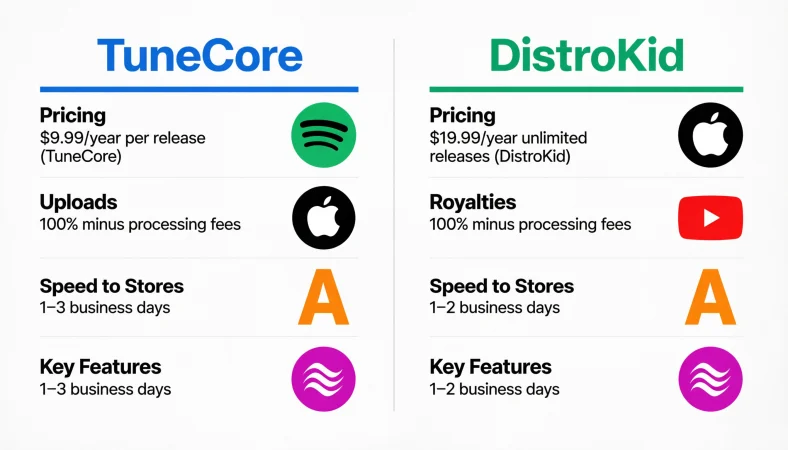
TuneCore vs DistroKid is a common comparison for musicians choosing a music distribution platform. TuneCore charges per release but lets artists keep 100% of royalties, while DistroKid uses a yearly subscription model with unlimited uploads. The best choice depends on how often you release music and how you manage long-term distribution costs.
Music distribution has changed a lot in the last decade. In the past, artists needed record labels to get their music into stores. Today, anyone can upload songs to platforms like Spotify, Apple Music, and Amazon Music.
But there is one challenge.
Streaming services do not allow artists to upload music directly. Instead, musicians must use a digital music distributor.
This is where the debate of TuneCore vs DistroKid begins.
Both platforms help artists send music to streaming services. Both claim to help musicians earn money and grow their audience. But they work very differently.
Some artists prefer TuneCore because it allows them to keep 100% of their royalties without yearly distribution limits. Others prefer DistroKid because it allows unlimited music uploads for a flat annual fee.
So which one is better?
This guide explains TuneCore vs DistroKid in detail. You will learn how they work, their advantages and disadvantages, pricing models, real world examples, and common mistakes artists make when choosing a distributor.
By the end of this guide, you will know which platform is best for your music career.
Quick Answer
If you want a quick summary of TuneCore vs DistroKid, here is the simple answer.
| Feature | TuneCore | DistroKid |
|---|---|---|
| Pricing Model | Pay per release | Annual subscription |
| Upload Limit | Unlimited but paid per release | Unlimited uploads |
| Royalties | 100% to artist | 100% to artist |
| Best For | Artists releasing few songs | Artists releasing many songs |
| Speed | Moderate | Very fast |
| Extra Features | Publishing admin | Collaboration tools |
Simple rule:
- Choose TuneCore if you release music rarely but want long-term control.
- Choose DistroKid if you release music frequently.
What Is TuneCore?
TuneCore is a digital music distribution platform founded in 2005.
It allows independent musicians to upload their songs and distribute them to:
- Spotify
- Apple Music
- Amazon Music
- YouTube Music
- TikTok
- Deezer
- Pandora
TuneCore became popular because it lets artists keep 100% of their royalties.
However, the platform charges a fee per release.
Example pricing structure:
- Single release fee
- Album release fee
- Annual renewal fee
This model works well for artists who release music occasionally.
What Is DistroKid?
DistroKid is another digital music distributor founded in 2013.
It quickly became popular because of one major feature.
Unlimited music uploads for one yearly price.
Instead of paying per release, artists pay a subscription fee each year.
Once subscribed, they can upload:
- Unlimited singles
- Unlimited albums
- Unlimited collaborations
This model is extremely attractive for musicians who release music often.
How Music Distribution Platforms Work
To understand TuneCore vs DistroKid, it helps to understand how music distribution works.
The process is simple.
Step 1: Upload Music
Artists upload:
- Audio files
- Cover art
- Song titles
- Metadata
Step 2: Distributor Sends Music to Stores
The distributor sends music to streaming platforms like Spotify.
Step 3: Listeners Stream Music
Fans listen on streaming services.
Step 4: Royalties Are Collected
Streaming services send royalties to the distributor.
Step 5: Artist Gets Paid
The distributor transfers money to the artist.
Both TuneCore and DistroKid follow this process.
TuneCore vs DistroKid Pricing Comparison
Pricing is one of the biggest differences.
TuneCore Pricing Example
| Release Type | First Year | Renewal |
|---|---|---|
| Single | Paid | Annual renewal |
| Album | Higher fee | Annual renewal |
| Distribution | Per release | Per year |
DistroKid Pricing Example
| Plan | Price Model | Upload Limit |
|---|---|---|
| Musician Plan | Annual fee | Unlimited |
| Musician Plus | Annual fee | Unlimited |
| Label Plan | Annual fee | Multiple artists |
Key Difference
TuneCore costs increase with each release.
DistroKid costs stay the same no matter how many songs you upload.
Advantages of TuneCore
Many artists prefer TuneCore for several reasons.
Full Royalty Ownership
Artists keep 100% of streaming revenue.
Strong Publishing Tools
TuneCore provides publishing administration services.
This helps collect royalties from:
- Performance rights
- Mechanical royalties
- International sources
Industry Reputation
TuneCore has been around longer than many distributors.
Many professional musicians trust it.
Stable Long-Term Distribution
Some artists prefer the predictable structure of paying per release.
Disadvantages of TuneCore
TuneCore also has limitations.
Higher Cost for Frequent Releases
If you release music often, costs can become high.
Example:
10 singles per year can cost more than a DistroKid subscription.
Renewal Fees
Artists must renew distribution each year.
If they stop paying, music may be removed from stores.
Slower Upload Speed
Some artists report slower distribution times.
Advantages of DistroKid
DistroKid has become extremely popular among independent artists.
Unlimited Uploads
Artists can release as many songs as they want.
This is perfect for modern music strategies.
Faster Distribution
Many releases reach stores quickly.
Some artists see their music live within days.
Collaboration Tools
DistroKid offers tools that split royalties automatically between artists.
Affordable for High Output Artists
If you release multiple singles per month, DistroKid is cheaper.
Disadvantages of DistroKid
Despite its popularity, DistroKid also has weaknesses.
Annual Subscription Dependency
If you stop paying the yearly fee, your music can be removed.
Add-On Fees
Some features require additional payments.
Examples include:
- YouTube Content ID
- Store maximization
- Legacy features
Limited Publishing Tools
Compared with TuneCore, publishing services are more limited.
TuneCore vs DistroKid Feature Comparison
| Feature | TuneCore | DistroKid |
|---|---|---|
| Pricing | Pay per release | Annual subscription |
| Upload Limit | Paid per upload | Unlimited |
| Royalties | 100% | 100% |
| Speed | Moderate | Fast |
| Royalty Splits | Limited | Advanced |
| Publishing Admin | Yes | Limited |
| Collaboration | Basic | Strong |
Real World Examples
Understanding TuneCore vs DistroKid becomes easier with examples.
Example 1: Independent Singer
Sara releases one song every year.
Best option: TuneCore
Reason: paying yearly subscription is unnecessary.
Example 2: YouTube Music Creator
Ali uploads a new track every week.
Best option: DistroKid
Reason: unlimited uploads save money.
Example 3: Music Producer Collective
Five producers release collaborative tracks monthly.
Best option: DistroKid
Reason: automatic royalty split tools.
Example 4: Professional Album Artist
A band releases one album every two years.
Best option: TuneCore
Reason: fewer releases reduce long-term cost.
Regional and Global Usage
Both distributors operate globally.
Artists from almost every country can use them.
Popular Regions
Common regions using these services include:
- United States
- United Kingdom
- Canada
- India
- Pakistan
- Europe
- Southeast Asia
Payment Methods
Most platforms support:
- PayPal
- Bank transfer
- Digital payments
This allows musicians worldwide to receive streaming royalties.
Common Mistakes Artists Make
When choosing between TuneCore vs DistroKid, many artists make mistakes.
Choosing Based Only on Price
Distribution cost is important, but features matter too.
Ignoring Release Frequency
Artists often underestimate how often they will release music.
Forgetting Renewal Fees
TuneCore requires yearly renewal.
DistroKid requires active subscription.
Not Understanding Add On Costs
Extra features can increase total cost.
Ignoring Metadata Accuracy
Incorrect song information can cause royalty issues.
Exercises to Test Your Understanding
Exercise 1
Which platform is best for unlimited uploads?
Answer: DistroKid.
Exercise 2
Which platform charges per release?
Answer: TuneCore.
Exercise 3
Which platform is better for weekly releases?
Answer: DistroKid.
Exercise 4
Which platform has stronger publishing tools?
Answer: TuneCore.
Related Concepts
Understanding TuneCore vs DistroKid also requires knowledge of related music industry concepts.
Music Distribution
The process of delivering music to digital stores.
Streaming Royalties
Money earned from plays on platforms like Spotify.
Publishing Royalties
Payments for songwriting rights.
Metadata
Song information such as:
- Artist name
- Release date
- Genre
- ISRC code
Correct metadata ensures artists get paid properly.
TuneCore vs DistroKid for Beginners
Beginners often wonder which distributor is easier.
Ease of Use
Both platforms offer simple dashboards.
But many users say DistroKid is faster and simpler.
Learning Curve
TuneCore provides more professional tools, which can feel complex for beginners.
Upload Process
Typical steps include:
- Upload audio file
- Upload cover art
- Enter metadata
- Choose release date
- Submit to stores
Both platforms follow similar steps.
TuneCore vs DistroKid for Professional Artists
Professional musicians may need advanced features.
Revenue Tracking
Both platforms provide royalty dashboards.
International Distribution
Both distribute to over 150 streaming platforms.
Marketing Tools
Some services include:
- Pre save campaigns
- YouTube monetization
- Social media integrations
DistroKid tends to focus on speed and automation.
TuneCore focuses more on publishing and royalty collection.
FAQs
What is the main difference between TuneCore vs DistroKid?
The main difference is pricing. TuneCore charges per release while DistroKid charges an annual subscription for unlimited uploads.
Is TuneCore better than DistroKid for beginners?
TuneCore can work for beginners releasing few songs, but many beginners prefer DistroKid because of its simpler pricing and unlimited uploads.
Do artists keep 100% royalties with TuneCore and DistroKid?
Yes. Both platforms allow artists to keep 100% of their streaming royalties.
Which platform is cheaper: TuneCore vs DistroKid?
DistroKid is usually cheaper for artists who release music frequently. TuneCore may be cheaper for artists releasing music rarely.
Can I switch from TuneCore to DistroKid?
Yes. Artists can move their catalog between distributors, but they must re upload music and maintain the same metadata and ISRC codes.
How fast does DistroKid distribute music?
DistroKid is known for fast distribution. Some releases appear on streaming platforms within a few days.
Does TuneCore offer publishing administration?
Yes. TuneCore provides publishing administration services to collect additional songwriter royalties.
Which platform is better for collaboration?
DistroKid is better for collaboration because it offers automatic royalty splitting between multiple artists.
Can independent artists use TuneCore and DistroKid worldwide?
Yes. Both platforms support global artists and distribute music to international streaming services.
Is DistroKid safe for professional musicians?
Yes. Many independent and professional artists use DistroKid for fast and affordable music distribution.
Conclusion
Choosing between TuneCore vs DistroKid depends on your music release strategy.
Both platforms help independent artists distribute music to major streaming services. Both allow musicians to keep 100% of their royalties. Both provide global reach and digital music delivery.
However, their pricing models are very different.
TuneCore charges per release. This makes it ideal for artists who release music occasionally. It also offers strong publishing administration services for collecting songwriter royalties worldwide.
DistroKid uses an annual subscription model. This allows unlimited uploads, making it perfect for artists who release music frequently or follow a modern streaming strategy with regular singles.
For most modern independent artists who release music often, DistroKid is usually the more affordable option.
But for artists who release only a few songs and want strong publishing support, TuneCore can still be the better choice.
Before choosing a distributor, consider your release frequency, budget, and long term music career strategy.

Justin Powell is a writer at GramBrix.com who focuses on grammar, clarity and effective communication, helping readers strengthen their language skills.