
Last Updated on July 5, 2026
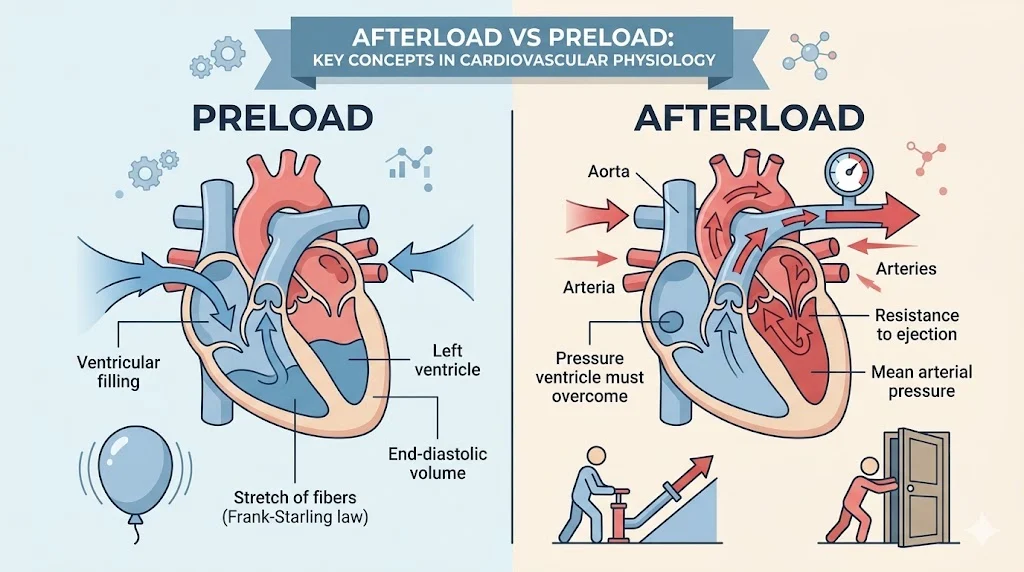
Afterload vs preload refers to two key forces that affect how the heart pumps blood. Preload is the stretch of the heart muscle before contraction, while afterload is the resistance the heart must overcome to eject blood. Understanding both helps explain heart function, blood pressure, and many cardiovascular conditions.
The human heart works like a pump. It fills with blood, then pushes it out to the body. But this process is not as simple as it sounds. Two important factors control how well the heart pumps: afterload and preload.
Many students, medical learners, and even professionals confuse these two terms. They sound similar, but they mean very different things. This confusion can make it hard to understand topics like blood pressure, heart failure, and circulation.
Learning the difference between afterload vs preload is important. It helps you understand how the heart works in health and disease. It also explains why certain medicines are used in heart patients.
In this guide, you will learn both concepts in a simple and clear way. We will use easy examples, tables, and real-life situations so you can remember them easily.
Quick Answer / Overview
| Factor | Preload | Afterload |
| Meaning | Blood filling the heart before pumping | Resistance heart faces while pumping |
| Time | Before contraction | During contraction |
| Related To | Venous return | Blood pressure |
| Example | Balloon filling with water | Squeezing water out against pressure |
| Affects | Stroke volume | Cardiac workload |
Simple Idea:
- Preload = how much blood enters the heart
- Afterload = how hard the heart must push blood out
Definition and Explanation
What Is Preload?
Preload is the amount of blood that fills the heart before it contracts. It mainly depends on how much blood returns to the heart from the body.
Think of it like filling a balloon with water. The more water you add, the more it stretches. This stretch is similar to preload.
Key Points About Preload
- Measured at the end of heart filling (diastole)
- Depends on venous return
- Affects how strongly the heart contracts
- Based on the Frank-Starling law
Simple Analogy
Imagine pulling a rubber band. The more you stretch it, the stronger it snaps back. That stretch is like preload.
What Is Afterload?
Afterload is the force or resistance the heart must overcome to pump blood out.
It is mainly affected by blood pressure and the condition of arteries.
Key Points About Afterload
- Occurs during heart contraction (systole)
- Linked to arterial pressure
- Higher afterload makes the heart work harder
- Important in conditions like hypertension
Simple Analogy
Imagine squeezing a water-filled balloon through a narrow pipe. The tighter the pipe, the harder you must squeeze. That resistance is afterload.
Deep Dive: Afterload vs Preload
Understanding afterload vs preload becomes easier when you compare them directly.
Side-by-Side Comparison
| Feature | Preload | Afterload |
| Phase | Diastole (filling) | Systole (pumping) |
| Pressure Source | Venous blood | Arterial system |
| Main Influence | Blood volume | Blood pressure |
| Effect on Heart | Stretch of muscle fibers | Force required to pump |
| Clinical Relevance | Fluid overload | Hypertension |
Advantages and Disadvantages
Advantages of Higher Preload
- Increases cardiac output (up to a limit)
- Helps maintain blood flow
- Improves stroke volume
Disadvantages of High Preload
- Can lead to fluid overload
- Causes heart strain in failure
- May result in pulmonary edema
Advantages of Lower Afterload
- Easier blood ejection
- Reduced heart workload
- Better cardiac efficiency
Disadvantages of High Afterload
- Increases heart stress
- Leads to hypertrophy
- May cause heart failure
Real-World Examples
Example 1: Exercise
- Preload increases due to more blood returning to heart
- Afterload may slightly increase due to higher pressure
- Result: Stronger heart pumping
Example 2: High Blood Pressure
- Afterload increases significantly
- Heart must work harder
- Can lead to heart thickening
Example 3: Dehydration
- Preload decreases due to low blood volume
- Less blood filling the heart
- Reduced cardiac output
Example 4: Heart Failure
- Preload may increase due to fluid retention
- Afterload may also rise
- Heart becomes inefficient
Regional and Global Usage
The concepts of afterload vs preload are used worldwide in:
- Medical education (MBBS, nursing, physiology)
- Cardiology practice
- Emergency medicine
- ICU monitoring
Differences in Application
- In developed countries, advanced tools measure preload and afterload
- In developing regions, doctors rely more on clinical signs
Despite these differences, the concepts remain universal.
Common Mistakes
Mistake 1: Mixing Up Timing
- Preload is before contraction
- Afterload is during contraction
Mistake 2: Thinking Both Are Pressure
- Preload is related to volume/stretch
- Afterload is related to resistance/pressure
Mistake 3: Ignoring Their Relationship
They are connected. Changes in one often affect the other.
Mistake 4: Overgeneralizing Effects
- More preload is not always good
- Less afterload is not always safe
Related Concepts or Comparisons
Stroke Volume
Amount of blood pumped in one beat
Cardiac Output
Total blood pumped per minute
Frank-Starling Law
Explains how preload affects contraction strength
Blood Pressure
Closely linked with afterload
Practical Analogy Section
Balloon Model
- Filling balloon = Preload
- Squeezing balloon = Afterload
Pump System
- Water entering pump = Preload
- Resistance in pipe = Afterload
These analogies help simplify complex ideas.
Exercises with Answers
Question 1
What does preload depend on?
A. Blood pressure
B. Venous return
C. Heart rate
Answer: B
Question 2
Afterload mainly depends on:
A. Blood volume
B. Arterial resistance
C. Oxygen levels
Answer: B
Question 3
Which increases in dehydration?
A. Preload
B. Afterload
C. Neither
Answer: C (Preload decreases)
Question 4
High blood pressure affects:
A. Preload
B. Afterload
C. Both equally
Answer: B
Question 5
Preload occurs during:
A. Systole
B. Diastole
C. Both
Answer: B
FAQs
What is the main difference between afterload vs preload?
Preload is the filling of the heart before contraction, while afterload is the resistance during blood ejection.
Why is preload important in heart function?
Preload helps determine how much the heart muscle stretches, which affects how strongly it contracts.
How does afterload affect the heart?
Higher afterload makes the heart work harder to pump blood, increasing strain and workload.
Can preload and afterload change together?
Yes, both can change at the same time depending on body conditions like exercise or disease.
What happens if preload is too high?
Excess preload can cause fluid overload and stress the heart, especially in heart failure.
What happens if afterload is too high?
High afterload can lead to high blood pressure and eventually heart damage.
Which drugs affect preload and afterload?
Diuretics reduce preload, while vasodilators reduce afterload.
Is afterload related to blood pressure?
Yes, afterload is strongly linked to arterial blood pressure.
How does dehydration affect preload vs afterload?
Dehydration lowers preload because less blood returns to the heart.
Why do students confuse afterload vs preload?
Because both terms sound similar and relate to heart function, but they occur at different stages.
Conclusion
Understanding afterload vs preload is essential for anyone studying or working in healthcare. These two concepts explain how the heart fills with blood and how it pushes blood out to the body.
Preload focuses on the amount of blood entering the heart. It depends on blood volume and venous return. Afterload, on the other hand, is about resistance. It depends on blood pressure and arterial stiffness.
Both play a major role in heart health. Too much or too little of either can lead to serious problems. That is why doctors carefully manage them in patients with heart disease.
To remember easily, think of this:
- Preload is filling
- Afterload is pushing
By mastering these basics, you build a strong foundation in cardiovascular physiology. This knowledge is useful not just for exams, but also for real-life medical understanding.

Victoria Lane is a grammar-focused writer at GramBrix.com, passionate about helping readers master the rules of language. She provides clear explanations and practical examples that make writing more accurate, polished and confident.