
Last Updated on March 25, 2026
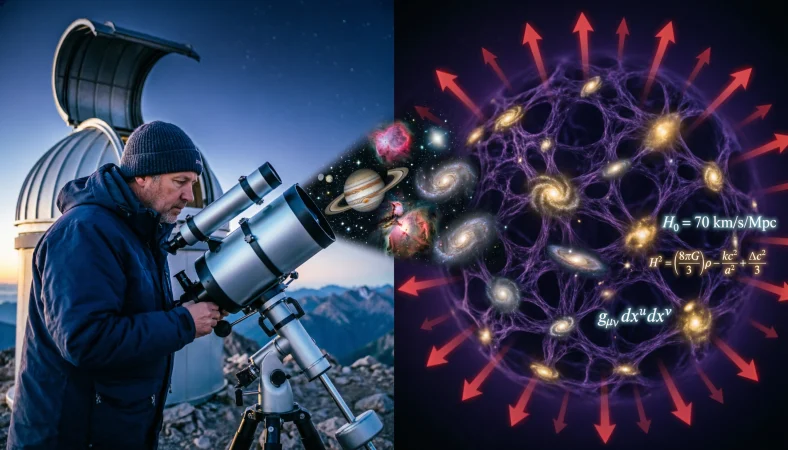
Cosmology and astronomy are related sciences but focus on different things. Astronomy studies specific objects in space like stars, planets, and galaxies through observation and measurement. Cosmology studies the universe as a whole, including how it began, how it is structured, and how it will evolve over time.
The exact search query cosmology vs astronomy reflects a common confusion between two sciences that sound similar but operate at very different scales. Astronomy is the observation and analysis of objects in space. Cosmology is the theoretical study of the universe itself, including how it began and how it changes over time. This confusion leads to real mistakes in academic writing, science communication, and even classroom instruction, where people often substitute one term when the other is required for precision.
Understanding the distinction is not just semantic. It shapes how we interpret discoveries, how research is categorized, and how scientific language communicates meaning.
Cosmology vs Astronomy: What’s the Difference?
Astronomy is a noun that refers to the scientific discipline focused on observing and explaining celestial bodies and phenomena. Cosmology is also a noun, but it refers to a branch of physics and astronomy concerned with the universe at its largest scale, including its origin, laws, and destiny.
Here is a structured comparison.
Term: Astronomy
Part of speech: Noun
Core focus: Individual objects and observable phenomena in space
Typical questions: What is that star made of? How do planets form?
Methods: Observation, imaging, spectroscopy, measurement
Scale: Local to galactic
Term: Cosmology
Part of speech: Noun
Core focus: The universe as a system
Typical questions: How did the universe begin? What is dark energy?
Methods: Mathematical modeling, theoretical physics, large scale surveys
Scale: Universal
Mini recap:
Astronomy looks outward to catalog and explain what we see.
Cosmology looks deeper to understand why the universe exists in its present form.
Astronomy gathers evidence. Cosmology interprets the grand narrative behind that evidence.
Is Cosmology vs Astronomy a Grammar, Vocabulary, or Usage Issue?
This distinction is primarily a vocabulary and usage issue rather than grammar.
These words are not interchangeable. Using the wrong one signals a misunderstanding of scientific scope.
In formal academic writing, the difference is strictly maintained. A research paper measuring exoplanet atmospheres is astronomy. A paper modeling the expansion of spacetime is cosmology.
In casual conversation, people blur the terms because both relate to space. However, precision matters whenever explanation, teaching, or publishing is involved.
Think of it this way. Astronomy describes parts of the universe. Cosmology explains the universe as a whole.
Practical Usage of Astronomy
Astronomy is used when discussing observation, classification, and physical properties of celestial objects.
Workplace example
An engineer working on telescope imaging software is contributing to astronomy because the goal is to capture clearer observations of distant galaxies.
Academic example
A university course titled Stellar Evolution is an astronomy course since it studies how stars form, age, and die.
Technology example
Satellite based observatories collecting infrared data are tools of astronomy because they measure detectable signals from space objects.
Usage recap
Use astronomy when the subject involves measuring, observing, or analyzing specific cosmic entities.
Practical Usage of Cosmology
Cosmology applies when the subject concerns the structure or history of the universe itself.
Workplace example
A physicist developing simulations of the early universe is working in cosmology because the research addresses conditions just after the Big Bang.
Academic example
A seminar on dark matter distribution across cosmic scales belongs to cosmology, not observational astronomy.
Technology example
Supercomputer simulations modeling universal expansion are cosmological tools because they test theories about spacetime behavior.
Usage recap
Use cosmology when discussing origins, universal laws, or the fate of everything that exists.
When You Should NOT Use Cosmology or Astronomy
Writers often misuse these terms in ways that weaken clarity.
- Do not use cosmology when describing telescope observations of a planet. That is astronomy.
- Do not use astronomy when discussing theories about the beginning of the universe. That is cosmology.
- Avoid calling every space related discovery cosmological. Most are astronomical measurements.
- Do not label satellite imaging research as cosmology unless it addresses universal scale structure.
- Do not use astronomy to describe philosophical discussions about existence or multiverse theory.
- Avoid using cosmology as a synonym for space science in journalism. It is far more specific.
- Do not apply either word to science fiction contexts unless referring to real scientific frameworks.
- Never substitute one term just to sound more technical.
Precision builds authority. Misuse erodes it.
Common Mistakes and Decision Rules
Correct sentence: The research team analyzed the chemical composition of a distant star.
Incorrect sentence: The research team conducted a cosmology study of a distant star.
Explanation: Studying a single star is astronomy.
Correct sentence: The paper explores how the universe expanded after the Big Bang.
Incorrect sentence: The paper explores astronomy after the Big Bang.
Explanation: Universal evolution belongs to cosmology.
Correct sentence: She specializes in radio astronomy.
Incorrect sentence: She specializes in radio cosmology.
Explanation: Observation based disciplines fall under astronomy.
Correct sentence: Cosmology attempts to explain dark energy.
Incorrect sentence: Astronomy attempts to explain dark energy at the universal level.
Explanation: This is a cosmological question.
Decision Rule Box
If you mean observation of objects, use astronomy.
If you mean explanation of the universe as a whole, use cosmology.
Cosmology vs Astronomy in Modern Technology and AI Tools
Modern data science has made the boundary even clearer.
Astronomy now relies heavily on automated detection systems that scan massive sky surveys to identify objects, classify galaxies, and detect anomalies.
Cosmology uses AI driven simulations to test models of universal expansion, gravitational structure, and cosmic background radiation patterns.
In simple terms, AI helps astronomy see more. AI helps cosmology understand more.
Etymology and Conceptual Origins
Astronomy comes from Greek roots meaning law of the stars. Historically, it referred to charting celestial movements for navigation and calendars.
Cosmology comes from the Greek word kosmos meaning order or world, combined with the study of structure and meaning. It has always carried a more philosophical and theoretical dimension.
Expert insight
Astronomy tells us what is out there. Cosmology asks why there is an out there at all.
Case Studies That Show the Difference in Action
Case Study One: Mapping Exoplanets
A global observatory network identified over four thousand candidate planets using transit detection. This was an astronomical achievement because it relied on repeated observation, measurement, and classification. The work expanded planetary catalogs but did not attempt to redefine universal theory.
Case Study Two: Measuring Universal Expansion
An international physics collaboration analyzed background radiation patterns to refine the estimated age of the universe. This was cosmology because the goal was to understand large scale structure and temporal evolution, not individual objects.
These examples show how the disciplines complement each other rather than compete.
Error Prevention Checklist
Always use astronomy when discussing observation, detection, or classification.
Always use cosmology when discussing origin, structure, or fate of the universe.
Never substitute cosmology for general space research.
Never use astronomy to describe theoretical models of existence.
Check the scale of the subject before choosing the word.
If the topic could fit inside a telescope field of view, it is likely astronomy.
If the topic describes reality itself, it is cosmology.
Related Grammar Confusions You Should Master
Students and writers who struggle with this distinction often confuse other academic terms as well. Strengthening these will improve clarity across disciplines.
- Theory vs law in scientific writing
- Universe vs galaxy in descriptive accuracy
- Observation vs inference in research language
- Physics vs astrophysics in curriculum terminology
- Model vs hypothesis in methodology
- Data vs evidence in analytical argument
- Space vs cosmos in formal usage
- Experiment vs simulation in reporting results
- Measurement vs interpretation in research summaries
- Science communication vs scientific publication tone
FAQs
What is the main difference between cosmology and astronomy?
Astronomy studies celestial objects and measurable phenomena, while cosmology investigates the origin, evolution, and structure of the universe as an integrated system.
Is cosmology a branch of astronomy?
Cosmology overlaps with astronomy but is more accurately considered an interdisciplinary field combining astronomy, physics, and mathematics to study universal scale questions.
Can an astronomer also be a cosmologist?
Yes. Many scientists work across both fields, using observational data from astronomy to test cosmological theories.
Why do people confuse cosmology with astronomy?
Both deal with space, but popular media often uses the terms loosely, masking the difference between observing objects and explaining the universe itself.
Which field is more theoretical, cosmology or astronomy?
Cosmology is generally more theoretical because it relies heavily on mathematical modeling and fundamental physics.
Does studying galaxies count as cosmology?
Studying individual galaxies is astronomy. Studying how galaxies formed across cosmic history becomes cosmology.
How do telescopes contribute differently to each field?
In astronomy, telescopes collect data about objects. In cosmology, that same data is used to test models about universal behavior.
Is the Big Bang part of astronomy or cosmology?
The Big Bang is a cosmological concept because it explains the origin and evolution of the entire universe.
Are dark matter studies astronomy or cosmology?
If examining its effect within a galaxy, it is astronomy. If studying its role in universal structure, it is cosmology.
Conclusion
Understanding cosmology vs astronomy is essential for accurate scientific communication. Astronomy focuses on observing and explaining celestial objects, while cosmology seeks to understand the universe at its largest scale, including its beginnings and ultimate fate. Recognizing this difference improves clarity, strengthens academic credibility, and ensures that complex ideas are described with the precision they deserve.

Justin Powell is a writer at GramBrix.com who focuses on grammar, clarity and effective communication, helping readers strengthen their language skills.