
Last Updated on July 8, 2026
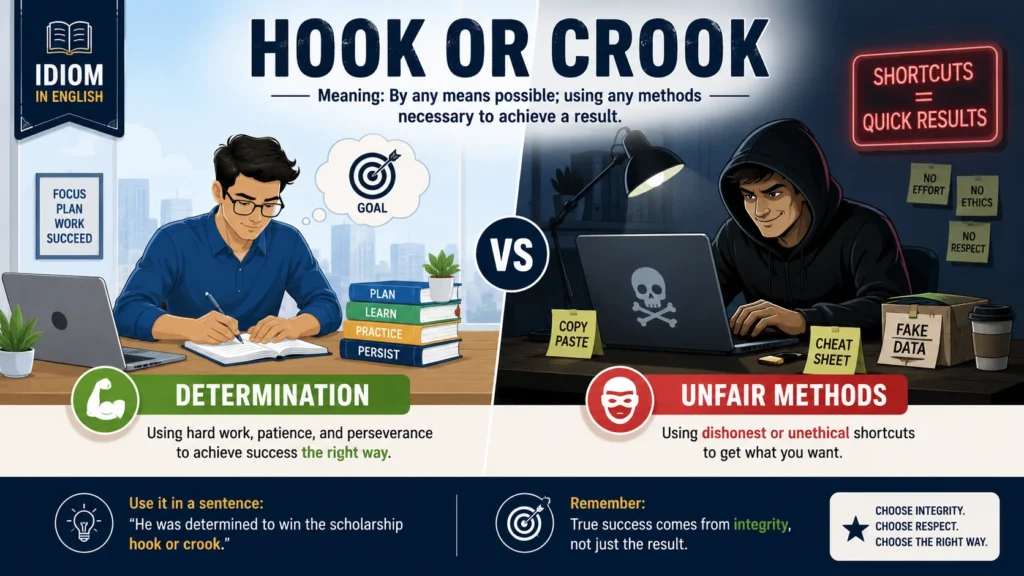
The phrase “hook or crook” is commonly used in the expression “by hook or by crook,” which means achieving something by any possible method, whether fair or unfair. It is an old English idiom still used today in conversations, literature, business discussions, and media to describe determination or questionable tactics.
The phrase hook or crook may sound strange at first. Many people hear it in movies, books, or conversations but do not fully understand what it means. The full expression is usually “by hook or by crook.” It describes a person who will reach a goal using any possible method.
Sometimes the phrase shows strong determination. Other times, it suggests dishonest behavior. That is why people often feel confused about its real meaning.
This idiom has existed for hundreds of years. Even today, it appears in news articles, business talks, politics, and everyday speech. Understanding the phrase can improve your English vocabulary and help you recognize hidden meanings in conversations.
In this guide, you will learn everything about hook or crook, including its definition, origin, examples, advantages, disadvantages, regional usage, grammar tips, exercises, and common mistakes. The article is written in simple language so both beginners and advanced English learners can understand it easily.
Quick Answer About Hook or Crook
| Phrase | Meaning |
|---|---|
| Hook or crook | Any method used to achieve something |
| By hook or by crook | To do something by any possible means, fair or unfair |
| Tone | Determined, forceful, sometimes negative |
| Common Usage | Conversation, politics, business, storytelling |
Simple Example
“He wanted the job by hook or by crook.”
This means he wanted the job no matter what methods he had to use.
What Does Hook or Crook Mean?
The phrase hook or crook comes from the longer idiom “by hook or by crook.” It means:
Achieving something through any method possible.
The methods can be:
- Honest
- Clever
- Creative
- Aggressive
- Dishonest
- Manipulative
The exact meaning depends on the situation.
Positive Meaning
Sometimes it simply shows determination.
Example:
“She studied day and night and passed the exam by hook or by crook.”
This means she worked hard and did everything possible to succeed.
Negative Meaning
Sometimes it suggests unethical behavior.
Example:
“He entered the company by hook or by crook.”
This may suggest cheating, bribery, or manipulation.
Origin of the Phrase Hook or Crook
The phrase is very old. Experts believe it started in medieval England.
There are several theories about its origin.
Theory About Gathering Wood
One popular explanation says poor people were allowed to collect firewood from forests using:
- Hooks
- Crooks
A hook was a cutting tool. A crook was a curved stick.
People could gather wood by any legal means available. Over time, the phrase changed into a broader idea of achieving something by any method.
Some historians connect the phrase to old land boundaries in England. Roads or borders may have followed hooks and crooks, meaning curved paths.
No single theory is fully proven, but the expression became popular in English literature by the 14th century.
Why the Phrase Is Still Popular
Many old idioms disappear over time, but hook or crook remains popular because it describes human behavior very well.
People often:
- Chase success
- Fight for survival
- Compete for opportunities
- Break rules to win
The phrase captures all these ideas in a short and memorable way.
How Hook or Crook Is Used in Everyday English
The phrase appears in many situations.
In Daily Conversation
People use it casually to describe determination.
Example:
“I will finish this project by hook or by crook.”
In Business
It can describe aggressive competition.
Example:
“The company wanted market control by hook or by crook.”
In Politics
Politicians sometimes use unfair methods to gain power.
Example:
“The party stayed in office by hook or by crook.”
In Education
Students may use every possible method to pass exams.
Example:
“He passed the course by hook or by crook.”
Difference Between Positive and Negative Usage
| Positive Usage | Negative Usage |
|---|---|
| Hard work | Dishonesty |
| Persistence | Manipulation |
| Creative effort | Corruption |
| Problem solving | Rule breaking |
| Determination | Cheating |
Understanding tone is very important.
Examples of Hook or Crook in Sentences
Positive Examples
- She saved enough money by hook or by crook.
- We completed the event by hook or by crook.
- The team found a solution by hook or by crook.
Negative Examples
- The criminal escaped by hook or by crook.
- He gained power by hook or by crook.
- They won the contract by hook or by crook.
Neutral Examples
- We will get there by hook or by crook.
- The company survived by hook or by crook.
Hook or Crook in Literature and Media
Writers love idioms because they add personality and emotion.
The phrase appears in:
- Novels
- Newspaper articles
- Political speeches
- TV dramas
- Crime stories
- Historical writing
Example in Storytelling
A character who says:
“I will protect my family by hook or by crook.”
sounds determined and emotionally driven.
Regional and Global Usage
British English
The phrase is very common in British English because it originated there.
American English
Americans also use it, especially in older speech or journalism.
Indian English
The phrase is widely understood and used in Indian English.
Pakistani English
English speakers in Pakistan often use the phrase in:
- Politics
- Business discussions
- News reporting
- Daily speech
Global English Learning
English learners worldwide study the phrase because it appears in exams, books, and conversations.
Grammar and Sentence Structure
The phrase usually follows these patterns.
Standard Structure
By hook or by crook
Example:
“She succeeded by hook or by crook.”
Informal Short Form
Sometimes people simply say:
- hook or crook
Example:
“Hook or crook, we must finish today.”
Synonyms of Hook or Crook
| Synonym | Meaning |
|---|---|
| By any means necessary | Use all possible methods |
| No matter what | Regardless of obstacles |
| Come what may | Whatever happens |
| At all costs | Any price or sacrifice |
| Through thick and thin | Through difficulties |
| Against all odds | Despite challenges |
Opposite Expressions
| Opposite Phrase | Meaning |
|---|---|
| Fair and square | Honestly |
| By the rules | Legally and ethically |
| Properly | Correctly |
| Ethically | Morally |
Hook or Crook vs By Any Means Necessary
| Hook or Crook | By Any Means Necessary |
|---|---|
| Often informal | More serious |
| Can sound humorous | Stronger tone |
| Old English idiom | Modern expression |
| Sometimes negative | Often intense or political |
Hook or Crook vs At All Costs
| Hook or Crook | At All Costs |
|---|---|
| Focus on methods | Focus on sacrifice |
| Includes possible dishonesty | Includes possible losses |
| Idiomatic phrase | General phrase |
Advantages of Using the Phrase
Adds Personality to Writing
Idioms make language colorful.
Shows Emotion Quickly
The phrase immediately shows urgency or determination.
Useful in Storytelling
It helps describe ambitious or desperate characters.
Common in Spoken English
Native speakers recognize the phrase easily.
Disadvantages of Using the Phrase
Can Sound Negative
Some listeners may assume dishonesty.
Old Fashioned in Some Contexts
Younger audiences may not use it often.
Confusing for English Learners
Without context, the phrase can seem strange.
Not Ideal for Formal Writing
Business reports or academic papers may prefer simpler language.
Real World Examples of Hook or Crook
Business Competition
A company may try aggressive marketing to beat competitors.
Example:
“The brand wanted dominance by hook or by crook.”
Sports
An athlete may push limits to win.
Example:
“The team wanted victory by hook or by crook.”
Politics
Political leaders may use strategic or unfair tactics.
Example:
“The candidate gained support by hook or by crook.”
Education
Students sometimes use extreme effort.
Example:
“She completed her degree by hook or by crook.”
Hook or Crook in Movies and TV
This phrase appears often in:
- Crime dramas
- Political thrillers
- Detective stories
- Comedy films
It usually describes characters who are:
- Ambitious
- Desperate
- Clever
- Ruthless
- Persistent
Psychological Meaning Behind the Phrase
The idiom reflects a deep human behavior.
People naturally want:
- Success
- Survival
- Recognition
- Security
- Power
Sometimes these desires create ethical conflicts.
The phrase captures the tension between:
- Determination
- Morality
Ethical Discussion About Hook or Crook
The phrase raises an important question:
Is success worth any method?
Different people answer differently.
Some Believe
Results matter most.
Others Believe
Methods matter more than results.
This ethical debate appears in:
- Business ethics
- Politics
- Law
- Education
- Leadership
Common Mistakes When Using Hook or Crook
Using It in Extremely Formal Writing
Avoid it in:
- Academic research
- Legal documents
- Scientific papers
Better Alternative
“By any available method.”
Forgetting the Full Phrase
Incorrect:
“By hook crook.”
Correct:
“By hook or by crook.”
Using It Without Context
The phrase can sound unclear if readers do not know the situation.
Incorrect:
“He did it by hook or by crook.”
Better:
“He secured the contract by hook or by crook.”
Assuming It Always Means Cheating
The phrase can also mean persistence or creativity.
Tips for Using Hook or Crook Correctly
Understand the Tone
Decide whether the context is:
- Positive
- Neutral
- Negative
Use It in Conversation
It sounds natural in speech.
Avoid Overusing It
Too many idioms can weaken writing.
Add Context
Explain the goal or action clearly.
Hook or Crook in Academic Learning
English learners often study idioms because they improve fluency.
Understanding idioms helps with:
- Reading comprehension
- Listening skills
- Writing style
- Speaking naturally
Exercises With Answers
Exercise 1: Choose the Correct Meaning
Sentence
“She wanted the promotion by hook or by crook.”
Options
A. She wanted it honestly only
B. She wanted it by any possible method
C. She refused the promotion
Answer
B. She wanted it by any possible method.
Exercise 2: Fill in the Blank
“We will finish this project ________.”
Answer
“by hook or by crook”
Exercise 3: Positive or Negative?
Sentence
“He entered politics by hook or by crook.”
Answer
Usually negative.
Exercise 4: Rewrite the Sentence
Original:
“She succeeded no matter what.”
Possible Rewrite:
“She succeeded by hook or by crook.”
Exercise 5: Correct the Mistake
Incorrect:
“By hook crook we survived.”
Correct:
“By hook or by crook we survived.”
Advanced Understanding of Hook or Crook
Advanced English learners should notice subtle meaning changes.
Tone Changes With Context
Friendly Tone
“We will make this trip happen by hook or by crook.”
Dark Tone
“The gang controlled the city by hook or by crook.”
Cultural Importance of Idioms
Idioms show how cultures think.
The phrase reflects ideas about:
- Ambition
- Survival
- Persistence
- Ethics
That is why it remains important even today.
Hook or Crook in Professional Communication
Professionals sometimes use the phrase carefully.
Appropriate Situations
- Informal meetings
- Speeches
- Motivational talks
Situations to Avoid
- Legal writing
- Official policy documents
- Formal academic work
Business Examples of Hook or Crook
Startup Competition
A startup may fight hard for customers.
Example:
“The startup survived by hook or by crook.”
Sales Pressure
A salesperson may use every strategy available.
Example:
“He closed the deal by hook or by crook.”
Ethical Risk
Companies using unethical tactics may damage trust.
Educational Examples
Positive Learning Example
A student studies extra hours.
Negative Learning Example
A student cheats during exams.
Both situations may be described using the phrase, depending on context.
Social Media and Modern Usage
The idiom still appears online.
People use it in:
- Tweets
- Blogs
- Memes
- Discussions
- News comments
Modern users often use it humorously.
Example:
“By hook or by crook, I will finish this Netflix series tonight.”
Common Confusions About Hook or Crook
Is It Always Negative?
No. Context matters.
Is It Old English?
Yes, but still widely understood.
Is It Formal?
Mostly informal or semi formal.
Is It British Only?
No. It is global now.
Related Concepts and Comparisons
Determination
The phrase often connects with persistence.
Ambition
It may describe strong desire for success.
Ethics
It can suggest moral compromise.
Survival
Sometimes it describes people facing difficult situations.
Table of Usage Contexts
| Situation | Meaning Tone |
|---|---|
| Student studying hard | Positive |
| Politician manipulating votes | Negative |
| Family surviving poverty | Sympathetic |
| Business fighting competition | Neutral or negative |
| Athlete training intensely | Positive |
Beginner Guide to Understanding the Phrase
If you are new to English idioms, remember this simple rule:
“By hook or by crook” means using every possible method to achieve something.
That is the easiest way to understand it.
Advanced Writing Tips
Use Context Clues
Readers understand tone from surrounding words.
Pair With Strong Verbs
Examples:
- Achieve
- Win
- Survive
- Gain
- Secure
Avoid Repetition
Do not use the idiom too often in one paragraph.
Mini Dialogue Examples
Example 1
Person A: “Will you finish the project?”
Person B: “Yes, by hook or by crook.”
Meaning: determination.
Example 2
Person A: “How did he get the contract?”
Person B: “By hook or by crook.”
Meaning: possibly dishonest methods.
Historical Evolution of the Phrase
The phrase survived because:
- It is memorable
- It rhymes slightly
- It sounds dramatic
- It captures human struggle
Many old idioms disappear, but this one remains useful.
FAQs
What does hook or crook mean?
It means using any possible method to achieve something, whether fair or unfair.
What is the full phrase of hook or crook?
The full idiom is “by hook or by crook.”
Is hook or crook a negative phrase?
Not always. It can describe determination or dishonest behavior depending on context.
Can I use hook or crook in formal writing?
It is better for informal or semi formal writing. Formal documents usually avoid idioms.
Where did the phrase hook or crook come from?
The phrase likely originated in medieval England and may relate to gathering wood using hooks and crooks.
Is by hook or by crook still used today?
Yes. People still use it in conversations, media, business, and politics.
What is another way to say by hook or by crook?
You can say:
- By any means necessary
- No matter what
- At all costs
Does hook or crook always mean cheating?
No. Sometimes it simply means persistence and determination.
Can students use hook or crook in essays?
Yes, but it is better in creative or informal essays rather than academic research papers.
Why do English learners study hook or crook?
It is a common idiom that improves speaking, reading, and listening comprehension.
Conclusion
The phrase hook or crook remains one of the most interesting idioms in the English language. Usually seen in the expression “by hook or by crook,” it describes achieving a goal through any possible method. Depending on context, the phrase can sound positive, neutral, or negative.
Understanding this idiom helps English learners improve vocabulary, recognize emotional tone, and communicate more naturally. The phrase appears in daily conversations, politics, business, literature, and media, making it useful for both casual and professional English.
When using the idiom, always think about tone and context. In some situations, it shows determination and persistence. In others, it suggests unethical behavior or manipulation. Because of this flexibility, the phrase remains powerful even after centuries of use.
For best results, use the phrase carefully, avoid overusing it in formal writing, and practice it through real examples and exercises. Learning idioms like hook or crook can make your English sound more fluent, expressive, and culturally aware.

Kevin Brooks is a grammar specialist at GramBrix.com, dedicated to helping readers understand language rules with clarity and confidence. He simplifies complex grammar concepts through practical examples and easy explanations.