Last Updated on July 7, 2026
An expressway vs highway comparison explains two major types of high-speed roads used for long-distance travel. Expressways are controlled-access roads designed for faster, smoother traffic with limited entry points. Highways are broader road networks that may include intersections, traffic signals, and mixed traffic conditions depending on the country.
The difference between expressway vs highway is one of the most common points of confusion for drivers, students, and travelers. Many people use these terms as if they mean the same thing. However, they are not identical in design, rules, or purpose.
Both expressways and highways help connect cities, towns, and regions. They make travel faster and easier. But the way they are built and used can be very different. Some roads have full access control with no stops, while others allow intersections, local traffic, and mixed speed conditions.
Understanding expressway vs highway is important for safe driving, travel planning, and even road safety exams. It helps drivers know what to expect on the road, such as speed limits, exits, tolls, and traffic flow.
In this article, you will learn everything about expressways and highways in simple language. We will cover definitions, differences, advantages, examples, FAQs, and practice exercises. By the end, you will clearly understand how expressways differ from highways in real life.
Quick Answer: Expressway vs Highway Overview
The simplest way to understand expressway vs highway is this:
- An expressway is a high-speed road with controlled access, no traffic signals, and limited entry or exit points.
- A highway is a general road that connects places and may include intersections, signals, and direct access to local roads.
In short:
- Expressway = faster, controlled, limited access
- Highway = flexible, mixed traffic, more access points
Definition of Expressway vs Highway
What is an Expressway?
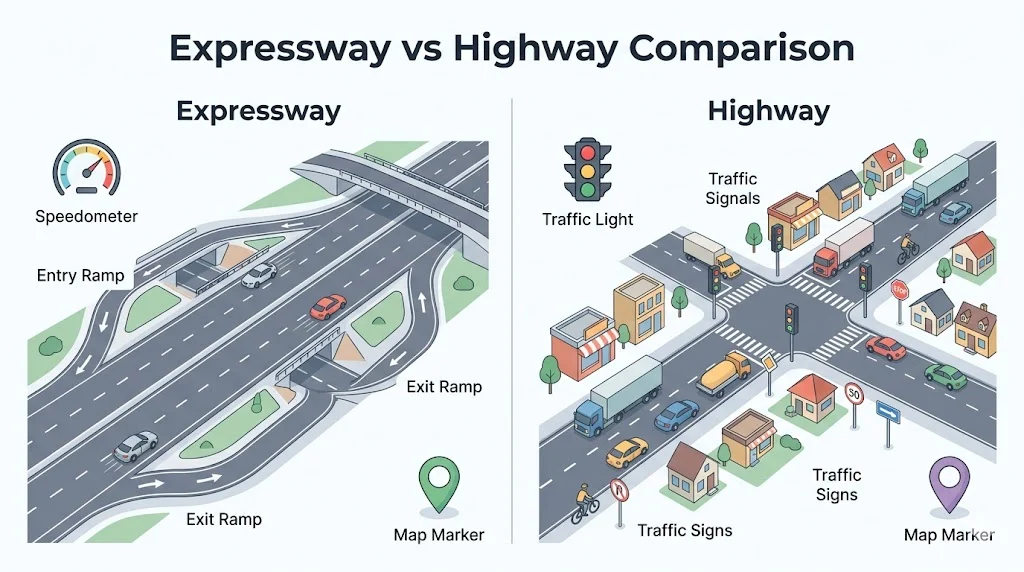
An expressway is a high-speed road designed for smooth and uninterrupted traffic flow. It has:
- Controlled entry and exit points
- No traffic signals or stop signs
- Divided lanes for opposite directions
- Higher speed limits
- Limited pedestrian or local access
Expressways are built to reduce travel time between major cities.
What is a Highway?
A highway is a general public road that connects cities, towns, and rural areas. It may include:
- Traffic signals
- Roundabouts or intersections
- Local road access
- Mixed vehicle types (cars, bikes, trucks)
- Variable speed limits
Highways are more flexible and widely used for both local and long-distance travel.
Expressway vs Highway: Key Differences Explained
Road Design Differences
- Expressways are fully divided roads with barriers.
- Highways may or may not be divided.
Expressways are engineered for speed. Highways are designed for accessibility.
Access Control
- Expressway: Controlled access only
- Highway: Open access with many entry points
This is the most important difference in expressway vs highway.
Speed Limits
- Expressways: Higher speed limits (often 80–120 km/h or more depending on country)
- Highways: Moderate speed limits (50–100 km/h typical)
Traffic Flow
- Expressway: Smooth and uninterrupted
- Highway: Can have stops, signals, and congestion
Safety Level
- Expressways are generally safer due to no intersections
- Highways may have more accident risks due to mixed traffic
Comparison Table: Expressway vs Highway
| Feature | Expressway | Highway |
| Access | Controlled | Open |
| Traffic Signals | No | Yes (sometimes) |
| Speed | High | Moderate |
| Entry Points | Limited | Many |
| Safety | Higher | Moderate |
| Purpose | Fast travel between cities | General connectivity |
| Stops | None | Possible |
| Pedestrians | Not allowed | Allowed in some areas |
Advantages and Disadvantages of Expressway vs Highway
Advantages of Expressways
- Faster travel time
- Less congestion
- Fewer accidents
- Smooth driving experience
- Designed for long-distance travel
Disadvantages of Expressways
- Limited entry/exit points
- Usually toll-based
- Not useful for short local travel
- Less flexible routes
Advantages of Highways
- Easy access to towns and cities
- More route options
- Suitable for all vehicle types
- Useful for local and regional travel
Disadvantages of Highways
- Traffic congestion
- Traffic signals and delays
- Higher accident risk
- Mixed vehicle speeds
Real-World Examples of Expressway vs Highway
Expressway Examples
- Yamuna Expressway (India)
- M2 Motorway (Pakistan)
- Autobahn (Germany – some sections)
- Interstate highways (USA – controlled sections)
These roads are built for speed and long-distance travel.
Highway Examples
- National Highways in Pakistan
- US Route highways
- Rural and urban connecting roads in most countries
Highways are more common and widely used for daily transport.
Regional and Global Usage of Expressway vs Highway
United States
- “Highway” is the general term.
- “Interstate” refers to controlled-access expressway systems.
United Kingdom
- Uses “motorway” instead of expressway.
- Highways include all major roads.
India
- Expressways are premium controlled roads.
- Highways (NH) connect most regions.
Pakistan
- Motorways are expressway-type roads.
- National highways serve general transport.
This shows that expressway vs highway definitions vary globally.
Common Mistakes in Understanding Expressway vs Highway
Mistake 1: Thinking they are the same
Many people assume expressway and highway mean identical roads. This is incorrect.
Mistake 2: Confusing speed limits
Not all highways are slow, and not all expressways are unlimited speed roads.
Mistake 3: Ignoring access rules
Some drivers wrongly enter expressways with non-permitted vehicles.
Mistake 4: Misunderstanding toll systems
Expressways are often toll roads, but not all highways are toll-based.
Exercises: Test Your Understanding of Expressway vs Highway
Exercise 1: Identify the Road Type
- A road with no traffic signals and controlled entry points
- A road passing through towns with intersections
- A high-speed toll road between cities
- A rural road connecting villages
Answers:
- Expressway
- Highway
- Expressway
- Highway
Exercise 2: True or False
- Expressways allow pedestrian movement
- Highways always have traffic signals
- Expressways are designed for high-speed travel
- Highways are more flexible than expressways
Answers:
- False
- False
- True
- True
Related Concepts to Expressway vs Highway
Motorway
A motorway is similar to an expressway with full access control and high speed limits.
Freeway
Common in the United States, a freeway is a type of expressway with no tolls in many cases.
Bypass Roads
These roads help traffic avoid city congestion and may behave like expressways or highways.
Urban Roads
City roads with signals, intersections, and local access.
Understanding these helps clarify expressway vs highway better.
FAQs
What is the main difference between expressway vs highway?
The main difference is access control. Expressways are fully controlled, while highways allow open access.
Is expressway faster than highway?
Yes, expressways are usually faster due to no traffic signals and limited entry points.
Can trucks use expressways?
Yes, but in many regions, only approved heavy vehicles are allowed.
Why are highways important?
Highways connect cities, towns, and rural areas and support daily transport needs.
Are expressways always toll roads?
Not always, but many expressways use toll systems for maintenance.
Which is safer: expressway vs highway?
Expressways are generally safer because they have no intersections.
Do highways have speed limits?
Yes, highways have variable speed limits depending on road type and country.
Can motorcycles use expressways?
It depends on local laws. Some expressways restrict motorcycles.
Is motorway the same as expressway?
In many countries, yes. A motorway is often a type of expressway.
Which is better for long travel: expressway or highway?
Expressways are better for long-distance travel due to speed and smooth flow.
Conclusion
Understanding expressway vs highway is important for safe and efficient travel. Both road types serve different purposes in transportation systems. Expressways are designed for speed, safety, and controlled traffic flow. Highways are designed for accessibility and connectivity across regions.
If your goal is fast travel between cities, expressways are the best choice. If you need flexible routes and local access, highways are more suitable. Knowing the difference helps drivers plan better, avoid confusion, and improve road safety.
In modern transport systems, both expressways and highways are essential. They work together to support economic activity, travel efficiency, and regional development. Always follow road rules and understand the type of road you are driving on for a safer journey.

Justin Powell is a writer at GramBrix.com who focuses on grammar, clarity and effective communication, helping readers strengthen their language skills.