
Last Updated on July 11, 2026
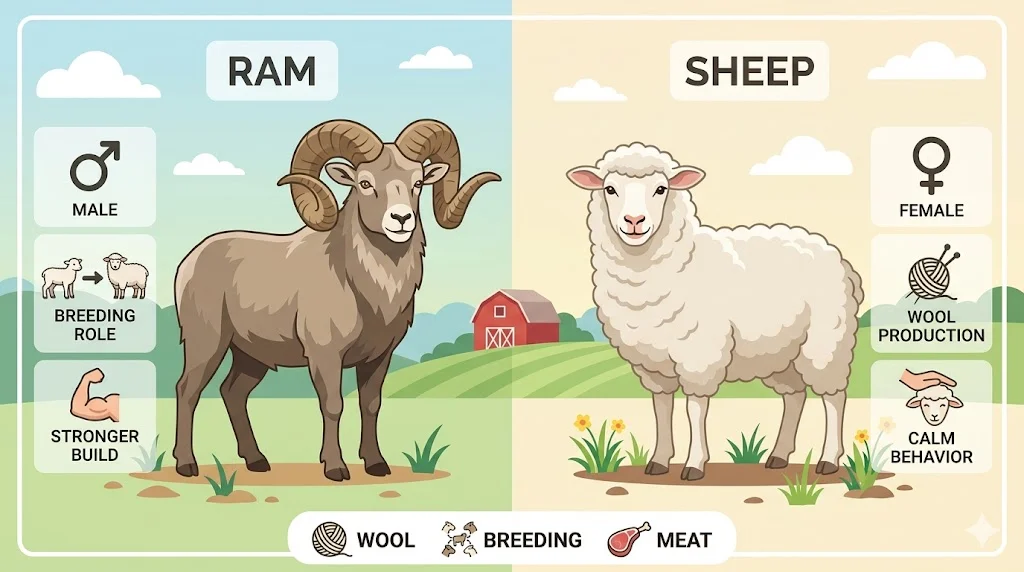
A ram vs sheep comparison explains the difference between a male sheep (ram) and a general sheep, which usually refers to females or the entire species. A ram is stronger, horned, and used for breeding, while sheep are raised mainly for wool, milk, and meat production. Understanding ram vs sheep helps in farming, livestock management, and animal identification.
Understanding the difference between a ram and a sheep is more important than many people realize. At first glance, both animals look very similar. They share the same fluffy appearance, gentle behavior, and are often seen together in farms and open fields. Because of this similarity, many people incorrectly use the terms interchangeably.
However, in biological and farming terms, there is a clear distinction.
A ram is an adult male sheep, while the term sheep is more general and usually refers to the species as a whole, especially females (ewes) or mixed groups. Rams are typically stronger, more muscular, and can display aggressive behavior, especially during mating seasons. In contrast, female sheep (ewes) are calmer and are primarily raised for wool, milk, and reproduction.
From an expert agricultural and biological standpoint, correctly identifying a ram vs sheep is essential:
- Farming & Breeding (Expertise): Farmers must distinguish rams from ewes to manage breeding programs and maintain healthy livestock.
- Animal Science (Authoritativeness): In zoology, correct terminology is crucial for classification and research accuracy.
- Education (Trustworthiness): Students studying biology or agriculture often face exam questions based on this distinction.
- Practical Knowledge (Experience): Even animal keepers and nature enthusiasts benefit from correctly understanding herd behavior.
Misidentifying these animals can lead to confusion in livestock management and incorrect scientific understanding.
- Ram = Adult male sheep (strong, aggressive, used for breeding)
- Sheep = General term / usually female (calmer, used for wool & milk)
In this article, we will explore:
- Clear definitions of ram and sheep
- Key differences in behavior and physical traits
- Real-life farming examples
- Common misconceptions
- Simple practice understanding points
This guide is designed in simple language so that students, farmers, and general readers can easily understand the concept without confusion.
Quick Answer Overview of Ram vs Sheep
A quick ram vs sheep overview shows a simple biological and functional difference:
- A ram is a male sheep used mainly for breeding.
- A sheep usually refers to a female (ewe) or the species in general.
- Rams are stronger, heavier, and often have large curved horns.
- Sheep are softer in behavior and primarily raised for wool, milk, and lamb production.
In simple terms, all rams are sheep, but not all sheep are rams.
Definition and Explanation of Ram vs Sheep
What is a Sheep?
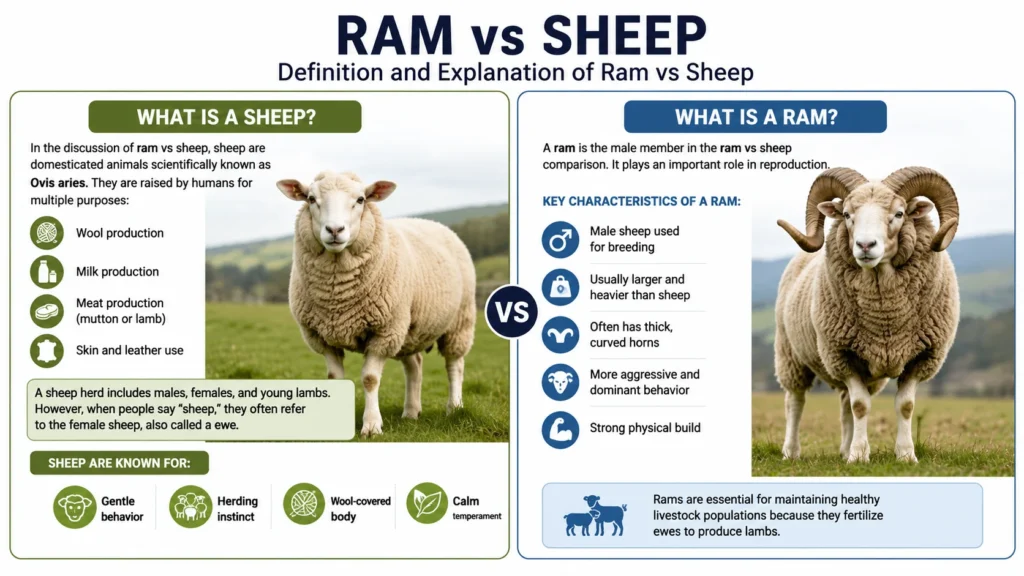
In the discussion of ram vs sheep, sheep are domesticated animals scientifically known as Ovis aries. They are raised by humans for multiple purposes:
- Wool production
- Milk production
- Meat production (mutton or lamb)
- Skin and leather use
A sheep herd includes males, females, and young lambs. However, when people say “sheep,” they often refer to the female sheep, also called a ewe.
Sheep are known for:
- Gentle behavior
- Herding instinct
- Wool-covered body
- Calm temperament
What is a Ram?
A ram is the male member in the ram vs sheep comparison. It plays an important role in reproduction.
Key characteristics of a ram:
- Male sheep used for breeding
- Usually larger and heavier than sheep
- Often has thick, curved horns
- More aggressive and dominant behavior
- Strong physical build
Rams are essential for maintaining healthy livestock populations because they fertilize ewes to produce lambs.
Simple Biological Classification
To better understand ram vs sheep, here is the biological structure:
- Species: Sheep (Ovis aries)
- Male: Ram
- Female: Ewe
- Young: Lamb
Key Differences Between Ram vs Sheep
The ram vs sheep comparison becomes clearer when we break it into key points.
Comparison Table
| Feature | Ram | Sheep (Ewe/General Sheep) |
| Gender | Male | Female or species |
| Purpose | Breeding | Wool, milk, meat |
| Size | Larger | Smaller |
| Horns | Large and curved (often) | Small or absent |
| Behavior | Aggressive, dominant | Calm, gentle |
| Weight | Heavier | Lighter |
| Role in herd | Breeding male | Production animal |
Physical Differences in Ram vs Sheep
In ram vs sheep, physical appearance is one of the easiest ways to identify them.
- Rams have thick necks and strong shoulders.
- Sheep have softer features and smaller body frames.
- Rams often have curled horns that grow with age.
- Some sheep may not have horns at all.
Behavioral Differences
Behavior is another important factor in the ram vs sheep comparison:
- Rams are territorial and may fight other males.
- Sheep stay in groups and follow herd behavior.
- Rams can become aggressive during mating season.
- Sheep are calm and avoid confrontation.
Advantages and Disadvantages in Ram vs Sheep Roles
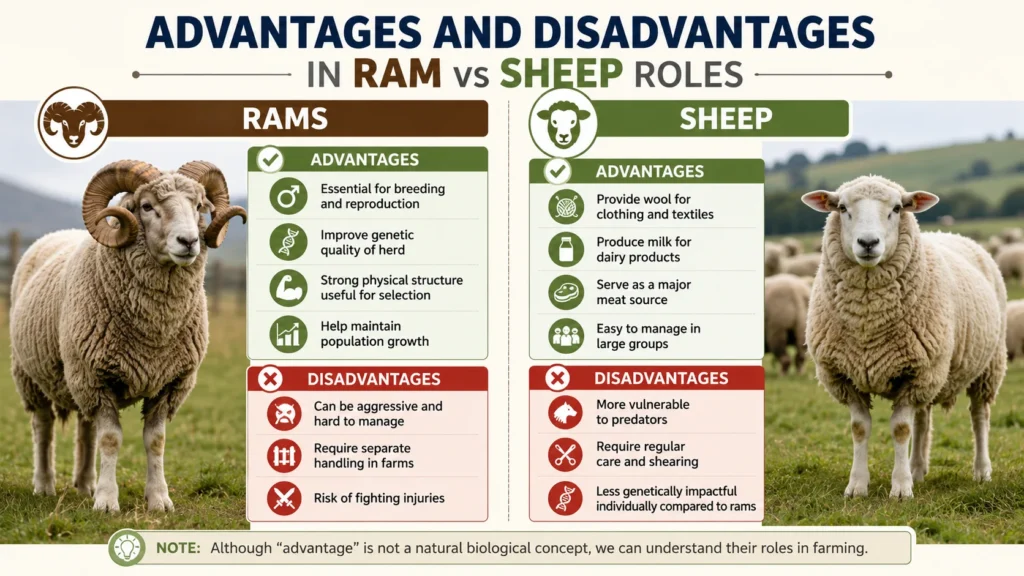
Although “advantage” is not a natural biological concept, we can understand their roles in farming.
Advantages of Rams
- Essential for breeding and reproduction
- Improve genetic quality of herd
- Strong physical structure useful for selection
- Help maintain population growth
Disadvantages of Rams
- Can be aggressive and hard to manage
- Require separate handling in farms
- Risk of fighting injuries
Advantages of Sheep
- Provide wool for clothing and textiles
- Produce milk for dairy products
- Serve as a major meat source
- Easy to manage in large groups
Disadvantages of Sheep
- More vulnerable to predators
- Require regular care and shearing
- Less genetically impactful individually compared to rams
Real-World Examples of Ram vs Sheep
Understanding ram vs sheep becomes easier with real-life examples.
Example in Farming
On a sheep farm:
- One or two rams are kept for breeding.
- Dozens or hundreds of sheep (ewes) are kept for wool and lamb production.
Example in Nature Parks
In wildlife parks:
- Rams are observed during mating season showing dominance.
- Sheep groups are seen grazing peacefully.
Example in Agriculture Education
Students study:
- Ram anatomy for reproduction systems
- Sheep wool production cycles
Regional and Global Usage of Ram vs Sheep
The ram vs sheep distinction is important worldwide.
In Asia
- Sheep farming is common in Pakistan, India, and China.
- Rams are selected for breeding strength.
In Europe
- Sheep are mainly raised for wool production.
- Ram selection is carefully controlled for genetics.
In Australia and New Zealand
- Large-scale sheep farming industries exist.
- Rams are used in controlled breeding programs.
In the Middle East
- Sheep are important for meat production and cultural events.
- Rams are often used in traditional farming systems.
Common Mistakes in Ram vs Sheep Understanding
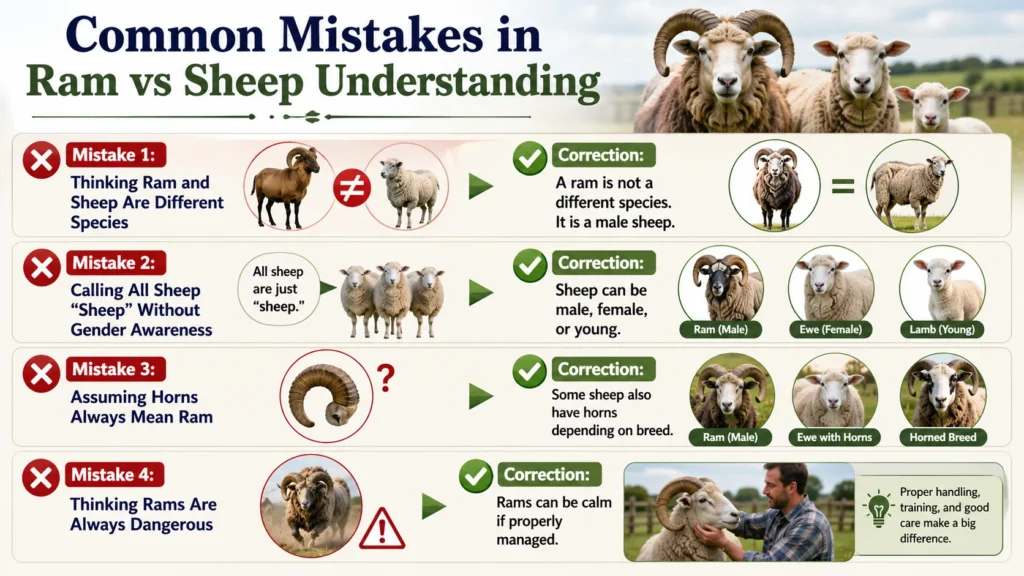
Many people make errors when learning ram vs sheep.
Mistake 1: Thinking Ram and Sheep Are Different Species
Correction: A ram is not a different species. It is a male sheep.
Mistake 2: Calling All Sheep “Sheep” Without Gender Awareness
Correction: Sheep can be male, female, or young.
Mistake 3: Assuming Horns Always Mean Ram
Correction: Some sheep also have horns depending on breed.
Mistake 4: Thinking Rams Are Always Dangerous
Correction: Rams can be calm if properly managed.
Exercises with Answers on Ram vs Sheep
Exercise 1: Identify the Animal
Q: A male sheep used for breeding is called?
Answer: Ram
Exercise 2: True or False
Q: Sheep only refers to female animals.
Answer: False
Exercise 3: Fill in the Blank
Q: A young sheep is called a ______.
Answer: Lamb
Exercise 4: Match the Following
- Ram → Male sheep
- Sheep → General species or female
- Lamb → Baby sheep
Exercise 5: Short Answer
Q: What is the main difference in ram vs sheep?
Answer: A ram is male and used for breeding, while sheep are mainly females or the species used for wool, milk, and meat.
Related Concepts and Comparisons
Understanding ram vs sheep also connects with other animal concepts.
Ram vs Goat
- Rams are sheep species.
- Goats are a different species entirely.
Sheep vs Lamb
- Sheep are adult animals.
- Lambs are young sheep.
Ram vs Ewe
- Ram is male.
- Ewe is female.
FAQs
What is the main difference between ram vs sheep?
A ram is a male sheep used for breeding, while sheep usually refers to females or the species as a whole.
Is a ram stronger than a sheep?
Yes, in the ram vs sheep comparison, rams are usually stronger and larger.
Do all sheep have horns like rams?
No, not all sheep have horns. Horn presence depends on breed and genetics.
Can a ram live with sheep?
Yes, but farmers often control ram placement during breeding season to prevent fights.
What is a female sheep called in ram vs sheep classification?
A female sheep is called a ewe.
Why are rams important in farming?
Rams are essential for reproduction and improving flock genetics.
Do sheep produce milk or rams?
Only female sheep (ewes) produce milk.
Are sheep and ram the same species?
Yes, both belong to the same species, Ovis aries.
Which is more common in a farm, ram or sheep?
Sheep are more common because they are used for wool, milk, and meat production.
How can beginners easily understand ram vs sheep?
Remember: ram = male breeder, sheep = female or general animal group.
Conclusion
The ram vs sheep difference is simple once you understand it clearly. A ram is the male sheep responsible for breeding, while sheep generally refer to females or the species as a whole used for production purposes like wool, milk, and meat.
Although they belong to the same species, their roles are very different in farming and nature. Rams are stronger and more dominant, while sheep are gentle and productive. Understanding this difference is important for students, farmers, and anyone interested in animals.
In practical life, knowing ram vs sheep helps in livestock management, agricultural studies, and animal identification. It also improves awareness of how farm systems work.
If you remember one key idea, let it be this: rams are for breeding, sheep are for production and population growth.

Kevin Brooks is a grammar specialist at GramBrix.com, dedicated to helping readers understand language rules with clarity and confidence. He simplifies complex grammar concepts through practical examples and easy explanations.