
Last Updated on June 18, 2026
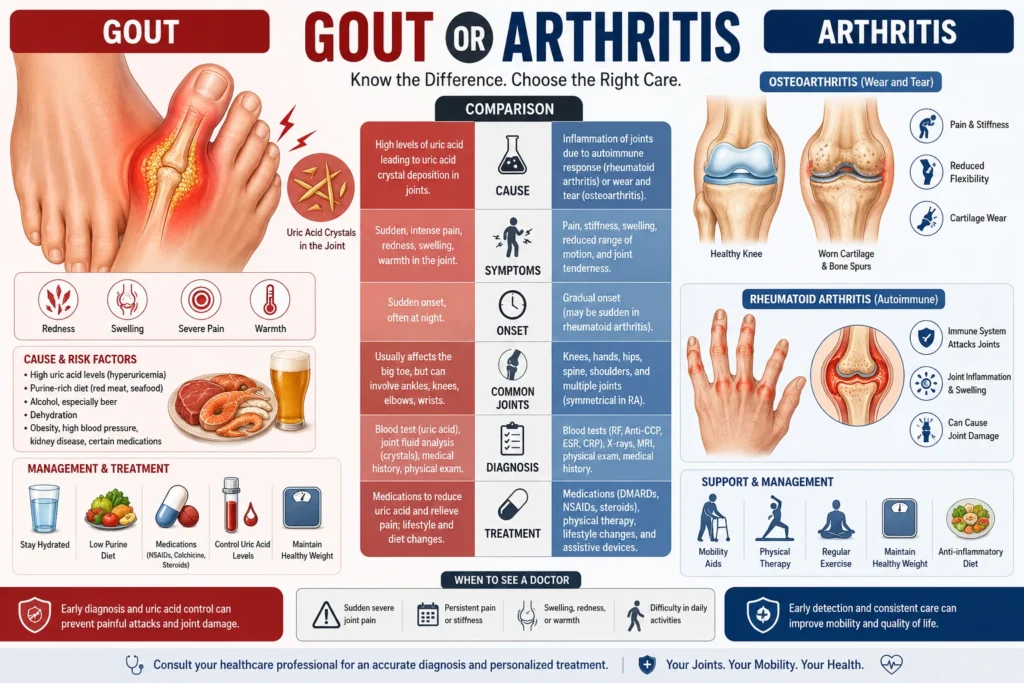
Gout and arthritis are not the same condition, although gout is a specific type of arthritis. Arthritis is a broad term that describes joint inflammation, while gout occurs when uric acid crystals build up in the joints, causing sudden and severe pain. Understanding the difference helps people get the right diagnosis and treatment faster.
Many people hear the terms gout and arthritis and assume they mean the same thing. Both conditions affect the joints. Both can cause pain, swelling, and stiffness. Because of these similarities, it is easy to confuse one with the other.
However, there is an important difference. Arthritis is a general term that covers more than 100 different joint diseases. Gout is one specific type of arthritis caused by high levels of uric acid in the body.
Knowing the difference between gout or arthritis matters because treatment approaches can be very different. A person with gout may need medication to lower uric acid levels, while someone with osteoarthritis may benefit more from exercise, weight management, and pain relief strategies.
This guide explains everything you need to know about gout or arthritis. You will learn how they differ, what symptoms to watch for, what causes them, and how doctors diagnose and treat these conditions. Whether you are experiencing joint pain yourself or helping a loved one, this article provides clear and practical information.
Quick Answer About Gout or Arthritis
The short answer is simple:
| Feature | Gout | Arthritis |
|---|---|---|
| What is it? | A specific type of arthritis | A broad group of joint disorders |
| Main Cause | Uric acid crystal buildup | Various causes depending on type |
| Pain Pattern | Sudden, severe attacks | Often gradual or chronic |
| Common Location | Big toe, foot, ankle | Any joint |
| Swelling | Often intense | Varies by type |
| Treatment | Uric acid management | Depends on arthritis type |
In other words, all gout is arthritis, but not all arthritis is gout.
What Is Arthritis?
Arthritis refers to inflammation or disease affecting one or more joints.
There are over 100 forms of arthritis. Some are caused by wear and tear, while others result from immune system problems or infections.
Common symptoms include:
- Joint pain
- Stiffness
- Swelling
- Reduced movement
- Tenderness
- Warmth around joints
Arthritis can affect people of all ages, although some forms become more common with age.
Common Types of Arthritis
Osteoarthritis
Osteoarthritis is the most common form of arthritis.
It develops when cartilage wears down over time.
Commonly affected joints include:
- Knees
- Hips
- Hands
- Spine
Rheumatoid Arthritis
Rheumatoid arthritis is an autoimmune disease.
The immune system mistakenly attacks healthy joint tissue.
Symptoms often include:
- Joint swelling
- Fatigue
- Morning stiffness
- Symmetrical joint involvement
Psoriatic Arthritis
This condition occurs in some people with psoriasis.
It can affect both skin and joints.
Gout
Gout is also classified as arthritis because it causes inflammation within joints.
What Is Gout?
Gout is a painful inflammatory arthritis caused by excess uric acid in the bloodstream.
When uric acid levels become too high, crystals form and collect inside joints. These sharp crystals trigger sudden inflammation and intense pain.
How Gout Develops
The process usually follows these steps:
- Uric acid levels rise.
- Crystals form in joints.
- The immune system reacts.
- Severe inflammation occurs.
- Pain and swelling develop.
Many people experience attacks without warning.
Common Areas Affected by Gout
Gout frequently affects:
- Big toe
- Ankle
- Foot
- Knee
- Wrist
- Elbow
The big toe is especially common.
Gout or Arthritis: Key Differences Explained
Many symptoms overlap, but important differences exist.
| Characteristic | Gout | Other Common Arthritis Types |
|---|---|---|
| Onset | Sudden | Usually gradual |
| Pain Intensity | Very severe | Mild to severe |
| Attack Duration | Days to weeks | Often ongoing |
| Cause | Uric acid crystals | Wear, immunity, injury, infection |
| Age Group | Often adults over 30 | All ages |
| Trigger Foods | Common | Usually not significant |
| Crystal Formation | Yes | Usually no |
Pain Characteristics
People with gout often describe pain as sudden and unbearable.
Someone may go to bed feeling normal and wake up with a swollen, red, painful toe.
Most forms of arthritis develop more slowly.
Swelling Differences
Gout swelling often appears rapidly and dramatically.
Other arthritis conditions may produce swelling that develops gradually over time.
Symptoms of Gout
Typical gout symptoms include:
- Sudden joint pain
- Extreme tenderness
- Redness
- Swelling
- Warmth
- Difficulty moving the joint
Acute Gout Attack
During an attack, even light pressure from a bedsheet may feel painful.
Symptoms commonly peak within 12 to 24 hours.
Chronic Gout
Untreated gout can become chronic.
Possible complications include:
- Frequent attacks
- Joint damage
- Kidney stones
- Tophi (uric acid deposits under the skin)
Symptoms of Arthritis
Symptoms depend on the specific type.
Common arthritis symptoms include:
- Persistent joint pain
- Morning stiffness
- Reduced flexibility
- Joint swelling
- Fatigue
- Weakness
Osteoarthritis Symptoms
Often include:
- Pain during movement
- Joint grinding
- Reduced range of motion
Rheumatoid Arthritis Symptoms
Often include:
- Symmetrical joint pain
- Fatigue
- Fever
- Prolonged morning stiffness
Causes of Gout
Gout develops when uric acid accumulates.
Risk Factors
Common risk factors include:
- Genetics
- Obesity
- Kidney disease
- High alcohol intake
- High-purine diet
- Diabetes
- High blood pressure
Foods Linked to Gout
Foods rich in purines may increase risk.
Examples include:
- Red meat
- Organ meats
- Sardines
- Anchovies
- Shellfish
Sugary beverages may also contribute.
Causes of Arthritis
The causes vary widely.
Osteoarthritis Causes
- Aging
- Joint injury
- Repetitive stress
- Excess weight
Rheumatoid Arthritis Causes
- Autoimmune dysfunction
- Genetics
- Environmental triggers
Infectious Arthritis Causes
- Bacterial infection
- Viral infection
- Fungal infection
Advantages and Disadvantages of Early Diagnosis
Advantages
| Benefit | Explanation |
|---|---|
| Faster Treatment | Symptoms improve sooner |
| Less Joint Damage | Prevents long-term complications |
| Better Mobility | Preserves joint function |
| Lower Medical Costs | Avoids severe disease progression |
| Improved Quality of Life | Reduces pain and disability |
Disadvantages
There are very few disadvantages to early diagnosis. Possible concerns include:
- Cost of testing
- Time needed for medical visits
- Lifestyle changes that require commitment
Overall, the benefits far outweigh the drawbacks.
How Doctors Diagnose Gout or Arthritis
Diagnosis starts with a medical history and physical examination.
Tests Used for Gout
Doctors may use:
- Blood uric acid testing
- Joint fluid analysis
- Ultrasound
- X-rays
- Dual-energy CT scans
Joint fluid analysis is often considered the most accurate method.
Tests Used for Arthritis
Depending on the type:
- X-rays
- MRI scans
- Blood tests
- Ultrasound
- Physical examination
Why Accurate Diagnosis Matters
A person treated for osteoarthritis may continue suffering if they actually have gout.
Correct diagnosis leads to appropriate treatment and better outcomes.
Treatment Options for Gout
Medications
Doctors commonly prescribe:
- Anti-inflammatory drugs
- Colchicine
- Corticosteroids
- Uric acid lowering medications
Lifestyle Changes
Helpful strategies include:
- Drinking more water
- Limiting alcohol
- Maintaining healthy weight
- Reducing high-purine foods
Long-Term Management
The goal is to keep uric acid levels low enough to prevent crystal formation.
Treatment Options for Arthritis
Treatment depends on the specific form.
Physical Therapy
Physical therapy can:
- Improve movement
- Increase strength
- Reduce pain
Medications
Common options include:
- Pain relievers
- Anti-inflammatory drugs
- Disease-modifying medications
- Biologic therapies
Surgery
Severe cases may require:
- Joint repair
- Joint replacement
Real World Examples of Gout or Arthritis
Example 1: Gout
A 50-year-old man attends a family celebration and consumes large amounts of meat and alcohol.
The next morning, he develops severe pain in his big toe.
Testing reveals elevated uric acid and gout.
Example 2: Osteoarthritis
A 65-year-old woman notices increasing knee pain over several years.
X-rays show cartilage loss consistent with osteoarthritis.
Example 3: Rheumatoid Arthritis
A 40-year-old person experiences swelling in both hands and wrists.
Blood tests confirm rheumatoid arthritis.
These examples show how symptoms and causes differ.
Regional and Global Usage of the Terms
The words gout and arthritis are used worldwide, but prevalence varies.
Gout Around the World
Higher rates often occur in regions with:
- High obesity rates
- Diets rich in meat
- Increased alcohol consumption
Arthritis Around the World
Arthritis affects hundreds of millions of people globally.
Osteoarthritis is the most common form in nearly every country.
Healthcare Awareness
Many countries now focus on:
- Early diagnosis
- Preventive care
- Lifestyle education
- Improved access to treatment
Common Mistakes When Understanding Gout or Arthritis
Mistake: Assuming They Are Identical
Correction: Gout is one specific type of arthritis.
Mistake: Ignoring Sudden Joint Pain
Correction: Sudden severe pain may indicate gout and should be evaluated.
Mistake: Believing Arthritis Only Affects Older Adults
Correction: Many arthritis forms affect younger adults and children.
Mistake: Self Diagnosing
Correction: Proper testing is necessary.
Mistake: Stopping Treatment Too Early
Correction: Long-term management often prevents complications.
Related Concepts and Comparisons
Gout vs Osteoarthritis
| Feature | Gout | Osteoarthritis |
|---|---|---|
| Cause | Uric acid crystals | Cartilage wear |
| Onset | Sudden | Gradual |
| Swelling | Significant | Mild to moderate |
| Age Group | Adults | Often older adults |
Gout vs Rheumatoid Arthritis
| Feature | Gout | Rheumatoid Arthritis |
|---|---|---|
| Cause | Crystals | Autoimmune disease |
| Pattern | Episodic attacks | Chronic inflammation |
| Joint Distribution | Often one joint | Usually multiple joints |
| Blood Markers | Elevated uric acid | Autoimmune markers |
Inflammation and Joint Health
Both gout and arthritis involve inflammation.
Reducing inflammation often improves:
- Pain
- Mobility
- Daily function
- Long-term joint health
Exercises With Answers
Exercise 1
Which statement is correct?
A. Gout and arthritis are exactly the same.
B. Arthritis is a type of gout.
C. Gout is a type of arthritis.
D. Neither affects joints.
Answer: C. Gout is a type of arthritis.
Exercise 2
What causes gout?
A. Cartilage wear
B. Uric acid crystal buildup
C. Bone fractures
D. Muscle strain
Answer: B. Uric acid crystal buildup.
Exercise 3
Which joint is commonly affected first in gout?
A. Shoulder
B. Elbow
C. Big toe
D. Neck
Answer: C. Big toe.
Exercise 4
True or False: Rheumatoid arthritis is an autoimmune disease.
Answer: True.
Exercise 5
Name two lifestyle changes that may help manage gout.
Answer:
- Drink more water
- Reduce high-purine foods
Exercise 6
Which condition usually develops gradually?
A. Acute gout attack
B. Osteoarthritis
Answer: B. Osteoarthritis.
FAQs
Is gout the same as arthritis?
No. Gout is one type of arthritis caused by uric acid crystal buildup in joints.
Which is more painful, gout or arthritis?
Gout attacks are often among the most painful forms of arthritis because symptoms can appear suddenly and intensely.
Can gout become chronic arthritis?
Yes. Untreated gout can lead to chronic joint damage and ongoing arthritis symptoms.
How do doctors tell the difference between gout or arthritis?
Doctors use physical exams, blood tests, imaging studies, and sometimes joint fluid analysis.
Can women get gout?
Yes. Although gout is more common in men, women can develop gout, especially after menopause.
Can arthritis increase gout risk?
Not necessarily. The two conditions have different causes, although a person can have both.
What foods should be avoided with gout?
Many doctors recommend limiting organ meats, shellfish, excessive red meat, and alcohol.
Can exercise help gout or arthritis?
Yes. Appropriate exercise can improve joint health, flexibility, strength, and overall wellness.
Can gout be cured permanently?
Gout can often be controlled very effectively, but ongoing management is usually needed to prevent attacks.
What is the biggest difference between gout or arthritis?
The biggest difference is that gout results from uric acid crystal deposits, while arthritis is a broader category that includes many different joint diseases.
Can gout and osteoarthritis occur together?
Yes. Some individuals experience both conditions at the same time, especially as they age.
Does drinking water help gout?
Adequate hydration may help the body eliminate uric acid more efficiently and reduce gout risk.
Conclusion
Understanding gout or arthritis is important because the terms are related but not identical. Arthritis is a broad category that includes many conditions affecting the joints, while gout is a specific form of inflammatory arthritis caused by uric acid crystal buildup. Although both can cause pain, swelling, and reduced movement, their causes, progression, and treatment approaches differ significantly.
Recognizing the warning signs can help people seek medical care sooner. Sudden and intense joint pain, especially in the big toe, often points toward gout. Gradual stiffness and long-term joint discomfort may indicate another form of arthritis such as osteoarthritis or rheumatoid arthritis.
The best approach is to obtain a professional diagnosis rather than relying on self assessment. Early treatment can reduce pain, prevent complications, and improve quality of life. Healthy eating, regular exercise, proper hydration, weight management, and following medical advice can all support better joint health. By understanding the differences between gout and arthritis, individuals can make informed decisions and take effective steps toward long-term wellness.

Kevin Brooks is a grammar specialist at GramBrix.com, dedicated to helping readers understand language rules with clarity and confidence. He simplifies complex grammar concepts through practical examples and easy explanations.