Last Updated on May 5, 2026
Ticks and fleas are both small parasitic pests that feed on blood, but they differ in biology, behavior, and health risks. tick are slow-feeding arachnids that attach firmly to skin, while flea are fast-moving insects that jump between hosts. Understanding these differences helps in proper identification, treatment, and prevention of infestations in humans and animals.
Ticks vs fleas is a common comparison because both are tiny blood-feeding parasites that affect humans, pets, and wildlife. At first glance, they may seem similar. Both can cause itching, skin irritation, and disease transmission. But they are actually very different in structure, behavior, and risk level.
Many pet owners confuse ticks with fleas, especially when they see small dark bugs on their dogs or cats. This confusion can lead to wrong treatment choices, making the problem worse. For example, flea treatments do not always work on ticks, and tick prevention does not fully stop fleas.
Understanding ticks vs fleas is important for health and safety. These pests can carry diseases like Lyme disease, typhus, and tapeworm infections. They also reproduce quickly and spread easily in homes, gardens, and animal fur.
This guide explains everything in simple language. You will learn how to identify them, how they behave, how they differ, and how to prevent them. Whether you are a pet owner or just curious, this article will give you a complete understanding of ticks vs fleas in a clear and practical way.
Quick Overview of Ticks vs Fleas
What are ticks and fleas?
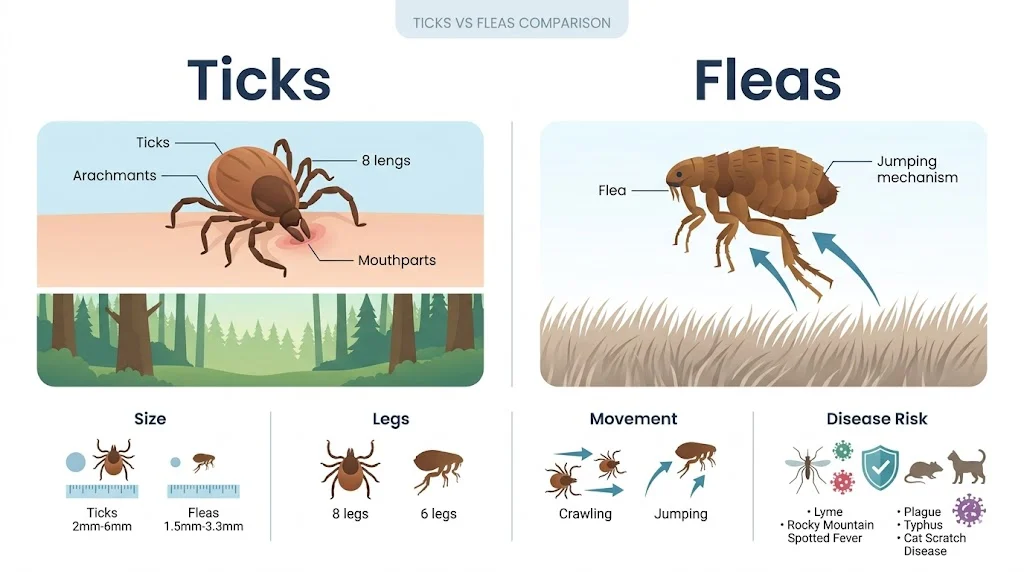
Ticks are arachnids related to spiders and mites. Fleas are insects with strong jumping legs.
Main difference in one line
Ticks attach and feed slowly, while fleas jump, move fast, and bite repeatedly.
Where they live
- Ticks: grass, forests, bushes, animals
- Fleas: carpets, bedding, pets, cracks in floors
How they feed
- Ticks: attach firmly and feed for hours or days
- Fleas: bite quickly and move to another spot or host
Definition and Biological Explanation (Ticks vs Fleas)
Ticks (Parasite Arachnids)
tick are small, blood-feeding creatures that belong to the arachnid family, meaning they are related to spiders. They have eight legs and cannot jump or fly.
Ticks survive by attaching themselves to a host, such as humans, dogs, or wild animals, and feeding slowly on blood. They often remain attached for hours or even days.
There are two main types:
- Hard ticks (common on pets and humans)
- Soft ticks (less common, often found in nests or burrows)
Fleas (Parasitic Insects)
flea are small, wingless insects with six legs. They are famous for their ability to jump long distances compared to their body size.
Fleas live on warm-blooded animals and feed quickly. A flea bite lasts only a short time, but they bite repeatedly, causing itching and irritation.
Ticks vs Fleas Comparison Table
| Feature | Ticks | Fleas |
| Classification | Arachnid | Insect |
| Legs | 8 legs | 6 legs |
| Movement | Slow crawling | Fast jumping |
| Feeding time | Hours to days | Seconds to minutes |
| Attachment | Firmly attached | Do not stay attached |
| Habitat | Grass, bushes | Carpets, pets, bedding |
| Disease risk | Lyme disease, babesiosis | Typhus, tapeworm |
| Visibility | Often visible when engorged | Very small, hard to see |
Life Cycle: Ticks vs Fleas
Tick Life Cycle
Ticks develop in four stages:
- Egg
- Larva
- Nymph
- Adult
At each stage, they need blood to survive and grow.
Flea Life Cycle
Fleas also have four stages:
- Egg
- Larva
- Pupa
- Adult
Flea eggs fall off the host into the environment, making infestations harder to control.
Advantages and Disadvantages (Biological Role)
Even though ticks and fleas are harmful to humans and pets, they play a role in ecosystems.
Ticks
Advantages
- Help control wildlife populations
- Serve as food for birds and small animals
Disadvantages
- Spread dangerous diseases
- Cause anemia in animals
- Hard to remove once attached
Fleas
Advantages
- Part of food chain in ecosystems
- Serve as food for some insects and animals
Disadvantages
- Cause severe itching and allergic reactions
- Spread tapeworms
- Infest homes quickly
Real-World Examples of Ticks vs Fleas
Example 1: Dog infestation
A dog playing in tall grass may pick up ticks. These ticks attach to ears or neck and stay for days.
Fleas, on the other hand, may come from carpets or other animals in the home and cause constant scratching.
Example 2: Human exposure
Hikers in forests often get tick bites. These bites may go unnoticed at first but can lead to illness.
Flea bites usually appear as small red itchy clusters on legs or ankles.
Example 3: Household infestation
Fleas spread rapidly in homes with pets. They lay eggs in carpets and furniture.
Ticks rarely infest homes unless brought in by animals.
Ticks vs Fleas: How to Identify Them
Signs of ticks
- Small round body attached to skin
- Swollen after feeding
- Usually found in hidden areas (ears, neck, armpits)
Signs of fleas
- Small dark jumping insects
- Pets scratching constantly
- Tiny black droppings in fur (“flea dirt”)
Regional and Global Distribution
Ticks
Ticks are common in:
- Forest regions
- Grasslands
- Warm and humid climates
They are highly prevalent in rural and wooded areas worldwide.
Fleas
Fleas are found in:
- Urban homes
- Pet environments
- Warm indoor spaces
They are more common in households than wild environments.
Common Mistakes in Understanding Ticks vs Fleas
Mistake 1: Thinking they are the same
Ticks and fleas are often confused, but they are biologically different.
Mistake 2: Using wrong treatment
Flea shampoo does not always kill ticks, and tick treatments may not stop fleas.
Mistake 3: Ignoring early signs
Small bites are often ignored, allowing infestations to grow.
Mistake 4: Assuming pets are safe indoors
Fleas can survive indoors easily, even without outdoor exposure.
Prevention and Control Methods
For ticks
- Avoid tall grass and bushes
- Use tick repellents
- Check pets after outdoor activity
- Remove ticks carefully with tweezers
For fleas
- Wash bedding regularly
- Vacuum carpets frequently
- Use flea treatments for pets
- Treat home environment
Exercises with Answers (Ticks vs Fleas Learning Practice)
Exercise 1
Which one jumps?
- A) Tick
- B) Flea
Answer: B) Flea
Exercise 2
Which one attaches for long feeding?
- A) Flea
- B) Tick
Answer: B) Tick
Exercise 3
Which one has 8 legs?
- A) Flea
- B) Tick
Answer: B) Tick
Exercise 4
Which one spreads faster in homes?
- A) Tick
- B) Flea
Answer: B) Flea
Exercise 5
Which one is harder to remove from skin?
- A) Flea
- B) Tick
Answer: B) Tick
Related Concepts and Comparisons
Ticks vs mosquitoes
Mosquitoes bite quickly and fly away, unlike ticks that attach for long periods.
Fleas vs bed bugs
Fleas jump and live on pets, while bed bugs hide in mattresses and bite at night.
Ticks vs mites
Mites are microscopic, while ticks are visible to the naked eye.
FAQs
What is the main difference between ticks vs fleas?
Ticks attach firmly and feed slowly, while fleas jump and bite quickly.
Do ticks or fleas spread more diseases?
Ticks generally spread more serious diseases like Lyme disease.
Can fleas live on humans?
Yes, but they prefer animals like cats and dogs.
Can ticks live inside homes?
They rarely survive indoors unless brought in by animals.
Which is harder to control, ticks or fleas?
Fleas are harder to control because they reproduce rapidly in homes.
How do I know if I have ticks or fleas at home?
Ticks are usually found on pets or skin; fleas are seen jumping in carpets or bedding.
Are flea bites dangerous?
They are usually not dangerous but can cause allergic reactions.
How do I remove a tick safely?
Use fine-tipped tweezers and pull slowly without twisting.
Do ticks and fleas die in cold weather?
Cold temperatures reduce activity but may not eliminate them completely.
Can one pet have both ticks and fleas?
Yes, simultaneous infestations are common.
Conclusion
Understanding ticks vs fleas is essential for protecting both human and animal health. While both are blood-feeding parasites, they behave very differently. Ticks attach firmly and feed slowly, often transmitting serious diseases. Fleas move quickly, bite repeatedly, and spread rapidly in homes.
Recognizing their differences helps in choosing the right treatment and prevention methods. Regular pet care, hygiene, and environmental cleaning are key to controlling both pests. Early detection is important to avoid infestations and health risks.
By learning how ticks vs fleas differ, you can better protect your pets, home, and family from discomfort and disease. Proper awareness leads to faster action and more effective control.

Justin Powell is a writer at GramBrix.com who focuses on grammar, clarity and effective communication, helping readers strengthen their language skills.