
Last Updated on August 22, 2026
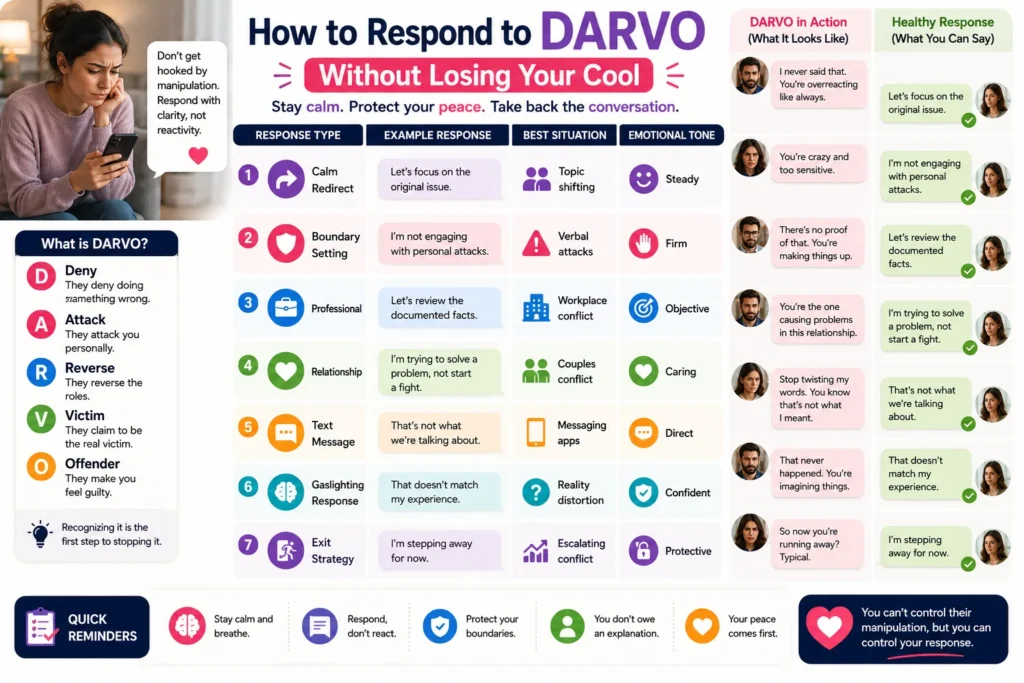
If you’re wondering how to respond to DARVO, the best approach is to stay calm, avoid defending yourself excessively, and redirect the conversation back to the original issue. DARVO stands for Deny, Attack, and Reverse Victim and Offender, a manipulation tactic where someone avoids accountability by making themselves seem like the victim.
Best short responses: “Let’s stay focused on the issue.”, “That’s not what happened.”, “I’m not discussing personal attacks.”, “We can revisit the facts.”, “I’m ending this conversation if it continues this way.”
Have you ever confronted someone about something hurtful, only to end up feeling like you were suddenly the bad guy?
Maybe it happened in a text message. A relationship argument. A family disagreement. Even a workplace conversation.
You bring up a concern, and instead of addressing it, the other person denies what happened, attacks your character, and somehow turns themselves into the victim.
That experience has a name: DARVO.
Understanding how to respond to DARVO can help you protect your confidence, communicate clearly, and avoid getting pulled into endless arguments. The right response is not about winning. It’s about staying grounded, recognizing manipulation, and keeping the conversation focused on reality. In this guide, you’ll find practical responses for different situations, personalities, and relationship dynamics.
What DARVO Means and Why People Use It
“Let’s focus on the original issue.”
Best used when:
Someone is changing the subject to avoid accountability.
Meaning:
This response gently redirects the discussion back to the concern that was originally raised.
“I’m discussing a specific behavior, not attacking you.”
Best used when:
The other person claims you’re personally attacking them.
Meaning:
It separates actions from identity and reduces opportunities for emotional diversion.
“That doesn’t address what I brought up.”
Best used when:
The conversation is being redirected away from the facts.
Meaning:
You calmly point out the avoidance without becoming defensive.
“Can we return to the facts?”
Best used when:
Emotions are escalating and facts are getting lost.
Meaning:
This reinforces objective discussion instead of emotional manipulation.
“I want accountability, not blame.”
Best used when:
Someone accuses you of trying to punish them.
Meaning:
It clarifies your intention and reduces confusion.
Calm Responses to DARVO
“I’m willing to talk when we’re discussing the actual issue.”
Best used when:
The conversation becomes chaotic.
Meaning:
It sets expectations for productive communication.
“I hear your feelings, but my concern still matters.”
Best used when:
The person shifts attention entirely to themselves.
Meaning:
It acknowledges emotions without abandoning your position.
“I’m not arguing about whether my feelings are valid.”
Best used when:
Someone minimizes your experience.
Meaning:
It protects your emotional boundaries.
“Let’s slow down and stick to one topic.”
Best used when:
Multiple accusations are being thrown at you.
Meaning:
It prevents overwhelm and confusion.
“I don’t want to debate reality.”
Best used when:
Clear facts are being denied.
Meaning:
It signals that manipulation will not change what happened.
Firm Boundary-Setting Responses
“I’m not engaging with personal attacks.”
Best used when:
The attack phase of DARVO begins.
Meaning:
It immediately identifies unacceptable behavior.
“This conversation isn’t productive right now.”
Best used when:
Discussion becomes circular.
Meaning:
It creates space and protects your mental energy.
“I’m ending this discussion if the attacks continue.”
Best used when:
You need a stronger boundary.
Meaning:
It communicates consequences clearly.
“Respect is required if we’re going to continue.”
Best used when:
The tone becomes hostile.
Meaning:
It reinforces healthy communication standards.
“I’m stepping away for now.”
Best used when:
You need emotional distance.
Meaning:
It prioritizes self-protection over winning the argument.
Professional Responses to DARVO at Work
“Let’s review the documented facts.”
Best used when:
Workplace accountability is involved.
Meaning:
Documentation often reduces manipulation opportunities.
“I’d like to focus on the issue rather than individuals.”
Best used when:
Conversations become personal.
Meaning:
It keeps discussions professional.
“Can we return to the original concern?”
Best used when:
Meetings get sidetracked.
Meaning:
It encourages productive problem-solving.
“Let’s keep the discussion objective.”
Best used when:
Emotional reactions dominate the conversation.
Meaning:
It redirects attention to evidence.
“I’d prefer to communicate through documented channels.”
Best used when:
Repeated manipulation occurs.
Meaning:
It creates accountability and transparency.
Responses for Romantic Relationships
“I’m trying to solve a problem, not start a fight.”
Best used when:
Your partner becomes defensive.
Meaning:
It lowers tension while staying focused.
“Both of our feelings matter here.”
Best used when:
The conversation becomes one-sided.
Meaning:
It promotes balance and mutual respect.
“I’m asking for understanding, not perfection.”
Best used when:
The issue is framed as an attack.
Meaning:
It encourages healthy vulnerability.
“Please address what I’m saying directly.”
Best used when:
Topics keep getting changed.
Meaning:
It encourages accountability.
“I need us to talk honestly about this.”
Best used when:
Avoidance is becoming a pattern.
Meaning:
It reinforces emotional honesty.
Responses for Family Conversations
“That’s not the concern I’m raising.”
Best used when:
Family members deflect responsibility.
Meaning:
It gently redirects the discussion.
“We can discuss your concerns afterward.”
Best used when:
Someone immediately changes the topic.
Meaning:
It keeps conversations organized and fair.
“I’d appreciate staying focused on this issue first.”
Best used when:
The discussion becomes scattered.
Meaning:
It prevents derailment.
“My perspective deserves consideration too.”
Best used when:
Your experience is being dismissed.
Meaning:
It reinforces self-respect.
“I don’t want this to become a blame game.”
Best used when:
Conflict is escalating.
Meaning:
It encourages healthier dialogue.
Responses to Gaslighting Within DARVO
“My memory of this situation is clear.”
Best used when:
Someone tries to rewrite events.
Meaning:
It demonstrates confidence in your experience.
“We remember this differently.”
Best used when:
Facts are disputed.
Meaning:
It avoids arguing while maintaining your perspective.
“I trust my understanding of what happened.”
Best used when:
You’re being pressured to doubt yourself.
Meaning:
It reinforces self-confidence.
“That version doesn’t match my experience.”
Best used when:
Reality is being distorted.
Meaning:
It calmly rejects false narratives.
“I don’t agree with that characterization.”
Best used when:
Your intentions are being misrepresented.
Meaning:
It creates a clear correction without escalating conflict.
Confident Responses That Shut Down Manipulation
“I’m comfortable standing by what I said.”
Best used when:
You’re being pressured to back down.
Meaning:
It communicates certainty.
“I’m not responsible for managing your reaction.”
Best used when:
Someone blames you for their emotions.
Meaning:
It reinforces emotional boundaries.
“I can be respectful without agreeing.”
Best used when:
Agreement is being demanded.
Meaning:
It separates respect from compliance.
“I’m not changing the subject.”
Best used when:
The conversation is being redirected.
Meaning:
It demonstrates focus and confidence.
“The issue remains unresolved.”
Best used when:
The discussion is being avoided.
Meaning:
It keeps accountability visible.
Text Message Responses to DARVO
“That’s not what we’re talking about.”
Best used when:
A text conversation goes off track.
Meaning:
Short, direct, and effective.
“Please answer the concern I raised.”
Best used when:
Questions are being ignored.
Meaning:
It redirects attention immediately.
“I’m not discussing insults.”
Best used when:
Texts become hostile.
Meaning:
It establishes boundaries quickly.
“Let’s stick to the facts.”
Best used when:
Emotions are replacing reality.
Meaning:
It keeps the exchange grounded.
“We can continue when the conversation is respectful.”
Best used when:
You need to pause the interaction.
Meaning:
It protects your emotional well-being.
Responses for Online Arguments and Social Media
“That’s a different issue entirely.”
Best used when:
Someone introduces unrelated accusations.
Meaning:
It identifies deflection clearly.
“Let’s stay on topic.”
Best used when:
Comment threads become chaotic.
Meaning:
It encourages productive discussion.
“I addressed the point you raised.”
Best used when:
Someone pretends their concerns were ignored.
Meaning:
It reinforces clarity.
“Personal attacks don’t strengthen an argument.”
Best used when:
Discussion turns hostile.
Meaning:
It highlights weak reasoning.
“The facts remain the same.”
Best used when:
Narratives are being manipulated.
Meaning:
It calmly centers reality.
Responses to Repeat Offenders
“We’ve had this conversation before.”
Best used when:
The pattern keeps repeating.
Meaning:
It identifies recurring behavior.
“I’m noticing the same cycle again.”
Best used when:
DARVO has become predictable.
Meaning:
It raises awareness without hostility.
“The pattern is part of the problem.”
Best used when:
Accountability is consistently avoided.
Meaning:
It focuses on behavior trends.
“Nothing changes if we avoid the issue.”
Best used when:
Progress is impossible.
Meaning:
It emphasizes responsibility.
“I won’t continue this cycle.”
Best used when:
Strong boundaries are necessary.
Meaning:
It prioritizes your well-being.
Responses You Should Avoid
“Fine, maybe it’s all my fault.”
Best used when:
Never.
Meaning:
This reinforces manipulation and undermines your confidence.
“You’re right, forget it.”
Best used when:
Never as a pressured response.
Meaning:
It may encourage future avoidance.
“Let me explain myself again.”
Best used when:
Use cautiously.
Meaning:
Excessive defending often fuels DARVO.
“Why are you doing this to me?”
Best used when:
Avoid in heated moments.
Meaning:
It can create further emotional escalation.
“I just want you to admit everything.”
Best used when:
Rarely.
Meaning:
It often triggers more defensiveness.
Communication Psychology Behind Effective DARVO Responses
“I understand you’re upset.”
Best used when:
Emotions are high.
Meaning:
Validation can lower defensiveness without surrendering your position.
“That doesn’t change the issue.”
Best used when:
Deflection occurs.
Meaning:
It separates emotion from accountability.
“Let’s focus on solutions.”
Best used when:
Arguments become repetitive.
Meaning:
It shifts attention toward progress.
“I’m listening, and I still have concerns.”
Best used when:
The other person demands complete agreement.
Meaning:
It balances empathy and self-respect.
“Both accountability and understanding matter.”
Best used when:
The conversation becomes polarized.
Meaning:
It encourages healthier conflict resolution.
People Also Ask
What is the best response to DARVO?
The best response to DARVO is calm, direct, and focused on the original issue. Avoid excessive defending, refuse personal attacks, and redirect the conversation back to facts and accountability. Strong boundaries often work better than long explanations.
How do you know if someone is using DARVO?
You may be experiencing DARVO when someone denies wrongdoing, attacks you for bringing up the issue, and then presents themselves as the victim. The conversation often leaves you confused, guilty, or questioning your own reality.
Should you argue with someone using DARVO?
Usually, arguing extensively is ineffective. People using DARVO often shift topics and create emotional distractions. Clear boundaries, concise responses, and focusing on facts are generally more productive.
Is DARVO considered emotional manipulation?
Yes, DARVO is widely recognized as a form of emotional manipulation. It can make the other person doubt themselves, feel guilty, or become distracted from the original concern being discussed.
How do you respond to DARVO in a relationship?
In relationships, respond calmly, avoid getting defensive, and restate your concern clearly. Healthy partners eventually engage with the issue, while persistent DARVO may indicate deeper communication problems.
Can DARVO happen in the workplace?
Yes. DARVO can appear in professional settings when someone avoids responsibility by denying mistakes, attacking colleagues, or portraying themselves as unfairly targeted. Documentation and objective communication are especially helpful at work.
Conclusion
Knowing how to respond to DARVO is less about finding the perfect comeback and more about staying grounded when someone tries to shift blame, rewrite events, or avoid accountability. The strongest responses are usually calm, clear, and focused on the original issue. Whether you’re dealing with a partner, family member, coworker, or online conversation, boundaries and emotional awareness matter. Remember that you don’t have to defend your reality endlessly. Sometimes the most powerful response is simply refusing to get pulled into the cycle. Clear communication, self-respect, and confidence are often your best tools.

Kevin Brooks is a grammar specialist at GramBrix.com, dedicated to helping readers understand language rules with clarity and confidence. He simplifies complex grammar concepts through practical examples and easy explanations.