Last Updated on August 23, 2026
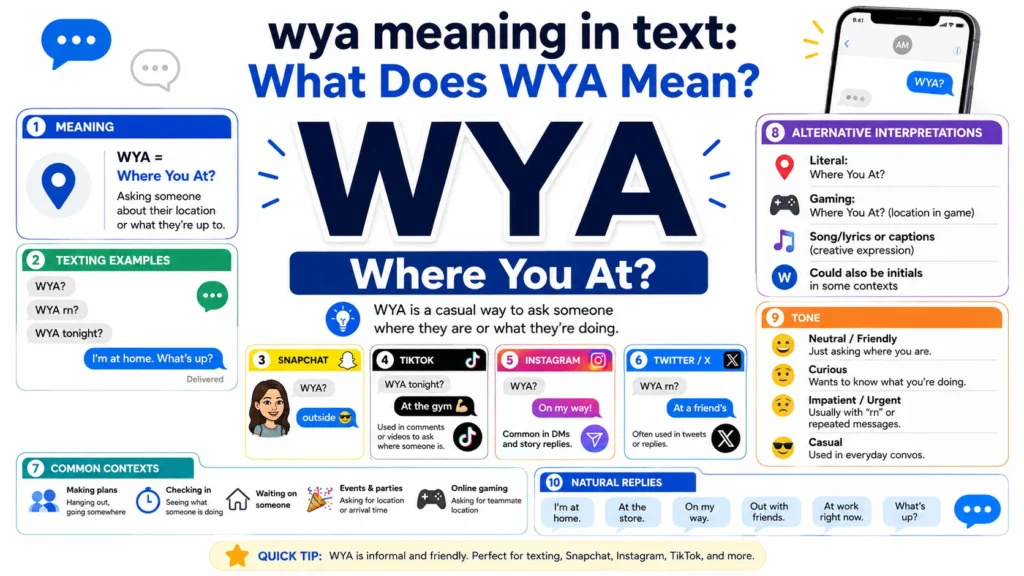
WYA means “Where You At?” in texting and social media. People use it to ask someone where they are, what they are doing, or whether they are available. It commonly appears in casual texts, Snapchat, TikTok, and Instagram conversations.
wya meaning in text usually refers to the casual question “Where you at?” People use it when they want to know someone’s current location or availability. However, the phrase does not always ask for an exact physical address.
Depending on the conversation, WYA can mean “Where are you?” or “Where are you at right now?” It can also carry a social meaning, such as asking whether someone wants to meet.
For example, a friend might text, “WYA?” when they are already outside. Someone might send “wya tonight?” to ask about your plans. Likewise, a person on Snapchat may use “WYA 👀” when they want to know where you are hanging out.
The abbreviation saves time and fits the fast style of digital communication. Therefore, it appears frequently in texting, Snapchat messages, Instagram DMs, TikTok comments, and other casual conversations.
Importantly, the tone depends on context. A simple “WYA?” can sound friendly. In another situation, it can sound impatient, concerned, flirtatious, or even confrontational.
This guide explains the phrase from every important angle. You will learn its meaning, tone, platform usage, variations, common misunderstandings, examples, and natural responses.
QUICK ANSWER BOX
| Meaning | Context | Primary Platforms | Example | Tone |
|---|---|---|---|---|
| Where you at? | Asking where someone is | Texting, Snapchat, Instagram | “WYA?” | Casual |
| Where are you? | Checking someone’s location | Text messages | “WYA rn?” | Friendly |
| Are you around? | Checking availability | Social media and texting | “WYA tonight?” | Casual |
| Where are you hanging out? | Asking about plans | Snapchat, Instagram | “WYA 👀” | Curious or playful |
What Does wya meaning in text Mean?
WYA is a texting abbreviation for “Where you at?” In standard English, “Where are you?” would be more grammatically conventional. However, “Where you at?” has become a familiar informal expression in spoken English and online communication.
The abbreviation simply removes the longer wording. As a result, “Where you at?” becomes “WYA?”
People normally use it when they want a quick answer. The question can refer to location, plans, availability, or social activity.
The basic definition
At its simplest, WYA asks:
Where are you?
For example:
“WYA?”
A natural response could be:
“I’m at home.”
However, the intended meaning can change with additional words.
| Message | Likely meaning |
|---|---|
| “WYA?” | Where are you? |
| “WYA rn?” | Where are you right now? |
| “WYA tonight?” | What are your plans tonight? |
| “WYA at the party?” | Where are you at the party? |
| “WYA 👀” | Where are you? I am curious or looking for you. |
| “WYA bro?” | Where are you, bro? |
The phrase therefore works as a flexible social question rather than a strict request for coordinates.
Why people shorten the phrase
Texting rewards speed and convenience. Therefore, users often shorten familiar phrases into compact abbreviations.
WYA works particularly well because its meaning remains obvious to most people familiar with online slang. The three letters can replace a complete sentence without creating much ambiguity.
Other examples include:
| Abbreviation | Meaning |
|---|---|
| WYD | What you doing? |
| WYF | Where you from? |
| WTW | What’s the word? or What’s the move? |
| WBU | What about you? |
| HBU | How about you? |
| LMK | Let me know |
| RN | Right now |
WYA belongs to this larger group of conversational internet abbreviations.
Where the phrase comes from
The exact abbreviation does not have one universally documented creator. Instead, it developed naturally from informal speech and digital communication.
The underlying phrase “where you at?” has existed in casual spoken English for a long time. Online communities then shortened it into WYA.
Consequently, the abbreviation became especially useful on mobile devices and social platforms where users often communicate quickly.
It is best understood as internet shorthand rather than a formal English expression.
Contextual Dynamics & Nuances of the Term
The meaning becomes clearer when you examine the surrounding conversation. A standalone “WYA?” usually asks about location. However, the same letters can communicate several different intentions.
Location checking
This is the most direct use.
“WYA?”
The sender probably wants to know where you currently are.
For example, two friends might meet at a large event. One person cannot find the other. They send “WYA?” to locate them.
A natural response would be:
“Near the entrance.”
Availability checking
Sometimes the question indirectly means “Are you free?”
Consider:
“WYA later?”
The sender may not care about your current location. Instead, they want to know where you will be or whether you are available to meet.
Similarly:
“WYA tonight?”
could mean:
“What are you doing tonight?”
The answer might therefore describe plans rather than a physical location.
Social invitation
WYA can also start an invitation.
For example:
“WYA? We’re getting food.”
The first question establishes location. The second sentence explains why the sender wants to know.
The implied message may be:
“Where are you? Do you want to join us?”
Flirty usage
The abbreviation can also appear in romantic or flirtatious conversations.
For example:
“WYA 👀”
The eyes emoji can add curiosity or playful interest.
Another example:
“WYA? I miss you.”
Here, the phrase carries more emotional weight than a basic location question.
Concern or urgency
Tone can change dramatically in a serious situation.
For example:
“WYA?? Please answer.”
The repeated question marks and added sentence suggest urgency.
Therefore, punctuation matters. The abbreviation itself does not determine the emotional tone.
Confrontational usage
WYA can occasionally sound aggressive.
For example:
“WYA? You said you were coming.”
The sender may be frustrated because the other person has not arrived.
Thus, context matters more than the three letters themselves.
Real Life Conversation Examples Using wya meaning in text
The best way to understand online slang is to see it in realistic conversations. The following examples show how the same abbreviation can carry different intentions.
Example 1: Friends meeting up
Alex: WYA?
Jordan: I’m outside the coffee shop.
Alex: Oh, I’m coming. Give me two minutes.
Here, the question has a simple location based meaning. Alex wants to find Jordan.
Example 2: Making evening plans
Maya: WYA tonight?
Chris: Probably home. Why?
Maya: A few of us are going downtown. Wanna come?
In this conversation, WYA does not necessarily ask for Chris’s current location. Instead, it asks about his plans.
Example 3: Snapchat conversation
Sam: WYA 👀
Taylor: At the mall lol.
Sam: No way. I’m here too.
Taylor: What store?
The message begins a spontaneous social interaction. The sender wants to discover where the other person is.
Example 4: Romantic conversation
Nina: WYA?
Evan: At my place.
Nina: I was hoping you’d say that 😂
Here, the abbreviation is straightforward, but the response gives it a flirtatious context.
Example 5: Frustrated conversation
Marcus: WYA?
Dylan: Five minutes away.
Marcus: You said that twenty minutes ago 😭
The same abbreviation now carries frustration. Therefore, readers should consider the conversation rather than interpreting WYA in isolation.
Platform Specific Breakdown
Different platforms encourage slightly different styles of slang. WYA generally keeps the same core meaning across platforms. However, the surrounding tone can change.
How It Is Used on Snapchat
Snapchat encourages quick, informal communication. Therefore, WYA fits naturally into snaps and chats.
A user might send:
“WYA?”
after seeing a friend’s story.
They might also combine the abbreviation with an emoji:
“WYA 👀”
or:
“WYA rn?”
The added “rn” means “right now.” Consequently, the question becomes more specific.
Snapchat users may also use WYA when coordinating meetups. For example:
“WYA? We’re by the courts.”
This message probably means the sender wants the recipient to join them.
Because Snapchat conversations are usually casual, there is rarely a need for formal punctuation or complete sentences.
The Role of wya meaning in text on TikTok
TikTok uses slang differently from private messaging because comments can become public conversations.
Someone might write WYA under a creator’s video when they want to know where an event happened. However, the phrase can also appear in captions, direct messages, or comments between friends.
For example:
“WYA in this video?”
could ask about the location shown in a clip.
A friend might also comment:
“WYA 😭”
after seeing a video that suggests an inside joke or shared situation.
TikTok also spreads slang quickly. A phrase that begins in texting can move into comments and short form content.
However, context remains essential. WYA does not automatically have a special TikTok definition. Its core meaning remains “Where you at?” unless the surrounding content gives it another interpretation.
Instagram and Texting Dynamics
Instagram DMs operate much like ordinary texting. Friends may use WYA to coordinate plans, ask about location, or start a conversation.
For example:
“WYA this weekend?”
could mean:
“What are you doing this weekend?”
Meanwhile:
“WYA rn?”
usually asks about someone’s current location.
Text messages work in much the same way. The abbreviation is especially common between friends, classmates, couples, and people who already have an informal relationship.
It is less appropriate in formal communication. For example, you would normally avoid WYA in a professional email to a manager or client.
Platform comparison
| Platform | Common use | Typical tone |
|---|---|---|
| Snapchat | Finding friends | Very casual |
| TikTok | Comments, DMs, location questions | Casual or playful |
| DMs and social planning | Casual | |
| Text messages | Location and availability | Casual |
| Group chats | Coordinating plans | Casual and direct |
| Professional email | Rarely appropriate | Too informal |
Alternative Meanings & NLP Variations of the Phrase
Although WYA most commonly means “Where you at?”, online abbreviations can sometimes develop secondary interpretations.
The exact meaning depends on the community, conversation, and surrounding words. Therefore, context should always take priority over a generic slang dictionary.
Common variations
People often modify WYA by adding another abbreviation.
| Phrase | Meaning |
|---|---|
| WYA rn? | Where are you right now? |
| WYA at? | Where are you at? |
| WYA tonight? | What are your plans tonight? |
| WYA today? | Where are you today? |
| WYA 👀 | Where are you? with curiosity or playful interest |
| WYA tho? | Where are you, though? |
| WYA lol | Where are you? with a relaxed tone |
WYA versus WYD
These two abbreviations can look similar, but they ask different questions.
WYA generally asks about location.
WYD generally asks what someone is doing.
Compare:
“WYA?”
Possible answer:
“At home.”
Now compare:
“WYD?”
Possible answer:
“Watching a movie.”
The distinction becomes less clear when people discuss plans.
For example:
“WYA tonight?”
can indirectly ask what someone plans to do.
WYA versus WYF
WYF usually means “Where you from?”
That question asks about someone’s background or hometown. WYA normally asks about their current location.
| Slang | Common meaning |
|---|---|
| WYA | Where you at? |
| WYF | Where you from? |
| WYD | What you doing? |
| WTW | What’s the word? or What’s the move? |
These abbreviations may appear together in a conversation.
For example:
“WYA?”
“At home.”
“WYF again?”
“Chicago.”
The first asks about current location. The second asks about origin.
NLP and semantic interpretation
From a language processing perspective, WYA contains three important concepts:
Question intent: The sender wants information.
Location or availability: The expected answer concerns where someone is or what they are doing.
Informal register: The abbreviation signals casual communication.
A language model or search engine should therefore interpret the surrounding words before assigning a fixed meaning.
For example, “WYA tonight?” has a different practical intent from “WYA rn?”
Both relate to location, but the first can refer to future plans while the second points to the present.
Misinterpretations: When NOT to Use wya meaning in text
WYA is easy to understand in casual settings. However, it can create problems when used with the wrong audience.
Avoid it in formal professional communication
A work email might say:
“Where are you currently located?”
rather than:
“WYA?”
The formal version sounds clearer and more professional.
Likewise, a manager might prefer:
“Are you available for the meeting?”
instead of:
“WYA?”
The issue is not that WYA is incorrect. The issue is register.
Do not assume it always asks for an exact location
Someone who says WYA may simply want to know whether you are available.
For example:
“WYA tonight?”
does not necessarily require an address.
A response such as:
“Probably staying home.”
may answer the intended question perfectly.
Be careful with unfamiliar people
If someone you barely know sends WYA, the message may feel intrusive.
You do not have to provide your exact location.
A safer casual response could be:
“I’m out right now. What’s up?”
This gives the sender useful information without revealing a precise location.
Avoid overinterpreting the tone
A short message can look colder than intended.
For example:
“WYA.”
may seem demanding because it lacks punctuation that softens the message.
However, the sender may simply type quickly.
Therefore, do not automatically assume anger, flirting, or urgency from the abbreviation alone.
How to Respond in Chat Comfortably
The best response depends on what the sender actually wants.
If they want your location, give a general location when comfortable.
If they appear to be making plans, explain what you are doing.
If you do not want to share your location, redirect the conversation.
Simple responses
“I’m at home.”
“At the mall rn.”
“Just got back home.”
“I’m downtown.”
These responses work when the conversation is casual.
When you are not sure why they asked
You can reply:
“I’m at home. What’s up?”
This answers the question and invites the sender to explain their reason.
Another option is:
“Out with friends. Why?”
This keeps the conversation natural.
When you want to meet
You could say:
“I’m downtown. You?”
Or:
“Near the park. Wanna meet?”
This turns a location question into a practical conversation.
When you cannot share your location
You can stay general.
“I’m out right now.”
Or:
“Not far from home. What’s up?”
You do not need to give a precise address or live location simply because someone asks.
When the message feels flirty
If you like the person, you can respond playfully.
“Why, you looking for me? 👀”
Or:
“Take a guess 😂”
If you do not want to encourage the tone, use a neutral answer.
“I’m at home. What do you need?”
The response should match your comfort level.
Response guide
| Their message | Natural response |
|---|---|
| “WYA?” | “At home.” |
| “WYA rn?” | “Downtown right now.” |
| “WYA tonight?” | “Probably staying in.” |
| “WYA 👀” | “Why, what’s up? 👀” |
| “WYA? We’re outside.” | “Coming now.” |
| “WYA??” | “I’m on my way.” |
FAQs
What does wya meaning in text stand for?
WYA stands for “Where you at?” It usually asks where someone is. Depending on context, it can also ask about plans or availability.
Is WYA the same as “where are you?”
Yes, in most casual conversations. WYA is simply a shorter, informal version of asking someone where they are.
What does WYA mean from a girl?
The meaning does not automatically change based on who sends it. A girl sending WYA may simply want to know your location. Context can make the message friendly, curious, romantic, or practical.
What does WYA mean from a guy?
Likewise, a guy using WYA usually asks where you are. The surrounding conversation determines whether he is checking your location, making plans, or showing interest.
Is WYA rude?
Not usually. It is a casual abbreviation. However, punctuation and context can make it sound impatient or demanding.
For example, “WYA?” sounds neutral. “WYA???” may sound more urgent.
What does WYA mean on Snapchat?
On Snapchat, WYA normally means “Where you at?” Friends may use it to find each other, ask about plans, or respond to a story.
What is the difference between WYA and WYD?
WYA usually asks where someone is. WYD usually asks what someone is doing.
For example, “WYA?” can receive “At the gym.” Meanwhile, “WYD?” can receive “Working out.”
How should I answer WYA?
Answer based on the situation. You can provide a general location, explain your plans, ask why they want to know, or keep your location private.
Can WYA be flirtatious?
Yes. The abbreviation itself is neutral, but context can make it flirtatious. Emojis, previous messages, and the relationship between the people involved all influence the tone.
Is WYA appropriate for professional messages?
Generally, no. WYA is strongly associated with casual digital communication. Professional messages should normally use clearer wording such as “Where are you?” or “Are you available?”
Conclusion
WYA is a simple example of how digital communication transforms everyday language. Three letters can replace a complete question while still communicating a clear social intention.
The phrase usually means “Where you at?” However, the practical meaning can shift based on context. Someone may ask about your current location, future plans, availability, or interest in meeting.
The platform can also influence the tone. Snapchat often uses it for quick friend coordination. Instagram uses it naturally in DMs. TikTok can bring it into comments and public conversations. Traditional texting remains one of its most common environments.
Understanding WYA therefore requires more than memorizing a definition. You should consider the sender, surrounding words, punctuation, emojis, relationship, and situation.
Most importantly, do not overthink a simple message. If someone sends “WYA?”, the safest interpretation is usually that they want to know where you are or what you are up to.
When the intention is unclear, a response such as “I’m at home. What’s up?” keeps the conversation easy and gives the sender an opportunity to explain.
As internet language continues to evolve, abbreviations like WYA show how people prioritize speed, context, and social connection in modern digital conversations.

Kevin Brooks is a grammar specialist at GramBrix.com, dedicated to helping readers understand language rules with clarity and confidence. He simplifies complex grammar concepts through practical examples and easy explanations.