Last Updated on August 23, 2026
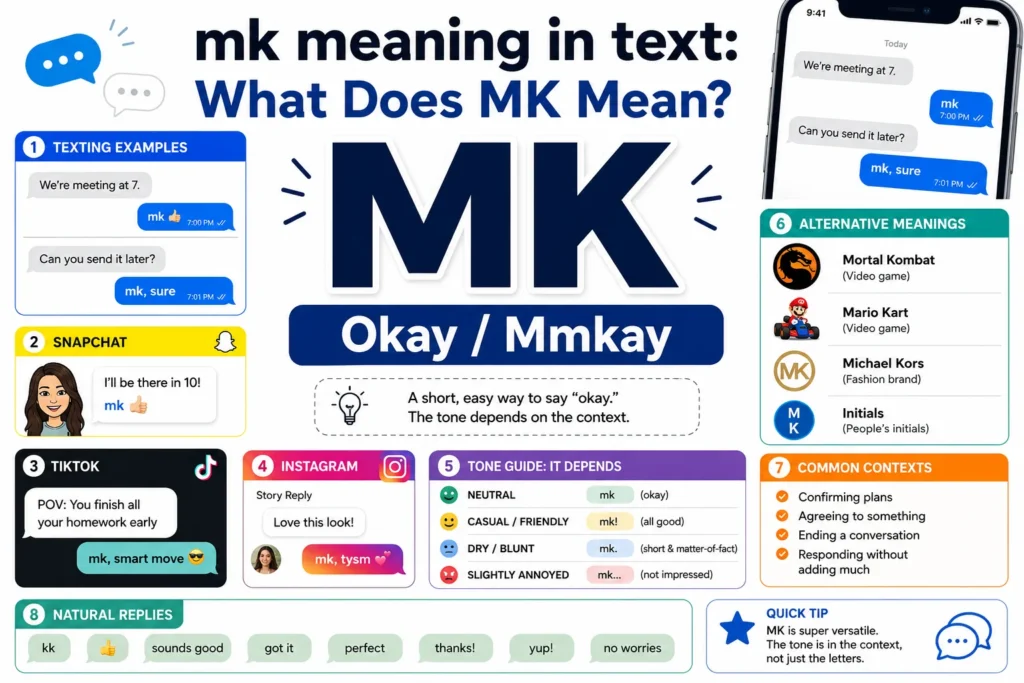
MK usually means “okay,” “mmkay,” or “I understand” in text messages. It is an informal acknowledgment. Depending on context, it can sound neutral, casual, hesitant, dismissive, or slightly sarcastic.
mk meaning in text is usually simple, but the tone can be surprisingly complicated. In most casual conversations, mk means “okay,” “alright,” or “I understand.” It works as a quick acknowledgment when someone wants to confirm a message without typing a full response.
However, the emotional meaning depends on context. A friend might send “mk” and mean nothing more than “okay.” Someone else might use the same two letters after an argument. In that situation, the reply may feel cold or dismissive.
Therefore, you should read the surrounding conversation before deciding what the sender intended. The relationship between both people also matters.
The spelling can appear as mk, MK, Mk, mkay, mmkay, or m’kay. These forms connect to the informal spoken expression “m’kay,” which dictionaries define as an informal form of “OK.”
This guide explains the meaning, tone, platform use, alternatives, common misunderstandings, and natural responses.
Quick Answer Box
| Meaning | Context | Primary Platforms | Example | Tone |
|---|---|---|---|---|
| Okay | Agreement or acknowledgment | Texting, Snapchat | “We meet at 7.” “mk” | Neutral |
| I understand | Confirming information | DMs, group chats | “Send it later.” “mk” | Casual |
| Alright | Accepting a suggestion | Instagram, texting | “Let’s go tomorrow.” “mk” | Relaxed |
| Fine | Reluctant agreement | Personal chats | “Please stop.” “mk” | Potentially annoyed |
| Got it | Ending a topic | Social media chats | “I already explained it.” “mk” | Dry |
What Does mk meaning in text Mean?
The most common interpretation is “okay” or “mmkay.” It acts as a short acknowledgment.
For example:
“I’ll call you after dinner.”
“mk”
Here, the sender probably means, “Okay, sounds good.”
However, the same reply can carry a different feeling:
“I already told you not to do that.”
“mk”
Now it may sound irritated or reluctant.
That difference comes from pragmatics, which refers to how context changes the meaning of language. Digital communication makes pragmatics especially important because text removes vocal tone, facial expressions, and body language.
The abbreviation itself does not automatically mean someone is angry.
That is an important distinction.
The Basic Definition
In everyday American texting, mk meaning in text generally points to one of these interpretations:
- Okay
- Alright
- I understand
- Got it
- Fine
- I acknowledge your message
Most of the time, the sender does not intend anything complicated.
The word simply saves time.
Why People Type MK Instead of Okay
Texting encourages speed and efficiency. People often shorten familiar expressions because the meaning remains obvious.
For example, someone might type:
“mk, see you soon”
instead of:
“Okay, see you soon.”
The shorter version feels more casual.
It can also sound more conversational because mk resembles the spoken “mmkay.” The expression “m’kay” is recognized as an informal form of “OK,” and its alternate spellings include “mkay,” “mmkay,” and “mk.”
Is MK the Same as OK?
Not exactly.
Both expressions can communicate agreement. However, they can create different impressions.
| Reply | Common impression |
|---|---|
| Okay | Clear and neutral |
| OK | Direct and neutral |
| Mk | Casual and slightly flat |
| Mmkay | Casual, playful, or slightly skeptical |
| K | Very brief and potentially cold |
| Sounds good | Friendly and positive |
| Got it | Clear and cooperative |
| Sure | Accepting, but context matters |
Consequently, mk often sits somewhere between friendly agreement and emotional neutrality.
The surrounding words determine which side it falls on.
Contextual Dynamics and Nuances of the Term
Digital slang rarely operates like a traditional dictionary entry. Meaning changes according to timing, punctuation, relationship, and conversation history.
That is why two people can receive the exact same reply and interpret it differently.
Neutral Acknowledgment
The most straightforward use is simple acknowledgment.
“The meeting starts at 3.”
“mk”
This usually means:
“Okay, I understand.”
There is no obvious negative emotion.
Casual Agreement
Someone can also use the abbreviation to accept a plan.
“Want to grab coffee after class?”
“mk”
The sender is probably agreeing.
Still, mk does not express strong excitement. If the person wanted to show enthusiasm, they might say:
“Absolutely!”
or:
“Yeah, sounds good!”
Reluctant Agreement
Sometimes the sender accepts something without sounding happy about it.
“Can you clean your room before you go out?”
“mk”
Here, the response may communicate:
“Fine, I’ll do it.”
The context creates the reluctant feeling.
Conversation Closure
The abbreviation can also close a topic.
“I’m heading to bed.”
“mk, night”
This use is generally harmless.
However, replying with only “mk” after an emotional message may feel much colder.
Dry or Dismissive Tone
A one word response can appear dismissive when the previous message required more emotional engagement.
For example:
“I’m really upset about what happened today.”
“mk”
The sender may not intend to be rude. Still, the recipient could reasonably perceive the reply as uncaring.
Therefore, context matters more than the abbreviation alone.
Punctuation Changes the Feeling
Compare these examples:
| Message | Possible feeling |
|---|---|
| mk | Neutral or dry |
| mk! | More energetic |
| mk 🙂 | Friendly |
| mk lol | Playful |
| mkk | Relaxed or playful |
| mmmkay | Playful or skeptical |
| MK. | More firm or abrupt |
These are not fixed rules.
Instead, they are common conversational signals.
Real Life Conversation Examples Using mk meaning in text
The best way to understand the expression is to see how it works in realistic conversations.
Example 1: Confirming Plans
Alex: We’re meeting at the mall at 6.
Jordan: mk
Alex: Cool, see you then.
Here, the response simply confirms the plan.
There is no obvious tension.
Example 2: Accepting a Request
Maya: Can you send me the notes tonight?
Chris: mk
Maya: Thanks!
In this situation, the reply means something close to “Sure” or “Okay.”
The short response works because the request is straightforward.
Example 3: Possible Irritation
Sam: Please don’t tell everyone what I said.
Taylor: mk
Sam: I’m serious.
Here, the reply could sound reluctant.
Still, you cannot prove that Taylor is annoyed from “mk” alone.
The surrounding conversation provides the clue.
Example 4: Ending a Conversation
Ava: I have to finish my homework.
Liam: mk, talk later
Ava: Bye!
This use is casual and normal.
The added words make the response warmer.
Example 5: Emotional Context
Nina: I feel like you’ve been ignoring me lately.
Ryan: mk
Nina: What does that mean?
This is where the abbreviation becomes ambiguous.
Ryan might mean “I understand.” He might also feel uncomfortable and not know what to say.
Therefore, Nina should ask for clarification rather than immediately assuming hostility.
Platform Specific Breakdown
How It Is Used on Snapchat
Snapchat encourages fast communication. Users often exchange short messages, snaps, reactions, emojis, and quick acknowledgments.
As a result, mk fits naturally into the platform’s conversational style.
For example:
“I’ll send the address.”
“mk”
On Snapchat, the expression can simply mean “got it.”
It may also appear during quick conversations about plans, school, friends, events, or streaks.
However, Snapchat does not give the abbreviation one special official definition. The meaning remains conversational.
A platform guide from Dexerto also describes MK on Snapchat as shorthand for “Mmm K” or “Mkay,” meaning an informal “okay.” It notes that the tone can vary with context.
Therefore, do not assume that every Snapchat mk carries attitude.
The Role of mk meaning in text on TikTok
TikTok has its own fast moving language culture. Users often shorten words in comments and direct messages.
You may see mk in a conversation such as:
“You’re coming tonight?”
“mk”
Here, it most likely means “okay.”
However, TikTok comments can be more performative. Someone might use the expression sarcastically.
For example:
“I’m definitely the best singer here.”
“mk 😭”
The emoji changes the interpretation.
The reply may now communicate playful disbelief.
Consequently, TikTok context can matter even more than the letters themselves.
Instagram and Texting Dynamics
Instagram DMs work similarly to ordinary texting. People use short acknowledgments when they want to keep a conversation moving.
For example:
“I’ll DM you the details.”
“mk”
The message is functional.
Meanwhile, a longer response can feel warmer:
“mk, thank you!!”
The same abbreviation can therefore fit both casual friendships and routine conversations.
Text messages follow the same principle. Your relationship with the sender matters.
A close friend may use mk constantly.
A person who normally writes complete sentences may make the same reply feel more noticeable.
Alternative Meanings and NLP Variations of the Phrase
Although “okay” is the dominant interpretation in casual texting, MK can represent other things.
This distinction matters because abbreviations are highly context dependent.
MK as Mortal Kombat
Gamers commonly use MK as a short form of Mortal Kombat, the fighting game franchise.
For example:
“Are you playing MK tonight?”
Here, “okay” makes no sense.
The gaming context clearly identifies the intended meaning.
MK as Mario Kart
Some gamers also use MK for Mario Kart.
For example:
“Wanna play MK after dinner?”
Again, the subject identifies the meaning.
MK as Michael Kors
In fashion conversations, MK may refer to Michael Kors.
For example:
“She bought an MK bag.”
The surrounding topic makes the meaning obvious.
MK as Initials
MK can also simply represent someone’s initials.
For example:
“MK emailed me yesterday.”
In that sentence, the letters may have nothing to do with slang.
Linguistic Variations
The expression appears in several forms:
| Form | Typical interpretation |
|---|---|
| mk | Okay |
| MK | Okay or another abbreviation |
| Mk | Okay |
| mkay | M’kay |
| mmkay | Mm, okay |
| m’kay | Informal okay |
| mmk | Mm, okay |
Dictionary sources identify m’kay as an informal form of “OK” and list several related spellings.
The form also has a history outside modern texting. Linguistic examples of “mkay” and “m’kay” appear in written sources from before today’s social media era.
The expression is also strongly associated with the character Mr. Mackey from South Park, although that association should not be confused with the actual origin of the expression. Earlier written examples existed before the character became popular.
Misinterpretations: When NOT to Use mk meaning in text
Although mk works well in casual conversations, it is not appropriate everywhere.
Avoid It in Formal Communication
Do not rely on slang when writing:
- A professional email
- A job application
- A formal complaint
- Academic communication
- A customer service response
- A message to an unfamiliar professional
Instead, use:
“Understood.”
or:
“Sounds good, thank you.”
These options communicate the same basic idea with less ambiguity.
Avoid It During Serious Conversations
Suppose someone tells you:
“I’m really hurt by what happened.”
A reply of:
“mk”
could appear dismissive.
A better response would be:
“I understand. I’m sorry you feel hurt.”
The goal is not to avoid slang completely.
Instead, match your response to the emotional weight of the conversation.
Do Not Assume MK Means Anger
This is one of the biggest mistakes people make.
A short reply does not automatically indicate hostility.
Someone may simply be busy.
They may also be driving, distracted, tired, or responding quickly.
Therefore, look at patterns.
One short message tells you little.
Repeated cold responses tell you more.
Do Not Confuse It With K
K and mk can both mean “okay,” but they often feel different.
A single K can appear especially abrupt.
By contrast, mk can feel more conversational because it resembles “mmkay.”
Still, neither interpretation is universal.
How to Respond in Chat Comfortably
Your best response depends on what you want to communicate.
If You Agree
You can simply say:
“Sounds good!”
or:
“Okay!”
This keeps the conversation friendly.
If You Want to Continue Talking
Ask a follow up question.
“mk, what time should we meet?”
That response moves the conversation forward.
If You Think the Sender Sounds Upset
Do not immediately accuse them.
Instead, ask:
“Everything okay?”
This gives them an opportunity to clarify.
If You Received Only “MK”
You usually do not need to overthink it.
If the conversation was casual, treat it as a normal acknowledgment.
For example:
“See you at 8.”
“mk”
You can simply reply:
“See you!”
There is no need to decode every short message as hidden emotion.
If You Want to Sound Warmer
Add an emoji or a few words.
| Basic reply | Warmer alternative |
|---|---|
| mk | mk, sounds good |
| mk | okay 😊 |
| mk | got it! |
| mk | sure, no problem |
| mk | sounds good, see you then |
Small additions can reduce ambiguity.
FAQs
What does mk meaning in text usually mean?
It usually means “okay,” “alright,” “got it,” or “I understand.” The exact emotional tone depends on the surrounding conversation.
Is MK rude in a text?
Not necessarily. It can be completely neutral. However, a one word reply may feel dry or dismissive when used after an emotional or serious message.
What does MK mean from a friend?
A friend will often use it as a quick acknowledgment. For example, “mk” can simply mean “okay, got it.” Your usual communication style with that friend matters.
Does MK mean okay on Snapchat?
Yes. On Snapchat, MK commonly works as an informal way to say “okay,” “mmkay,” or “I understand.”
What is the difference between MK and K?
Both can communicate agreement, but they can create different impressions. K often feels more abrupt, while MK can sound more conversational or slightly playful.
Can MK sound passive aggressive?
Yes, but it does not automatically have a passive aggressive meaning. The previous message, punctuation, relationship, and conversation history all matter.
What does “mmkay” mean?
“Mmkay” is an informal spelling of “m’kay,” which means “okay.” It can express acknowledgment or affirmation and may sometimes sound ironic or condescending.
Can MK have meanings besides slang?
Yes. Depending on context, MK can refer to Mortal Kombat, Mario Kart, Michael Kors, initials, or other proper names.
Should I use MK in professional messages?
Generally, no. Professional communication benefits from clearer wording. “Okay,” “Understood,” or “Sounds good” usually works better.
How should I respond when someone sends MK?
Match the situation. If they are confirming plans, you can move forward. If the conversation feels tense, ask a gentle question. If you are unsure, “Got it” or “Sounds good” keeps your response safe and friendly.
Conclusion
Understanding mk meaning in text is less about memorizing two letters and more about understanding digital communication.
In most casual messages, mk means “okay,” “alright,” or “I understand.” It provides a quick way to acknowledge information without writing a full sentence.
However, tone can change.
A friendly conversation may make “mk” feel completely normal. A tense conversation may make the same reply seem cold. Therefore, the surrounding words, punctuation, relationship, and timing all deserve attention.
The expression also has a broader linguistic history. Forms such as “m’kay,” “mkay,” and “mmkay” existed before modern social media. Dictionaries recognize “m’kay” as an informal form of “OK.”
Modern platforms have simply made short forms more visible.
Snapchat, TikTok, Instagram, messaging apps, and online communities all reward fast communication. Consequently, compact expressions remain useful.
Still, context should always come first.
If someone sends mk, do not immediately assume they are angry. Look at the conversation as a whole. If the situation is casual, the simplest interpretation is usually the right one.
In short, mk is a flexible digital shorthand for “okay.” Its basic definition is simple. Its tone is where the real meaning begins.

Kevin Brooks is a grammar specialist at GramBrix.com, dedicated to helping readers understand language rules with clarity and confidence. He simplifies complex grammar concepts through practical examples and easy explanations.