Last Updated on April 16, 2026
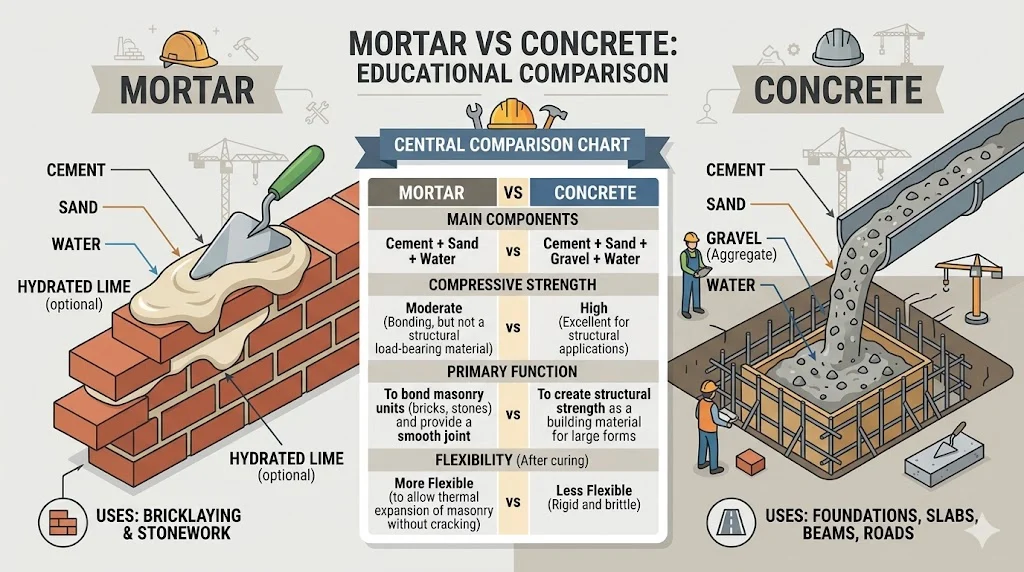
Mortar vs concrete refers to two different construction materials used in building and masonry work. Mortar is a smooth binding material made of cement, sand, and water, used to hold bricks or stones together. Concrete is a stronger structural material made of cement, sand, gravel (or crushed stone), and water, used for foundations, slabs and heavy load-bearing structures.
The main difference between mortar vs concrete is strength and purpose. Mortar acts as a glue for masonry, while concrete forms the actual structural body of buildings, roads, and infrastructure.
Introduction
Understanding mortar vs concrete is important for anyone involved in construction, home improvement, or civil engineering. These two materials look similar at first glance, but they serve very different purposes. Many beginners confuse them because both are made with cement and water. However, their composition, strength, and usage are not the same.
This confusion often leads to mistakes in building projects. For example, using mortar instead of concrete in foundations can cause structural failure. On the other hand, using concrete where mortar is needed can make brickwork weak and messy.
Learning the difference between mortar vs concrete helps you choose the right material for the right job. It also improves durability, safety, and cost efficiency in construction projects. In this guide, we will break down everything in simple language so even beginners can understand it easily. You will learn definitions, comparisons, uses, advantages, mistakes, and real-world examples.
Quick Answer Overview: Mortar vs Concrete
Mortar vs concrete can be understood in one simple way:
- Mortar is used for bonding materials like bricks and stones.
- Concrete is used for building strong structural elements like floors, beams, and foundations.
Simple Analogy
Think of mortar as glue, and concrete as solid rock. Glue holds pieces together, but rock forms the structure itself.
What Is Mortar?
Mortar is a mixture used in construction to bind building blocks together. It is soft, workable, and designed to fill gaps between bricks, stones, or blocks.
Composition of Mortar
Mortar typically contains:
- Cement (binding agent)
- Fine sand (aggregate)
- Water (activator)
Sometimes lime is added to improve flexibility and workability.
Characteristics of Mortar
- Smooth texture
- Easy to spread
- Lower strength compared to concrete
- High bonding ability
- Flexible and workable
Types of Mortar
- Cement mortar
- Lime mortar
- Gypsum mortar
- Surkhi mortar (traditional type used in some regions)
Uses of Mortar
- Bricklaying
- Stone masonry
- Plastering walls
- Filling joints between blocks
- Repair work
Mortar is essential in masonry work because it creates a strong bond between individual units.
What Is Concrete?
Concrete is a strong construction material used for structural purposes. It becomes extremely hard after setting and can support heavy loads.
Composition of Concrete
Concrete includes:
- Cement
- Sand (fine aggregate)
- Gravel or crushed stone (coarse aggregate)
- Water
The addition of coarse aggregate is what makes concrete much stronger than mortar.
Characteristics of Concrete
- Very high strength
- Hard and durable
- Can bear heavy loads
- Long-lasting
- Less flexible after setting
Types of Concrete
- Plain cement concrete (PCC)
- Reinforced concrete (RCC)
- Pre-stressed concrete
- Lightweight concrete
- High-strength concrete
Uses of Concrete
- Building foundations
- Roads and highways
- Bridges
- Columns and beams
- Floors and slabs
Concrete is the backbone of modern construction.
Mortar vs Concrete: Key Differences
Below is a clear comparison table for better understanding of mortar vs concrete.
| Feature | Mortar | Concrete |
| Composition | Cement, sand, water | Cement, sand, gravel, water |
| Strength | Low to medium | High |
| Purpose | Bonding material | Structural material |
| Texture | Smooth | Coarse |
| Load-bearing ability | Poor | Excellent |
| Workability | Very high | Moderate |
| Durability | Medium | Very high |
| Cost | Lower | Higher |
| Use case | Masonry joints | Foundations, slabs |
Composition Breakdown: Mortar vs Concrete
Mortar Composition Explained
Mortar uses only fine sand, which makes it smooth and easy to spread between bricks. It is designed for adhesion, not strength.
Concrete Composition Explained
Concrete includes gravel or crushed stone, which acts like a skeleton inside the mix. This gives it high compressive strength.
Why Gravel Matters in Concrete
The coarse aggregate:
- Increases strength
- Reduces shrinkage
- Improves durability
- Helps distribute load evenly
This is the main reason concrete is stronger than mortar.
Strength Comparison: Mortar vs Concrete
Strength is the biggest difference in mortar vs concrete.
Mortar Strength
- Designed for bonding, not structure
- Can crack under heavy load
- Suitable for non-load-bearing applications
Concrete Strength
- High compressive strength
- Can handle tons of weight
- Used in structural engineering
Simple Explanation
If a building is a human body:
- Mortar = skin glue holding bricks together
- Concrete = bones supporting the body
Advantages and Disadvantages of Mortar
Advantages of Mortar
- Easy to apply
- Good bonding material
- Smooth finishing
- Cost-effective
- Flexible for adjustments
Disadvantages of Mortar
- Low strength
- Not load-bearing
- Can crack under pressure
- Limited structural use
Advantages and Disadvantages of Concrete
Advantages of Concrete
- Very strong and durable
- Long lifespan
- Fire and weather resistant
- Suitable for heavy loads
- Versatile applications
Disadvantages of Concrete
- Expensive compared to mortar
- Requires proper mixing
- Hard to modify after setting
- Needs curing time
Real-World Examples of Mortar vs Concrete
Example 1: Brick Wall
- Mortar is used between bricks
- Concrete is not used here directly
Example 2: House Foundation
- Concrete is used for foundation
- Mortar is not suitable
Example 3: Road Construction
- Concrete forms the road surface
- Mortar is used only for repairs
Example 4: Plastering
- Mortar is applied as wall plaster
- Concrete is too coarse for this job
Regional and Global Usage of Mortar vs Concrete
Mortar Usage Worldwide
Mortar is universally used in:
- Residential buildings
- Historical structures
- Decorative masonry
In many traditional buildings in Asia and Europe, lime mortar is still used.
Concrete Usage Worldwide
Concrete is the most widely used construction material globally:
- Skyscrapers
- Infrastructure projects
- Industrial buildings
Modern cities depend heavily on concrete.
Common Mistakes in Mortar vs Concrete Usage
Mistake 1: Using Mortar for Structural Work
This leads to weak structures and safety risks.
Mistake 2: Using Concrete for Brick Joints
Concrete is too rough and reduces bonding quality.
Mistake 3: Wrong Water Ratio
Too much water weakens both mortar and concrete.
Mistake 4: No Curing Process
Concrete must be cured properly to gain strength.
Mistake 5: Poor Mixing
Uneven mixing leads to weak construction material.
Exercises with Answers
Exercise 1
Which is stronger, mortar or concrete?
Answer: Concrete
Exercise 2
What is the main use of mortar?
Answer: Bonding bricks and stones together
Exercise 3
Which material contains gravel?
Answer: Concrete
Exercise 4
Can mortar be used for foundations?
Answer: No
Exercise 5
What is the main role of concrete?
Answer: Structural support and load-bearing
Related Concepts: Cement vs Mortar vs Concrete
Cement
- A binding ingredient
- Used in both mortar and concrete
Mortar
- Cement + sand + water
- Used for bonding
Concrete
- Cement + sand + gravel + water
- Used for structural strength
Simple Relationship
Cement is the base ingredient, mortar is a bonding mix, and concrete is a structural material.
Advanced Insights into Mortar vs Concrete
Workability Differences
Mortar is more workable because it contains fine particles. Concrete requires mechanical mixing in large projects.
Durability Factors
Concrete lasts longer due to:
- Dense structure
- Coarse aggregate
- Lower permeability
Mortar is more exposed to weathering and requires maintenance.
Engineering Perspective
Engineers choose materials based on:
- Load requirements
- Environmental conditions
- Cost efficiency
- Design structure
FAQs
What is the main difference between mortar vs concrete?
Mortar is used for bonding bricks, while concrete is used for structural strength.
Can concrete replace mortar?
No, concrete is too coarse and not suitable for fine joints.
Which is stronger, mortar vs concrete?
Concrete is much stronger due to gravel and higher density.
Why is sand used in both mortar and concrete?
Sand fills gaps and improves binding in both materials.
Is mortar waterproof?
Mortar is not fully waterproof but can resist moisture to some extent.
What happens if we use mortar instead of concrete?
The structure will be weak and may fail under load.
Can mortar be used for flooring?
Only for thin finishing layers, not for structural flooring.
Why is concrete used in skyscrapers?
Because it provides high load-bearing strength and stability.
What is the lifespan of mortar vs concrete?
Concrete lasts much longer, often decades more than mortar.
Which is cheaper, mortar vs concrete?
Mortar is generally cheaper due to simpler composition.
Conclusion
Understanding mortar vs concrete is essential for anyone involved in construction or home improvement. Although both materials contain cement, their roles are completely different. Mortar is designed for bonding bricks and stones, while concrete is designed for strength and structural support.
Choosing the right material ensures safety, durability, and cost efficiency. Using mortar where concrete is needed can weaken a structure, while using concrete where mortar is required can reduce quality and finish.
For best results, always follow engineering guidelines and mix materials properly. In modern construction, both mortar and concrete are equally important, but their applications must never be confused. By understanding their differences clearly, you can make smarter decisions in any building project.

Justin Powell is a writer at GramBrix.com who focuses on grammar, clarity and effective communication, helping readers strengthen their language skills.