
Last Updated on July 15, 2026
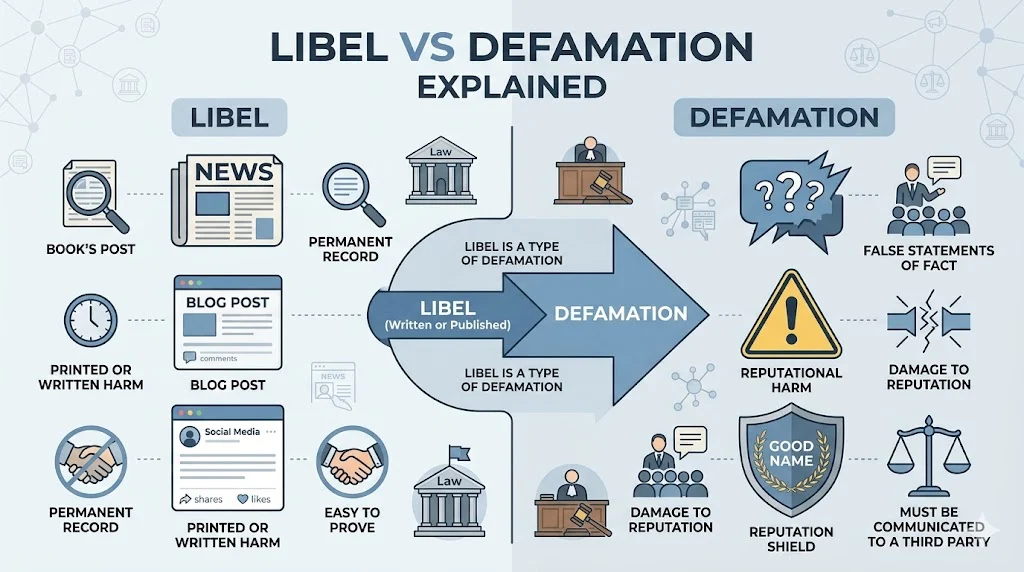
Libel vs defamation refers to the difference between written or published false statements and the broader legal concept of harming someone’s reputation. Libel is a form of defamation that appears in permanent form such as writing, images, or online posts. Defamation is the umbrella term that also includes spoken false statements known as slander.
Understanding libel vs defamation is important because laws differ across countries, and the consequences can include fines or legal action.
Libel vs defamation is one of the most confusing topics in law for students, writers, journalists, and social media users. Many people use these words as if they mean the same thing. In reality, they are closely related but not identical.
Defamation is a general legal concept. It refers to any false statement that harms a person’s reputation. Libel is a specific type of defamation that is written or published in a permanent form. The other type is slander, which refers to spoken statements.
In today’s digital world, confusion around libel vs defamation is more common than ever. Social media posts, online reviews, blogs, and comments can all create legal risks if false statements are shared. A single post can spread quickly and cause serious damage to someone’s reputation.
This article explains libel vs defamation in simple language. You will learn definitions, differences, real examples, legal rules, and common mistakes. You will also get exercises, FAQs, and practical insights to help you understand the topic from basic to advanced level.
Quick Answer Overview of Libel vs Defamation
Defamation is the broad legal category that covers false statements harming a person’s reputation. Libel vs defamation is often confused because libel is actually a subset of defamation.
In simple terms:
Defamation includes all harmful false statements
Libel refers only to written or published defamation
Slander refers to spoken defamation
So, libel vs defamation is not a competition. Libel is part of defamation, not separate from it.
Definition of Libel vs Defamation
What is Defamation
Defamation is a false statement presented as a fact that harms a person’s reputation. It can affect personal life, business, or social standing.
To qualify as defamation, most legal systems require:
The statement is false
It is presented as a fact, not opinion
It is shared with others
It causes harm to reputation
Defamation is the umbrella term that includes libel vs defamation discussions in law.
What is Libel
Libel is a type of defamation that is expressed in a permanent form. This includes:
Written articles
Newspaper reports
Blog posts
Social media posts
Images with false captions
Online reviews
Libel vs Defamation Core Idea
Defamation is the general category
Libel is written defamation
Slander is spoken defamation
This structure helps simplify the legal relationship between the terms.
Key Differences Between Libel vs Defamation
The table below explains libel vs defamation in a simple comparison:
| Feature | Defamation | Libel |
| Meaning | Any false statement harming reputation | Written or published defamation |
| Type | Umbrella term | Subcategory of defamation |
| Form | Written or spoken | Only written or recorded |
| Permanence | Temporary or permanent | Permanent |
| Examples | False accusation, rumor | Online post, newspaper article |
| Proof required | Damage to reputation | Often assumed damage in some laws |
| Legal seriousness | General category | Often treated more seriously |
Understanding these differences is key to mastering libel vs defamation.
Types of Defamation: Libel vs Slander
Defamation is divided into two main types. This helps clarify libel vs defamation further.
Libel
Libel includes written or recorded false statements. Because it remains available over time, it can spread widely and cause long term harm.
Examples:
Blog posts with false claims
Fake news articles
Defamatory social media posts
Slander
Slander refers to spoken defamation. It is usually temporary but still harmful.
Examples:
False spoken accusations
Rumors spread verbally
Misleading statements in public speeches
Why Libel vs Defamation Matters
Understanding libel vs defamation is important for many reasons.
Legal protection
People have the right to protect their reputation. Laws around libel vs defamation ensure fairness.
Media responsibility
Journalists must verify facts before publishing. Libel laws help maintain ethical reporting.
Online behavior
Social media users often unknowingly engage in libel vs defamation issues when sharing false content.
Business impact
False statements can damage companies, reduce trust, and affect revenue.
Advantages and Disadvantages of Defamation Laws
Although libel vs defamation is a legal concept, it also connects to broader law benefits and challenges.
Advantages
Protects individual reputation
Prevents false accusations
Encourages truth in media
Promotes responsible communication
Supports justice for victims
Disadvantages
Can limit freedom of speech if misused
Legal cases may be expensive
Sometimes difficult to prove intent
Different laws across countries create confusion
Real World Examples of Libel vs Defamation
Understanding libel vs defamation becomes easier with examples.
Example of Libel
A person writes a blog claiming a business is involved in fraud without evidence. This post is shared widely online. If false, this is libel.
Example of Slander
A person verbally tells others that a colleague has committed theft without proof. This is slander, not libel.
Example of Defamation in Business
A competitor spreads false online reviews to damage another company’s reputation. This falls under libel vs defamation laws depending on format.
Example in Social Media
A false tweet accusing someone of criminal activity is libel because it is written and permanent.
Regional and Global Usage of Libel vs Defamation
Laws about libel vs defamation differ across countries.
United States
Defamation includes libel and slander. Public figures must prove actual malice, meaning intent or reckless disregard for truth.
United Kingdom
Libel laws are stricter. Written defamation is taken very seriously and often favors the claimant.
Pakistan and South Asia
Defamation laws exist under civil and criminal systems. Libel vs defamation cases often involve media and online content.
Europe
Many countries follow civil law systems where reputation protection is strong but balanced with free speech rights.
Common Mistakes in Understanding Libel vs Defamation
Many people misunderstand libel vs defamation. Here are common mistakes.
Mistake 1: Thinking they are the same
Defamation is the general category. Libel is only a part of it.
Mistake 2: Believing opinions are defamation
Opinions are usually not defamation unless they present false facts.
Mistake 3: Assuming spoken words are libel
Spoken statements are slander, not libel.
Mistake 4: Thinking truth can be defamation
True statements are not defamation, even if harmful.
Mistake 5: Ignoring online posts
Social media content can legally count as libel.
Libel vs Defamation Comparison in Simple Language
Think of libel vs defamation like this:
Defamation is a big box
Inside that box are two smaller boxes
One box is libel
The other box is slander
If someone says or writes something false that harms reputation, it fits inside the defamation box.
Exercises on Libel vs Defamation
Exercise 1
Is a false newspaper article libel or slander?
Answer: Libel
Exercise 2
Is a spoken rumor about someone slander or libel?
Answer: Slander
Exercise 3
Is defamation the same as libel?
Answer: No, libel is part of defamation
Exercise 4
A social media post contains false accusations. What is it?
Answer: Libel
Exercise 5
Can true statements be defamation?
Answer: No
Advanced Understanding of Libel vs Defamation
At an advanced level, libel vs defamation involves legal standards such as:
Burden of proof
Intent or negligence
Public vs private figures
Damages and compensation
Courts often analyze whether:
The statement was factual or opinion
The statement was published
Harm can be proven
There was intent to harm
This makes libel vs defamation a complex area of law.
Related Concepts and Comparisons
Libel vs Slander
Libel is written
Slander is spoken
Defamation vs Freedom of Speech
Defamation laws protect reputation
Freedom of speech protects expression
Courts balance both rights
Libel vs Misinformation
Misinformation is false information
Libel is legally harmful false publication
Libel vs Fake News
Fake news may lead to libel if it harms reputation and is false
FAQs
What is the main difference between libel vs defamation?
Defamation is the general concept. Libel is written defamation.
Is libel always defamation?
Yes, libel is a type of defamation.
Can spoken words be libel?
No, spoken words are slander, not libel.
Is social media posting libel or defamation?
It is usually libel because it is written and permanent.
Do opinions count as libel vs defamation?
Usually no, unless they include false factual claims.
Can businesses sue for libel?
Yes, businesses can file libel cases for reputational harm.
Is defamation a crime?
In some countries yes, in others it is a civil matter.
What must be proven in libel cases?
False statement, publication, and reputational harm.
Why is libel treated more seriously than slander?
Because libel is permanent and widely spread.
How can I avoid libel vs defamation issues?
Verify facts, avoid false claims, and be careful online.
Conclusion
Libel vs defamation is a key legal concept that helps protect reputation in society. Defamation is the broad term that includes any false statement that harms a person’s or business’s image. Libel is a specific form of defamation that is written or published, while slander is spoken.
Understanding libel vs defamation is important in today’s digital world where information spreads quickly through social media and online platforms. A single post can have long lasting consequences if it contains false information.
To avoid legal risks, always ensure accuracy before sharing information. Respecting truth, verifying sources, and understanding basic legal principles can protect both individuals and organizations. Whether you are a writer, student, or business owner, knowing libel vs defamation helps you communicate responsibly and safely.

Kevin Brooks is a grammar specialist at GramBrix.com, dedicated to helping readers understand language rules with clarity and confidence. He simplifies complex grammar concepts through practical examples and easy explanations.