
Last Updated on July 9, 2026
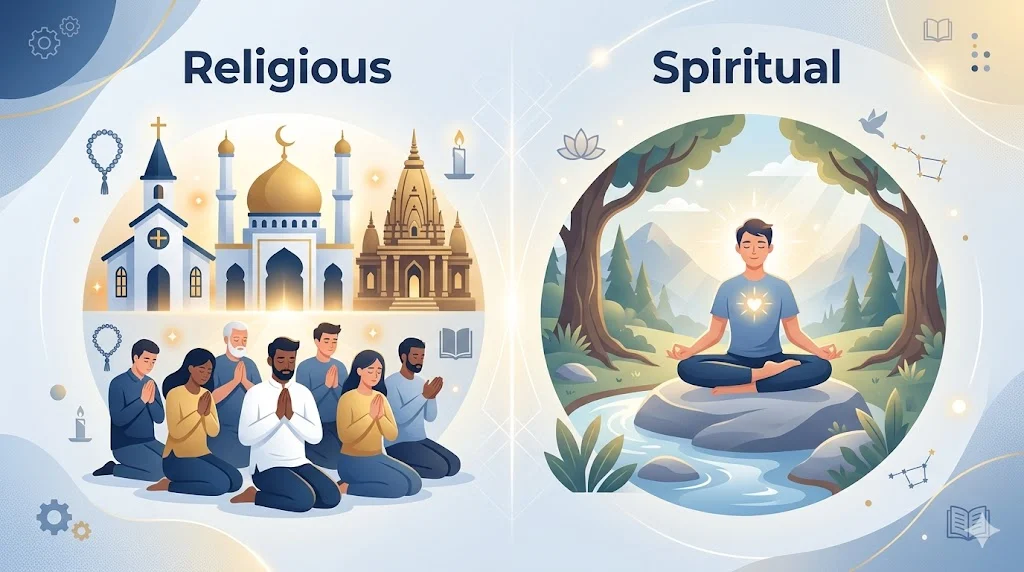
The difference between religious vs spiritual lies in structure and personal experience. Religion is an organized system of beliefs, practices, and traditions shared by a group. Spirituality is a personal journey of seeking meaning, purpose, and connection with something greater than oneself.
While religion often follows rules, rituals, and institutions, spirituality focuses on inner growth, awareness, and personal belief systems. Many people combine both, but they are not the same.
The terms religious vs spiritual are often used as if they mean the same thing. But they are not identical. Many people attend religious services but still feel spiritually empty. Others may not follow any religion but feel deeply connected to life, nature, or a higher power.
This confusion creates questions like:
Are you religious or spiritual? Can you be both? Do you need religion to be spiritual?
Understanding religious vs spiritual helps us better understand human belief, identity, and personal growth. It also helps reduce judgment between different worldviews. In today’s world, where people are exploring identity more freely, this topic has become even more important.
In simple terms, religion is structured. Spirituality is personal. Religion is shared. Spirituality is internal. But the real difference goes deeper than this. In this article, we will explore meanings, differences, advantages, examples, mistakes, and practical insights to fully understand religious vs spiritual in a clear and simple way.
Quick Answer Overview: Religious vs Spiritual
The difference between religious vs spiritual can be understood in a simple way:
- Religion is a system of organized beliefs, rituals, and community practices.
- Spirituality is a personal journey of meaning, inner peace, and connection.
A religious person may follow specific teachings, scriptures, and traditions. A spiritual person may follow personal beliefs and inner experiences without formal rules.
Both paths aim to answer the same big questions:
- Who am I?
- Why am I here?
- What happens after life?
But they approach these questions differently.
Definition of Religious vs Spiritual
What Does Religious Mean?
Being religious means following an organized system of faith. This usually includes:
- Belief in a God or multiple gods
- Sacred texts like the Bible, Quran, Torah, or Vedas
- Regular rituals like prayer, fasting, or worship
- Participation in a religious community
- Following moral and ethical rules defined by the religion
Religion is often passed down through families and cultures. It provides structure, discipline, and shared identity.
What Does Spiritual Mean?
Being spiritual means focusing on personal connection with life, energy, or a higher power. It does not always require organized religion.
Spirituality includes:
- Personal belief in meaning and purpose
- Meditation or mindfulness practices
- Inner reflection and self-awareness
- Feeling connected to nature or the universe
- Personal interpretation of life and existence
Spirituality is flexible and individual. It can exist inside or outside religion.
Key Differences Between Religious vs Spiritual
Understanding religious vs spiritual becomes easier when we compare them directly.
Comparison Table
| Aspect | Religious | Spiritual |
| Structure | Organized system | Personal and flexible |
| Authority | Religious leaders, texts | Inner guidance, experience |
| Practices | Rituals, worship, rules | Meditation, reflection, awareness |
| Community | Strong community-based | Often individual-focused |
| Beliefs | Fixed doctrines | Open and evolving beliefs |
| Goal | Follow faith correctly | Find inner peace and truth |
| Worship | External (church, mosque, temple) | Internal (mind, soul, energy) |
This table shows that religious vs spiritual differences are not about right or wrong. They are about approach.
Advantages and Disadvantages of Religious vs Spiritual
Both religious vs spiritual paths have strengths and limitations.
Advantages of Religion
- Provides structure and discipline
- Builds strong community support
- Offers moral guidance
- Preserves cultural traditions
- Gives a sense of identity and belonging
Disadvantages of Religion
- Can become rigid or strict
- May create divisions between groups
- Sometimes discourages questioning
- Can feel limiting for some individuals
Advantages of Spirituality
- Encourages personal freedom
- Focuses on inner peace and awareness
- Flexible belief system
- Encourages self-discovery
- Can be practiced anywhere
Disadvantages of Spirituality
- Lack of structure for some people
- No clear guidance system
- Can lead to confusion or misinformation
- May feel isolating without community
Real-World Examples of Religious vs Spiritual
Example of a Religious Person
A person who:
- Attends church every Sunday
- Follows the teachings of the Bible
- Prays daily
- Celebrates religious festivals
- Believes in structured doctrines
This is a clear example of a religious lifestyle.
Example of a Spiritual Person
A person who:
- Practices meditation daily
- Believes in universal energy or nature
- Does not follow a specific religion
- Focuses on mindfulness and peace
- Creates personal beliefs based on experience
This is a spiritual approach.
Example of Both Combined
Many people are both religious vs spiritual at the same time:
- They attend religious services
- But also meditate privately
- They follow traditions
- But also explore personal beliefs
This shows that religion and spirituality can overlap.
Regional and Global Understanding of Religious vs Spiritual
Western Perspective
In many Western countries:
- Spirituality is often separate from religion
- Many people identify as “spiritual but not religious”
- Personal belief systems are common
Eastern Perspective
In many Eastern cultures:
- Religion and spirituality are deeply connected
- Practices like meditation and prayer coexist
- Spirituality is often part of religion
Global Trend
Globally, there is a growing shift:
- Decline in formal religious participation in some regions
- Increase in personal spiritual practices
- Blending of both approaches
The idea of religious vs spiritual is becoming more flexible worldwide.
Common Mistakes in Understanding Religious vs Spiritual
Many people misunderstand religious vs spiritual. Here are common mistakes:
Mistake 1: Thinking They Are Opposites
Religion and spirituality are not enemies. They can coexist.
Mistake 2: Assuming Spiritual Means No Belief
Spirituality still involves belief, but it is personal.
Mistake 3: Thinking Religion Has No Spirituality
Many religions include deep spiritual practices like prayer and meditation.
Mistake 4: Judging One as Better
Neither is superior. Both serve different needs.
Mistake 5: Confusing Ritual with Meaning
Some think rituals are meaningless, but they often have deep symbolic value.
Exercises on Religious vs Spiritual (With Answers)
Exercise 1: Identify the Type
- A person follows a holy book and attends weekly worship.
- A person meditates daily and believes in universal energy.
- A person follows religion but also practices mindfulness.
Answers:
- Religious
- Spiritual
- Both religious and spiritual
Exercise 2: True or False
- Spirituality always requires a religion.
- Religion always includes spirituality.
- A person can be both religious and spiritual.
Answers:
- False
- False
- True
Exercise 3: Match the Concept
- Rituals → ___
- Inner peace → ___
- Sacred texts → ___
- Meditation → ___
Answers:
- Rituals → Religion
- Inner peace → Spirituality
- Sacred texts → Religion
- Meditation → Spirituality
Related Concepts and Comparisons
Understanding religious vs spiritual connects to other ideas:
Faith vs Belief
- Faith: Trust in something greater
- Belief: Acceptance of ideas
Tradition vs Experience
- Religion: Often based on tradition
- Spirituality: Based on personal experience
Organized Religion vs Personal Faith
- Organized religion: Structured system
- Personal faith: Individual interpretation
Mindfulness vs Worship
- Mindfulness: Awareness practice
- Worship: Religious devotion
FAQs
What is the main difference between religious vs spiritual?
Religion is structured and community-based, while spirituality is personal and focused on inner growth.
Can a person be both religious and spiritual?
Yes, many people follow religious practices while also developing personal spirituality.
Is spirituality better than religion?
Neither is better. Both serve different emotional and psychological needs.
Do you need religion to be spiritual?
No. Spirituality can exist independently of religion.
Why are people becoming more spiritual today?
Many people seek personal meaning, freedom, and inner peace outside structured systems.
Is meditation religious or spiritual?
Meditation is generally considered a spiritual practice, but it is also used in religions.
What does “spiritual but not religious” mean?
It means a person believes in spirituality without following organized religion.
Can religion include spirituality?
Yes, many religions include spiritual practices like prayer, meditation, and reflection.
Is atheism part of spirituality?
Some atheists practice spirituality through mindfulness and self-awareness without belief in God.
How do I know if I am religious or spiritual?
If you follow structured beliefs, you are more religious. If you focus on personal inner experience, you are more spiritual. You can also be both.
Conclusion
Understanding religious vs spiritual helps clarify one of the most important topics in human belief systems. Religion provides structure, tradition, and community. Spirituality provides freedom, inner peace, and personal growth. Both aim to answer life’s biggest questions but in different ways.
In today’s world, many people combine both paths. They follow traditions while also exploring personal meaning. This balance allows structure with freedom, and community with individuality.
The best approach is not to choose one over the other blindly but to understand what brings you peace, purpose, and clarity. Whether religious, spiritual, or both, the goal is the same: to live a meaningful and aware life.

Victoria Lane is a grammar-focused writer at GramBrix.com, passionate about helping readers master the rules of language. She provides clear explanations and practical examples that make writing more accurate, polished and confident.