
Last Updated on August 16, 2026
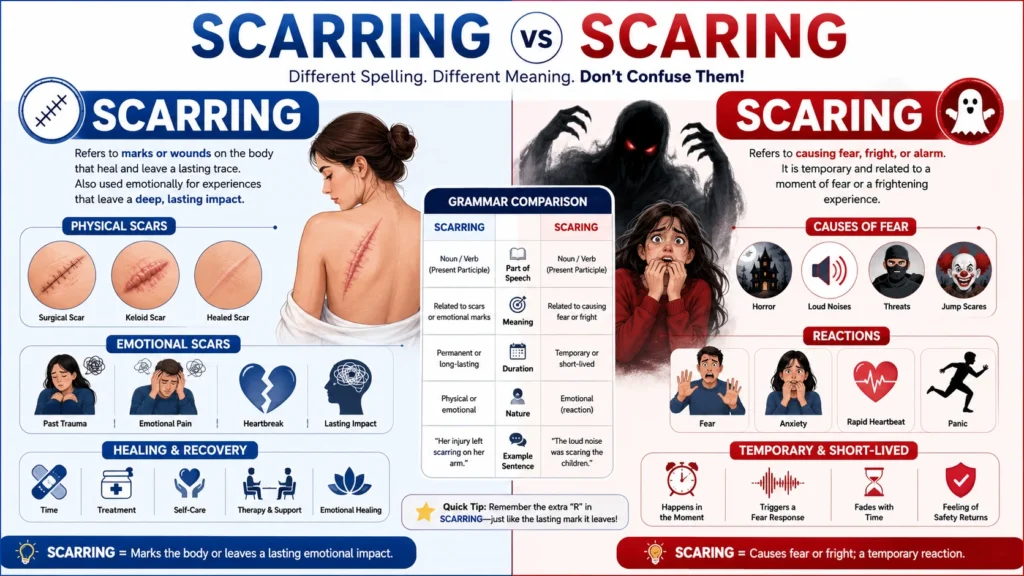
“Scarring” and “scaring” are often confused because they look and sound similar. “Scarring” relates to marks left on the skin or emotional damage, while “scaring” means frightening or causing fear. Knowing the difference helps improve writing, speaking, and professional communication.
Have you ever written “scarring” when you meant “scaring”? You are not alone. These two words look almost identical, but their meanings are very different. Scarring refers to a lasting mark or effect caused by an injury, surgery, acne, or even emotional trauma. Scaring means frightening someone or causing fear.
The difference comes down to one letter, but that small change can completely alter your sentence. This is why understanding scarring vs. scaring matters in everyday English, academic writing, emails, and social media. In this guide, we’ll explain the meaning, pronunciation, grammar, examples, common mistakes, and correct usage of both words. You’ll also learn simple ways to remember which spelling to use, so you can write with confidence and avoid confusing these commonly mixed-up English words.
Quick Answer About Scarring or Scaring
| Word | Meaning | Example |
|---|---|---|
| Scarring | Leaving marks or emotional damage | The burn caused permanent scarring. |
| Scaring | Causing fear or fright | The loud noise was scaring the baby. |
Easy Memory Trick
- Scarring = Scar
- Think about skin marks or emotional wounds.
- Scaring = Scare
- Think about fear or being frightened.
Understanding the Word Scarring
What Does Scarring Mean?
“Scarring” comes from the noun “scar.” A scar is a mark left on the skin after a wound heals. The word can also describe emotional pain that leaves a long lasting effect on a person.
Physical Scarring
Physical scarring happens after:
- Cuts
- Burns
- Surgery
- Acne
- Injuries
- Skin infections
Example sentences:
- The accident caused severe scarring on his arm.
- Acne scarring can take years to fade.
- The surgery left minimal scarring.
Emotional Scarring
Emotional scarring refers to psychological pain that continues after a traumatic event.
Examples:
- Bullying can cause emotional scarring.
- Childhood trauma left deep emotional scars.
- War experiences may result in lifelong emotional scarring.
Understanding the Word Scaring
What Does Scaring Mean?
“Scaring” comes from the verb “scare.” It means causing someone to feel fear, worry, or panic.
Examples:
- The thunderstorm was scaring the children.
- Horror movies are scaring him.
- Stop scaring your little sister.
The action is usually happening in the present or continuously.
Scarring or Scaring: Main Difference
Simple Comparison Table
| Feature | Scarring | Scaring |
|---|---|---|
| Root Word | Scar | Scare |
| Main Meaning | Leaving marks or trauma | Causing fear |
| Part of Speech | Verb or adjective form | Verb form |
| Related To | Injury or emotional damage | Fear or fright |
| Common Contexts | Medicine, psychology, skincare | Horror, danger, fear |
| Example | The fire caused scarring. | The fire was scaring people. |
Why People Confuse Scarring and Scaring
Similar Pronunciation
The words sound very close in casual speech. Fast pronunciation often hides the extra “r.”
Typing Errors
Autocorrect and fast typing can replace one word with the other.
Similar Sentence Structure
Both words can appear after “was,” “is,” or “are.”
Examples:
- The event was scarring.
- The event was scaring people.
Both sentences are grammatically correct but have different meanings.
Grammar Rules for Scarring and Scaring
Scarring as a Verb
“Scarring” can act as a present participle.
Examples:
- The chemical burn is scarring the skin.
- The trauma is scarring her emotionally.
Scarring as an Adjective
Examples:
- Scarring injuries
- Scarring memories
- Scarring experiences
Scaring as a Verb
“Scaring” is usually used as a continuous verb.
Examples:
- The clown is scaring the kids.
- Loud noises are scaring the dog.
Real World Examples of Scarring
Medical Example
Doctors often discuss scarring after surgery.
Example:
- Laser treatments may reduce surgical scarring.
Acne Treatment Example
Skincare professionals help patients manage acne scars.
Example:
- Retinol products can improve acne scarring.
Emotional Trauma Example
Psychologists use the term emotional scarring when discussing trauma.
Example:
- Emotional scarring from abuse may affect relationships later in life.
Sports Injury Example
Athletes may experience permanent tissue scarring after injuries.
Example:
- Knee surgery resulted in muscle scarring.
Real World Examples of Scaring
Parenting Example
Parents often tell older children not to frighten younger siblings.
Example:
- You are scaring your brother with those ghost stories.
Animal Example
Pets may become anxious during storms.
Example:
- Fireworks are scaring the dog.
Entertainment Example
Horror films are designed to create fear.
Example:
- The movie was scaring viewers in the theater.
Workplace Example
Aggressive behavior can frighten coworkers.
Example:
- His shouting was scaring the staff.
Emotional Scarring vs Temporary Fear
This is one of the biggest differences between the two words.
| Emotional Scarring | Temporary Fear |
|---|---|
| Long lasting | Usually short term |
| Deep psychological effect | Immediate reaction |
| Often caused by trauma | Often caused by danger or surprise |
| May need therapy | Usually fades quickly |
Example:
- A frightening dog bark may scare a child temporarily.
- A serious attack could leave emotional scarring for years.
Scarring in Medical and Skincare Fields
Types of Physical Scars
Hypertrophic Scars
Raised scars caused by excess collagen.
Keloid Scars
Large scars that grow beyond the original wound.
Atrophic Scars
Sunken scars often caused by acne or chickenpox.
Contracture Scars
Tight scars usually caused by burns.
Treatments for Scarring
Topical Creams
Doctors may recommend:
- Silicone gel
- Retinoids
- Vitamin E creams
Laser Therapy
Laser treatment can reduce visible scarring.
Microneedling
This procedure stimulates collagen production.
Surgery
Scar revision surgery may improve severe scars.
Emotional Scarring and Mental Health
Emotional scarring is not visible like physical scars, but it can strongly affect daily life.
Causes of Emotional Scarring
- Abuse
- Bullying
- War
- Neglect
- Serious accidents
- Toxic relationships
Symptoms
- Anxiety
- Depression
- Fear
- Trust issues
- Low self esteem
Healing Methods
- Therapy
- Support groups
- Mindfulness
- Counseling
- Healthy relationships
How Fear Works in Scaring
Fear is a natural survival response.
Common Causes of Fear
- Loud noises
- Dangerous situations
- Horror stories
- Threats
- Darkness
Physical Reactions
When something is scaring a person, the body may respond with:
- Faster heartbeat
- Sweating
- Shaking
- Rapid breathing
Regional and Global Usage of Scarring or Scaring
American English
Both words are commonly used in medical, emotional, and conversational contexts.
Examples:
- Acne scarring treatment
- Stop scaring me
British English
British English uses the same meanings and spelling.
Global English Learning
English learners worldwide often confuse these words because of pronunciation similarities.
Countries where learners frequently ask about this confusion include:
- India
- Pakistan
- Philippines
- Nigeria
- Bangladesh
Common Mistakes With Scarring or Scaring
Mistake One
Incorrect:
- The clown was scarring the children.
Correct:
- The clown was scaring the children.
Reason:
The clown caused fear, not physical or emotional scars.
Mistake Two
Incorrect:
- The burn left permanent scaring.
Correct:
- The burn left permanent scarring.
Reason:
A burn leaves scars, not fear.
Mistake Three
Incorrect:
- Horror movies leave emotional scaring.
Correct:
- Horror movies leave emotional scarring.
Reason:
Long term trauma relates to scars.
Tips to Remember the Difference
Tip One: Look for the Root Word
- Scar → Scarring
- Scare → Scaring
Tip Two: Think About Time
- Fear is often temporary.
- Scars are often long lasting.
Tip Three: Use Context Clues
Ask yourself:
- Is someone frightened?
- Use “scaring.”
- Is there damage or trauma?
- Use “scarring.”
Scarring or Scaring in Literature and Media
Horror Stories
Authors use “scaring” for immediate fear.
Example:
- The ghost was scaring the villagers.
Psychological Drama
Writers use “scarring” for deep emotional impact.
Example:
- The tragedy was emotionally scarring.
Related Words and Concepts
Scar
A mark left after healing.
Example:
- He has a scar on his cheek.
Scare
An act that causes fear.
Example:
- The sudden noise gave me a scare.
Trauma
A deeply disturbing experience.
Fear
An emotional response to danger.
Anxiety
Ongoing worry or nervousness.
Comparison Between Scarring and Trauma
| Aspect | Scarring | Trauma |
|---|---|---|
| Physical or Emotional | Both | Mostly emotional |
| Permanent Effect | Often | Sometimes |
| Visible | Sometimes | Usually invisible |
| Medical Context | Common | Common |
Scarring in Popular Medical Discussions
Acne Scarring
Acne scars are one of the most searched skincare issues online.
Common treatments include:
- Chemical peels
- Laser therapy
- Retinoids
- Dermabrasion
Surgical Scarring
Modern surgical methods try to minimize visible scars.
Burn Scarring
Burn scars may require long term treatment.
Scaring in Entertainment and Social Situations
Haunted Houses
Haunted attractions are designed for scaring visitors.
Movies
Horror films focus on fear and suspense.
Pranks
Practical jokes often involve temporarily scaring people.
Scarring or Scaring in Psychology
Psychologists carefully separate temporary fear from long lasting emotional damage.
| Psychological Concept | Related Word |
|---|---|
| Fear response | Scaring |
| Long term trauma | Scarring |
Beginner Friendly Examples
Easy Sentences With Scarring
- The knife injury caused scarring.
- The painful memory was emotionally scarring.
- Acne scarring improved after treatment.
Easy Sentences With Scaring
- The thunder was scaring the baby.
- You are scaring the cat.
- The dark room is scaring him.
Advanced Usage Examples
Academic Writing
- Childhood neglect may result in severe emotional scarring.
Medical Writing
- Early treatment can reduce tissue scarring.
Psychological Analysis
- Repeated exposure to violence may be psychologically scarring.
Film Review
- The director succeeded in scaring the audience.
Scarring or Scaring in Everyday Conversations
Conversation Example One
Person A:
- Why is your arm marked?
Person B:
- The injury caused scarring.
Conversation Example Two
Person A:
- Why is the baby crying?
Person B:
- The fireworks are scaring her.
Exercises With Answers
Exercise One: Choose the Correct Word
Questions
- The horror movie was ______ the children.
- The burn caused permanent ______.
- Emotional ______ can affect mental health.
- The barking dog was ______ the visitors.
- Acne ______ may fade over time.
Answers
- Scaring
- Scarring
- Scarring
- Scaring
- Scarring
Exercise Two: Correct the Mistake
Questions
- The loud thunder was scarring me.
- The accident caused deep scaring.
- Stop scarring the dog.
- Emotional scaring can last years.
Correct Answers
- The loud thunder was scaring me.
- The accident caused deep scarring.
- Stop scaring the dog.
- Emotional scarring can last years.
Exercise Three: Fill in the Blank
Questions
- The surgery left visible ______.
- The strange noise is ______ me.
- Childhood trauma may cause emotional ______.
- Fireworks were ______ the animals.
Answers
- Scarring
- Scaring
- Scarring
- Scaring
Professional Writing Tips
In Healthcare Writing
Use “scarring” when discussing:
- Wounds
- Burns
- Skin healing
- Emotional trauma
In Journalism
Use “scaring” when discussing:
- Public fear
- Dangerous events
- Panic situations
Digital Writing Considerations
Writers often target keywords like:
- Scarring vs scaring
- Difference between scarring and scaring
- Emotional scarring meaning
- What does scaring mean
- Acne scarring treatment
- Scaring someone meaning
Using the correct word improves:
- Search rankings
- Reader trust
- Clarity
- Professionalism
Common Contexts Where Scarring Appears
| Context | Example |
|---|---|
| Dermatology | Acne scarring |
| Surgery | Surgical scarring |
| Psychology | Emotional scarring |
| Burn treatment | Burn scarring |
Common Contexts Where Scaring Appears
| Context | Example |
|---|---|
| Horror movies | Scaring viewers |
| Parenting | Scaring children |
| Animal behavior | Scaring pets |
| Dangerous situations | Scaring people |
Related Comparisons
Scarring vs Healing
Healing is recovery. Scarring is a lasting mark after healing.
Scaring vs Warning
Scaring creates fear. Warning provides caution.
Idioms and Expressions Related to Scaring
Scared to Death
Meaning:
Very frightened.
Example:
- She was scared to death during the storm.
Scare Tactics
Meaning:
Methods used to frighten people.
Example:
- The campaign used scare tactics.
Idioms and Expressions Related to Scarring
Battle Scars
Meaning:
Physical or emotional signs of difficult experiences.
Example:
- The veteran carried emotional battle scars.
How Teachers Explain Scarring or Scaring
Teachers often use simple association methods.
Classroom Trick
- Scar = Mark
- Scare = Fear
This helps students remember quickly.
Why Correct Word Choice Matters
Using the wrong word can:
- Change the meaning
- Confuse readers
- Reduce professionalism
- Hurt academic writing quality
Example:
Incorrect:
- The speech was scarring the audience.
Correct:
- The speech was scaring the audience.
FAQs
What is the difference between scarring and scaring?
“Scarring” refers to leaving marks or emotional trauma, while “scaring” means causing fear or frightening someone.
Is emotional scarring real?
Yes. Emotional scarring describes long term psychological effects caused by trauma, abuse, or painful experiences.
Can acne cause scarring?
Yes. Severe acne can damage skin tissue and leave permanent or temporary scars.
Why do people confuse scarring and scaring?
The words sound similar and differ by only one letter, which makes spelling mistakes common.
Does scaring always involve horror?
No. Anything that creates fear can be described as scaring, including loud noises, danger, or threats.
How do I remember scarring vs scaring?
Think of the root words:
- Scar = mark or damage
- Scare = fear or fright
Can emotional scarring heal over time?
Yes. Therapy, support, and healthy coping methods can help reduce emotional pain and trauma.
Is scarring permanent?
Some scars are permanent, while others fade over time with treatment or natural healing.
What does scaring someone mean?
It means making a person feel frightened, nervous, or afraid.
Which word should I use for trauma, scarring or scaring?
Use “scarring” for long lasting emotional trauma and “scaring” for temporary fear.
Conclusion
Understanding the difference between “scarring” and “scaring” is important for clear communication. Although the words look and sound similar, their meanings are very different. “Scarring” relates to physical marks or emotional trauma that may last for a long time. “Scaring” refers to causing fear or frightening someone in the moment.
This small spelling difference can completely change the meaning of a sentence. That is why writers, students, professionals, and English learners should pay close attention to context. If the topic involves wounds, trauma, burns, or emotional damage, “scarring” is usually correct. If the topic involves fear, panic, or frightening experiences, “scaring” is the right choice.
The best way to master these words is through reading, writing practice, and repetition. Use the exercises and memory tricks in this guide to build confidence. Over time, choosing between “scarring” and “scaring” will become natural and automatic.
Discover more Articles:
- Mustang vs Camaro: Key Differences Explained Clearly For 2026
- Memrise vs Duolingo Comparison Guide 2026: Which Language App Is Better for You?

Justin Powell is a writer at GramBrix.com who focuses on grammar, clarity and effective communication, helping readers strengthen their language skills.