
Last Updated on August 10, 2026
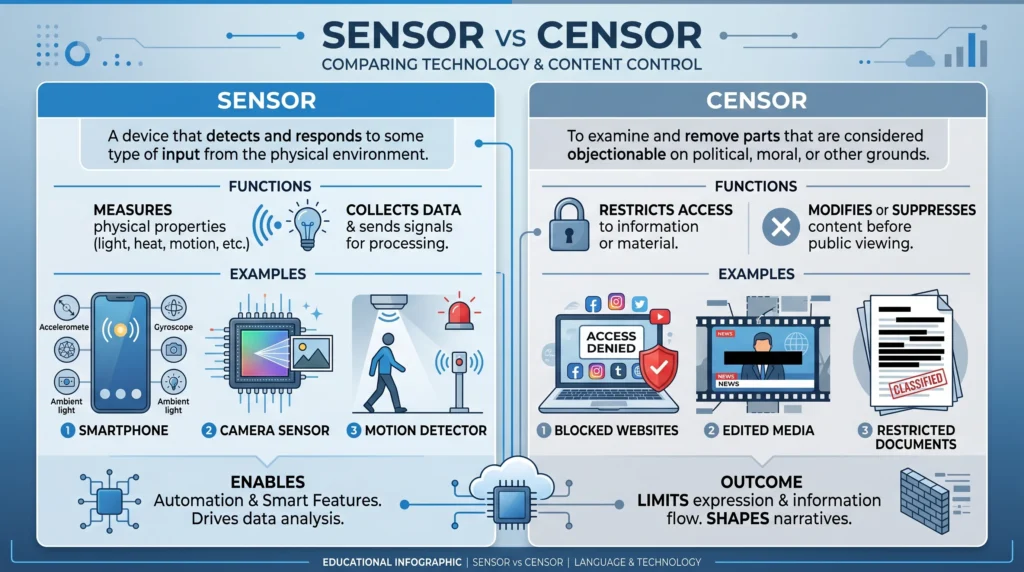
Sensor and censor sound alike but have completely different meanings. A sensor is a device that detects or measures physical activity such as temperature, motion, or light. A censor is a person, organization, or system that blocks, removes, or controls information or content. Understanding the difference helps avoid common spelling and communication mistakes.
English contains many confusing word pairs, but “sensor” and “censor” are among the most commonly mixed-up words online. Since both words sound almost identical, many people accidentally use the wrong spelling in writing, school assignments, business communication, and even social media posts.
For example:
- A phone camera uses a sensor.
- A government may censor media content.
Even though the words sound similar, their meanings are completely unrelated.
Many English learners search for censor meaning, meaning of censor, or what is the meaning of censor because they want to understand how the word is used in everyday English. In simple terms, censor means to examine, restrict, remove, or suppress information, speech, images, or content that is considered objectionable, sensitive, or inappropriate.
The censor meaning in English is commonly associated with governments, media organizations, schools, publishers, and online platforms that control what information can be publicly shared. The verb can also be used in personal situations when someone intentionally removes or hides information.
You may also come across censors meaning, which refers to multiple people or authorities responsible for reviewing and restricting content. Likewise, to censor meaning is simply the act of suppressing, editing, or limiting access to information.
Another term that causes confusion is sensored meaning. While many people use sensored informally when referring to content that has been restricted, the standard and grammatically correct form in English is usually censored, the past tense of censor.
This confusion matters because using the wrong word can change the meaning of a sentence entirely. In technology, science, journalism, education, and online communication, accuracy is important. Understanding the correct censor meaning helps writers communicate clearly and professionally.
According to major English dictionaries and style guides, censor is an established English word related to reviewing, restricting, or suppressing content, while sensor refers to a device that detects or measures physical changes such as light, temperature, motion, or pressure. This distinction is widely accepted in academic, professional, and journalistic writing.
In this guide, you will learn:
- The meaning of sensor and censor
- The meaning of censor in different contexts
- Main differences between the two words
- Real-world examples
- Common mistakes
- Grammar and spelling tips
- Easy memory tricks
- Practice exercises with answers
The explanations are simple, practical, beginner-friendly, and based on standard English usage to help you use these words confidently in both formal and informal communication.
Quick Answer
| Word | Meaning |
|---|---|
| Sensor | Detects or measures something |
| Censor | Blocks or controls information |
Simple Summary
- A sensor collects information.
- A censor restricts information.
What Is a Sensor?
Definition of Sensor
A sensor is a device or tool that detects physical changes or environmental conditions.
Sensors are commonly used in:
- Smartphones
- Cars
- Medical devices
- Smart homes
- Industrial systems
Common Types of Sensors
Temperature Sensors
Measure heat levels.
Motion Sensors
Detect movement.
Light Sensors
Respond to brightness changes.
Pressure Sensors
Measure force or pressure levels.
Real World Sensor Examples
Smartphone Sensors
Modern phones contain:
- Camera sensors
- Fingerprint sensors
- Face recognition sensors
Car Sensors
Vehicles use sensors for:
- Parking assistance
- Tire pressure monitoring
- Collision detection
Smart Home Devices
Smart lights and security systems use motion sensors.
What Is a Censor?
Definition of Censor
A censor is a person, authority, or system that suppresses, removes, or restricts information.
Censorship usually involves:
- Media
- Internet content
- Books
- Movies
- Political speech
Forms of Censorship
Government Censorship
Authorities may restrict certain information.
Social Media Censorship
Online platforms sometimes remove content violating policies.
Movie and TV Censorship
Certain scenes may be edited or removed.
Real World Censor Examples

Internet Restrictions
Some countries censor websites or online platforms.
Film Editing
Movies may be censored for violence or language.
School Content Filtering
Schools sometimes censor inappropriate online content.
Main Difference Between Sensor or Censor
Technology vs Information Control
This is the easiest way to remember the difference.
Sensor
- Detects data
Censor
- Restricts content
Simple Sentence Comparison
Sensor Example
- The camera sensor captures light.
Censor Example
- The agency tried to censor the article.
Pronunciation Difference
Why People Confuse Them
Both words sound very similar in spoken English.
Approximate pronunciation:
- Sensor → SEN-ser
- Censor → SEN-ser
The pronunciation overlap causes spelling confusion.
Memory Tricks to Remember the Difference
Sensor = Sensing
The word “sensor” relates to sensing information.
Think:
- Sensor → Sense
Censor = Control
Censors control or remove content.
Think:
- Censor → Control
Common Mistakes People Make
Using Sensor Instead of Censor
Incorrect:
- The government sensor the news.
Correct:
- The government censor the news.
Using Censor Instead of Sensor
Incorrect:
- My phone censor detects fingerprints.
Correct:
- My phone sensor detects fingerprints.
Confusing Technology and Media Contexts
Technology usually uses “sensor.”
Media and speech restrictions usually use “censor.”
Sensor in Modern Technology
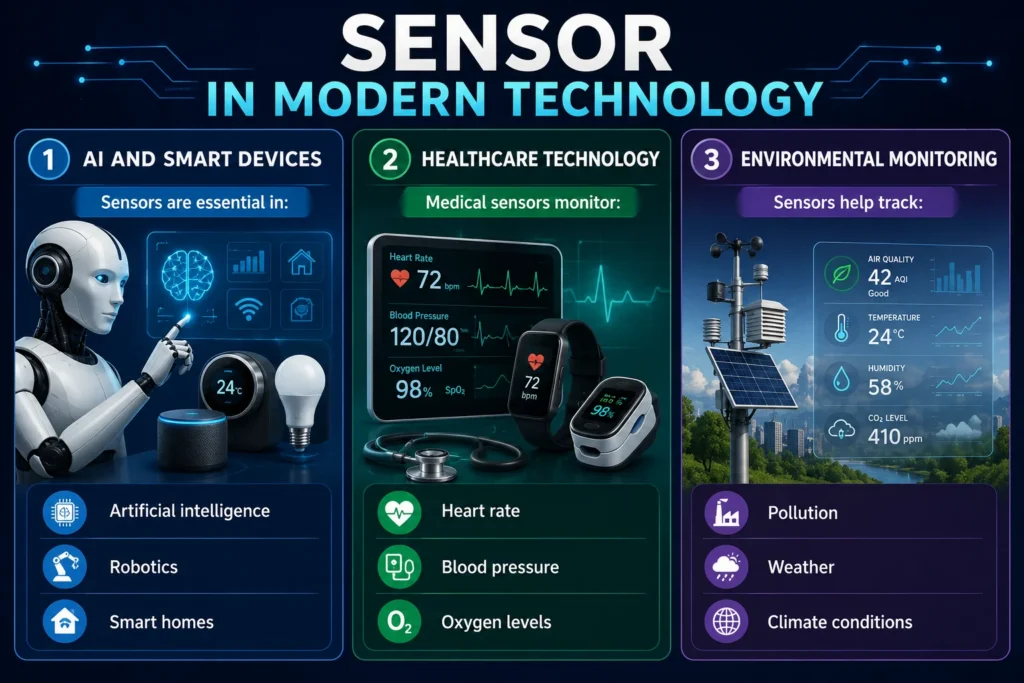
AI and Smart Devices
Sensors are essential in:
- Artificial intelligence
- Robotics
- Smart homes
Healthcare Technology
Medical sensors monitor:
- Heart rate
- Blood pressure
- Oxygen levels
Environmental Monitoring
Sensors help track:
- Pollution
- Weather
- Climate conditions
Censorship in the Digital Age
Social Media Moderation
Platforms may censor:
- Hate speech
- Violence
- Harmful misinformation
Political Debate
Censorship remains controversial in discussions about:
- Free speech
- Privacy
- Internet regulation
AI Content Filtering
Modern AI systems sometimes censor harmful or unsafe content automatically.
Related Word Comparisons
Sense vs Cense
“Sense” relates to understanding or feeling.
“Cense” is rare and unrelated to sensor.
Control vs Detect
Censors control information.
Sensors detect information.
Advantages and Disadvantages
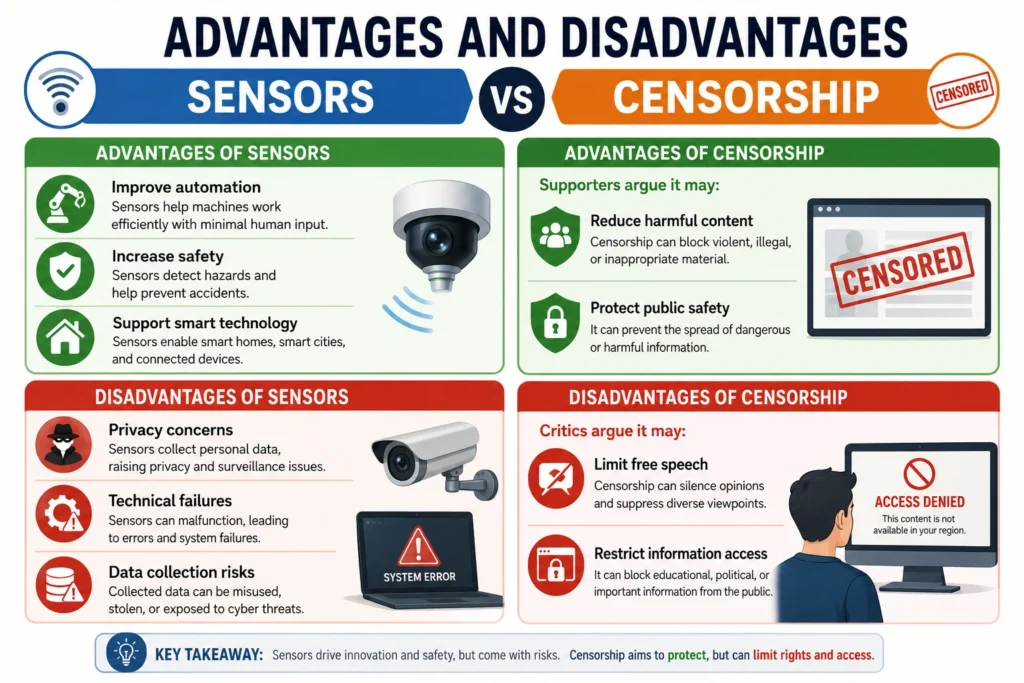
Advantages of Sensors
- Improve automation
- Increase safety
- Support smart technology
Disadvantages of Sensors
- Privacy concerns
- Technical failures
- Data collection risks
Advantages of Censorship
Supporters argue it may:
- Reduce harmful content
- Protect public safety
Disadvantages of Censorship
Critics argue it may:
- Limit free speech
- Restrict information access
Exercises With Answers
Exercise 1
Which word relates to detecting temperature?
Answer: Sensor
Exercise 2
Which word relates to blocking information?
Answer: Censor
Exercise 3
Which sentence is correct?
A. The phone censor tracks movement.
B. The phone sensor tracks movement.
Answer
✅ B
Exercise 4
Can governments censor media content?
Answer: Yes
Exercise 5
Are sensors used in smart devices?
Answer: Yes
FAQs
What is the difference between sensor or censor?
A sensor detects data or environmental changes, while a censor blocks or controls information.
What is a sensor used for?
Sensors are used in technology to detect motion, light, temperature, and other physical conditions.
What does censor mean?
Censor means restricting, removing, or controlling information or content.
Why do people confuse sensor and censor?
The words sound almost identical in pronunciation.
Is a camera part called a sensor?
Yes. Cameras use image sensors to capture light and create photos.
Can social media platforms censor content?
Yes. Platforms may remove or limit content based on policies.
Are sensors important in AI technology?
Yes. Sensors help AI systems gather environmental information.
What is government censorship?
It is the restriction or control of public information or media by authorities.
How can I remember the difference?
Think:
- Sensor = sensing
- Censor = controlling content
Can a sensor fail?
Yes. Technical problems can affect sensor accuracy or function.
Conclusion
Understanding the difference between sensor or censor is important because the words have completely different meanings despite sounding similar.
A sensor is a technology tool used to detect or measure information like motion, temperature, light, or pressure. Sensors power modern devices, smart technology, vehicles, healthcare systems, and artificial intelligence.
A censor, on the other hand, controls or restricts information, media, or communication. Censorship is commonly discussed in politics, journalism, social media, and online safety debates.
The easiest way to remember the difference is:
- Sensors collect information
- Censors limit information
Learning the correct usage improves communication, writing accuracy, and understanding in both technology and media discussions.

Kevin Brooks is a grammar specialist at GramBrix.com, dedicated to helping readers understand language rules with clarity and confidence. He simplifies complex grammar concepts through practical examples and easy explanations.