
Last Updated on August 19, 2026
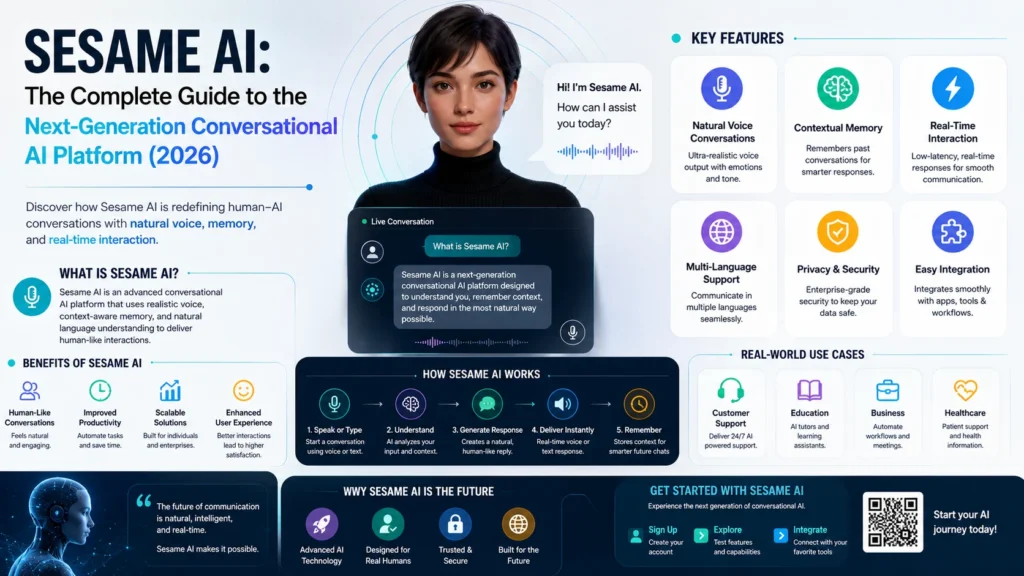
Sesame AI is an advanced conversational AI platform that combines natural language processing, speech recognition, and text-to-speech to create human-like, real-time interactions. It powers voice assistants, chatbots, and AI agents with context awareness, emotional tone detection, and personalization, making it ideal for businesses, developers, and next-gen AI applications.
Sesame AI – What It Is, How It Works and Why It Matters in 2026
Artificial intelligence isn’t just evolving it’s becoming more human.
That shift is exactly where Sesame AI stands out. Instead of stiff, robotic responses, this platform focuses on natural, fluid conversation. It listens, understands, and responds in a way that feels closer to talking with a person than interacting with software.
Now think about how you use AI today. You type prompts, wait for responses, maybe speak to a voice assistant that still sounds… mechanical. Sesame AI changes that experience. It brings together voice, language, and emotion into one unified system.
So why does that matter?
Because the future of AI isn’t just about intelligence. It’s about interaction.
In this guide, you’ll learn:
- What Sesame AI actually is
- How its technology works under the hood
- Real-world use cases across industries
- Key features and limitations
- Whether it’s worth using in 2026
Let’s break it down.
What Is Sesame AI?
Sesame AI is a conversational AI platform designed to enable natural, human-like interaction between users and machines.
At its core, it combines:
- Natural Language Processing (NLP)
- Speech Recognition
- Text-to-Speech (TTS)
- Large Language Models (LLMs)
Unlike traditional AI tools that focus only on text, Sesame AI delivers a multimodal experience. That means it can:
- Understand spoken language
- Process meaning in context
- Respond with realistic voice output
- Adapt tone and emotion
Simple Definition
Sesame AI is a real-time conversational AI system that enables machines to communicate like humans using voice and language.
The Company Behind Sesame AI
Sesame AI operates as a modern AI startup focused on human-centered interaction design.
Key Focus Areas
- Conversational AI systems
- Voice-based interfaces
- Real-time AI communication
- Personal AI assistants
What Sets the Company Apart
Instead of chasing generic AI features, the team prioritizes:
- Natural conversation flow
- Emotional intelligence in AI
- Low-latency communication
This positioning places Sesame AI closer to next-gen AI companions than basic chatbot platforms.
How Sesame AI Works (Technical Breakdown)
At a high level, Sesame AI follows a multi-stage pipeline that processes input and generates responses in real time.
Input → Processing → Output Flow
| Stage | Description |
|---|---|
| Input | User speaks or types a query |
| Speech Recognition | Converts voice into text |
| NLP Processing | Understands meaning and intent |
| Context Engine | Maintains conversation memory |
| Response Generation | Uses LLMs to create replies |
| Text-to-Speech | Converts response into natural voice |
Real Example Workflow
You say:
“Hey, can you remind me to call John tomorrow morning?”
Here’s what happens behind the scenes:
- Speech gets converted into text
- NLP detects intent: set reminder
- Context engine identifies “tomorrow morning”
- AI generates a response
- Voice output delivers confirmation
Result:
A smooth, human-like interaction.
Key Technologies Powering Sesame AI
Natural Language Processing (NLP)
- Understands grammar, intent, and semantics
- Enables contextual awareness
Speech Recognition
- Converts spoken input into structured text
- Supports real-time processing
Text-to-Speech (TTS)
- Produces natural voice output
- Mimics human tone and rhythm
Large Language Models (LLMs)
- Generate intelligent responses
- Maintain conversational flow
Emotion / Tone Detection
- Detects user sentiment
- Adjusts response style accordingly
Core Features of Sesame AI
Sesame AI doesn’t just offer features it delivers interaction quality.
Key Features
- Real-Time Voice Interaction
Responds instantly without noticeable delay - Context Awareness
Remembers previous inputs within conversations - Human-Like Speech Output
Uses advanced TTS for natural delivery - Multimodal Capabilities
Handles both voice and text seamlessly - Personalization Algorithms
Learns user preferences over time - AI Agent Integration
Enables automation through intelligent agents
Unique Differentiators
What makes Sesame AI different?
- Emotion-aware responses
- Low-latency voice processing
- Continuous conversation memory
- More natural dialogue pacing
In simple terms, it feels less like software and more like a conversation partner.
Sesame AI Use Cases (Real Applications)
Sesame AI shines when communication matters.
Business Automation
- Automates customer interactions
- Handles support queries
AI Voice Assistants
- Builds next-gen voice apps
- Enables personal AI companions
Customer Support
- Replaces static chatbots
- Provides dynamic responses
Content Generation
- Assists with writing and scripting
- Generates conversational content
Industry-Specific Use Cases
| Industry | Application |
|---|---|
| SaaS | AI-powered onboarding assistants |
| E-commerce | Voice-based product search |
| Healthcare | Patient interaction systems |
| Finance | AI advisory chat systems |
Benefits of Using Sesame AI
Why should you care?
Because it solves real problems.
Key Benefits
- Faster Communication
- Improved User Experience
- Reduced Operational Costs
- Scalable AI Solutions
Practical Impact
Imagine replacing:
- Static FAQs → Dynamic conversations
- Robotic bots → Human-like assistants
- Delayed responses → Instant replies
That’s the shift Sesame AI enables.
Limitations and Challenges
No system is perfect.
Key Limitations
- Requires high-quality data
- Can struggle with niche contexts
- Voice processing may vary by accent
Technical Challenges
- Real-time latency optimization
- Emotion detection accuracy
- Context memory scaling
Sesame AI vs Competitors
Let’s compare.
Comparison Table
| Feature | Sesame AI | Traditional Chatbots | Standard Voice Assistants |
|---|---|---|---|
| Conversation Quality | High | Low | Medium |
| Voice Naturalness | High | None | Medium |
| Context Awareness | Strong | Weak | Limited |
| Emotion Detection | Yes | No | Partial |
When to Choose Sesame AI
Use it if you need:
- Human-like interaction
- Voice + text integration
- Real-time responses
Pricing and Access
While exact pricing may vary, most AI platforms follow this structure:
Typical Pricing Model
- Free tier (limited usage)
- Subscription plans
- Enterprise-level pricing
Access Options
- API integration
- Web-based platform
- SDKs for developers
How to Get Started with Sesame AI
Getting started is straightforward.
Step-by-Step Guide
- Create an account
- Access the dashboard
- Choose use case (chatbot, voice assistant)
- Configure inputs and outputs
- Deploy your AI agent
Security, Privacy, and Compliance
AI systems handle sensitive data. Sesame AI addresses this through:
- Data encryption
- Secure API endpoints
- User data controls
Future of Sesame AI
The future looks promising.
Expected Trends
- More realistic voice synthesis
- Better emotional intelligence
- Fully autonomous AI agents
Expert Insights and Market Impact
AI experts increasingly focus on interaction quality.
Sesame AI aligns with:
- Human-computer interaction trends
- Real-time AI communication
- Personalized AI experiences
FAQs
What is Sesame AI used for?
It powers conversational AI systems like chatbots and voice assistants.
Is Sesame AI free?
It typically offers tiered pricing, including free access.
How is it different?
It focuses on human-like interaction, not just responses.
Conclusion
Sesame AI isn’t just another AI tool.
It represents a shift from interaction to conversation.
If AI feels more human, more responsive, and more intuitive, people use it more. Businesses benefit. Users stay engaged.
That’s the real value.
And in 2026, that’s exactly what matters.

Kevin Brooks is a grammar specialist at GramBrix.com, dedicated to helping readers understand language rules with clarity and confidence. He simplifies complex grammar concepts through practical examples and easy explanations.