
Last Updated on August 8, 2026
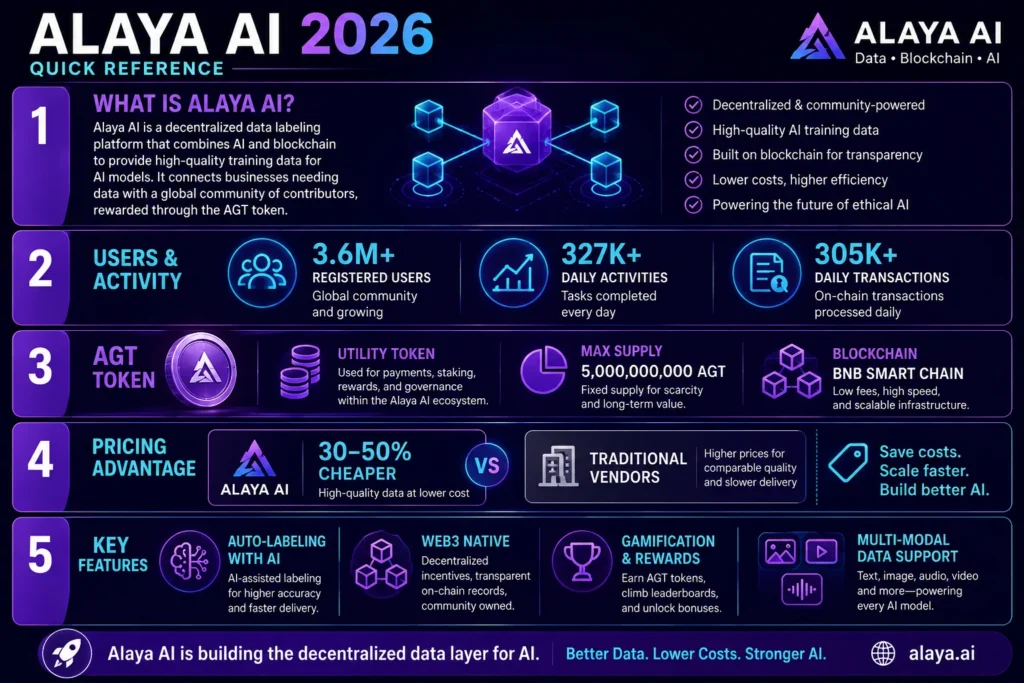
Alaya AI is a Web3 data infrastructure platform that connects decentralized data communities with AI projects through blockchain, gamification, and token rewards. Launched in 2024, it has over 3.6 million users and generates more than $6 million in annual revenue. The platform supports multimodal data collection including images, videos, text, audio, and IoT sensor data. Contributors earn AGT tokens for completing labeling tasks, and the auto-labeling system achieves over 80% verification rates through a hybrid AI and human feedback loop. Alaya AI is 30-50% cheaper than traditional centralized labeling vendors like Scale AI. The project was selected for BNB Chain’s MVB Season 8 accelerator and conducted its Token Generation Event on Binance Wallet in May 2025. AGT is a BEP-20 token with a maximum supply of 5 billion, serving utility and governance functions. The platform uses a four-layer architecture including application, data production, intelligent optimization, and on-chain coordination layers. Data quality is ensured through AI-assisted checks, peer review, and random manual audits.
What Is Alaya AI?
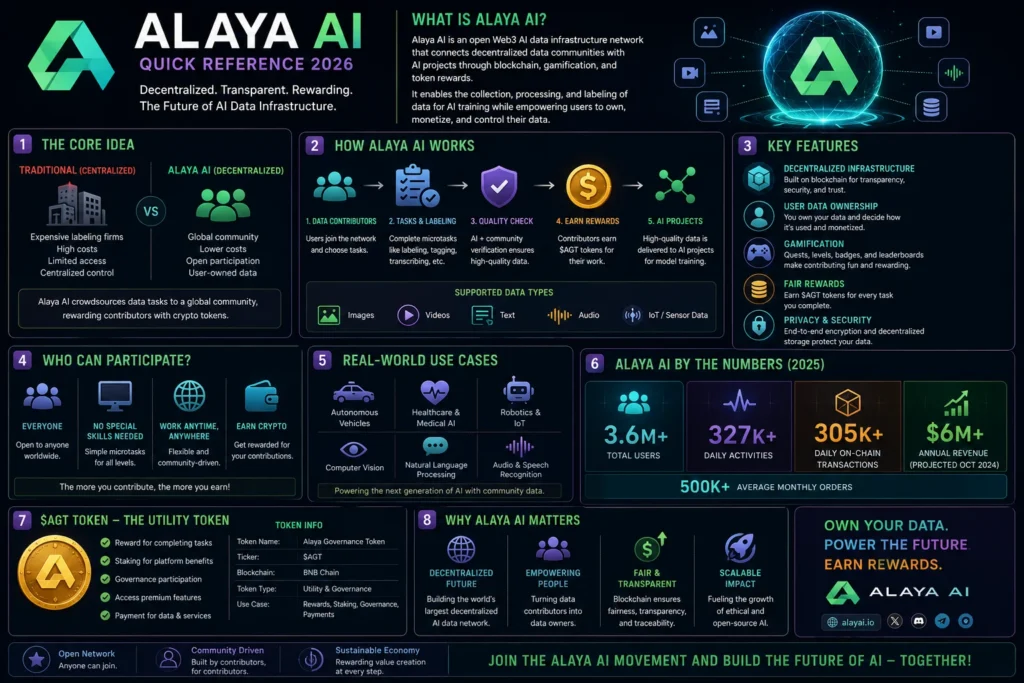
Alaya AI is an open Web3 AI data infrastructure network that connects decentralized data communities with AI projects through blockchain, gamification, and token rewards. It enables the collection, processing, and labeling of data for AI training while empowering users to own, monetize, and control their own data.
The core idea is elegant: Instead of relying on expensive, centralized labeling firms like Scale AI, Alaya taps into a global community of contributors who complete microtasks and earn crypto tokens in return. The platform supports images, videos, text, audio, and even IoT sensor data, making it one of the most versatile decentralized data platforms available.
The platform has achieved impressive traction: as of 2025, it boasts over 3.6 million users, 327,000 daily activities, and 305,000 daily on-chain transactions. In October 2024, Alaya AI’s annual revenue was projected to surpass $6 million, with average monthly orders exceeding 500,000.
How Alaya AI Works: The Technical Architecture
Alaya AI’s architecture is more sophisticated than a simple “task-for-token” site. It implements a four-layer collaborative model where each layer has clearly separated responsibilities.
The Four Layers
1. Application and Interface Layer
This includes a gamified dApp for data contributors featuring task panels, quiz challenges, and daily tasks. AI project teams can access custom data requests and the Open Data Platform (ODP) marketplace. The emphasis is on low-barrier participation and composable access.
2. Data Production Layer
Responsible for multimodal data intake (text, images, video, audio), preprocessing (cleaning, deduplication, privacy protection), auto-labeling, manual verification, and quality scoring. This layer uses swarm intelligence principles: the same task is cross-labeled by multiple contributors, and consensus mechanisms improve label consistency.
3. Intelligent Optimization Layer
The core component is the Data Auto-Labelling Toolset, driven by a proprietary three-layer intelligent optimization architecture. Combined with Reinforcement Learning from Human Feedback (RLHF), it injects distributed human expertise into self-supervised processes, supporting model alignment and capability improvement.
4. On-Chain Coordination Layer
Key coordination information like AGT staking, governance voting, task status records, and NFT qualification binding relies on blockchain. The chain doesn’t store raw data volumes but handles incentive settlement, proof of permission, and audit trail anchoring.
The Auto-Labeling System
The auto-labeling system is where Alaya AI gets interesting. The technical process typically includes:
- Multimodal Intake: Accepts static and dynamic visual data, text, and sensor inputs
- Algorithmic Preprocessing: Automatic cleaning and deduplication, with Zero-Knowledge encryption applied to sensitive data paths
- Model Pre-Labeling: A proprietary model generates initial labels with a claimed verification rate exceeding 80% for common AI data categories
- RLHF Optimization Loop: Contributor verification results are fed back into the model, continuously reducing the proportion of manual review
- Expert Truth Layer: For enterprise-grade orders, domain experts serve as the final arbitration layer
This hybrid architecture provides scale and speed through the public network while maintaining quality baselines in risk-sensitive industries through expert oversight.
Alaya AI Products: The Full Stack
Alaya AI offers several products that serve different user groups.
For Contributors: The Gamified dApp
Contributors sign up with email and connect a crypto wallet. The platform walks users through setting language skills and availability, completing sample tasks, taking accuracy quizzes, and then unlocking paid tasks.
Task types include:
| Data Type | Examples |
|---|---|
| Image | Object detection, image tagging, bounding boxes |
| Text | Sentiment analysis, intent classification |
| Audio | Speech-to-text, speaker identification |
| Video | Frame-by-frame annotation, activity recognition |
| Autonomous driving | 3D annotation, object tracking |
For Requesters: The Open Data Platform
The Open Data Platform (ODP), launched in November 2024, extends the network from a “labeling factory” into a “data marketplace.” AI developers and data consumers connect directly with distributed suppliers through customizable token incentives.
Requesters can:
- Define data types and output standards
- Set reward budgets and deadlines
- Create custom token reward pools
The system automatically distributes tasks to matched contributors and delivers standard-compliant data.
For Developers: Alaya NeW Cloud Platform
Alaya NeW is a separate cloud platform offering a full stack of AI infrastructure services:
| Product | What It Does |
|---|---|
| Cloud Container Instance (CCI) | Kubernetes-based serverless container service |
| Alaya Lab | One-stop AI development platform with VS Code and Jupyter |
| HyperTrain | Serverless distributed training service |
| Virtual Kubernetes Service (VKS) | Unified scheduling for large-scale GPU compute |
| LM Lab | One-stop LLM development and training platform |
| Inference | Enterprise-grade model inference platform |
| Alaya Studio | AI agent development and application building |
Important note: Alaya NeW appears to be a separate product line from the main Alaya AI data labeling platform. It’s a cloud compute service with its own billing system (DCU, or DataCanvas Units).
The AGT Token: Tokenomics and Utility
Alaya AI’s native token is AGT, launched on May 16, 2025, through a Token Generation Event (TGE) on Binance Wallet in collaboration with PancakeSwap.
Token Data
| Metric | Value |
|---|---|
| Token Name | Alaya AI |
| Ticker | AGT |
| Blockchain | BNB Smart Chain |
| Token Type | BEP-20, Utility + Governance |
| Max Supply | 5 billion AGT |
Token Utility
AGT serves multiple functions on the platform:
- Rewards: Contributors earn AGT for completing labeling tasks and milestones
- Staking: Users stake AGT to unlock advanced tasks, participate in DAO governance, and create custom data pools
- Fees: AGT is used for requesting data and upgrading NFTs
- Model Staking: Users can stake AGT in model pools to fund AI model fine-tuning and share benefits
How to Earn AGT
According to the platform:
- Participate in data tasks on the app or web
- Stake and claim rewards from AI model pools
- Buy at TGE, PancakeSwap, or CEX after listing
Important: AGT staking itself does not provide passive yield, preventing speculative capital from disrupting labeling quality incentives.
The AIA Credit System
Contributors earn AIA credits from tasks, which can be exchanged for AGT in a monthly “Redemption” pool. This creates a periodic mapping of off-chain activity to on-chain value distribution.
Pricing: What Does It Cost?
For Contributors
Contributors can use the platform for free. You just need to sign up and start completing tasks.
For Requesters
Pricing depends on task complexity. According to a detailed review, here are sample costs:
| Task Type | Cost per Item |
|---|---|
| Basic image tagging | $0.06 – $0.10 |
| Text sentiment labeling | $0.07 – $0.12 |
| Audio transcription | $0.15 – $0.20 |
| Complex bounding boxes | $0.18 – $0.25 |
Compared to traditional annotation vendors (often $0.20-$0.50 for simple tags), Alaya AI is 30-50% cheaper.
Important: As of 2025, Alaya has no publicly listed pricing. Enterprises must contact the team for quotes.
For Cloud Users (Alaya NeW)
Alaya NeW uses a DCU (DataCanvas Unit) billing system:
- 1 DCU = 312 TFLOPS × 1 hour (FP16 computing)
- 1 A100 80G NVLink running for 1 hour = 1 DCU
- 1 H800 80G NVLink running for 1 hour = 2.56 DCU
AlayaCode (LLM API) uses a subscription model with token quotas:
| Tier | Monthly | Token Quota | Models |
|---|---|---|---|
| Free | ¥0 | 1 M | minimax-m2.1, glm-5 (throttled) |
| Pro | Contact sales | 30 M | + minimax-m2.5, glm-5.1 |
| Team | Contact sales | 200 M | + deepseek-v4-pro (1M ctx) |
| Enterprise | Contact sales | Custom | All + private models |
Data Quality and Verification
Alaya AI uses a three-step verification process to ensure data quality:
- AI-assisted checks flag obvious errors
- Peer review from other contributors
- Random manual audits for high-priority tasks
Case study results:
- A chatbot project achieved 94% accuracy on intent classification
- A medical imaging project reached 92% accuracy on X-ray annotations
The platform also implements Zero-Knowledge encryption to desensitize data before it goes on-chain, protecting contributor privacy and enterprise compliance.
Alaya AI vs Competitors: Quick Comparison
| Platform | Type | Strengths | Weaknesses | Price Range |
|---|---|---|---|---|
| Alaya AI | Decentralized Web3 | Blockchain transparency, lower cost, gamification, 3.6M+ users | Token volatility, newer platform, no mobile app | $0.06-$0.25/task |
| Scale AI | Centralized enterprise | Enterprise-ready, massive workforce | Higher costs, closed system | $0.15-$0.50/task |
| Appen | Centralized enterprise | Long track record, large client list | Slower onboarding, variable quality | $0.10-$0.40/task |
| Labelbox | Centralized software | Strong annotation tools, flexible integrations | Requires internal workforce | N/A |
Project Team and Backing
Team
Pascal Weinberger – Founder & CEO, described as an AI expert who has led many ML/Blockchain projects. The core team consists of AI/ML engineers, data security experts, and blockchain architects.
Backing
- BNB Chain: Selected for BNB Chain MVB Season 8 accelerator program in Q4 2024
- Binance Wallet & PancakeSwap: Collaborating to organize TGE and early liquidity
- Investors: Seed round information not publicly disclosed
Roadmap
| Phase | Milestones |
|---|---|
| Q4 2024 | Selected for BNB Chain MVB Season 8 accelerator |
| H1 2025 | TGE on Binance Wallet; deploy mainnet Beta on BNB Chain |
| H2 2025 | Expand to Optimism & Ethereum L2s for scalability |
| 2026 | Complete DAO, support large-scale tokenized AI model, integrate zk-ML Toolkit |
Should You Use Alaya AI?
Alaya AI Is Best For:
- AI startups needing affordable, scalable datasets without big contracts
- Researchers requiring quick, diverse data labeling
- Crypto-savvy contributors wanting to earn tokens in flexible microtasks
- Enterprises with compliance needs that value blockchain audit trails
Avoid Alaya AI If:
- You want to avoid crypto (traditional fiat payment platforms may suit you better)
- You work in a highly specialized field that still requires domain experts not found in the crowd
- You prefer a non-gamified, straightforward interface
- You need a mobile app (none is available yet)
Frequently Asked Questions
Is Alaya AI free?
For contributors, yes. You can sign up and start completing tasks for free. For requesters (businesses needing data labeled), there are costs per task. For cloud users, Alaya NeW has both free and paid tiers.
How does Alaya AI work?
It uses a four-layer architecture combining a gamified dApp for contributors, a data production layer with auto-labeling, an intelligent optimization layer using RLHF, and an on-chain coordination layer for token rewards and governance.
What is the AGT token?
AGT is Alaya AI’s native BEP-20 token on BNB Smart Chain, launched in May 2025. It serves utility and governance functions with a maximum supply of 5 billion.
How much does Alaya AI cost?
For requesters, costs range from $0.06-$0.25 per task depending on complexity. This is 30-50% cheaper than traditional vendors like Scale AI. For cloud users, Alaya NeW has a free tier and paid subscription plans.
Is Alaya AI legit?
Alaya AI has legitimate backing from BNB Chain, Binance Wallet, and PancakeSwap. It was selected for BNB Chain’s MVB Season 8 accelerator. However, as with any crypto project, users should conduct their own research.
Does Alaya AI have a mobile app?
No mobile app is currently available. The platform is accessible via web browser only.
Conclusion
Alaya AI represents an ambitious attempt to solve one of AI’s biggest bottlenecks — the high cost and opacity of data labeling — using Web3 technology. The platform’s traction is impressive: 3.6 million users, 327,000 daily activities, and revenue exceeding $6 million annually. The auto-labeling system, gamified contributor experience, and blockchain transparency are genuine differentiators.
However, Alaya AI isn’t without risks. Tokenomics aren’t fully transparent, competition in the AI data space is intense, and enterprise adoption is still early. The platform’s success depends on growing its enterprise client base, stabilizing token value, and continuing to attract high-quality contributors.
If you’re an AI startup, researcher, or crypto-savvy contributor, Alaya AI is worth testing. The cost savings and transparent audit trail are compelling. But if you’re an enterprise with strict compliance requirements or you prefer to avoid cryptocurrency, consider starting with a small pilot project rather than fully committing.
The future of Alaya AI depends on execution: scaling its enterprise client base, demonstrating consistent data quality, and navigating the complex regulatory landscape for both AI and crypto. As one reviewer concluded: “Alaya AI isn’t just another annotation platform it’s a new model for how AI training data can be sourced, validated, and paid for.”

Justin Powell is a writer at GramBrix.com who focuses on grammar, clarity and effective communication, helping readers strengthen their language skills.