Last Updated on August 20, 2026
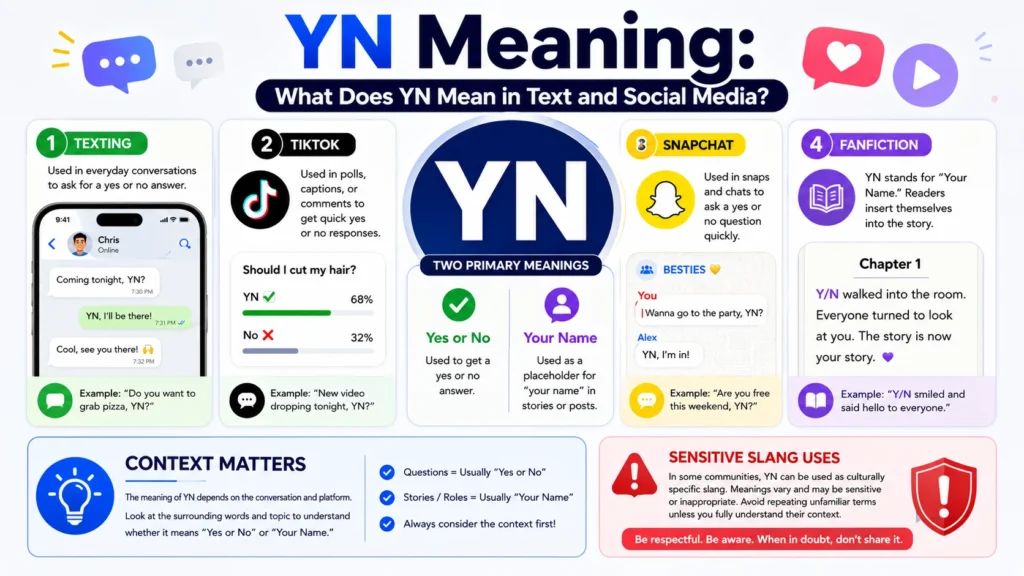
YN usually means “yes or no” in casual texting, while Y/N commonly means “your name” in fanfiction and reader insert stories. Context matters because the abbreviation also has niche slang meanings on social media.
YN meaning depends heavily on where you see the abbreviation and how someone uses it. In a quick text, YN can ask for a yes or no answer. However, in fanfiction or a TikTok POV story, Y/N often means “your name.”
That difference explains why the abbreviation can confuse people. The same two letters can serve different purposes across online communities.
For example, a friend might write, “You coming tonight, YN?” In that situation, the sender likely wants a simple yes or no response.
Now imagine a story saying, “Y/N opened the door and looked around.” Here, Y/N works as a placeholder for the reader’s name.
Context therefore matters more than the letters themselves. The surrounding words, platform, punctuation, and type of content usually reveal the intended meaning.
The abbreviation also appears in fandom culture, TikTok edits, Instagram captions, Snapchat conversations, and private messages. Furthermore, some communities use YN for culturally specific slang. That usage requires more caution because it can carry meanings that are inappropriate outside the community where they developed.
This guide explains the major interpretations, real conversation examples, platform differences, common mistakes, and safer ways to respond.
QUICK ANSWER BOX
| Meaning | Context | Primary Platforms | Example | Tone |
|---|---|---|---|---|
| Yes or no | Quick questions and chats | Snapchat, texting, Instagram | “Are you coming, YN?” | Casual and direct |
| Your name | Reader insert content | TikTok, fanfiction, Instagram | “Y/N walked into the room.” | Personal and imaginative |
| Niche slang | Specific online communities | TikTok, comments, music culture | Depends on surrounding context | Informal and culturally specific |
| Other abbreviation | Individual communities | Various | Depends on the sentence | Context dependent |
What Does YN Meaning Refer To?
The simplest answer is that YN does not have one universal definition.
In everyday texting, YN can mean “yes or no.” Someone may use it after a question when they want a direct answer. The abbreviation removes extra words and keeps the conversation moving.
For example:
“Movie tonight, YN?”
The sender essentially asks, “Are you going to the movie or not?”
However, Y/N has another established use in reader insert writing. There, it means “your name.” Writers use the placeholder instead of giving the main character a fixed name.
Consider this sentence:
“Y/N looked at the message and smiled.”
The reader mentally substitutes their own name for Y/N. Therefore, the sentence becomes personal without requiring the writer to choose a character name.
YN Versus Y/N
The slash can provide an important clue.
| Form | Common interpretation | Typical setting |
|---|---|---|
| YN | Yes or no | Texting and casual chat |
| Y/N | Your name | Fanfiction and reader insert stories |
| Y/N | Yes or no | Some forms, prompts, and questionnaires |
| yn | Community specific slang | Certain social media spaces |
Still, punctuation does not guarantee the meaning. People often type abbreviations loosely. A person may leave out the slash even when referring to “your name.”
Therefore, read the complete sentence before deciding what the abbreviation means.
Why Context Changes Everything
Internet language works differently from formal vocabulary.
A dictionary word usually has a relatively stable definition. Online abbreviations can behave more like signals. The community, platform, conversation, and topic can change the interpretation.
For example, “YN?” after “Are you free tonight?” strongly suggests “yes or no.”
By contrast, “YN walked into the café” looks like a character placeholder.
The grammar gives you a clue. The surrounding content confirms it.
Where Did the “Your Name” Usage Come From?
The “your name” interpretation developed strongly through reader insert and self insert storytelling. Fanfiction writers used Y/N as a practical placeholder.
The concept became especially visible across fandom communities. Readers could imagine themselves inside stories involving fictional characters, musicians, actors, or other public figures.
Over time, the convention moved beyond traditional fanfiction. It appeared in Tumblr posts, Wattpad stories, social media edits, TikTok POV content, memes, and Instagram fandom pages.
Modern creators may use Y/N even when they are not writing a full story. Instead, they use it to create an imagined situation where the viewer becomes the central character.
This explains why the abbreviation can appear in a short caption rather than an actual chapter of fiction.
Contextual Dynamics and Nuances of the Term
Understanding the abbreviation requires more than memorizing one definition.
The same letters can perform different grammatical jobs. They can function as a question shortcut, a character placeholder, or a community specific slang expression.
When YN Means Yes or No
The “yes or no” interpretation usually appears around a question.
Examples include:
“Did you finish the assignment, YN?”
“You coming with us, YN?”
“Should I post it, YN?”
In each case, the sender expects a binary response.
However, natural texting often makes the abbreviation unnecessary. A sender may simply write “yes or no?” instead. Therefore, YN is best understood as an informal shortcut rather than a universal texting rule.
When YN Means Your Name
The “your name” interpretation usually appears inside a story or imagined scenario.
For example:
“Y/N entered the room and everyone turned around.”
Here, Y/N does not describe a real person named YN. It tells the reader to imagine their own name.
This convention is especially common in romance, fandom, anime, celebrity, gaming, and fictional POV content.
Why People Use Reader Insert Language
Reader insert writing creates a direct relationship between the story and the audience.
Instead of reading about a completely separate protagonist, the reader imagines themselves as the protagonist.
That can make short social media stories feel more immersive. It also works well with POV videos because the audience can easily imagine participating in the scene.
Tone Can Change the Interpretation
Tone matters too.
A message such as “YN?” can sound impatient if the sender has already asked the question several times.
Meanwhile, “Movie tonight? yn?” may feel relaxed between friends.
In a fictional caption, Y/N usually has no conversational tone at all. It functions as a storytelling device.
Therefore, never judge the meaning from capitalization alone.
Real Life Conversation Examples Using YN
The best way to understand YN meaning is to examine realistic situations.
Example 1: Quick Text Confirmation
Alex: You still coming to the party?
Jordan: Yeah, why?
Alex: Just checking. You coming with us, YN?
Jordan: Yes 😂 Give me ten minutes.
Here, YN means “yes or no.” Alex wants confirmation rather than a detailed explanation.
Example 2: Group Chat Decision
Maya: We can order pizza at 8.
Chris: Works for me.
Taylor: Same.
Maya: Everyone good with pepperoni, YN?
Chris: Yep.
In this situation, the abbreviation makes the question short and casual.
Example 3: Reader Insert Story
Caption: Y/N walked into the concert venue and heard the crowd cheering.
Comment: Why does Y/N always have the best life? 😭
Here, Y/N means “your name.” It represents the person imagined as the main character.
Example 4: TikTok POV Content
Creator: POV: Y/N accidentally gets seated beside their celebrity crush.
Commenter: Y/N is living my dream.
This usage comes from reader insert culture. The viewer becomes the imagined character.
Example 5: Confusing Message
Sam: YN?
Riley: Wait, what do you mean?
Sam: Yes or no. Are you coming?
Riley: Ohhh. Yeah 😂
This example shows why abbreviations can create confusion. When context is missing, asking for clarification is often the best response.
Platform Specific Breakdown
Different platforms develop different communication habits. As a result, the same abbreviation can feel slightly different depending on where you encounter it.
How It Is Used on Snapchat
Snapchat encourages fast, informal communication.
People often send short messages, reactions, photos, and quick questions. Therefore, a compact abbreviation can fit naturally into the platform’s conversational style.
In direct messages, YN may mean “yes or no” when someone wants a quick answer.
For example:
“Coming tonight yn?”
A friend could answer:
“Yeah.”
However, Snapchat users may also share screenshots of TikTok or fandom content. In that situation, Y/N may refer to “your name.”
The surrounding message provides the strongest clue.
The Role of YN Meaning on TikTok
TikTok creates a more complicated environment because several online communities overlap there.
One video may use Y/N as a reader insert character. Another comment may use YN as casual shorthand. A third post may use the letters as community specific slang.
Reader insert content is especially relevant to TikTok POV culture. A creator may write:
“POV: Y/N gets caught sneaking out.”
The viewer is expected to imagine themselves as Y/N.
TikTok also encourages remixing. A phrase can move from fanfiction into memes, captions, comments, and reaction videos. Consequently, the original context may disappear while the abbreviation remains.
That is why someone unfamiliar with fandom culture may see Y/N and assume it represents a real person’s initials.
Instagram and Texting Dynamics
Instagram combines visual storytelling with private messaging.
In a DM, YN may work as a quick question. In a Reel caption, however, Y/N may identify the viewer as the fictional character.
For example:
“POV: Y/N finally gets revenge.”
This resembles TikTok storytelling.
Text messaging is different. A private conversation usually provides enough context to identify the intended meaning.
If someone asks, “You free tomorrow, YN?” the yes or no interpretation makes sense.
If someone sends, “Y/N walked into the classroom,” the reader insert interpretation becomes much more likely.
Other Places You May See It
The abbreviation can also appear in:
- Fanfiction communities
- Tumblr style fandom posts
- Wattpad stories
- YouTube comments
- Group chats
- X conversations
- Gaming communities
- Meme pages
- Online roleplay
- Private messages
The meaning can shift between these environments. Therefore, platform knowledge helps, but it never replaces context.
Alternative Meanings and NLP Variations of the Phrase
Searches for YN meaning can produce several definitions. Not all of them have equal frequency or relevance.
“Your Name”
This is the key interpretation in reader insert storytelling.
It usually appears as Y/N rather than plain YN. The placeholder allows readers to imagine themselves as the protagonist.
“Yes or No”
This is a straightforward conversational abbreviation.
It usually appears around a question. The sender wants a binary response.
For example:
“You want to go, YN?”
The expected answer is either yes or no.
“Why Not?”
Some informal online sources list YN as shorthand for “why not?” However, this interpretation is less standardized.
People usually write “why not,” “wn,” or simply “why not?” when they want to express that idea. Therefore, you should not automatically interpret YN as “why not.”
Context must support the reading.
“You Know”
Some communities may use similar letters as a conversational shortcut for “you know.” However, this is not a reliable universal definition.
If the sentence reads:
“That movie was wild, yn?”
the intended phrase could depend on the writer’s personal style or community.
Do not assume that every unusual abbreviation has one official meaning.
Culturally Specific Slang
There is also a sensitive slang interpretation in some online and music related communities. In that context, YN can refer to a shortened phrase containing a racial slur and describing a young person.
This meaning is not interchangeable with “your name” or “yes or no.”
It is also not appropriate to repeat or adopt a culturally specific term simply because it appears in a viral post.
If you encounter this usage, focus on understanding the context rather than copying the language.
NLP Signals That Help Identify the Meaning
From a language analysis perspective, several signals can help.
| Signal | Likely Interpretation |
|---|---|
| YN appears after a question | Yes or no |
| Y/N appears before a verb | Your name |
| POV appears nearby | Your name |
| Fanfiction language surrounds it | Your name |
| A story uses Y/N repeatedly | Your name |
| A message demands a binary response | Yes or no |
| Niche slang appears nearby | Check the community context |
| Meaning remains unclear | Ask the sender |
This approach is more reliable than memorizing a single definition.
Misinterpretations: When NOT to Use YN Meaning
Abbreviations save time, but they can also create misunderstandings.
Do Not Use It in Formal Writing
Avoid YN in professional emails, academic papers, job applications, official documents, and formal customer communication.
Instead of:
“Are you available tomorrow, YN?”
write:
“Are you available tomorrow?”
Clear language works better in professional settings.
Do Not Assume Everyone Knows It
Internet slang is not universal.
A friend may understand YN instantly. A parent, teacher, manager, client, or new acquaintance may not.
Therefore, consider the audience before using it.
Do Not Guess a Sensitive Meaning
If you see YN in a community where it may have a culturally specific meaning, do not immediately repeat it.
First, examine the surrounding words and conversation.
If the meaning remains uncertain, ask:
“What do you mean by YN here?”
That simple question prevents unnecessary mistakes.
Do Not Confuse YN With Y/N Automatically
The slash can matter.
Y/N in fanfiction commonly means “your name.” YN in a short question may mean “yes or no.”
Still, the distinction is not absolute.
Online writers frequently remove punctuation. Consequently, you should use grammar and context together.
Do Not Overinterpret a Two Letter Message
Someone sending “YN?” may not be using a sophisticated slang term.
They may simply want an answer.
Before analyzing the message too deeply, look at the conversation immediately before it.
How to Respond in Chat Comfortably
You do not need special slang knowledge to respond naturally.
The safest strategy is to identify the likely meaning and answer accordingly.
If YN Means Yes or No
Give a direct answer.
Message: “You coming tonight, YN?”
Natural response: “Yeah, I’ll be there.”
Or:
“No, I can’t make it.”
You do not need to repeat the abbreviation.
If You Are Unsure
Ask for clarification.
Try:
“Do you mean yes or no?”
Or:
“What does YN mean here?”
This sounds natural and avoids guessing.
If It Means Your Name
Treat Y/N as the fictional reader character.
For example, if someone says:
“Y/N finally got the message.”
You can respond:
“LOL, Y/N really took their time.”
The conversation already establishes the meaning.
If the Context Is Sensitive
Do not imitate unfamiliar slang.
Instead, ask what the person means or simply respond to the broader topic.
This is especially important when an abbreviation may carry cultural or racial implications.
Simple Responses You Can Use
| Situation | Comfortable Response |
|---|---|
| You understand it as yes or no | “Yep.” |
| You disagree | “Nope.” |
| You need clarification | “What do you mean by YN?” |
| It refers to your name | Continue the fictional scenario |
| The meaning seems sensitive | Avoid repeating the term |
| The context is formal | Use full words |
FAQs
What does YN mean in text?
In casual text conversations, YN can mean “yes or no.” It usually appears after a question when someone wants a direct answer. However, context can change the interpretation.
Does Y/N mean your name?
Yes. In fanfiction and reader insert stories, Y/N commonly means “your name.” The reader mentally substitutes their own name into the story.
What does YN mean on TikTok?
On TikTok, the meaning depends on the content. Y/N often appears in POV and reader insert videos. However, other uses can appear in comments and casual conversations.
What does YN mean on Snapchat?
In a direct Snapchat conversation, YN can mean “yes or no.” However, if the message discusses fanfiction or POV content, Y/N may instead mean “your name.”
Is YN formal English?
No. YN is an informal abbreviation. It works best in casual digital conversations and online communities. Avoid it in professional or academic writing.
Why do people write Y/N in fanfiction?
Writers use Y/N as a placeholder for the reader’s name. This technique lets readers imagine themselves inside the story.
Can YN have more than one meaning?
Yes. Internet abbreviations often have multiple meanings. Context, grammar, platform, and community culture help determine the intended interpretation.
Is YN always slang?
No. It can function as a simple abbreviation rather than slang. For example, someone might use it as shorthand for “yes or no.”
Should I use YN with strangers?
Use caution. If the person may not understand the abbreviation, write the full phrase instead. Clear communication matters more than saving two characters.
What should I do if I cannot understand YN?
Ask for clarification. A simple “What do you mean by YN here?” is better than guessing. This approach works across texting, TikTok comments, Instagram DMs, and group chats.
Conclusion
The biggest lesson behind YN meaning is simple: context beats assumptions.
In casual texting, YN can function as a shortcut for “yes or no.” In reader insert stories, Y/N commonly means “your name.” On social platforms, both interpretations can appear within the same digital environment.
That flexibility reflects how internet language evolves.
People shorten phrases to communicate faster. Communities also create specialized vocabulary that outsiders may not immediately recognize. As content moves between TikTok, Instagram, Snapchat, fanfiction, group chats, and other platforms, meanings can overlap.
Therefore, the safest approach is to examine the sentence around the abbreviation.
Ask what grammatical role the letters play. Look at the platform. Consider the topic. Check whether the content resembles a question, a fictional story, or a social media meme.
Most importantly, do not assume that every abbreviation has one fixed definition.
If someone sends YN after a direct question, a yes or no interpretation is likely. If you see Y/N inside a fictional POV story, “your name” is usually the better reading.
When the context remains unclear, simply ask.
That small habit is more useful than memorizing every piece of internet slang. Digital language changes quickly, but clear communication remains universal.

Kevin Brooks is a grammar specialist at GramBrix.com, dedicated to helping readers understand language rules with clarity and confidence. He simplifies complex grammar concepts through practical examples and easy explanations.