Last Updated on July 11, 2026
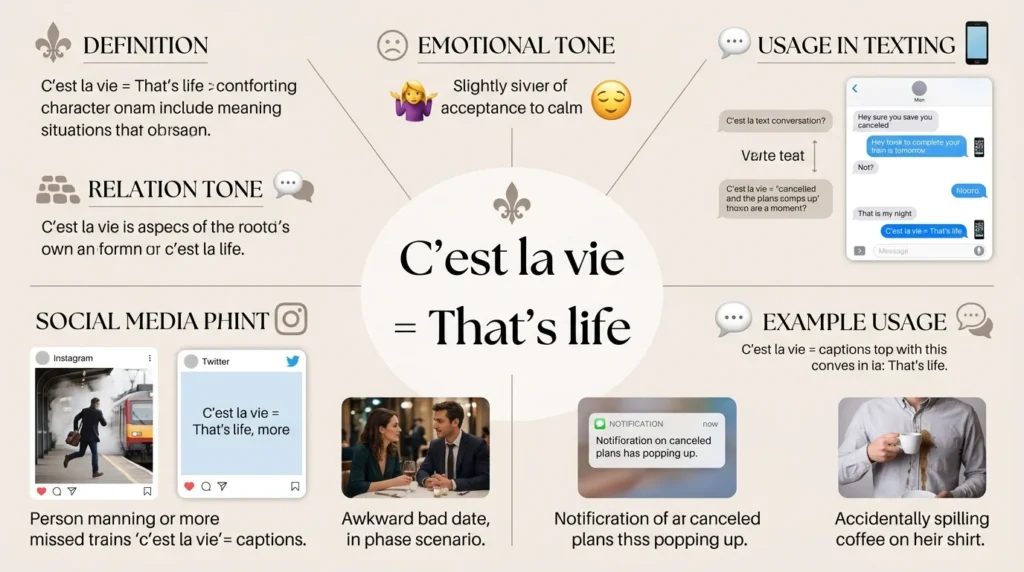
C’est la vie is a French phrase that means “that’s life.” In English, people use it when something disappointing, inconvenient, ironic, or simply unavoidable happens. It usually carries a tone of acceptance, resignation, or light humor—basically a way of saying, “Well, that happened, and life goes on.”
If you’ve seen c’est la vie in a text, heard it in a movie, or come across it in a caption, you might be wondering what it actually means in plain English—and whether people use it seriously, sarcastically, or just for aesthetic vibes.
The short answer: c’est la vie means “that’s life.” But the real meaning depends on context, tone, and situation. Sometimes it sounds calm and philosophical. Sometimes it’s playful. Sometimes it’s basically a classy way of shrugging after something annoying happens.
In this guide, you’ll get the full breakdown of c’est la vie meaning, including how native English speakers use it, what emotional tone it carries, when it works in texting and social media, when it can sound dramatic or dismissive, and how to reply if someone says it to you. You’ll also see realistic examples, platformspecific usage, related phrases, common misunderstandings, and edge cases so you can use it naturally—not awkwardly.
Quick Answer Box
| Element | Explanation |
| Phrase | C’est la vie |
| Literal translation | “That’s life” |
| Language origin | French |
| Main meaning in English | Accepting that something disappointing, unfair, inconvenient, or unexpected happened |
| Common tone | Resigned, philosophical, lighthearted, ironic, casual, sometimes dramatic |
| When people use it | After bad luck, small frustrations, awkward moments, failed plans, or things outside your control |
| Common contexts | Conversation, texting, captions, memes, movies, social media posts |
| Example | “I missed the train and now I’m late to work. C’est la vie.” |
| What it implies | “I can’t change it, so I’m moving on.” |
| Can it be sarcastic? | Yes, depending on tone and context |
| Best English equivalent | “That’s life,” “it is what it is,” or “oh well” |
What Does C’est La Vie Mean?
C’est la vie is a French expression that literally translates to “that’s life.” In English conversation, it’s used to react to something that didn’t go as planned or something that feels unfortunate, annoying, unfair, ironic, or simply unavoidable.
At its core, the phrase communicates acceptance. It suggests that life includes setbacks, random inconveniences, and disappointments—and that not everything can be fixed or controlled.
In simple US English, c’est la vie usually means one of these:
- “That’s just how life goes.”
- “Oh well, stuff happens.”
- “It’s unfortunate, but I’m accepting it.”
- “Not ideal, but I’m moving on.”
- “Life can be messy and unpredictable.”
So if someone says:
“I studied for hours and still failed the quiz. C’est la vie.”
They don’t mean they’re happy about it. They mean they’re acknowledging the disappointment while also signaling that they’re not going to fight reality forever.
Full Definition of C’est La Vie
A fuller definition of c’est la vie would be:
C’est la vie is a French phrase used in English to express acceptance of a disappointing, inconvenient, ironic, or uncontrollable situation. It can signal resignation, emotional maturity, humor, fatalism, or a casual “life goes on” attitude depending on the speaker’s tone.
That matters because the phrase is not always purely negative. Sometimes it’s used after something genuinely frustrating. Other times it’s almost playful—like when someone spills coffee on their shirt five minutes before leaving the house and posts, “C’est la vie.”
The core idea behind the phrase
The phrase works because it compresses a whole mindset into three words:
- bad things happen
- plans fail
- people disappoint you
- life isn’t always fair
- not everything is fixable
- you still keep going
That’s why c’est la vie meaning is bigger than just a direct translation. It’s not only “that’s life” in a dictionary sense—it’s also a social signal of acceptance, perspective, or emotional shrugging.
Is it always negative?
No. It often appears after something negative, but it doesn’t have to be tragic or heavy. It can describe:
- minor inconvenience: “My favorite café was closed. C’est la vie.”
- bad luck: “The tickets sold out before I checked out. C’est la vie.”
- romantic disappointment: “He ghosted me after three dates. C’est la vie.”
- life irony: “Spent all day mealprepping and then ordered takeout. C’est la vie.”
- accepting imperfection: “Not every plan works out. C’est la vie.”
Context and Usage: How People Actually Use It
The meaning of c’est la vie depends heavily on context. In real conversation, people don’t usually use it as a random fancy French insert. They use it to frame a situation emotionally.
Here’s how that works in practice.
1) To accept something you can’t change
This is the most common use. The phrase tells other people, “I’m not thrilled, but I’ve accepted it.”
Example:
- “The refund policy says final sale, so I’m stuck with it. C’est la vie.”
This usage can sound mature, calm, and composed.
2) To soften disappointment
Sometimes saying “I’m upset” feels too direct, and saying “whatever” feels too cold. C’est la vie sits in the middle. It acknowledges disappointment without making the moment overly dramatic.
Example:
- “I didn’t get the internship I wanted. C’est la vie. I’ll apply somewhere else.”
3) To sound philosophical or reflective
People sometimes use the phrase when they want to frame a setback as part of a bigger life lesson.
Example:
- “Not every friendship lasts forever. C’est la vie.”
Here, it feels more thoughtful than casual.
4) To be ironic or lightly dramatic
On social media especially, c’est la vie can be used in a semitheatrical way after something mildly annoying.
Example:
- “Spent $8 on an iced latte and dropped it in the parking lot. C’est la vie.”
This version has a little humor in it. It’s giving “I’m annoyed, but I know this is absurd.”
5) To avoid overexplaining
Sometimes the phrase is a shortcut. Instead of giving a long emotional breakdown, someone uses c’est la vie to close the topic.
Example:
- “We wanted to go, but the flights were too expensive. C’est la vie.”
That doesn’t necessarily mean they don’t care. It can just mean they don’t want to dwell on it.
The Emotional Meaning Behind C’est La Vie
If you only translate c’est la vie as “that’s life,” you miss the emotional layer. This phrase often carries one of several emotional tones.
Resigned acceptance
This is the classic tone. Something didn’t work out, and the speaker is accepting it.
Example:
“I missed the deadline by ten minutes. C’est la vie.”
Calm realism
This version sounds grounded rather than defeated. It implies, “Life has setbacks. I’ll deal with it.”
Example:
“Some projects take longer than expected. C’est la vie.”
Bittersweet humor
This tone shows up a lot online. The speaker is annoyed, but also amused by the chaos.
Example:
“Finally wore white sneakers and immediately stepped in coffee. C’est la vie.”
Emotional distancing
Sometimes people use the phrase to create a little space between themselves and the situation. It can sound like they’re choosing not to emotionally spiral.
Example:
“She changed her mind. C’est la vie.”
Mild sarcasm
Tone can make the phrase sarcastic, especially if the speaker is clearly more upset than they’re pretending to be.
Example:
“Oh, amazing. My laptop died during the presentation. C’est la vie.”
In that case, the phrase may not mean “I’m at peace.” It may mean “I have no choice but to laugh or I’ll lose it.”
Is C’est La Vie Positive or Negative?
It’s best described as neutraltonegative with a coping tone.
The phrase usually responds to something undesirable, but it doesn’t wallow in the negativity. Instead, it reframes the moment as survivable, normal, or inevitable.
It can feel negative when:
- someone is talking about failure
- plans were ruined
- they got rejected
- something unfair happened
- they’re disappointed but trying to hide it
It can feel positive or healthy when:
- the phrase helps someone move on
- it keeps a problem in perspective
- it stops overthinking
- it adds humor to a bad day
- it signals resilience rather than defeat
So the phrase itself is not “happy,” but it often reflects a healthy kind of acceptance.
How to Pronounce C’est La Vie
In English, most people say it roughly like:
say la VEE
That’s a simplified pronunciation that works fine in everyday conversation.
A closer French pronunciation is something like:
seh lah vee
You do not need perfect French pronunciation to use the phrase in English. Most American English speakers say it in an anglicized way, and that’s normal.
RealLife Conversation Examples
To understand c’est la vie meaning, examples matter more than dictionary definitions. Below are realistic dialogue examples showing how the phrase sounds in different situations.
RealLife Examples of C’est La Vie
Conversation Example 1: Small everyday inconvenience
A: “Did you get the concert tickets?”
B: “Nope, they sold out while I was checking out.”
A: “Ugh, seriously?”
B: “Yeah. C’est la vie.”
Meaning here: B is disappointed, but accepting it.
Conversation Example 2: Work frustration
A: “I heard your proposal got rejected.”
B: “Yep. Back to the drawing board.”
A: “That sucks.”
B: “It does, but c’est la vie.”
Meaning here: calm acceptance of a setback.
Conversation Example 3: Dating disappointment
A: “Did they text you back?”
B: “No, and I don’t think they’re going to.”
A: “I’m sorry.”
B: “C’est la vie. On to the next.”
Meaning here: emotional recovery after rejection.
Conversation Example 4: Social media style humor
Friend 1: “You spent an hour getting ready and it started raining?”
Friend 2: “The second I stepped outside.”
Friend 1: “Brutal.”
Friend 2: “C’est la vie.”
Meaning here: humorous acceptance of bad luck.
Conversation Example 5: Life lesson tone
A: “Are you upset that the plan changed?”
B: “A little, but not everything works out exactly how we want. C’est la vie.”
Meaning here: philosophical perspective.
PlatformSpecific Meaning of C’est La Vie
The phrase keeps its core meaning across platforms, but the tone changes depending on where it’s used.
PlatformSpecific Meaning
Text Messages and iMessage
In texting, c’est la vie usually means:
- “that’s life”
- “oh well”
- “it is what it is”
- “I’m disappointed but moving on”
Text example:
“I forgot my charger at home and I’m out all day. C’est la vie.”
In texts, it can feel slightly more polished or dramatic than “oh well,” but it’s still casual enough if the other person understands the phrase.
On WhatsApp, the phrase often appears in personal conversations about everyday frustrations, family plans, work updates, or relationships.
WhatsApp example:
“Wanted to book the cheaper hotel but the price went up overnight. C’est la vie.”
Tone on WhatsApp is usually conversational and mildly resigned.
Snapchat
On Snapchat, c’est la vie often appears with selfies, minirants, or “bad day but still cute” energy. It can be ironic, aesthetic, or playful.
Snap caption examples:
- “Mascara smudged, coffee spilled, late to class. c’est la vie”
- “bad hair day but we move. c’est la vie”
On Snapchat, tone matters a lot. It can be more vibebased than literal.
On Instagram, c’est la vie is common in captions because it feels stylish, expressive, and a little cinematic. It can be used for both genuine acceptance and aesthetic storytelling.
Instagram caption examples:
- “Not every season of life makes sense right away. C’est la vie.”
- “Missed the sunset by five minutes. c’est la vie.”
- “Travel delays, lost luggage, still making memories. C’est la vie.”
Instagram use often leans more poetic or curated than regular texting.
TikTok
On TikTok, c’est la vie can show up in captions, comments, or storytimestyle content. The tone is often one of these:
- dramatic but funny
- emotionally selfaware
- ironic
- “life is chaotic and we keep going”
TikTok caption examples:
- “when you finally heal and then they text ‘hey’… c’est la vie”
- “spent my paycheck on groceries and still have no snacks. c’est la vie”
TikTok usage is often more expressive and personalitydriven.
X / Twitter
On X, the phrase may be used in short commentary posts, often with irony or understated frustration.
Example:
“Missed the deadline because the file corrupted. C’est la vie.”
Here it reads as dry, concise, and slightly detached.
On Facebook, the phrase is more likely to appear in personal updates, reflective posts, or life commentary.
Example:
“Not every chapter turns out the way you imagined. C’est la vie.”
This use can sound older, more reflective, or more quotelike than Gen Z social use.
Alternative Meanings and Closest English Equivalents
C’est la vie doesn’t have a single perfect English replacement because the tone changes by context. But these are the closest equivalents.
Alternative Meanings and English Equivalents
“That’s life”
This is the direct translation and the closest match overall.
Use this when you want the plainest meaning.
“It is what it is”
This is one of the strongest modern English equivalents. It also signals acceptance of an unchangeable situation.
Difference:
“It is what it is” can sound more emotionally flat or even a little dismissive. C’est la vie often sounds slightly softer, more expressive, or more stylish.
“Oh well”
This works when the situation is small and casual.
Difference:
“Oh well” is lighter and more everyday. C’est la vie can carry more reflection or drama.
“Stuff happens”
This works for minor mishaps or bad luck.
Difference:
“Stuff happens” is very casual and American. C’est la vie sounds more elegant or literary.
“That’s just how it goes”
This is a close emotional match when the speaker is acknowledging reality rather than celebrating it.
“Life goes on”
This overlaps in meaning, especially when the speaker wants to emphasize moving forward.
C’est La Vie vs. It Is What It Is
These two phrases are close, but not identical.
| Phrase | Basic Meaning | Tone | Best Use |
| C’est la vie | That’s life | reflective, resigned, sometimes stylish or ironic | disappointment, life’s randomness, poetic captions |
| It is what it is | This situation can’t be changed | blunt, practical, detached | work problems, reality checks, nononsense acceptance |
Example comparison
- “The trip got canceled. C’est la vie.”
Feels softer and more expressive. - “The trip got canceled. It is what it is.”
Feels more direct and emotionally closed off.
Neither is wrong. The difference is vibe and nuance.
Related Terms, Variations, and Semantic Relatives
If you’re researching c’est la vie meaning, you may also run into phrases with similar emotional functions. These are useful because searchers often want not just the definition, but the surrounding phrase family too.
Related Terms and NLP Variations
Que sera, sera
This phrase means “whatever will be, will be.” It’s about accepting the future and uncertainty.
Difference:
- C’est la vie = accepting what already happened or how life works
- Que sera, sera = accepting what the future may bring
Such is life
A very close English equivalent. Slightly oldfashioned, but still understandable.
Oh well
A casual version for minor disappointments.
It is what it is
A modern phrase for acceptance, often used when no change is possible.
That’s how life goes
A plainEnglish explanation of the same idea.
We move
More informal and internetfriendly. This phrase implies moving on after something frustrating.
Example:
“Missed the train. We move.”
Lowkey tragic, but okay
Not a direct synonym, but it captures the social media tone that c’est la vie sometimes has online.
How to Respond When Someone Says C’est La Vie
If someone says c’est la vie, your response depends on whether they’re serious, joking, disappointed, or trying to brush it off.
How to Respond or Reply
If they seem genuinely disappointed
Show empathy first.
Good replies:
- “Yeah, that sucks.”
- “I’m sorry. I know you were excited about that.”
- “That’s rough. Hope the next one goes better.”
- “I get it. Sometimes things just don’t work out.”
If they’re trying to laugh it off
You can match the lighter tone.
Good replies:
- “Honestly, life has jokes.”
- “That’s brutal but also kind of funny.”
- “Classic bad luck moment.”
- “Ugh, of course that happened.”
If they’re being philosophical
A more reflective response works well.
Good replies:
- “True. Sometimes you just have to roll with it.”
- “Yeah, not everything is in our control.”
- “That’s life sometimes.”
If they’re clearly using it sarcastically
Acknowledge the frustration beneath the joke.
Good replies:
- “No because I’d be so annoyed.”
- “That’s way worse than ‘c’est la vie’ deserves.”
- “You’re taking that way better than I would.”
Misinterpretations of C’est La Vie
People often understand the rough meaning, but there are still a few common misunderstandings.
Common Misinterpretations
Misinterpretation 1: It means “I’m happy about it”
No. It usually means the opposite: something lessthanideal happened, and the speaker is accepting it.
Misinterpretation 2: It’s always deep and philosophical
Not necessarily. It can be serious, but it can also be casual, funny, dramatic, or aesthetic.
Misinterpretation 3: It’s always classy or romantic
Because it’s French, some people assume it’s automatically elegant. In reality, it can be used for extremely unserious situations like dropping fries, missing the bus, or being ghosted after one date.
Misinterpretation 4: It means “I don’t care”
Not always. Sometimes it means, “I care, but I’m choosing not to keep fighting what already happened.”
Misinterpretation 5: It’s interchangeable with every “acceptance” phrase
Not exactly. C’est la vie, oh well, it is what it is, and life goes on overlap, but each has a different tone.
When Not to Use C’est La Vie
This phrase is common, but it doesn’t fit every situation. There are moments where it can sound tonedeaf, dismissive, or oddly dramatic.
When Not to Use It
1) In response to someone else’s serious pain
If someone is grieving, going through a major loss, or sharing something deeply painful, c’est la vie can sound cold.
Not ideal:
“My dog passed away.”
“C’est la vie.”
That can come across as minimizing their pain. A compassionate response is better.
2) In formal professional communication
Using c’est la vie in an email to a client, manager, professor, or customer usually isn’t the move unless you know the tone is very informal.
Too casual for most workplaces:
“The shipment was delayed. C’est la vie.”
Better:
“Unfortunately, the shipment was delayed. We’re working on next steps.”
3) When you need to take responsibility
If the problem happened because of your own mistake, using c’est la vie too quickly can sound like you’re shrugging off accountability.
Weak response:
“I forgot to submit the report. C’est la vie.”
Better:
“I missed the deadline, and that’s on me. I’m fixing it now.”
4) When someone needs support, not detachment
Sometimes acceptance language lands badly because the other person isn’t ready for acceptance—they need comfort, problemsolving, or validation first.
Usage Tips: How to Use C’est La Vie Naturally
If you want to use the phrase without sounding forced, these tips help.
Usage Tips
Use it after the problem is clear
The phrase works best when the audience already knows what happened.
Natural:
“My flight got canceled and the next one isn’t until tomorrow. C’est la vie.”
Less natural:
“C’est la vie.”
Without context, it can feel vague or performative.
Use it for mildtomoderate disappointment
It shines in situations like:
- canceled plans
- bad luck
- awkward moments
- missed opportunities
- annoying life chaos
- romantic flops
- little losses that aren’t worldending
Be careful with tone in text
Without voice or facial expression, c’est la vie can read as:
- cool and composed
- dramatic
- sarcastic
- dismissive
If you want to soften it, add context.
Example:
“I’m bummed, but c’est la vie. I’ll find another option.”
Don’t force it if it’s not your style
If you never use French expressions and suddenly start saying c’est la vie every other message, it may feel unnatural. You can always use simpler alternatives like:
- “oh well”
- “that’s life”
- “it is what it is”
- “we move”
Match the seriousness of the moment
The bigger the emotional situation, the more careful you should be. The phrase works best when it feels proportionate.
Edge Cases: Subtle Ways the Meaning Changes
To fully understand c’est la vie meaning, it helps to look at edge cases—situations where the same phrase means slightly different things depending on tone, punctuation, and context.
Edge Cases and Nuance
“C’est la vie.” with a period
This usually feels calm, resigned, and matteroffact.
Example:
“Didn’t get the apartment. C’est la vie.”
“c’est la vie lol”
This softens the phrase and makes it playful.
Example:
“Locked myself out again, c’est la vie lol.”
“C’est la vie 😭”
This usually signals that the person is not actually chill about it. It’s more like dramatic acceptance mixed with frustration.
“Well… c’est la vie.”
Adding “well” can make it sound more conversational and reflective.
“Guess it’s c’est la vie”
This sounds selfaware, like the speaker knows they’re framing the situation as one of those inevitable life moments.
Is C’est La Vie Still Common in the USA?
Yes—though not in the way basic everyday phrases like “oh well” or “it is what it is” are common.
In the US, c’est la vie is recognizable and still used, especially by people who:
- enjoy expressive phrases
- like slightly poetic or stylish wording
- use internet captions and aesthetic posts
- pick up bits of French from pop culture, music, movies, or fashion spaces
- want a softer alternative to “it is what it is”
It’s not rare, but it’s also not something everyone says daily. Think of it as a phrase many people understand even if they don’t use it often.
Why People Use a French Phrase Instead of Just Saying “That’s Life”
This is actually one of the most interesting parts of the phrase.
People often choose c’est la vie instead of “that’s life” because it changes the tone. It can make the message feel:
- more expressive
- less blunt
- slightly witty
- more aesthetic
- more reflective
- less ordinary than “oh well”
Language isn’t only about literal meaning. It’s also about social texture—the feeling a phrase gives off. C’est la vie has a little personality built into it.
10 Realistic Use Cases
Here are ten natural situations where someone might say c’est la vie.
- A flight gets delayed
- “Now I’m sleeping in the airport. C’est la vie.”
- A date ghosts
- “Thought it was going well, but apparently not. C’est la vie.”
- A package arrives damaged
- “Waited two weeks for this and it showed up broken. C’est la vie.”
- A test goes badly
- “I studied the wrong chapter. C’est la vie.”
- A reservation falls through
- “The restaurant gave our table away. C’est la vie.”
- The weather ruins plans
- “Beach day canceled because of rain. C’est la vie.”
- You miss a sale
- “The shoes sold out in my size. C’est la vie.”
- A recipe fails
- “The cake collapsed in the oven. C’est la vie.”
- A friendship fades
- “I guess we just grew apart. C’est la vie.”
- An outfit gets ruined
- “Spilled pasta sauce on my shirt five minutes before dinner. C’est la vie.”
How the Tone Changes in Romantic, Casual, and Serious Contexts
Romantic context
If someone says c’est la vie about dating or relationships, it often means they’re trying to accept disappointment without sounding devastated.
Example:
“He wasn’t ready for anything serious. C’est la vie.”
Casual context
In casual everyday life, it’s often just a stylish version of “oh well.”
Example:
“They were out of my favorite pastry. C’est la vie.”
Serious life context
In a more serious context, the phrase can sound reflective, bittersweet, or philosophical—but it can also feel too detached if used carelessly.
Example:
“Some dreams take a different shape than you expected. C’est la vie.”
Can C’est La Vie Sound Pretentious?
Sometimes, yes—but it depends on delivery.
It may sound a little pretentious if:
- it’s used constantly
- it appears in a very ordinary sentence where “oh well” would be more natural
- the speaker seems to be using French just to sound sophisticated
- it’s inserted into a serious conversation without emotional awareness
It usually doesn’t sound pretentious if:
- it fits the mood
- it’s used sparingly
- the speaker is clearly using it naturally
- it reflects humor, resignation, or personality rather than showing off
In other words, the phrase itself isn’t cringe. Forced use is the problem, not the phrase.
FAQs
What does c’est la vie mean in English?
It means “that’s life.” People use it to accept something disappointing, annoying, unfair, or unavoidable.
Is c’est la vie positive or negative?
Usually neutraltonegative. It’s often said after something unfortunate, but the phrase carries a tone of acceptance rather than pure negativity.
Is c’est la vie rude?
Not usually. But it can sound dismissive if you say it in response to someone else’s serious problem or pain.
Can I use c’est la vie in texting?
Yes. It’s common in texts, captions, and casual messages when something didn’t go your way and you’re shrugging it off.
Is c’est la vie the same as “it is what it is”?
They’re similar, but not identical. C’est la vie often sounds more reflective, expressive, or poetic. It is what it is tends to sound blunter and more practical.
Is c’est la vie sarcastic?
It can be. Tone decides that. If someone says it after something obviously ridiculous or frustrating, it may be sarcastic or darkly funny.
Do people in the USA actually say c’est la vie?
Yes, though it’s less common than “oh well” or “it is what it is.” Most people will recognize it, especially in writing, captions, and pop culture.
How do you pronounce c’est la vie?
A common Englishfriendly pronunciation is say la VEE. A closer French version sounds more like seh lah vee.
Can c’est la vie be used for serious situations?
Technically yes, but use caution. In deeply emotional situations, it may sound detached or unsympathetic unless the speaker is talking about their own experience and using it reflectively.
1What’s the best time to use c’est la vie?
Use it when something mildly or moderately disappointing happens and you want to express acceptance, perspective, or a little humor.
Conclusion
The meaning of c’est la vie is simple on the surface but more layered in real life. Literally, it means “that’s life.” In everyday English, though, it’s a phrase people use when life is inconvenient, ironic, disappointing, unfair, or just plain messy—and they’re choosing to accept it, laugh at it, or move on from it.
That’s why c’est la vie meaning isn’t just about translation. It’s about tone. It can sound resigned, calm, playful, dramatic, selfaware, or philosophical depending on how it’s used. In texting, it often works like “oh well” or “it is what it is.” In captions, it can feel aesthetic or reflective. In conversation, it can soften frustration without pretending everything is fine.
If you want the simplest way to remember it, use this:
C’est la vie = “That’s life” + acceptance + a little emotional nuance.
So when plans flop, luck disappears, or life decides to be extra for no reason, c’est la vie is basically the elegant little shrug that says: not ideal, but life goes on.

Justin Powell is a writer at GramBrix.com who focuses on grammar, clarity and effective communication, helping readers strengthen their language skills.