
Last Updated on July 5, 2026
10W30 vs 5W30 engine oil refers to different viscosity grades that affect how oil flows in cold and hot temperatures.
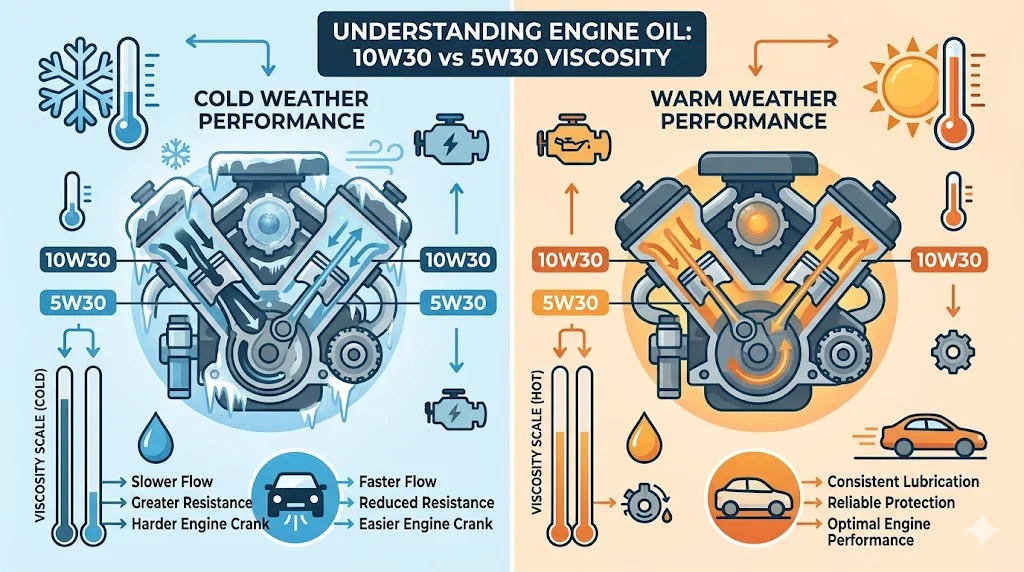
5W30 flows better in cold weather, making it ideal for cold starts, while 10W30 is slightly thicker at low temperatures and often better for warmer climates or older engines. Both oils can perform similarly at operating temperature.
Choosing between 10W30 vs 5W30 engine oil can be confusing for many drivers. Both oils are widely used in cars, bikes, and light trucks, but their small difference in viscosity can impact engine performance, fuel efficiency, and cold start behavior.
Many people assume all engine oils are the same. This is not true. The wrong oil can reduce engine life, increase wear, and lower fuel economy. That is why understanding 10W30 vs 5W30 is important for every vehicle owner.
This guide explains everything in simple words. You will learn what these oil grades mean, when to use each one, and how they affect your engine. We will also cover real examples, common mistakes, comparisons, exercises, and FAQs. By the end, you will be able to confidently choose between 10W30 vs 5W30 for your vehicle.
Quick Answer Overview of 10W30 vs 5W30
The main difference between 10W30 vs 5W30 is how they behave in cold temperatures.
- 5W30 flows better in cold weather (thinner when cold)
- 10W30 is slightly thicker in cold starts
- Both perform similarly at normal engine temperature
Simple Summary
- Cold climate → 5W30 is better
- Warm climate → 10W30 is fine
- Modern engines → mostly prefer 5W30
- Older engines → may prefer 10W30
Understanding Engine Oil Viscosity
To understand 10W30 vs 5W30, you must first understand viscosity.
Viscosity means how thick or thin a liquid is.
- Water = low viscosity (flows fast)
- Honey = high viscosity (flows slow)
Engine oil must be thin enough to flow quickly but thick enough to protect engine parts.
What does 5W30 mean?
- “5W” = Winter (cold temperature flow rating)
- “30” = high temperature viscosity
So, 5W30 oil flows like a 5-grade oil in cold weather and performs like a 30-grade oil when hot.
What does 10W30 mean?
- “10W” = slightly thicker in cold weather
- “30” = same hot temperature performance as 5W30
10W30 vs 5W30: Full Comparison Table
| Feature | 5W30 | 10W30 |
| Cold start performance | Excellent | Good |
| Cold weather flow | Faster | Slower |
| Fuel efficiency | Slightly better | Standard |
| Engine protection in cold | High | Moderate |
| Hot temperature performance | Same | Same |
| Best climate | Cold to moderate | Warm to hot |
| Engine wear at startup | Lower | Slightly higher |
| Common usage | Modern cars | Older vehicles |
Advantages and Disadvantages of 10W30 vs 5W30
Advantages of 5W30
- Better cold start lubrication
- Improves fuel economy slightly
- Reduces engine wear in winter
- Recommended for modern engines
- Works in wide temperature range
Disadvantages of 5W30
- Slightly more expensive in some regions
- May be too thin for very old engines
- Not always needed in hot-only climates
Advantages of 10W30
- Good for hot weather conditions
- Slightly thicker protection at startup
- Often cheaper and widely available
- Suitable for older engines with wear
Disadvantages of 10W30
- Poorer cold start performance
- Slightly lower fuel efficiency
- Not ideal for freezing temperatures
- Less suitable for modern engine designs
Real-World Examples of 10W30 vs 5W30
Example 1: Cold Climate Driving
A driver in a cold region starts the car at -10°C.
- 5W30 flows quickly
- Engine starts smoothly
- Less wear occurs
👉 Best choice: 5W30
Example 2: Hot Climate Driving
A driver in a hot region where temperature reaches 40°C.
- Both oils perform similarly at engine temperature
- 10W30 provides slightly thicker protection at startup
👉 Best choice: 10W30
Example 3: Daily City Driving
A modern car used for short trips.
- Engine starts frequently
- Cold start protection is important
👉 Best choice: 5W30
Example 4: Older Engine with High Mileage
An engine with wear and oil consumption issues.
- Thicker oil helps reduce leakage
- Better sealing inside engine
👉 Best choice: 10W30
Regional and Global Usage of 10W30 vs 5W30
Different countries prefer different oil grades based on climate.
Cold Regions (Europe, Canada, Northern USA)
- Mostly use 5W30
- Required for winter starting conditions
Moderate Climates (UK, parts of Asia)
- Both oils used depending on vehicle
Hot Regions (Middle East, South Asia)
- 10W30 is commonly used
- Sometimes 20W50 is also used in extreme heat
Common Mistakes in 10W30 vs 5W30 Selection
Mistake 1: Using only price as decision factor
Cheap oil is not always better.
Mistake 2: Ignoring manufacturer recommendation
Always check your vehicle manual first.
Mistake 3: Mixing oil types without understanding
Mixing is sometimes possible but not ideal.
Mistake 4: Thinking thicker oil is always better
Thicker oil can reduce fuel efficiency and damage modern engines.
Mistake 5: Not changing oil on time
Even the best oil fails if not replaced regularly.
Exercises with Answers (10W30 vs 5W30 Practice)
Exercise 1
Which oil flows better in cold weather?
Answer: 5W30
Exercise 2
Which oil is better for hot climates?
Answer: 10W30 (slightly better for older engines and hot conditions)
Exercise 3
Both oils perform the same at what temperature?
Answer: Normal engine operating temperature
Exercise 4
Which oil reduces cold start engine wear more?
Answer: 5W30
Exercise 5
Which oil is often preferred in modern vehicles?
Answer: 5W30
Related Concepts and Comparisons
10W30 vs 5W30 vs 20W50
- 5W30 → thin, best for cold and modern engines
- 10W30 → medium, balanced performance
- 20W50 → thick, used in hot climates and older engines
Synthetic vs Conventional Oil
- Synthetic oil flows better and lasts longer
- Conventional oil is cheaper but needs frequent changes
Engine Wear and Lubrication
Proper viscosity reduces:
- Friction
- Heat
- Engine wear
- Fuel consumption
FAQs
What is the main difference between 10W30 vs 5W30?
The main difference is cold temperature flow. 5W30 flows better in cold starts compared to 10W30.
Can I use 10W30 instead of 5W30?
Yes, in warm climates and older engines, but always check your vehicle manual first.
Is 5W30 better than 10W30 for fuel economy?
Yes, 5W30 usually improves fuel efficiency slightly due to lower resistance.
Which is better for winter, 10W30 vs 5W30?
5W30 is better for winter because it flows more easily in cold temperatures.
Does 10W30 protect engine better than 5W30?
Not necessarily. Both protect equally at operating temperature.
Can using wrong oil damage engine?
Yes, long-term use of incorrect oil can increase wear and reduce engine life.
Is 5W30 good for high mileage engines?
Sometimes yes, but high mileage engines may benefit from slightly thicker oil depending on condition.
Why do manufacturers recommend 5W30?
Because it improves efficiency, cold start protection, and meets modern engine design needs.
Can I mix 10W30 and 5W30?
It is possible in emergencies, but not recommended for long-term use.
Which is more common today, 10W30 vs 5W30?
5W30 is more common in modern vehicles worldwide.
Conclusion
Understanding 10W30 vs 5W30 is essential for maintaining engine health, performance, and fuel efficiency. While both oils serve similar purposes at normal operating temperatures, their difference becomes important during cold starts and climate conditions.
5W30 is generally the better choice for modern engines and cold climates because it flows more easily and reduces startup wear. 10W30 still has strong value, especially in warmer regions and older engines that require slightly thicker oil protection.
The best recommendation is always to follow your vehicle manufacturer’s manual. Climate, driving habits, and engine condition should also guide your decision. Choosing the right oil ensures longer engine life, smoother performance, and better fuel economy.

Kevin Brooks is a grammar specialist at GramBrix.com, dedicated to helping readers understand language rules with clarity and confidence. He simplifies complex grammar concepts through practical examples and easy explanations.