
Last Updated on July 7, 2026
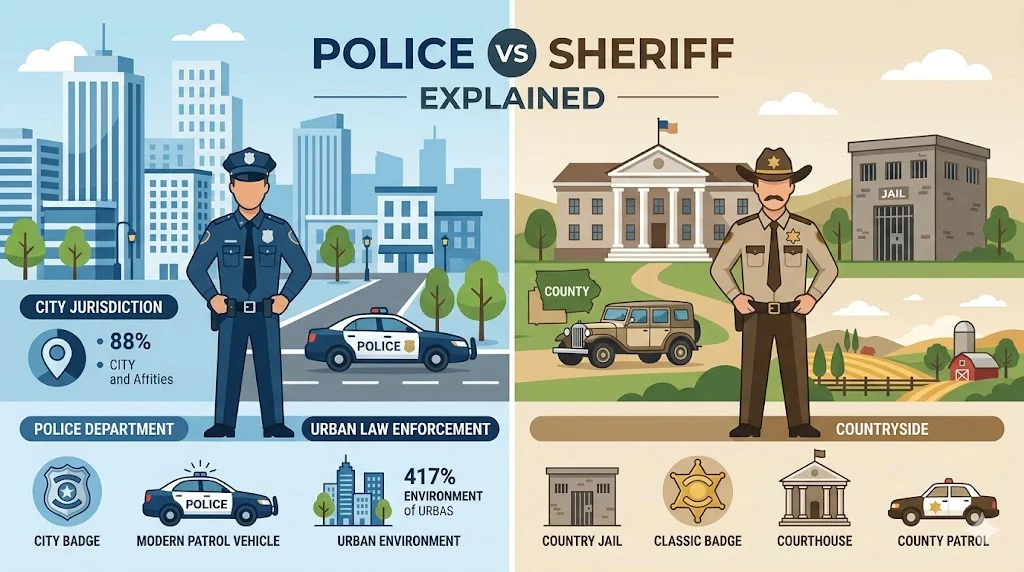
The difference between police and sheriff mainly lies in jurisdiction and authority structure. Police officers work for city or municipal governments, while sheriffs are elected officials who serve at the county level. Both enforce laws, but their responsibilities, areas of control, and organizational systems differ significantly.
The terms police and sheriff are often used in the same way, but they are not the same. Many people get confused about who does what, especially in movies, news, and real life situations. Both are law enforcement agencies, but they work in different ways and serve different levels of government.
Understanding police vs sheriff is important for students, citizens, and anyone interested in public safety. It helps you know who to call in emergencies, how law is enforced in your area, and how justice systems are structured.
The confusion comes from overlap in duties. Both arrest criminals, respond to emergencies, and protect communities. However, their jurisdiction, hiring system, and responsibilities are not identical. In some places, you may see both working together, while in others only one is present.
This article explains everything in simple words. You will learn definitions, differences, real examples, advantages, disadvantages, and common mistakes. By the end, you will clearly understand police vs sheriff and how each plays a vital role in maintaining law and order.
Quick Answer Overview of Police vs Sheriff
Police and sheriffs both enforce laws but operate in different systems.
Police officers usually work in cities or towns and are hired by municipal governments. Their main job is to maintain law and order within city limits.
Sheriffs work at the county level and are often elected by the public. They manage county jails, serve legal documents, and provide law enforcement in rural areas.
In simple terms:
Police = city level law enforcement
Sheriff = county level law enforcement
Both are essential for public safety but serve different geographic and administrative roles.
Definition and Explanation of Police vs Sheriff
What is a Police Department
A police department is a local government agency responsible for enforcing laws within a city or municipality. Police officers are hired, trained, and managed by city officials.
Their duties include:
- Responding to emergency calls
- Investigating crimes
- Patrolling neighborhoods
- Enforcing traffic laws
- Preventing crime in urban areas
Police departments are common in cities, towns, and urban communities where population density is high.
What is a Sheriff’s Office
A sheriff’s office is a county level law enforcement agency. The sheriff is usually an elected official chosen by voters in the county.
Their responsibilities include:
- Managing county jails
- Serving court orders and legal documents
- Providing law enforcement in rural areas
- Supporting courts and legal processes
- Assisting police when needed
Sheriffs often cover areas outside city limits, especially rural or unincorporated regions.
Key Idea
The main difference in police vs sheriff is not authority level but jurisdiction. Both enforce the law but in different geographic and administrative boundaries.
Police vs Sheriff Comparison Table
| Feature | Police | Sheriff |
| Jurisdiction | City or municipality | County |
| Leadership | Appointed chief | Elected sheriff |
| Area covered | Urban areas | Rural and county areas |
| Main focus | City law enforcement | County law enforcement and jail management |
| Funding | City government | County government |
| Jail management | Rarely | Primary responsibility |
| Court duties | Limited | Serve warrants and legal documents |
| Uniform style | Varies by city | Often standardized county design |
This table shows the core structural differences in police vs sheriff systems.
Advantages and Disadvantages of Police vs Sheriff
Advantages of Police Departments
- Faster response in cities due to local focus
- Specialized units like cybercrime or narcotics
- Strong community policing programs
- Better urban infrastructure support
Disadvantages of Police
- Limited jurisdiction outside city limits
- May require sheriff support in rural or border areas
- Higher workload in densely populated cities
Advantages of Sheriff Offices
- Wider jurisdiction across counties
- Manage jails and court systems
- Elected accountability to public
- Strong presence in rural areas
Disadvantages of Sheriff Offices
- Slower response in remote regions
- Broader responsibilities can stretch resources
- Political influence due to elected position
Real World Examples of Police vs Sheriff
Example in a City
If a crime happens in New York City, the New York Police Department handles it. They patrol streets, investigate crimes, and maintain city safety.
This is a clear example of police vs sheriff difference where police take the lead in urban environments.
Example in a County
If a crime happens in a rural part of Texas outside city boundaries, the county sheriff’s office responds. They may also transport suspects to jail and handle court orders.
This shows sheriff responsibility in county level jurisdiction.
Example Collaboration
Sometimes police and sheriffs work together. For example:
- A criminal moves from city to rural area
- A major investigation crosses jurisdictions
- Emergency disaster response
In such cases, cooperation is essential for public safety.
Regional and Global Usage of Police vs Sheriff
United States
The distinction between police vs sheriff is most common in the United States. Cities have police departments, while counties have sheriff’s offices.
United Kingdom
The UK does not use sheriffs in the same law enforcement sense. Police forces cover both city and county level responsibilities.
Canada
Canada mainly uses police services. Sheriffs exist in some provinces but often focus on court security rather than general policing.
Other Countries
Most countries use a unified police system without a separate sheriff structure. The sheriff model is mainly historical and regional.
Common Mistakes About Police vs Sheriff
Mistake 1: Thinking they have different authority levels
Both police and sheriffs have similar law enforcement authority within their jurisdiction.
Mistake 2: Assuming sheriffs outrank police
Sheriffs do not rank above police officers. They simply serve different areas.
Mistake 3: Believing police handle everything in a county
Police only handle city areas. Outside cities, sheriffs take over.
Mistake 4: Thinking sheriffs only manage jails
Sheriffs also patrol, investigate crimes, and serve legal documents.
Mistake 5: Confusing uniforms with authority
Uniforms vary by department and do not indicate power differences.
Exercises with Answers on Police vs Sheriff
Exercise 1
Which agency handles law enforcement in a city?
Answer: Police department
Exercise 2
Who is usually elected by the public?
Answer: Sheriff
Exercise 3
Which agency manages county jails?
Answer: Sheriff’s office
Exercise 4
True or False: Police and sheriffs work in the same jurisdiction.
Answer: False
Exercise 5
A crime occurs outside city limits. Who responds?
Answer: Sheriff
Exercise 6
Match the responsibility:
- Traffic control in city
- Serving court orders
Answers:
- Traffic control in city: Police
- Serving court orders: Sheriff
Exercise 7
Which agency is more common in rural areas?
Answer: Sheriff
Exercise 8
Can police and sheriffs work together?
Answer: Yes, they often collaborate.
Related Concepts and Comparisons
Police vs Sheriff vs State Trooper
- Police: City level
- Sheriff: County level
- State Trooper: State highways and statewide jurisdiction
Law Enforcement Structure
Understanding police vs sheriff also helps understand the broader system:
- Local government agencies
- County government agencies
- State agencies
- Federal agencies
Federal Agencies
Examples include FBI and DEA, which operate above local police and sheriffs.
Jurisdiction Importance
Jurisdiction determines:
- Who responds to crime
- Who investigates cases
- Who manages detention facilities
FAQs
What is the main difference between police and sheriff?
The main difference is jurisdiction. Police work in cities, while sheriffs work in counties.
Is a sheriff higher than police?
No. A sheriff is not higher in rank. They just have different responsibilities.
Who has more power, police or sheriff?
Both have equal law enforcement power within their areas of authority.
Do sheriffs go on patrol like police?
Yes. Sheriffs also patrol, especially in rural and county areas.
Who runs the jail, police or sheriff?
Sheriffs usually manage county jails.
Why are sheriffs elected?
Sheriffs are elected to ensure public accountability at the county level.
Can police enter sheriff territory?
Yes, but usually with coordination or special authority.
Do police and sheriffs wear different uniforms?
Yes, but it varies by region and department, not by authority level.
Who responds faster in emergencies?
It depends on location. Police respond faster in cities, sheriffs in rural areas.
Are sheriffs only in the United States?
Mostly yes. The sheriff system is primarily used in the United States.
Conclusion
Understanding police vs sheriff is essential for knowing how law enforcement works in your community. Both agencies are crucial for public safety, but they operate in different jurisdictions and have distinct responsibilities.
Police departments focus on cities and urban areas, while sheriffs cover counties and rural regions. Despite differences, both work together to maintain law and order.
The key takeaway is simple: neither is superior. They are partners in the same mission of protecting people and enforcing laws.
For citizens, knowing the difference helps in emergencies, legal awareness, and civic understanding. Whether you live in a city or rural area, both police and sheriffs play an important role in keeping communities safe.

Justin Powell is a writer at GramBrix.com who focuses on grammar, clarity and effective communication, helping readers strengthen their language skills.