
Last Updated on July 15, 2026
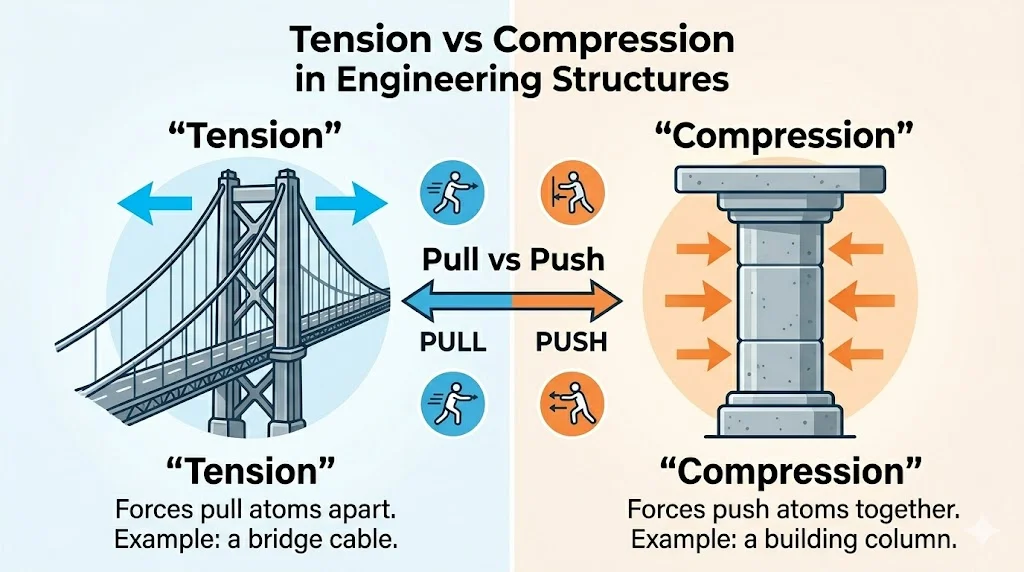
Tension and compression are two fundamental forces in physics and engineering that describe how materials respond to stress. Tension pulls and stretches a material apart, while compression pushes and shortens it. Understanding tension vs compression is essential for designing safe structures like bridges, buildings, and machines.
Tension and compression are among the most fundamental concepts in physics, engineering, and construction. Every structure around us whether it is a skyscraper, a cable bridge, or even a simple wooden chair relies on how materials respond to these two forces.
When a force pulls a material apart, it creates tension. You can think of a rope being stretched while pulling a heavy object. The material is being “pulled” from both ends. On the other hand, when a force pushes a material inward, it creates compression. A building column supporting a roof is constantly under compression as it carries the weight above it.
These forces are not just textbook ideas—they are present everywhere in daily life. From the cables of elevators and cranes (tension) to the legs of tables and pillars of houses (compression), both forces continuously shape how structures stand, bend, and sometimes fail.
Understanding tension vs compression is essential for engineers, architects, and material scientists. It allows them to design safe, stable, and efficient structures that can withstand real world loads without breaking or collapsing. Even in biomechanics, our bones and muscles depend on these forces to support movement and posture.
In this guide, you will build a clear and practical understanding of both concepts. We will break down simple definitions, compare their differences, explore real world examples, and highlight common mistakes students make when learning them. By the end, you will not only be able to distinguish tension from compression but also see how these forces quietly control the stability of the world around you.
Quick Overview of Tension vs Compression
Tension and compression are opposite types of mechanical stress.
- Tension pulls materials apart.
- Compression pushes materials together.
Both forces act on structures all the time. A bridge cable is under tension, while a bridge pillar is under compression. Without understanding these forces, safe construction would not be possible.
Definition of Tension vs Compression
What is Tension?
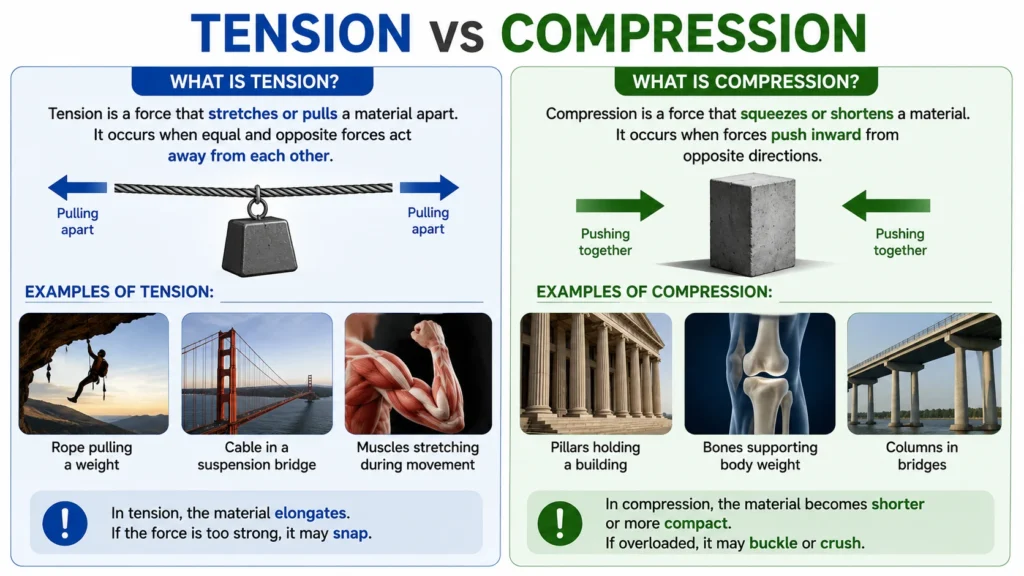
Tension is a force that stretches or pulls a material apart. It occurs when equal and opposite forces act away from each other.
Examples of tension:
- Rope pulling a weight
- Cable in a suspension bridge
- Muscles stretching during movement
In tension, the material elongates. If the force is too strong, it may snap.
What is Compression?
Compression is a force that squeezes or shortens a material. It occurs when forces push inward from opposite directions.
Examples of compression:
- Pillars holding a building
- Bones supporting body weight
- Columns in bridges
In compression, the material becomes shorter or more compact. If overloaded, it may buckle or crush.
Tension vs Compression in Simple Terms
Think of a rope and a sponge:
- When you pull a rope from both ends, it experiences tension.
- When you press a sponge from both sides, it experiences compression.
This simple idea forms the foundation of structural engineering.
Comparison Table: Tension vs Compression
| Feature | Tension | Compression |
| Force Type | Pulling force | Pushing force |
| Effect on Material | Stretches | Shortens |
| Structural Behavior | May snap | May buckle |
| Common Examples | Cables, ropes, muscles | Columns, pillars, bones |
| Failure Mode | Fracture or tearing | Crushing or buckling |
| Direction of Force | Away from each other | Toward each other |
How Tension vs Compression Works in Physics
In physics, both tension and compression are part of mechanics of materials. When a force is applied to an object, internal stresses develop.
Stress and Strain Relationship
- Stress = Force applied per unit area
- Strain = Deformation caused by stress
When tension is applied:
- Stress is positive (pulling effect)
- Material length increases
When compression is applied:
- Stress is negative (pushing effect)
- Material length decreases
Advantages and Disadvantages of Tension vs Compression
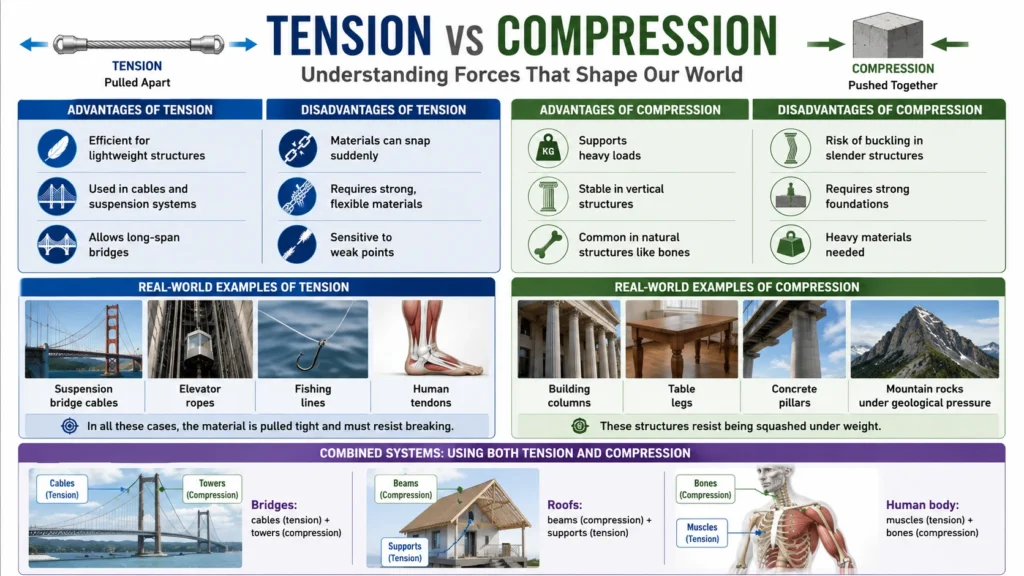
Advantages of Tension
- Efficient for lightweight structures
- Used in cables and suspension systems
- Allows long-span bridges
Disadvantages of Tension
- Materials can snap suddenly
- Requires strong, flexible materials
- Sensitive to weak points
Advantages of Compression
- Supports heavy loads
- Stable in vertical structures
- Common in natural structures like bones
Disadvantages of Compression
- Risk of buckling in slender structures
- Requires strong foundations
- Heavy materials needed
Real-World Examples of Tension vs Compression
Examples of Tension
- Suspension bridge cables
- Elevator ropes
- Fishing lines
- Human tendons
In all these cases, the material is pulled tight and must resist breaking.
Examples of Compression
- Building columns
- Table legs
- Concrete pillars
- Mountain rocks under geological pressure
These structures resist being squashed under weight.
Combined Systems
Many structures use both tension and compression:
- Bridges: cables (tension) + towers (compression)
- Roofs: beams (compression) + supports (tension)
- Human body: muscles (tension) + bones (compression)
Regional and Global Usage in Engineering
Tension vs compression principles are used globally in:
Civil Engineering
- Bridges
- High-rise buildings
- Roads and tunnels
Mechanical Engineering
- Machine parts
- Engines
- Mechanical frames
Aerospace Engineering
- Aircraft wings
- Space structures
- Satellite frames
Architecture
- Modern design structures
- Lightweight roofs
- Stadiums
Every region uses these principles in construction standards and safety codes.
Common Mistakes in Understanding Tension vs Compression
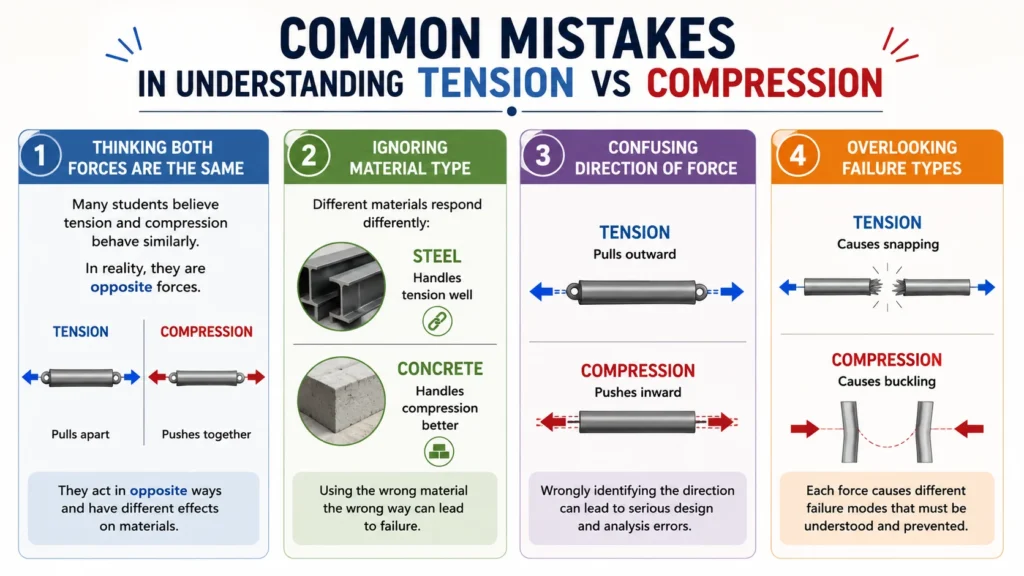
Mistake 1: Thinking both forces are the same
Many students believe tension and compression behave similarly. In reality, they are opposite forces.
Mistake 2: Ignoring material type
Different materials respond differently:
- Steel handles tension well
- Concrete handles compression better
Mistake 3: Confusing direction of force
- Tension pulls outward
- Compression pushes inward
Mistake 4: Overlooking failure types
- Tension causes snapping
- Compression causes buckling
Exercises on Tension vs Compression
Exercise 1
Identify whether the force is tension or compression:
- A rope holding a bucket
- A pillar supporting a roof
- A stretched rubber band
- A crushed aluminum can
Answers
- Tension
- Compression
- Tension
- Compression
Exercise 2
Fill in the blanks:
- Tension is a ______ force.
- Compression causes ______ of a material.
- Bridge cables mainly experience ______.
- Building columns mainly experience ______.
Answers
- pulling
- shortening
- tension
- compression
Exercise 3
Match the object with force type:
- Suspension bridge → ?
- Bone → ?
- Rope → ?
- Concrete column → ?
Answers
- Suspension bridge → Tension and compression
- Bone → Compression
- Rope → Tension
- Concrete column → Compression
Related Concepts to Tension vs Compression
Stress and Strain
These describe how materials deform under force.
Elasticity
The ability of a material to return to original shape.
Plastic Deformation
Permanent change in shape after force removal.
Shear Force
Force that causes sliding between layers.
Buckling
Sudden failure in compression structures.
Fracture Mechanics
Study of crack formation and breaking.
Tension vs Compression in Structures
Bridges
- Cables: tension
- Towers: compression
Buildings
- Columns: compression
- Reinforcement bars: tension
Natural Structures
- Trees: trunk compression, branches tension
- Human body: bones compression, tendons tension
Material Behavior in Tension vs Compression
Steel
- Very strong in tension
- Also strong in compression
Concrete
- Strong in compression
- Weak in tension without reinforcement
Wood
- Moderate in both
- Can split under tension
Rubber
- Very strong in tension flexibility
- Weak in compression stability
Advanced Understanding of Tension vs Compression
In advanced engineering, tension and compression are analyzed using:
- Finite Element Analysis (FEA)
- Load distribution models
- Structural simulations
- Stress-strain curves
Engineers calculate safety factors to ensure structures do not fail under extreme conditions.
Safety Factor in Engineering
A safety factor ensures structures can handle more load than expected.
Example:
- Bridge designed for 10 tons may support 20 tons safely.
This accounts for:
- Unexpected tension loads
- Excess compression forces
- Environmental conditions
Why Tension vs Compression Matters in Real Life
Understanding these forces helps in:
- Preventing building collapse
- Designing safe machines
- Building durable infrastructure
- Improving transportation systems
- Protecting human life
Without this knowledge, modern engineering would not exist.
FAQs
What is the main difference between tension and compression?
Tension pulls materials apart, while compression pushes materials together.
Where do we see tension vs compression in real life?
In bridges, buildings, ropes, bones, and machines.
Which is stronger, tension or compression?
It depends on the material. Steel is strong in both, while concrete is stronger in compression.
What happens when tension is too high?
The material may stretch too much and break.
What happens when compression is too high?
The material may crush or buckle.
Is a rope under tension or compression?
A rope is always under tension when supporting weight.
Are human bones under tension or compression?
Bones mainly experience compression, while tendons experience tension.
Why is compression important in buildings?
Because columns and foundations must support heavy loads safely.
Can an object experience both tension and compression?
Yes, many structures experience both at the same time.
What is an example of both forces working together?
A suspension bridge uses tension in cables and compression in towers.
Conclusion
Tension vs compression is a fundamental concept in physics and engineering that explains how materials respond to forces. Tension pulls and stretches materials, while compression pushes and shortens them. Both forces are essential in designing safe structures like bridges, buildings, and machines.
Understanding the difference helps engineers choose the right materials and prevent structural failures. From simple ropes to massive skyscrapers, every structure depends on the balance between tension and compression.
For beginners, the key takeaway is simple: tension pulls, compression pushes. Once you understand this, you can better understand how the physical world is built.
Professionals use this knowledge to design safer, stronger, and more efficient systems. Whether you are a student, engineer, or curious learner, mastering tension vs compression is a valuable step in understanding the science of structures.

Victoria Lane is a grammar-focused writer at GramBrix.com, passionate about helping readers master the rules of language. She provides clear explanations and practical examples that make writing more accurate, polished and confident.