
Last Updated on July 15, 2026
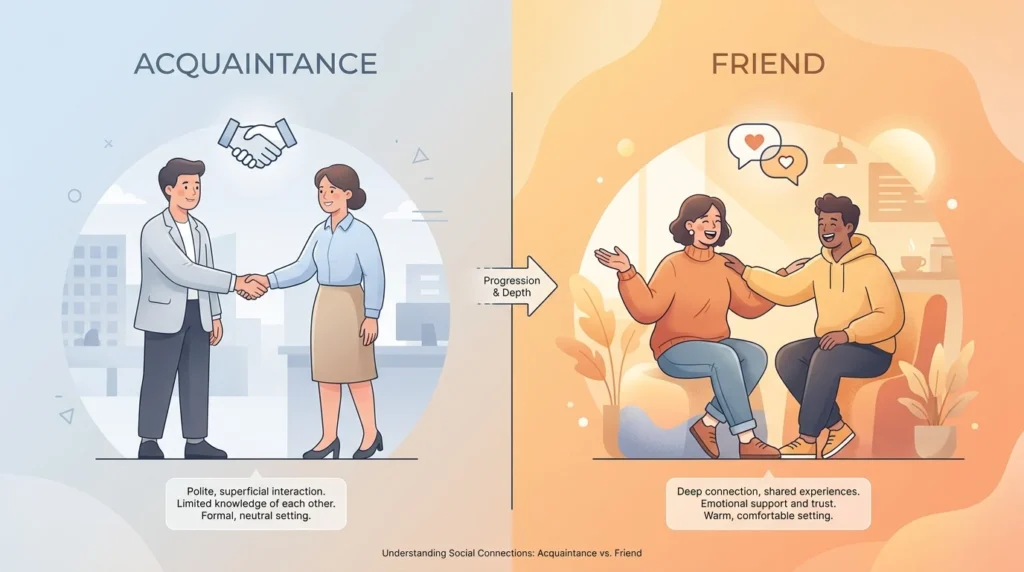
An acquaintance vs friend difference explains two levels of social connection. An acquaintance is someone you know casually, while a friend is someone you trust, share emotions with, and spend meaningful time with. The key difference is depth of trust, emotional bond, and support in the relationship.
The difference between an acquaintance vs friend is something many people misunderstand in daily life. We meet many people at school, work, social media, and events. But not all of them are true friends. Some are just acquaintances.
This confusion can lead to emotional stress, wrong expectations, and even disappointment. You may expect support from someone who only sees you casually. Or you may ignore a real friend by thinking they are just an acquaintance.
Understanding acquaintance vs friend is important for building healthy relationships. It helps you set boundaries, avoid misunderstandings, and build stronger emotional connections. It also improves communication skills in personal and professional life.
In this article, we will clearly explain the difference between acquaintance and friend in simple language. You will learn definitions, examples, advantages, common mistakes, and real-life usage. By the end, you will be able to easily identify who is an acquaintance and who is a true friend.
Quick Answer: Acquaintance vs Friend Overview
An acquaintance is someone you know but do not share a deep emotional bond with. A friend is someone you trust, care about, and interact with on a deeper emotional level.
In simple terms:
- Acquaintance = You recognize each other
- Friend = You connect and support each other
Definition of Acquaintance vs Friend
What is an Acquaintance?
An acquaintance is a person you know casually. You may have met them through work, school, or social events. You can recognize each other and sometimes talk, but the relationship is limited.
Key traits of an acquaintance:
- Limited interaction
- No deep emotional connection
- Formal or polite communication
- Little personal sharing
- Situational contact (work, class, events)
Example:
A coworker you greet in the hallway but do not share personal life with.
What is a Friend?
A friend is someone with whom you share trust, emotions, and personal experiences. Friendship involves mutual care and emotional support.
Key traits of a friend:
- Regular communication
- Emotional support
- Trust and loyalty
- Sharing personal thoughts
- Spending time together willingly
Example:
A person you call when you are happy or sad and who supports you in return.
Acquaintance vs Friend: Key Differences Explained
To understand acquaintance vs friend more clearly, let’s compare them side by side.
| Feature | Acquaintance | Friend |
| Level of trust | Low | High |
| Emotional bond | Weak | Strong |
| Communication | Occasional | Regular |
| Personal sharing | Very little | Open and honest |
| Support | Limited | Strong emotional support |
| Time spent together | Rare | Frequent |
| Relationship depth | Surface level | Deep connection |
This table shows that the main difference is depth. An acquaintance stays on the surface, while a friend goes deeper emotionally.
Understanding Acquaintance vs Friend in Real Life
Social Circles
In real life, your social circle includes both acquaintances and friends.
- At school or work, most people are acquaintances
- Close classmates or coworkers may become friends over time
- Only a small number of people become true friends
Emotional Connection
An acquaintance does not usually know your feelings or personal struggles. A friend understands your emotions and supports you during difficult times.
Communication Style
- Acquaintance: “Hello, how are you?”
- Friend: “How are you really feeling today?”
Advantages and Disadvantages
Advantages of Acquaintances
Even though acquaintances are not close friends, they are still important.
- Help expand your social network
- Useful for professional connections
- Provide new opportunities
- Keep communication polite and formal
Disadvantages of Acquaintances
- Lack emotional support
- No deep trust
- Limited reliability in personal matters
Advantages of Friends
Friends play a very important role in life.
- Provide emotional support
- Help reduce stress
- Increase happiness
- Offer honest advice
- Build long-term trust
Disadvantages of Friends
Even friendships can have challenges:
- Misunderstandings can happen
- Requires time and effort
- Emotional dependency risk if unbalanced
Real-World Examples of Acquaintance vs Friend
Example 1: Workplace
- Acquaintance: A colleague you greet during meetings
- Friend: A coworker you eat lunch with and talk about personal life
Example 2: School
- Acquaintance: Classmate you rarely talk to
- Friend: Someone you study with and share secrets with
Example 3: Social Media
- Acquaintance: A follower or online contact
- Friend: Someone you chat with regularly and trust
Regional and Global Understanding of Acquaintance vs Friend
The concept of acquaintance vs friend is universal, but cultural differences exist.
Western Perspective
In many Western cultures:
- Friendships form quickly
- People are more open emotionally
- Boundaries are flexible
Asian Perspective
In many Asian cultures:
- Friendships develop slowly
- Trust is built over time
- Acquaintances are kept more formal
Global Similarity
Despite differences, the core idea remains the same:
- Acquaintance = surface-level relationship
- Friend = emotional connection
Common Mistakes in Understanding Acquaintance vs Friend
Mistake 1: Assuming Everyone is a Friend
Not everyone who is friendly is a true friend.
Mistake 2: Expecting Emotional Support from Acquaintances
This leads to disappointment.
Mistake 3: Ignoring True Friends
Sometimes people value acquaintances more than loyal friends.
Mistake 4: Not Setting Boundaries
Mixing acquaintance vs friend roles can cause confusion.
Exercises on Acquaintance vs Friend (with Answers)
Exercise 1
Identify whether the relationship is acquaintance or friend:
A person you only greet at the gym.
Answer: Acquaintance
Exercise 2
A person you share personal problems with.
Answer: Friend
Exercise 3
A classmate you only talk to during group projects.
Answer: Acquaintance
Exercise 4
A person who supports you during difficult times.
Answer: Friend
Exercise 5
A neighbor you only say hello to.
Answer: Acquaintance
Related Concepts to Acquaintance vs Friend
Understanding acquaintance vs friend connects with other social concepts:
Friendship Levels
- Close friend
- Best friend
- Casual friend
Social Bonds
- Professional relationships
- Emotional relationships
- Formal relationships
Trust Levels
- Low trust = acquaintance
- High trust = friend
FAQs
What is the main difference between acquaintance vs friend?
An acquaintance is someone you know casually, while a friend is someone you trust and share emotions with.
Can an acquaintance become a friend?
Yes, with time, communication, and trust, an acquaintance can become a friend.
How many friends does a person usually have?
Most people have few close friends but many acquaintances.
Is every coworker a friend?
No, most coworkers are acquaintances unless a deeper bond develops.
Can social media contacts be friends?
They can be either, depending on emotional connection and interaction level.
Why is it important to understand acquaintance vs friend?
It helps set boundaries and avoid emotional misunderstandings.
What defines a true friend?
Trust, emotional support, honesty, and regular communication define a true friend.
Is it bad to have many acquaintances?
No, having many acquaintances is useful for networking and opportunities.
How do I turn an acquaintance into a friend?
Spend more time together, communicate openly, and build trust gradually.
What is stronger: acquaintance vs friend relationship?
A friend relationship is stronger because it includes emotional connection and trust.
Conclusion
Understanding acquaintance vs friend is important for building healthy social relationships. An acquaintance is someone you know casually, while a friend is someone you trust deeply and share emotional bonds with.
In daily life, both relationships are important. Acquaintances help expand your social and professional network. Friends provide emotional support, loyalty, and comfort. Knowing the difference helps you manage expectations and avoid confusion.
To build strong relationships, invest time in people who show trust, care, and consistency. At the same time, respect boundaries with acquaintances. A balanced social life includes both, but true happiness often comes from meaningful friendships.

Justin Powell is a writer at GramBrix.com who focuses on grammar, clarity and effective communication, helping readers strengthen their language skills.