
Last Updated on July 11, 2026
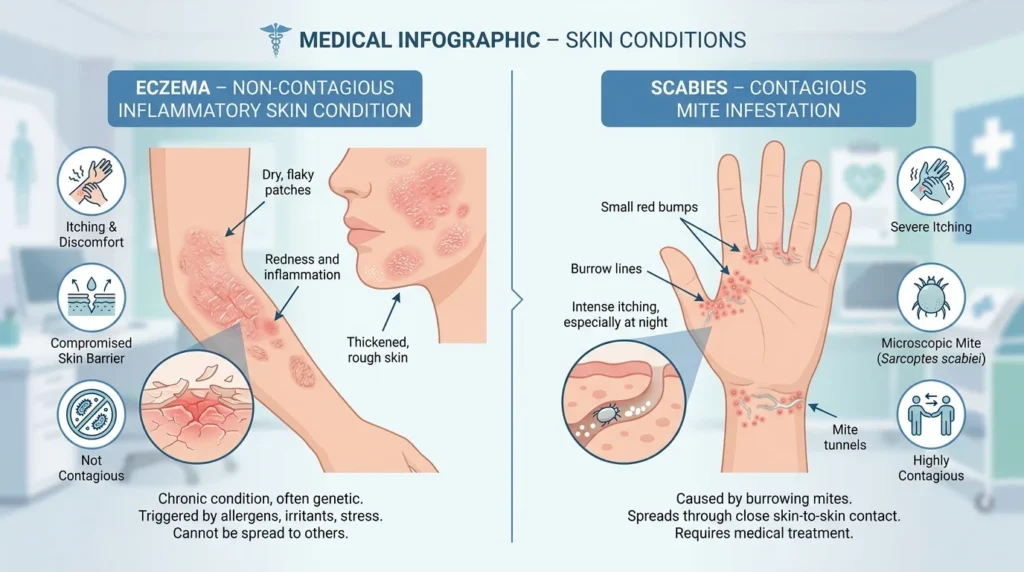
Eczema vs scabies is a common comparison in skin health because both conditions cause intense itching and rashes. However, eczema is a chronic inflammatory skin condition, while scabies is a contagious skin infestation caused by mites. The key difference is that eczema is not contagious, but scabies spreads easily through close contact.
Skin problems are very common, and many people confuse them. One of the most common mix-ups is between eczema vs scabies. Both can cause redness, itching, and irritation, but they are very different conditions. One is a long-term skin disorder, while the other is a contagious infestation caused by tiny mites.
This confusion often leads to wrong treatment. People may use creams that do not work or delay proper medical care. This makes symptoms worse and can spread infection in the case of scabies.
Understanding eczema vs scabies is important for fast relief and correct treatment. Eczema needs long-term skin care and triggers control. Scabies needs medical treatment for both the person and close contacts.
In this guide, you will learn everything in simple words. We will explain symptoms, causes, differences, treatments, and real-life examples. By the end, you will easily tell the difference between eczema and scabies and know what to do next.
Quick Answer / Overview
When comparing eczema vs scabies, the main difference is:
- Eczema is a non-contagious inflammatory skin condition that causes dry, itchy patches.
- Scabies is a contagious skin disease caused by mites that burrow under the skin.
Key takeaway:
If itching is long-term and dry → likely eczema
If itching is sudden, severe, and spreads quickly in close contact → likely scabies
What is Eczema vs Scabies
What is Eczema?
Eczema is a long-term skin condition that makes the skin red, dry, itchy, and sensitive. It often comes and goes in flare-ups.
Common types include:
- Atopic dermatitis (most common)
- Contact dermatitis
- Hand eczema
Eczema is not caused by infection. It is linked to:
- Weak skin barrier
- Allergies
- Genetics
- Environmental triggers
What is Scabies?
Scabies is a contagious skin condition caused by tiny mites that dig into the skin and lay eggs.
It spreads through:
- Skin-to-skin contact
- Sharing clothes or bedding
- Close living conditions
Scabies causes intense itching, especially at night, and small burrow-like tracks on the skin.
Eczema vs Scabies Quick Comparison Table
| Feature | Eczema | Scabies |
| Cause | Skin inflammation | Mite infestation |
| Contagious | No | Yes |
| Itching | Moderate to severe | Very intense (worse at night) |
| Rash type | Dry, red patches | Small bumps, burrows |
| Spread | Localized or widespread | Starts in one area, spreads fast |
| Treatment | Moisturizers, steroids | Anti-mite medications |
| Duration | Chronic | Curable in weeks |
Symptoms of Eczema vs Scabies
Symptoms of Eczema
- Dry, cracked skin
- Red or brown patches
- Itching (mild to severe)
- Thickened skin over time
- Flare-ups during stress or weather change
- Common on hands, face, elbows, knees
Symptoms of Scabies
- Severe itching, especially at night
- Small red bumps or blisters
- Thin burrow lines on skin
- Rash between fingers, wrists, waist, armpits
- Spread to family members
- Sleep disturbance due to itching
Causes of Eczema vs Scabies
Causes of Eczema
Eczema is not infectious. It is linked to:
- Genetics (family history)
- Weak skin barrier
- Allergies (dust, pollen, food)
- Irritants (soap, detergent)
- Weather (dry or cold air)
- Stress
Think of eczema skin like a “broken wall” that lets moisture escape and irritants enter.
Causes of Scabies
Scabies is caused by:
- Microscopic mites (Sarcoptes scabiei)
- Direct skin contact
- Sharing bedding or clothes
- Crowded living conditions
Think of scabies like “tiny insects living under the skin.”
Eczema vs Scabies: How Doctors Diagnose
Eczema Diagnosis
Doctors check:
- Skin appearance
- Medical history
- Allergy history
- Family history
No lab test is usually needed.
Scabies Diagnosis
Doctors may:
- Look for burrow tracks
- Take skin scraping samples
- Use dermatoscope (skin microscope)
- Check if others in family are itchy
Treatment of Eczema vs Scabies
Treatment of Eczema
Eczema treatment focuses on skin care:
- Moisturizers (daily use)
- Steroid creams for flare-ups
- Antihistamines for itching
- Avoiding triggers
- Gentle soaps
Long-term management is needed.
Treatment of Scabies
Scabies treatment is medical and must be complete:
- Permethrin cream (most common)
- Oral ivermectin (in severe cases)
- Treat all family members
- Wash bedding and clothes in hot water
Important: Even after treatment, itching may continue for weeks.
Advantages and Disadvantages (Eczema vs Scabies)
Eczema
Advantages of understanding eczema early:
- Prevents flare-ups
- Improves skin health
- Reduces long-term damage
Disadvantages:
- Chronic condition
- No permanent cure
- Lifestyle management required
Scabies
Advantages of early detection:
- Quick cure possible
- Prevents spread
- Reduces outbreak risk
Disadvantages:
- Highly contagious
- Causes severe discomfort
- Requires strict hygiene control
Real-World Examples of Eczema vs Scabies
Example 1: Eczema
A child has dry, itchy patches on elbows and cheeks during winter. No one else in the family is affected. This is likely eczema.
Example 2: Scabies
Two siblings and their parents all develop intense itching at night after one child returns from boarding school. This suggests scabies.
Regional / Global Usage and Awareness
- Eczema is common worldwide, especially in urban areas with pollution and allergies.
- Scabies is more common in crowded regions, refugee camps, and shared living spaces.
- In developing countries, scabies outbreaks are more frequent due to limited hygiene access.
- In developed countries, eczema is more commonly diagnosed due to environmental triggers and allergies.
Common Mistakes in Eczema vs Scabies
Mistake 1: Self-diagnosis
People often confuse eczema with scabies and use wrong creams.
Mistake 2: Ignoring family spread
Scabies spreads fast. Treating only one person is not enough.
Mistake 3: Overusing steroid creams
Steroids help eczema but may worsen scabies if misused.
Mistake 4: Not moisturizing eczema skin
Dry skin worsens eczema symptoms.
Mistake 5: Stopping scabies treatment early
Incomplete treatment leads to recurrence.
Exercises with Answers
Exercise 1: Identify the condition
- Itching at night with burrow marks
- Dry patches on elbows and knees
- Family members also itching
- Chronic flare-ups in winter
Answers:
- Scabies
- Eczema
- Scabies
- Eczema
Exercise 2: True or False
- Scabies is contagious
- Eczema is caused by mites
- Eczema is chronic
- Scabies can spread through clothing
Answers:
- True
- False
- True
- True
Exercise 3: Match the treatment
- Moisturizer → ?
- Permethrin cream → ?
- Avoid triggers → ?
- Wash bedding hot → ?
Answers:
- Moisturizer → Eczema
- Permethrin cream → Scabies
- Avoid triggers → Eczema
- Wash bedding hot → Scabies
Related Concepts or Comparisons
- Psoriasis vs eczema
- Ringworm vs scabies
- Allergic dermatitis vs eczema
- Bed bugs vs scabies
- Skin allergy vs infection
These comparisons help further clarify eczema vs scabies differences.
FAQs
What is the main difference between eczema vs scabies?
Eczema is a skin inflammation condition, while scabies is a contagious mite infestation.
Can eczema spread from person to person?
No, eczema is not contagious and cannot spread.
How fast does scabies spread in a family?
Scabies can spread within days through close contact.
Does eczema cause night itching like scabies?
Eczema can itch at night, but scabies itching is usually more severe at night.
Can scabies be mistaken for eczema?
Yes, early scabies can look like eczema, causing confusion.
What is the fastest treatment for scabies?
Prescription creams like permethrin are the standard fast treatment.
Can eczema turn into scabies?
No, they are completely different conditions.
Is eczema permanent?
Eczema is long-term but can be controlled with care.
Do both conditions need a doctor?
Yes, proper diagnosis is important for correct treatment.
Which is more dangerous, eczema or scabies?
Scabies spreads quickly but is curable. Eczema is long-term but not contagious.
Conclusion
Understanding eczema vs scabies is essential for proper skin care and fast recovery. Although both conditions cause itching and rashes, they are very different in cause, treatment, and spread. Eczema is a chronic skin condition linked to inflammation and triggers, while scabies is a contagious infestation caused by mites.
Correct identification helps avoid wrong treatment. Eczema requires long-term skin care, moisturizers, and trigger control. Scabies requires medical treatment for all affected individuals and close contacts.
If you experience persistent itching or spreading rash, it is important to consult a healthcare professional. Early diagnosis ensures faster relief and prevents complications. With the right care, both conditions can be managed effectively.

Kevin Brooks is a grammar specialist at GramBrix.com, dedicated to helping readers understand language rules with clarity and confidence. He simplifies complex grammar concepts through practical examples and easy explanations.