Last Updated on June 24, 2026
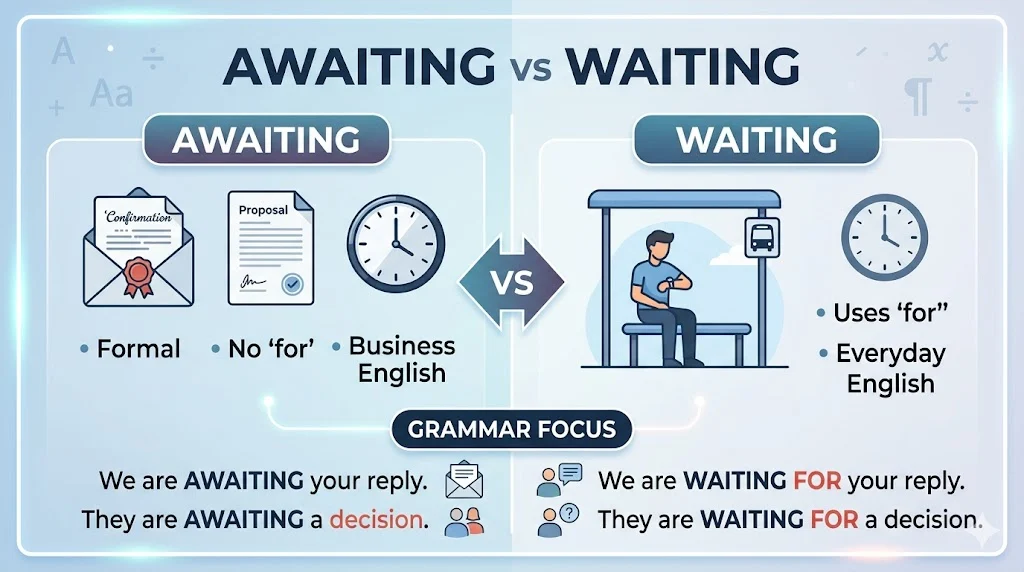
Awaiting vs waiting are two similar English words that both describe the idea of expecting something in the future, but they are not used in the same way. “Awaiting” is more formal and is often used in professional or written contexts, while “waiting” is more common in everyday speech and casual writing. The key difference lies in grammar usage and tone.
Many English learners get confused between awaiting vs waiting because both words seem to mean the same thing. They both talk about expecting something to happen. But in real English, they are used in different ways.
Using the wrong word can make your sentence sound unnatural or too formal. For example, “I am awaiting your reply” sounds formal, while “I am waiting for your reply” is more natural in daily conversation.
This difference is small but very important for writing emails, exams, job applications, and daily communication. Many learners also mix them with incorrect grammar patterns like missing prepositions or wrong sentence structure.
In this article, you will learn the full difference between awaiting vs waiting, when to use each one, common mistakes, real-life examples, exercises, FAQs, and expert tips to master both words easily.
Quick Answer: Awaiting vs Waiting
The difference between awaiting vs waiting is mainly grammar and formality:
- Awaiting is more formal and does NOT use “for”
- Waiting is more common and usually uses “for”
Simple rule:
- I am awaiting your response (correct, formal)
- I am waiting for your response (correct, common)
What does “Awaiting” mean?
Awaiting is a verb form of “await.” It means to expect something or someone.
It is usually used in formal writing, such as:
- Emails
- Business communication
- Official messages
- Academic writing
Structure:
Subject + is/are + awaiting + object
Examples:
- I am awaiting your approval.
- The company is awaiting results.
- We are awaiting further instructions.
👉 Important: You do NOT say “awaiting for.” This is incorrect.
What does “Waiting” mean?
Waiting is the present participle form of “wait.” It means staying in one place or delaying action until something happens.
It is used in both formal and informal situations, but it is more common in everyday speech.
Structure:
Subject + is/are + waiting + for + object
Examples:
- I am waiting for the bus.
- She is waiting for her friend.
- They are waiting for results.
Key Differences Between Awaiting vs Waiting
| Feature | Awaiting | Waiting |
| Formality | Formal | Neutral / Casual |
| Preposition | No “for” used | Uses “for” |
| Usage | Written English | Spoken English |
| Grammar style | Direct object | Requires object with “for” |
| Example | I am awaiting approval | I am waiting for approval |
Advantages and Disadvantages
Advantages of “Awaiting”
- Sounds professional
- Common in business emails
- Short and direct
- Useful in formal documents
Example advantage usage:
- “We are awaiting your feedback” (professional tone)
Disadvantages:
- Not natural in daily conversation
- Can sound too formal in casual speech
Advantages of “Waiting”
- Natural in everyday English
- Easy to understand
- Flexible in speech and writing
- Works in most situations
Example advantage usage:
- “I am waiting for you” (natural conversation)
Disadvantages:
- Slightly less formal in official writing
- Can sound too casual in legal or business documents
Real-World Examples of Awaiting vs Waiting
Business Communication
- We are awaiting your approval of the contract.
- We are waiting for your confirmation.
Customer Service
- We are awaiting your response regarding the complaint.
- The agent is waiting for your reply.
Daily Life
- I am waiting for my friend at the café.
- (Not usually: I am awaiting my friend)
Academic Context
- The committee is awaiting the final report.
- Students are waiting for exam results.
Regional and Global Usage of Awaiting vs Waiting
British English
- Both “awaiting” and “waiting” are used
- “Awaiting” is more common in formal writing
American English
- “Waiting” is more commonly used
- “Awaiting” appears mostly in business/legal writing
Global English
In international English (emails, corporate communication):
- “Awaiting your response” is widely accepted
- “Waiting for your response” is also correct but less formal
Common Mistakes in Awaiting vs Waiting
Mistake 1: Using “awaiting for”
❌ I am awaiting for your reply
✔ I am awaiting your reply
Mistake 2: Using “awaiting” in casual speech
❌ I am awaiting the bus
✔ I am waiting for the bus
Mistake 3: Forgetting “for” with waiting
❌ I am waiting you
✔ I am waiting for you
Mistake 4: Mixing tone incorrectly
❌ Casual email: I am awaiting for you at the café
✔ I am waiting for you at the café
Simple Grammar Rule Summary
- Use awaiting + object
- Use waiting + for + object
Exercises with Answers
Exercise 1: Fill in the blanks
- I am ______ your reply.
- She is ______ for the bus.
- We are ______ approval from the manager.
- They are ______ for the results.
Answers:
- awaiting
- waiting
- awaiting
- waiting
Exercise 2: Correct the mistakes
- I am awaiting for your message.
- He is waiting the train.
- They are awaiting for instructions.
Answers:
- I am awaiting your message.
- He is waiting for the train.
- They are awaiting instructions.
Exercise 3: Choose the correct option
- I am (awaiting / waiting for) your call.
- The team is (awaiting / waiting) results.
- She is (awaiting / waiting for) her friend.
Answers:
- waiting for
- awaiting
- waiting for
Related Concepts and Comparisons
Await vs Wait
- Await is formal and direct
- Wait is common and flexible
Expect vs Await
- Expect = general anticipation
- Await = formal expectation of something specific
Look forward to vs Awaiting
- Look forward to = emotional expectation
- Awaiting = neutral, formal expectation
FAQs
What is the main difference between awaiting vs waiting?
Awaiting is formal and does not use “for,” while waiting is common and uses “for.”
Is “awaiting for” correct?
No, “awaiting for” is incorrect. Only “awaiting” should be used.
Can I use awaiting in speaking English?
You can, but it sounds formal. Waiting is more natural in speech.
Which is more polite: awaiting or waiting?
Both are polite, but awaiting sounds more professional in business communication.
Is “I am awaiting your reply” correct?
Yes, it is correct and commonly used in formal emails.
Is “I am waiting your reply” correct?
No, it is incorrect. You must say “waiting for your reply.”
When should I use awaiting in emails?
Use awaiting when writing formal or professional emails, especially in business settings.
Can awaiting and waiting be interchangeable?
Not always. Grammar rules and tone decide which one is correct.
Which is better for exams: awaiting or waiting?
Both are correct if used properly, but awaiting is preferred in formal writing tasks.
What is the easiest way to remember the difference?
Remember: Awaiting = formal, no “for.” Waiting = normal, always “for.”
Conclusion
Understanding awaiting vs waiting helps you speak and write English more accurately and professionally. Both words describe the idea of expecting something, but their usage depends on grammar structure and formality.
“Awaiting” is best for formal communication like business emails, reports, and official messages. It is direct and does not use a preposition. On the other hand, “waiting” is more natural in everyday conversation and always uses “for.”
To master both words, practice simple sentences daily and focus on structure:
- Awaiting + object
- Waiting + for + object
With regular practice, you will avoid common mistakes and sound more fluent in both spoken and written English.

Victoria Lane is a grammar-focused writer at GramBrix.com, passionate about helping readers master the rules of language. She provides clear explanations and practical examples that make writing more accurate, polished and confident.