
Last Updated on August 16, 2026
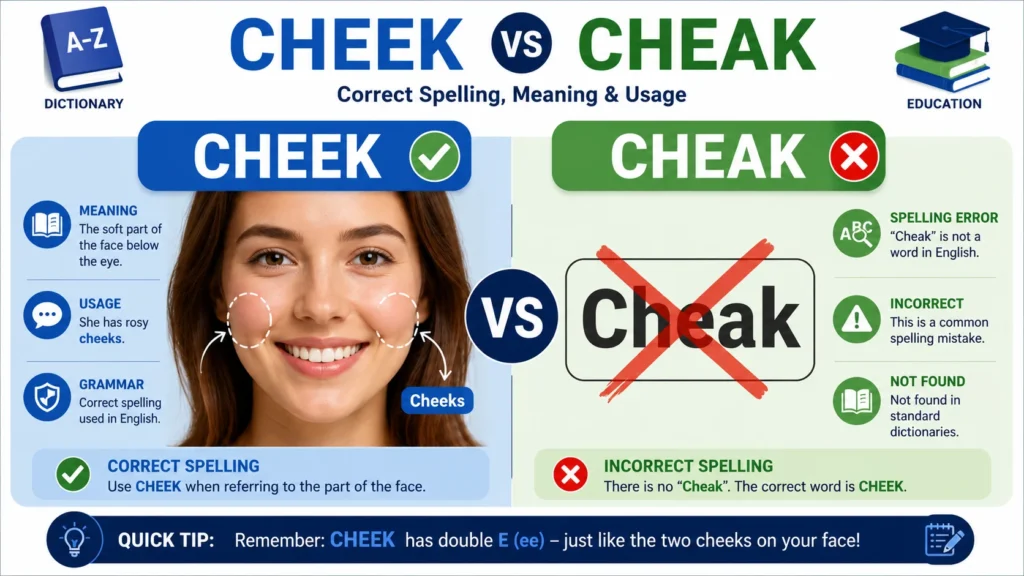
“Cheek” is the correct English word used for the sides of the face, bold behavior, or parts of objects. “Cheak” is usually a spelling mistake and is not considered a standard English word. Understanding the difference between “cheek or cheak” helps improve spelling, grammar, writing accuracy, and communication skills.
Hook: One tiny spelling mistake can make a simple word look completely wrong. So, is it cheek or cheak?
If you have ever wondered whether the correct spelling is cheek or cheak, you are not alone. These two spellings look almost identical, but only one is correct in standard English. Cheek is the correct spelling. It refers to the fleshy part of the face below the eye and beside the nose and mouth. It can also describe someone’s bold or disrespectful behavior, as in “He had the cheek to complain.” Cheak is generally a spelling mistake, not the standard English word. In this guide, we will explain the cheek meaning, pronunciation, common uses, examples, and the difference between cheek vs. cheak, so you can confidently use the word in everyday writing and conversation.
Quick Answer About Cheek or Cheak
| Word | Correct Spelling | Meaning | Common Usage |
|---|---|---|---|
| Cheek | Yes | Side of the face, bold behavior, or part of an object | Daily English |
| Cheak | No | Usually a spelling error of “cheek” | Rare or incorrect |
Simple Answer
If you are choosing between “cheek or cheak,” always use “cheek” in standard English writing.
Example:
✔ She kissed the baby on the cheek.
✘ She kissed the baby on the cheak.
What Does Cheek Mean?
The word “cheek” has several meanings in English. It can describe body parts, behavior, emotions, or even locations on objects and machines.
Cheek as a Body Part
The most common meaning is the soft area on either side of the face below the eyes.
Examples:
- Her cheeks turned red from embarrassment.
- The child had round cheeks.
- He smiled with dimples in his cheeks.
Cheek as Bold or Rude Behavior
“Cheek” can also mean rude confidence or disrespectful behavior.
Examples:
- He had the cheek to interrupt the meeting.
- That comment was full of cheek.
- She spoke with playful cheekiness.
Cheek in Machinery or Objects
In engineering or woodworking, “cheek” may describe side sections or supporting parts.
Examples:
- The cheek plates support the structure.
- The hammer cheek was damaged.
What Does Cheak Mean?
“Cheak” is generally considered an incorrect spelling of “cheek.” It does not appear in major English dictionaries as a standard word.
People often write “cheak” because:
- English vowels can sound confusing
- Typing mistakes happen
- Pronunciation differences affect spelling
- Some learners confuse “ea” and “ee” sounds
Why People Write “Cheak”
Here are common reasons:
| Cause | Explanation |
|---|---|
| Pronunciation confusion | “Cheek” and “cheak” may sound similar to learners |
| Typing speed | Fast typing causes spelling errors |
| Lack of spellcheck | Manual writing increases mistakes |
| Learning English | Non native speakers often confuse vowels |
Why Correct Spelling Matters
Correct spelling improves communication. Wrong spelling can confuse readers and reduce credibility.
Benefits of Correct Spelling
Better Communication
Readers understand your message quickly.
Professional Writing
Correct spelling looks more educated and polished.
Stronger SEO Performance
Search engines prefer properly written content.
Better Academic Results
Correct grammar and spelling improve grades.
Improved Confidence
People feel more comfortable when writing correctly.
Cheek in Everyday English
The word “cheek” appears in many common situations.
Talking About Appearance
Examples:
- She has rosy cheeks.
- His cheekbones are sharp.
- The cold wind hurt my cheeks.
Talking About Emotions
Facial cheeks often show emotion.
Examples:
- Tears rolled down her cheeks.
- His cheeks flushed with anger.
- Her cheeks turned pink with joy.
Talking About Personality
Examples:
- He gave a cheeky reply.
- She showed great cheek in the interview.
- That joke was full of cheek.
Common Expressions Using Cheek
English has many idioms and expressions with “cheek.”
| Expression | Meaning |
|---|---|
| Turn the other cheek | Forgive someone |
| Cheek by jowl | Very close together |
| Have the cheek | Be bold or rude |
| Tongue in cheek | Humorous or sarcastic |
| Cheek to cheek | Very close together |
Examples in Sentences
- He made a tongue in cheek comment.
- The houses stood cheek by jowl.
- She had the cheek to complain after arriving late.
Cheek vs Similar Words
Many words relate to “cheek.” Understanding differences helps avoid confusion.
Cheek vs Face
| Word | Meaning |
|---|---|
| Cheek | Side area of the face |
| Face | Entire front part of the head |
Example:
- She touched his cheek.
- She washed her face.
Cheek vs Cheeky
| Word | Type | Meaning |
|—|—|
| Cheek | Noun | Side of face or rude behavior |
| Cheeky | Adjective | Playfully rude or bold |
Example:
- The child showed cheek.
- The child made a cheeky joke.
Cheek vs Chin
| Word | Location |
|---|---|
| Cheek | Side of face |
| Chin | Bottom front of face |
Pronunciation of Cheek
The word “cheek” is pronounced like:
/tʃiːk/
It rhymes with:
- seek
- week
- peak
- speak
Pronunciation Tip
The double “ee” usually creates a long “e” sound in English.
Examples:
| Word | Pronunciation |
|---|---|
| Green | Long e |
| Sleep | Long e |
| Cheek | Long e |
Why “Cheak” Looks Incorrect
English spelling patterns make “cheek” the logical spelling.
English Vowel Rules
The “ee” vowel pair often creates the long “e” sound.
Examples:
- Feet
- Need
- Green
- Cheek
The “ea” combination can produce different sounds.
Examples:
| Word | Sound |
|---|---|
| Bread | Short e |
| Speak | Long e |
| Great | Long a |
Because “ea” has many sound patterns, learners sometimes incorrectly write “cheak.”
Real World Examples of Cheek
In Schools
Students often confuse “cheek or cheak” during spelling exercises.
Teacher correction:
✘ The girl kissed my cheak.
✔ The girl kissed my cheek.
In Social Media
People typing quickly may write:
- “My cheak hurts”
Correct form:
- “My cheek hurts”
In Healthcare
Doctors and nurses use “cheek” correctly in medical records.
Examples:
- Swelling on left cheek
- Rash near the cheekbone
- Injury to the right cheek
In Beauty and Fashion
The word appears often in makeup and skincare.
Examples:
- cheek contour
- cheek blush
- cheek highlighter
Cheek in Anatomy
The cheek is an important facial structure.
Main Parts of the Cheek
| Part | Function |
|---|---|
| Skin | Protects the face |
| Fat tissue | Creates facial shape |
| Muscles | Help facial expression |
| Cheekbone | Supports structure |
Functions of the Cheek
- Helps facial expressions
- Supports speech
- Assists chewing
- Protects mouth structure
Cheek in Beauty and Cosmetics
Beauty industries frequently use the word “cheek.”
Popular Makeup Terms
| Term | Meaning |
|---|---|
| Cheek blush | Adds color |
| Cheek contour | Defines shape |
| Cheek highlight | Reflects light |
Example Sentences
- Apply blush lightly on the cheeks.
- Contour under the cheekbones.
- Use cream products for soft cheek glow.
Cheek in Literature and Media
Writers use “cheek” to describe emotion, beauty, or attitude.
Literary Examples
- Tears streamed down her cheeks.
- A cold wind touched his pale cheeks.
- The child smiled with rosy cheeks.
Humor and Personality
“Cheek” can describe playful boldness.
Examples:
- cheeky humor
- cheeky grin
- cheeky response
Advantages and Disadvantages of English Spelling Patterns
Understanding spelling patterns helps avoid mistakes like “cheak.”
Advantages
Predictable Rules
Many English words follow patterns.
Easier Vocabulary Growth
Knowing vowel rules improves spelling.
Better Reading Skills
Recognizing patterns increases reading speed.
Disadvantages
Many Exceptions
English has irregular spelling rules.
Similar Pronunciations
Words can sound alike but look different.
Silent Letters
Some words contain unused letters.
Common Mistakes With Cheek or Cheak
Mistake One: Using “Cheak” in Formal Writing
Incorrect:
- The injury was on her cheak.
Correct:
- The injury was on her cheek.
Mistake Two: Mixing Up “Cheek” and “Check”
Incorrect:
- Please cheek your email.
Correct:
- Please check your email.
Mistake Three: Using “Cheeky” Incorrectly
Incorrect:
- Her cheek behavior was funny.
Correct:
- Her cheeky behavior was funny.
How to Remember the Correct Spelling
Memory Trick One
“Cheek” has double “ee” like “see.”
You see someone’s cheek.
Memory Trick Two
Think about smiling.
A smile stretches your cheeks.
Memory Trick Three
Most face related words with long “e” sounds use “ee.”
Examples:
- teeth
- cheek
- green
Regional and Global Usage
The word “cheek” is used worldwide in English speaking countries.
United States
Americans commonly use:
- cheek
- cheeky
- rosy cheeks
United Kingdom
British English uses “cheek” frequently for rude behavior.
Examples:
- cheeky child
- cheeky joke
- cheeky attitude
Australia
Australians often use “cheeky” casually.
Examples:
- cheeky snack
- cheeky holiday
- cheeky comment
Canada and New Zealand
The spelling remains “cheek.”
“Cheak” is still considered incorrect.
Cheek in Digital Communication
Typing mistakes happen more online.
Why Errors Increase Online
- Fast texting
- Autocorrect problems
- Informal writing
- Small keyboards
How to Avoid Errors
- Use spellcheck
- Read before sending
- Slow down typing
- Learn common spelling patterns
Educational Importance of Learning Correct Spelling
Correct spelling supports education and career growth.
Benefits for Students
- Better essays
- Higher grades
- Strong vocabulary
Benefits for Professionals
- Professional emails
- Better presentations
- Strong communication skills
Benefits for Writers
- Improved credibility
- Better readability
- Stronger audience trust
Comparison Table Between Cheek and Cheak
| Feature | Cheek | Cheak |
|---|---|---|
| Correct English word | Yes | No |
| Found in dictionaries | Yes | Rarely |
| Common usage | Very common | Usually error |
| Used in schools | Yes | No |
| Used professionally | Yes | No |
| Accepted in grammar | Yes | No |
Related Concepts and Comparisons
Cheek vs Check
| Word | Meaning |
|---|---|
| Cheek | Side of face |
| Check | Examine something |
Examples:
- She kissed my cheek.
- Please check the report.
Cheek vs Chick
| Word | Meaning |
|---|---|
| Cheek | Face part |
| Chick | Baby bird |
Cheek vs Peak
These words rhyme but differ in meaning.
| Word | Meaning |
|---|---|
| Cheek | Face side |
| Peak | Highest point |
Grammar Rules for Cheek
Cheek as a Noun
Examples:
- His cheek was bruised.
- Her cheeks looked red.
Cheek as an Uncountable Idea
Examples:
- He showed great cheek.
- That took real cheek.
Adjective Form
“Cheeky” acts as the adjective.
Examples:
- cheeky child
- cheeky smile
Sentence Examples for Better Understanding
Beginner Examples
- My cheek hurts.
- She kissed his cheek.
- His cheeks turned red.
Intermediate Examples
- The comedian made a cheeky joke.
- Tears rolled down her cheeks.
- He had the cheek to laugh.
Advanced Examples
- The author described her pale cheeks in poetic detail.
- His cheeky confidence impressed the audience.
- Facial muscles beneath the cheeks help expression.
Exercises With Answers
Exercise One: Choose the Correct Word
Questions
- She touched my _____.
- His _____ turned red.
- That spelling is incorrect because “_____” is not standard English.
- The child made a _____ comment.
Answers
- cheek
- cheeks
- cheak
- cheeky
Exercise Two: Correct the Sentence
Questions
- My cheak feels sore.
- She has pink cheaks.
- He had the cheak to argue.
- The doctor checked my cheakbone.
Answers
- My cheek feels sore.
- She has pink cheeks.
- He had the cheek to argue.
- The doctor checked my cheekbone.
Exercise Three: Fill in the Blank
Questions
- Tears rolled down her ______.
- He gave a ______ grin.
- The boxer injured his left ______.
- She had the ______ to interrupt.
Answers
- cheeks
- cheeky
- cheek
- cheek
Advanced Understanding of Spelling Errors
Spelling errors like “cheak” are common in language learning.
Cognitive Reasons
People spell based on sound.
Visual Memory
Frequent reading helps correct spelling memory.
Keyboard Influence
Typing quickly increases mistakes.
SEO and Content Writing Importance
Writers should use the correct keyword form.
Why “Cheek” Matters in SEO
Search engines prefer correct spelling.
Benefits:
- Better rankings
- Improved readability
- Higher trust
- More user engagement
When “Cheak” Appears Online
“Cheak” sometimes appears in:
- typo searches
- beginner writing
- social media mistakes
Professional websites should still use “cheek.”
Cheek in Medical Terminology
Healthcare professionals use cheek related terms regularly.
Common Medical Terms
| Term | Meaning |
|---|---|
| Cheekbone | Facial bone |
| Buccal area | Inner cheek region |
| Cheek tissue | Facial soft tissue |
Medical Examples
- Swelling in the cheek area
- Injury near the cheekbone
- Pain inside the cheek
Cheek in Art and Photography
Artists study cheeks for expression and lighting.
Why Cheeks Matter in Portraits
- Show emotion
- Create facial balance
- Reflect light naturally
Photography Terms
- cheek highlight
- cheek shadow
- cheek contour
Cheek in Idioms and Culture
Different cultures use cheek related expressions.
Popular Idioms
Turn the Other Cheek
Meaning: forgive instead of seeking revenge.
Tongue in Cheek
Meaning: joking or sarcastic.
Have the Cheek
Meaning: act boldly or rudely.
Tips to Improve English Spelling
Read More Often
Reading builds spelling memory.
Practice Writing
Writing reinforces vocabulary.
Use Spellcheck Tools
Technology catches errors quickly.
Learn Word Families
Examples:
- cheek
- cheeks
- cheeky
- cheekbone
FAQs
Is “cheak” a real English word?
No. “Cheak” is generally considered a misspelling of “cheek” in standard English writing.
Which spelling is correct: cheek or cheak?
“Cheek” is the correct spelling. It refers to the side of the face or bold behavior.
Why do people type “cheak” instead of “cheek”?
People confuse vowel sounds, type too quickly, or are still learning English spelling rules.
Can I use “cheak” in formal writing?
No. Professional and academic writing should always use “cheek.”
What does “cheeky” mean?
“Cheeky” describes playful, bold, or slightly rude behavior in a humorous way.
How do I remember the spelling of cheek?
Remember that “cheek” uses double “ee,” like “see” and “green.”
Is “cheek” used differently in British English?
Yes. British English often uses “cheek” to describe rude confidence or playful boldness.
What is the plural of cheek?
The plural form is “cheeks.”
Example:
- Her cheeks turned red.
What are common phrases with cheek?
Common phrases include:
- tongue in cheek
- turn the other cheek
- cheek by jowl
Does “cheek” only refer to the face?
No. It can also describe attitude, humor, or parts of machines and structures.
Conclusion
Understanding the difference between “cheek or cheak” is simple once you learn the correct spelling rules. “Cheek” is the proper English word and is widely used for facial features, expressions, attitude, humor, and technical descriptions. “Cheak” is usually just a spelling mistake caused by pronunciation confusion or typing errors.
Using the correct spelling improves writing quality, professionalism, and communication clarity. Whether you are writing school assignments, professional emails, social media captions, or blog articles, choosing the correct form matters. Learning spelling patterns like the double “ee” sound in “cheek” can also improve your overall English skills.
To avoid mistakes, practice reading, writing, and proofreading regularly. Use spellcheck tools when possible and learn common word families such as cheek, cheeks, cheeky, and cheekbone. Small improvements in spelling can create a big difference in confidence and communication success.
Discover More Article
- Buses or Busses: Which Spelling Is Correct? Complete Guide (2026)
- Stint or Stent: Meaning, Differences and Correct Usage Guide (2026)

Victoria Lane is a grammar-focused writer at GramBrix.com, passionate about helping readers master the rules of language. She provides clear explanations and practical examples that make writing more accurate, polished and confident.