
Last Updated on July 6, 2026
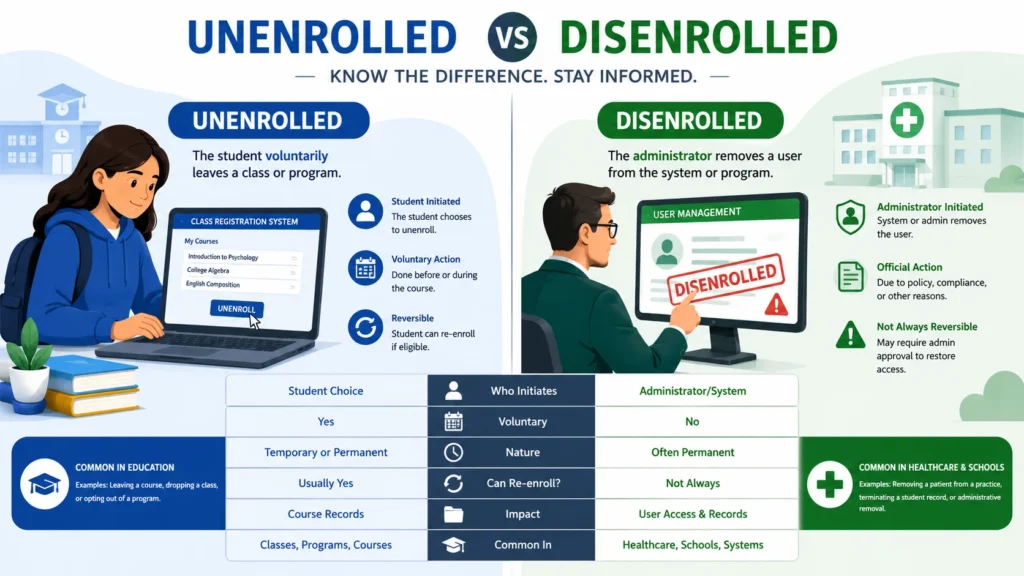
“Unenrolled” and “disenrolled” both describe someone no longer being part of a school, program, plan, or organization. However, “unenrolled” usually means a person is simply not enrolled, while “disenrolled” often means they were actively removed or withdrawn from enrollment. Understanding the difference helps avoid mistakes in education, healthcare, insurance, and membership systems.
The terms “unenrolled” and “disenrolled” look very similar. Many people use them the same way. But they do not always mean the same thing.
This confusion happens often in schools, colleges, healthcare programs, insurance plans, online courses, and employee benefits. A student may be called unenrolled after leaving a class. Another student may be disenrolled because the school removed them from the program. The difference matters because it can affect records, payments, benefits, and future eligibility.
People also see these words in government systems and healthcare programs like Medicare or Medicaid. In these cases, using the wrong word can create misunderstandings about whether someone left voluntarily or was removed by the organization.
This guide explains the meaning of unenrolled or disenrolled in simple language. You will learn definitions, examples, comparisons, common mistakes, regional usage, and practical exercises. By the end, you will clearly understand when to use each term correctly in professional and everyday communication.
Quick Answer About Unenrolled or Disenrolled
| Term | Simple Meaning | Common Use | Voluntary or Forced |
|---|---|---|---|
| Unenrolled | Not enrolled anymore or never enrolled | Schools, online courses, systems | Usually neutral or voluntary |
| Disenrolled | Officially removed from enrollment | Insurance, schools, government programs | Often official or forced |
Simple Explanation
Think of it this way:
- “Unenrolled” means someone is outside the system.
- “Disenrolled” means someone was taken out of the system.
For example:
- A student who chooses to leave a course may become unenrolled.
- A student removed for unpaid fees may be disenrolled.
What Does Unenrolled Mean?
The word “unenrolled” describes a person who is not enrolled in something.
This may happen because:
- They never joined
- They left voluntarily
- Their registration expired
- They completed the program
The word is usually neutral. It does not strongly suggest punishment or forced removal.
Common Uses of Unenrolled
Education
A student may become unenrolled after:
- Dropping a class
- Graduating
- Taking a break from studies
- Missing registration deadlines
Example:
Maria became unenrolled after taking a semester off.
Online Learning Platforms
Users may be unenrolled from courses after completion.
Example:
The platform automatically marked completed learners as unenrolled.
Membership Systems
A person may become unenrolled after canceling membership.
Example:
John is currently unenrolled from the gym program.
What Does Disenrolled Mean?
“Disenrolled” usually means someone was officially removed from enrollment.
This word often suggests administrative action. It may happen because of policy violations, nonpayment, inactivity, or eligibility changes.
Common Uses of Disenrolled
Healthcare and Insurance
Insurance providers frequently use the term.
Example:
The patient was disenrolled from the health plan after missing payments.
Schools and Universities
Schools may disenroll students because of:
- Academic issues
- Discipline problems
- Failure to pay tuition
- Attendance violations
Example:
The university disenrolled several students for incomplete registration.
Government Programs
Government agencies use “disenrolled” in benefit programs.
Example:
Participants were disenrolled after failing to renew eligibility documents.
Main Difference Between Unenrolled and Disenrolled
The key difference is intent and action.
| Factor | Unenrolled | Disenrolled |
|---|---|---|
| Tone | Neutral | Official or administrative |
| Suggests removal? | Not always | Usually yes |
| Voluntary? | Often voluntary | Often involuntary |
| Common in healthcare? | Less common | Very common |
| Common in education? | Yes | Yes |
| Implies system action? | Sometimes | Usually |
Easy Analogy
Imagine a movie theater membership.
- If you stop renewing your membership, you are unenrolled.
- If the theater cancels your membership for breaking rules, you are disenrolled.
Origins and Word Formation
Understanding the prefixes helps explain the meaning.
Prefix “Un”
The prefix “un” usually means:
- Not
- Opposite of
- Without
So “unenrolled” means “not enrolled.”
Prefix “Dis”
The prefix “dis” often means:
- Remove
- Reverse
- Take away
So “disenrolled” means “removed from enrollment.”
When to Use Unenrolled
Use “unenrolled” when discussing general enrollment status without focusing on removal action.
Best Situations for Using Unenrolled
- Temporary absence
- Voluntary withdrawal
- Course completion
- Neutral system status
- Expired enrollment
Examples
- She is currently unenrolled from any college classes.
- The software shows inactive users as unenrolled.
- Employees became unenrolled after leaving the training program.
When to Use Disenrolled
Use “disenrolled” when discussing official removal from a program or system.
Best Situations for Using Disenrolled
- Administrative action
- Policy violations
- Insurance termination
- Eligibility loss
- Forced withdrawal
Examples
- Patients were disenrolled after missing deadlines.
- The school disenrolled students with unpaid balances.
- Members may be disenrolled for violating policies.
Educational Context of Unenrolled or Disenrolled
Schools and universities use both terms, but the meaning changes slightly depending on the situation.
Unenrolled Students
An unenrolled student may:
- Take a break
- Transfer schools
- Complete studies
- Withdraw voluntarily
Example
Emily became unenrolled after moving overseas.
Disenrolled Students
A disenrolled student is usually removed officially.
Reasons Include
- Academic probation
- Nonpayment
- Misconduct
- Failure to register
Example
The college disenrolled students who did not submit documents.
Healthcare Usage of Unenrolled or Disenrolled
Healthcare systems strongly prefer the term “disenrolled.”
Why Healthcare Uses “Disenrolled”
Healthcare programs often involve:
- Legal eligibility
- Government regulations
- Insurance contracts
Because removal is official, “disenrolled” fits better.
Common Healthcare Situations
| Situation | Common Term |
|---|---|
| Insurance canceled | Disenrolled |
| Medicaid eligibility ended | Disenrolled |
| Plan removed member | Disenrolled |
| User never joined | Unenrolled |
Example
Members were disenrolled after income changes affected eligibility.
Technology and Software Usage
Modern software systems also use these terms.
Unenrolled in Technology
In tech systems, unenrolled often means:
- A device is no longer registered
- A user left a platform
- Access expired
Example
The tablet became unenrolled from device management.
Disenrolled in Technology
Disenrolled in software often implies system removal.
Example
The administrator disenrolled inactive devices.
Advantages and Disadvantages of Using Each Term
Advantages of “Unenrolled”
| Advantage | Explanation |
|---|---|
| Neutral tone | Sounds less harsh |
| Easy to understand | Simple meaning |
| Flexible use | Works in many contexts |
| Suitable for voluntary exits | Good for casual situations |
Disadvantages of “Unenrolled”
| Disadvantage | Explanation |
|---|---|
| Can sound vague | Does not explain why |
| Less formal | May not fit legal systems |
| May confuse status | Removal action unclear |
Advantages of “Disenrolled”
| Advantage | Explanation |
|---|---|
| Precise meaning | Clearly indicates removal |
| Formal tone | Good for official documents |
| Common in healthcare | Matches industry language |
| Strong administrative clarity | Explains system action |
Disadvantages of “Disenrolled”
| Disadvantage | Explanation |
|---|---|
| Sounds strict | May feel negative |
| Less casual | Not ideal for informal speech |
| Implies removal | Can sound punitive |
Real World Examples of Unenrolled or Disenrolled
Example From a School
Scenario:
A student decides not to continue next semester.
Correct term:
The student became unenrolled.
Reason:
The student left voluntarily.
Scenario:
The school removes the student for unpaid tuition.
Correct term:
The student was disenrolled.
Reason:
The removal was official and administrative.
Example From Healthcare
Scenario:
A patient loses eligibility for Medicaid.
Correct term:
The patient was disenrolled from Medicaid.
Reason:
The system officially removed the person.
Example From Online Learning
Scenario:
A learner finishes a digital course.
Correct term:
The learner is now unenrolled from the course.
Reason:
No forced removal happened.
Regional and Global Usage
Different regions may prefer one word more than the other.
United States
In the United States:
- “Disenrolled” is common in healthcare and insurance.
- “Unenrolled” appears more in education and software.
United Kingdom
The UK often uses simpler phrases like:
- Removed from enrollment
- No longer enrolled
- Withdrawn student
“Disenrolled” is less common than in American English.
Canada and Australia
Both countries use:
- Unenrolled in educational settings
- Disenrolled in administrative or healthcare contexts
Common Mistakes With Unenrolled or Disenrolled
Using Them Interchangeably
Many writers treat the words as identical.
Incorrect:
The insurance company unenrolled members for policy violations.
Better:
The insurance company disenrolled members for policy violations.
Reason:
The company actively removed the members.
Choosing the Wrong Tone
Incorrect:
Students were disenrolled after graduating.
Better:
Students became unenrolled after graduating.
Reason:
Graduation is normal completion, not forced removal.
Ignoring Context
The right term depends on who initiated the action.
| Situation | Better Term |
|---|---|
| User leaves voluntarily | Unenrolled |
| Organization removes user | Disenrolled |
Grammar and Sentence Structure
Unenrolled as an Adjective
Example:
She is an unenrolled student.
Unenrolled as a Verb
Example:
The platform unenrolled inactive users.
Disenrolled as a Verb
Example:
The company disenrolled nonpaying members.
Disenrolled as an Adjective
Example:
Disenrolled patients lost access to benefits.
Synonyms and Related Words
Synonyms for Unenrolled
- Unregistered
- Withdrawn
- Inactive
- Not enrolled
- Removed from course
Synonyms for Disenrolled
- Expelled
- Removed
- Terminated
- Excluded
- Canceled
Be careful because some synonyms are stronger or more negative.
Unenrolled or Disenrolled in Legal and Administrative Documents
Legal documents prefer precise language.
Why Precision Matters
Incorrect wording can affect:
- Benefits
- Insurance claims
- Student records
- Government eligibility
- Compliance reports
Example
“Disenrolled” may legally indicate formal termination, while “unenrolled” may only show inactive status.
Related Concepts and Comparisons
Withdrawn vs Disenrolled
| Term | Meaning |
|---|---|
| Withdrawn | Person chooses to leave |
| Disenrolled | Organization removes person |
Inactive vs Unenrolled
| Term | Meaning |
|---|---|
| Inactive | Temporarily unused |
| Unenrolled | Not enrolled anymore |
Expelled vs Disenrolled
| Term | Meaning |
|---|---|
| Expelled | Punishment based removal |
| Disenrolled | Administrative removal |
Business and Corporate Usage
Companies use these terms in employee training systems.
Example
An employee who leaves a training portal voluntarily may become unenrolled.
An employee removed for policy reasons may be disenrolled.
Digital Learning Platforms and LMS Systems
Learning Management Systems often automate enrollment changes.
Typical LMS Statuses
| Status | Meaning |
|---|---|
| Enrolled | Active participant |
| Unenrolled | No longer registered |
| Disenrolled | Removed by admin |
| Suspended | Temporary restriction |
Psychological Impact of Word Choice
Words affect how people feel.
“Unenrolled” Sounds Softer
It feels neutral and less emotional.
“Disenrolled” Sounds Formal
It may feel strict or disciplinary.
Organizations sometimes choose wording carefully to avoid confusion or conflict.
How Writers and Editors Choose the Correct Term
Professional writers look at:
- Who initiated the action
- Whether removal was official
- Industry standards
- Emotional tone
- Legal meaning
Quick Rule
Ask this question:
“Was the person simply not enrolled, or were they officially removed?”
If officially removed, “disenrolled” is usually correct.
SEO and Digital Content Usage
Search trends show both keywords are used online.
Why People Search “Unenrolled or Disenrolled”
Users often want to know:
- Which word is correct
- Healthcare terminology
- School enrollment meanings
- Administrative language differences
- Insurance status explanations
Beginner Friendly Examples
Example 1
A student leaves college for personal reasons.
Correct:
The student became unenrolled.
Example 2
A health plan removes a patient.
Correct:
The patient was disenrolled.
Example 3
An online app deletes inactive accounts.
Correct:
Users were disenrolled by the administrator.
Advanced Usage Notes
Context Overrides Dictionary Definitions
Sometimes industries create specialized meanings.
Healthcare almost always favors “disenrolled” because the process is official and documented.
Passive Voice Is Common
Example:
Members were disenrolled last month.
This structure appears often in formal reports.
Exercises With Answers
Exercise 1
Choose the correct word.
Sentence
The university _____ students who failed to pay tuition.
Answer
Disenrolled
Reason:
The university officially removed the students.
Exercise 2
Choose the correct word.
Sentence
After finishing the course, learners became _____ automatically.
Answer
Unenrolled
Reason:
Completion is neutral, not forced.
Exercise 3
Choose the correct word.
Sentence
Several Medicaid recipients were _____ after eligibility reviews.
Answer
Disenrolled
Reason:
Administrative action occurred.
Exercise 4
Choose the correct word.
Sentence
She is currently _____ from all training sessions.
Answer
Unenrolled
Reason:
The sentence describes inactive enrollment status.
Exercise 5
Incorrect Sentence
The gym disenrolled members after they completed the program.
Correct Sentence
The gym unenrolled members after they completed the program.
Reason:
Completion is not forced removal.
Practice Quiz
| Scenario | Correct Term |
|---|---|
| Insurance removes patient | Disenrolled |
| Student graduates | Unenrolled |
| Admin deletes account | Disenrolled |
| User cancels membership | Unenrolled |
| School removes student | Disenrolled |
FAQs
What is the difference between unenrolled and disenrolled?
Unenrolled usually means someone is simply not enrolled anymore. Disenrolled means someone was officially removed from enrollment.
Is disenrolled more formal than unenrolled?
Yes. “Disenrolled” is more formal and commonly used in healthcare, insurance, and administrative systems.
Can unenrolled and disenrolled mean the same thing?
Sometimes they overlap, but the tone and context differ. Disenrolled often implies official removal.
Which term is correct for insurance cancellation?
“Disenrolled” is usually correct for insurance plans because the removal is administrative and official.
Should schools use unenrolled or disenrolled?
Schools use both. “Unenrolled” fits voluntary withdrawal, while “disenrolled” fits official removal by the institution.
Is disenrolled a negative word?
Not always, but it can sound stricter because it often suggests forced removal or administrative action.
What does unenrolled mean in online learning?
It usually means a learner is no longer registered in a course or platform.
Can a student be disenrolled after nonpayment?
Yes. Many colleges disenroll students who fail to pay tuition or complete registration requirements.
What is the opposite of disenrolled?
The opposite is usually “enrolled” or “registered.”
Which word should I use in professional writing?
Use “unenrolled” for neutral status changes and “disenrolled” for official removals or administrative actions.
Best Practices for Using Unenrolled or Disenrolled
Use “Unenrolled” When
- The action is voluntary
- The tone should remain neutral
- A person simply lacks active enrollment
- Discussing course completion
Use “Disenrolled” When
- The organization removed someone
- Legal or administrative records are involved
- Healthcare or insurance systems are discussed
- Policies or violations caused removal
Expert Communication Tips
For Schools
Use consistent terminology across student records.
For Healthcare Providers
Prefer “disenrolled” for regulatory clarity.
For Content Writers
Match the term to the emotional tone and context.
For Businesses
Define enrollment terminology clearly in policies and contracts.
Conclusion
Understanding the difference between unenrolled or disenrolled helps improve communication in education, healthcare, business, and technology. While the two words appear similar, they carry different meanings and emotional tones. “Unenrolled” usually describes a neutral or voluntary enrollment change. “Disenrolled” often signals official removal by an organization or system.
Using the correct term matters because it affects clarity, professionalism, and legal understanding. In schools, a student may become unenrolled after graduating, but may be disenrolled for unpaid tuition. In healthcare, disenrollment is commonly used when a patient loses eligibility or coverage. These distinctions help readers and organizations understand exactly what happened.
When choosing between unenrolled or disenrolled, focus on who initiated the action and whether the removal was formal. If the person simply stopped participating, “unenrolled” is often best. If the institution actively removed them, “disenrolled” is usually the correct choice.

Kevin Brooks is a grammar specialist at GramBrix.com, dedicated to helping readers understand language rules with clarity and confidence. He simplifies complex grammar concepts through practical examples and easy explanations.