
Last Updated on June 16, 2026
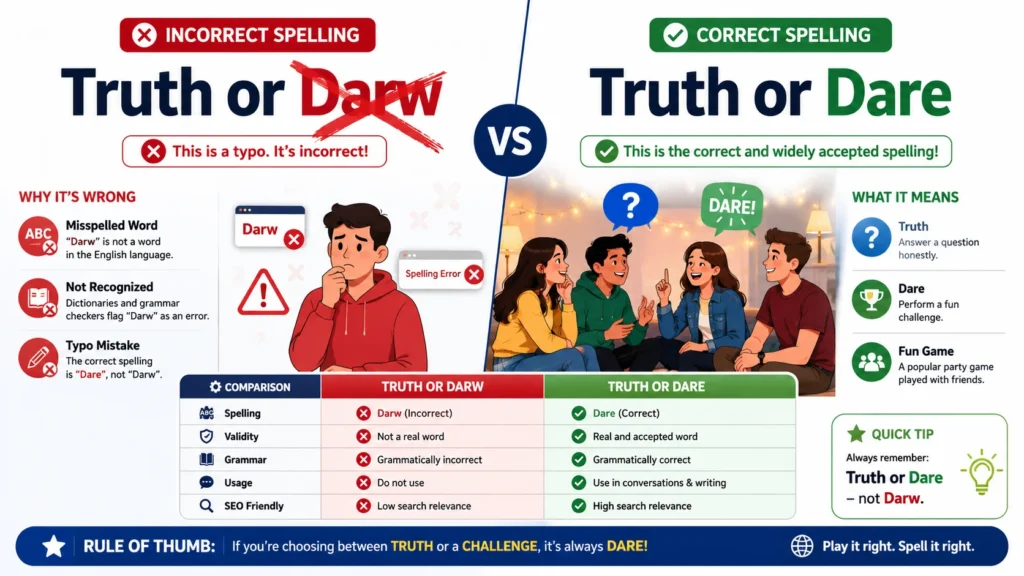
“Truth or Darw” is usually a misspelling or typo of the popular party game “Truth or Dare.” The correct phrase is “Truth or Dare,” where players either answer a question honestly or complete a challenge. Understanding the difference helps avoid spelling mistakes and improves communication in games, writing, and online searches.
The phrase “truth or darw” often appears online because of typing mistakes, autocorrect errors, or confusion about spelling. Many people search for it when looking for the famous game called “Truth or Dare.” This simple party game has been popular for many years among friends, families, students, and even coworkers during social events.
Knowing the correct spelling matters. It helps when writing invitations, searching online, creating game content, or communicating clearly. Small spelling mistakes can change meanings or make writing look less professional. Since “darw” is not a standard English word in this context, people often wonder if it has a hidden meaning or regional use.
This guide explains everything about “truth or darw” and “truth or dare.” You will learn the correct spelling, meanings, examples, common mistakes, cultural usage, and fun ways to use the game. The article also includes exercises, FAQs, comparison tables, and expert tips to help beginners and advanced learners fully understand the topic.
Quick Answer
| Phrase | Correct or Incorrect | Meaning |
|---|---|---|
| Truth or Dare | Correct | A popular game where players answer honestly or perform a challenge |
| Truth or Darw | Incorrect | Usually a typo or misspelling of “Truth or Dare” |
The correct phrase is “Truth or Dare.”
What Does Truth or Dare Mean?
Definition of Truth or Dare
Truth or Dare is a social game where players choose between:
- Truth
Answering a question honestly - Dare
Completing a challenge or task
The game is popular during:
- Sleepovers
- Birthday parties
- School gatherings
- Icebreaker activities
- Online video calls
- Team bonding events
Meaning of “Truth”
The word “truth” means honesty or factual information. In the game, a player must answer a question honestly without hiding information.
Example:
- “Who is your best friend?”
- “What is your biggest fear?”
Meaning of “Dare”
The word “dare” means a challenge or brave action. In the game, the player performs a task.
Example:
- Sing a song loudly
- Dance for one minute
- Call a friend and say something funny
Meaning of “Darw”
“Darw” does not have a recognized meaning in standard English connected to the game. It is mainly:
- A typing error
- A spelling mistake
- A keyboard slip
- An autocorrect issue
Why People Type “Truth or Darw”
There are several reasons why users type “truth or darw” instead of “truth or dare.”
Keyboard Mistakes
The letters “w” and “e” are close on a keyboard. Fast typing often causes mistakes.
Example:
- dare → darw
Autocorrect Problems
Phones sometimes change words automatically, especially when typing quickly.
Pronunciation Confusion
Some learners of English may not clearly hear the word “dare” and write it incorrectly.
Lack of Familiarity
People who have never played the game before may not know the correct spelling.
History of Truth or Dare
Early Origins
Truth or Dare has roots in old social games played centuries ago. Earlier versions existed in Europe and involved questions, challenges, and honesty tests.
Growth in Modern Culture
The game became popular among teenagers and young adults during the twentieth century.
It later spread through:
- Television
- Movies
- Social media
- YouTube videos
- Mobile apps
Digital Version
Today, many apps and websites offer online Truth or Dare games with random questions and dares.
Truth or Dare vs Truth or Darw
| Feature | Truth or Dare | Truth or Darw |
|---|---|---|
| Correct English | Yes | No |
| Common Usage | Very common | Rare |
| Dictionary Recognition | Yes | No |
| Used in Games | Yes | Usually no |
| Professional Writing | Acceptable | Incorrect |
| Search Intent | Clear | Often typo related |
Advantages of Playing Truth or Dare
Encourages Social Interaction
The game helps people communicate and connect.
Builds Confidence
Completing dares can improve bravery and self confidence.
Creates Fun Memories
Funny questions and challenges make gatherings enjoyable.
Improves Honesty
Truth questions encourage open conversation.
Easy to Play
The game requires no expensive equipment.
Disadvantages of Truth or Dare
Can Become Uncomfortable
Some questions may feel too personal.
Peer Pressure Risks
Players may feel forced to complete difficult dares.
Embarrassment
Certain dares can cause awkward moments.
Privacy Concerns
Truth questions may reveal sensitive information.
Rules of Truth or Dare
Basic Rules
- Players sit in a group.
- One player asks another: “Truth or Dare?”
- The chosen player selects one option.
- The player answers honestly or completes the dare.
- The turn moves to another player.
Optional Rules
Some groups add special rules like:
- Skip limits
- Time limits
- Family friendly questions
- Safe dares only
Real World Examples of Truth or Dare
School Parties
Students use the game to break the ice and make new friends.
Family Gatherings
Families often play friendly versions with children.
Online Streaming
Content creators use Truth or Dare for entertainment videos.
Team Building
Some companies use light versions during workshops.
Popular Truth Questions
| Category | Example Question |
|---|---|
| Friendship | Who do you trust most? |
| Fun | What is your funniest memory? |
| School | Have you ever skipped homework? |
| Personal | What is your biggest fear? |
| Dreams | What job do you want someday? |
Popular Dare Ideas
| Category | Example Dare |
|---|---|
| Funny | Dance like a robot |
| Singing | Sing loudly for 30 seconds |
| Creative | Draw with your eyes closed |
| Social | Tell a joke to everyone |
| Silly | Wear socks on your hands |
Safe Truth or Dare Practices
Respect Boundaries
Players should never force others to answer uncomfortable questions.
Avoid Dangerous Dares
Never include harmful or illegal activities.
Keep It Age Appropriate
Children should only receive safe and simple dares.
Use Consent
Everyone should agree to the rules before playing.
Regional and Global Usage
United States
Truth or Dare is very popular among teenagers and college students.
United Kingdom
The game is common during sleepovers and social gatherings.
Pakistan and India
Young people often play the game during school events and family functions.
Online Global Culture
Social media platforms helped spread the game worldwide.
Common Spelling Mistakes Related to Truth or Dare
| Incorrect Word | Correct Word |
|---|---|
| Darw | Dare |
| Truthe | Truth |
| Dair | Dare |
| Turth | Truth |
| Truth or Dear | Truth or Dare |
Grammar Explanation
Why “Dare” Is Correct
The word “dare” is a real English verb and noun.
Example:
- I dare you to sing.
Why “Darw” Is Incorrect
“Darw” is not accepted as standard English in this phrase.
Truth or Dare in Pop Culture
Movies
Truth or Dare helped increase global interest in the game.
Social Media Trends
TikTok, Instagram, and YouTube creators regularly make Truth or Dare challenge videos.
Mobile Apps
Many gaming apps now offer digital Truth or Dare experiences.
Beginner Guide to Playing Truth or Dare
Start with Simple Questions
Easy questions help players feel comfortable.
Use Friendly Dares
Choose fun activities instead of embarrassing tasks.
Rotate Turns Fairly
Everyone should have equal chances to participate.
Maintain Respect
Avoid offensive jokes or personal attacks.
Advanced Truth or Dare Variations
Couples Version
Questions focus on relationships and romance.
Family Version
Safe and educational questions are used.
Online Version
Players participate through video calls or apps.
Classroom Version
Teachers sometimes use educational variations for communication practice.
Psychological Effects of Truth or Dare
Positive Effects
- Better communication
- Increased confidence
- Stronger friendships
Negative Effects
- Anxiety
- Embarrassment
- Social discomfort
Educational Benefits
Truth or Dare can teach:
- Communication skills
- Listening skills
- Confidence building
- Social interaction
Comparison With Similar Games
| Game | Main Activity | Similar to Truth or Dare |
|---|---|---|
| Would You Rather | Choosing options | Yes |
| Never Have I Ever | Sharing experiences | Yes |
| Charades | Acting words | Partly |
| Spin the Bottle | Social interaction | Sometimes |
Digital Truth or Dare Games
Modern technology changed the way people play.
Mobile Apps
Apps provide random:
- Questions
- Dares
- Timers
- Difficulty levels
Online Multiplayer Games
Friends from different countries can play together online.
How Search Engines Interpret “Truth or Darw”
Search engines usually assume users mean “Truth or Dare.”
This is called:
- Spell correction
- Search intent recognition
- Keyword matching
When users type “truth or darw,” search engines often show results for:
- Truth or Dare game
- Truth or Dare questions
- Truth or Dare movies
SEO Importance of Correct Spelling
Correct spelling matters in:
- Blog writing
- Search engine rankings
- Social media captions
- Educational content
Using the correct keyword improves readability and professionalism.
Common Mistakes When Using Truth or Dare
Spelling Errors
Wrong:
- Truth or Darw
Correct:
- Truth or Dare
Unsafe Dares
Players sometimes create dangerous challenges.
Personal Questions
Avoid questions that hurt feelings.
Forcing Participation
Everyone should play voluntarily.
Exercises With Answers
Exercise 1
Choose the correct phrase.
- Truth or Darw
- Truth or Dare
Answer:
2. Truth or Dare
Exercise 2
Fill in the blank.
The player chose a ______ and had to dance.
Answer:
dare
Exercise 3
True or False
“Darw” is the correct spelling in the game name.
Answer:
False
Exercise 4
Correct the sentence.
“We played truth or darw yesterday.”
Correct Answer:
“We played Truth or Dare yesterday.”
Truth or Dare for Different Age Groups
Children
Use educational and safe prompts.
Example:
- Name your favorite animal.
Teenagers
Fun social questions work well.
Example:
- What is your dream vacation?
Adults
Players may prefer deeper conversations or creative dares.
Truth or Dare for Team Building
Companies sometimes use professional versions to improve teamwork.
Examples include:
- Sharing career goals
- Discussing strengths
- Completing fun office challenges
Cultural Differences in Truth or Dare
Different cultures change the style of gameplay.
Conservative Cultures
Questions are usually more respectful and private.
Open Social Cultures
Players may ask bold or humorous questions.
Online Safety Tips
Avoid Sharing Personal Information
Never reveal passwords or private data.
Use Trusted Apps
Some online apps collect unnecessary information.
Protect Younger Players
Parents should monitor children during online gameplay.
Related Concepts and Comparisons
Truth vs Lie
| Feature | Truth | Lie |
|---|---|---|
| Honest | Yes | No |
| Reliable | Yes | No |
| Builds Trust | Yes | No |
Dare vs Challenge
| Feature | Dare | Challenge |
|---|---|---|
| Usually Fun | Yes | Sometimes |
| Social Game | Yes | Not Always |
| Requires Bravery | Yes | Often |
Truth or Dare Party Ideas
Birthday Party
Add music and snacks for extra fun.
Classroom Activity
Teachers can use educational questions.
Virtual Game Night
Friends can play through video calls.
How to Create Good Truth Questions
Good truth questions should be:
- Safe
- Interesting
- Age appropriate
- Respectful
Bad questions can hurt feelings or invade privacy.
How to Create Good Dares
Good dares should be:
- Fun
- Safe
- Short
- Non harmful
Examples:
- Draw a cat in 20 seconds
- Speak in a funny voice
Truth or Dare and Communication Skills
The game helps players:
- Speak confidently
- Listen carefully
- Respond quickly
- Understand emotions
Why Truth or Dare Remains Popular
Simple Rules
Anyone can learn quickly.
Flexible Gameplay
The game works in many situations.
Entertainment Value
Players enjoy surprises and humor.
Social Bonding
The game helps people connect emotionally.
FAQs
Is “truth or darw” correct?
No. The correct phrase is “Truth or Dare.” “Truth or darw” is usually a typing mistake.
What does Truth or Dare mean?
It is a game where players choose between answering honestly or completing a challenge.
Why do people search for “truth or darw”?
Most people accidentally type “darw” instead of “dare” because the keyboard letters are close together.
Is “darw” a real English word?
Not in this context. It is generally considered a spelling error.
Can Truth or Dare be educational?
Yes. Teachers and trainers sometimes use safe versions to improve communication and teamwork.
Is Truth or Dare safe for children?
Yes, if adults use age appropriate questions and harmless dares.
What are good Truth or Dare questions for beginners?
Simple questions about hobbies, favorite foods, and dreams work well for beginners.
Can Truth or Dare be played online?
Yes. Many apps and video call platforms support online Truth or Dare games.
Why is correct spelling important for Truth or Dare?
Correct spelling improves communication, professionalism, and search engine visibility.
What is the difference between Truth or Dare and Never Have I Ever?
Truth or Dare focuses on questions and challenges, while Never Have I Ever focuses on sharing experiences.
Conclusion
The phrase “truth or darw” is almost always a misspelling of the well known game “Truth or Dare.” Understanding the correct spelling helps improve writing, communication, and online searches. Truth or Dare remains one of the most popular social games because it is simple, flexible, and entertaining for people of all ages.
The game encourages honesty, confidence, laughter, and social bonding. However, players should always respect boundaries, avoid harmful dares, and create a safe environment for everyone involved. Whether played at a party, in a classroom, or online with friends, Truth or Dare can become a memorable and enjoyable experience when used responsibly.
For the best results, always use the correct phrase “Truth or Dare” in conversations, blog posts, invitations, and online content. Clear spelling and respectful gameplay make the experience more professional, fun, and meaningful for everyone.

Justin Powell is a writer at GramBrix.com who focuses on grammar, clarity and effective communication, helping readers strengthen their language skills.