
Last Updated on June 14, 2026
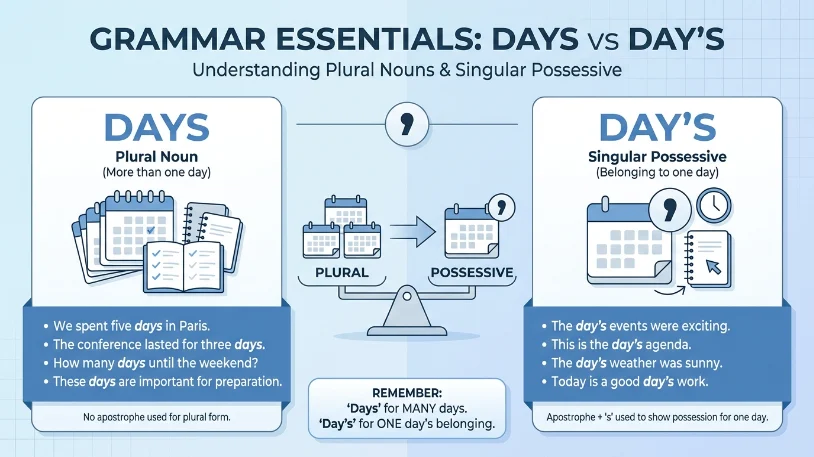
“Days” and “day’s” may look similar, but they have different meanings. “Days” is the plural form of day, while “day’s” shows possession, meaning something belongs to one day. Understanding the difference helps improve grammar, writing clarity, and professional communication.
Many English learners struggle with small grammar mistakes. One of the most common examples is understanding the difference between days or day’s. At first glance, both words look almost the same. The only visible difference is an apostrophe. But that tiny mark changes the meaning completely.
This confusion appears in emails, assignments, blog posts, and even business writing. Some people write “three day’s work” when they actually mean “three days of work.” Others use “days” when they should show possession with “day’s.”
The good news is that the rule is simple once you understand it properly.
In this guide, you’ll learn the exact difference between days and day’s in plain English. We’ll cover meanings, grammar rules, real-life examples, common mistakes, exercises, and practical writing tips. By the end, you’ll know exactly when to use each one confidently.
Quick Answer / Overview
Here’s the simple answer:
| Word | Meaning | Example |
|---|---|---|
| Days | More than one day | I worked for five days. |
| Day’s | Something belonging to one day | It was a long day’s journey. |
Easy Rule to Remember
- Days = plural
- Day’s = possession
If there is ownership or belonging, use “day’s.”
If you are talking about more than one day, use “days.”
What Does “Days” Mean?
“Days” is simply the plural form of the word “day.”
You use it when talking about:
- Multiple days
- A period of time
- More than one calendar day
Examples of “Days”
- I stayed there for three days.
- The school closes for five days.
- Those were happy days.
In all these examples, there is no ownership. We are simply talking about more than one day.
What Does “Day’s” Mean?
“Day’s” is the possessive form of “day.”
It means something belongs to one day.
Examples of “Day’s”
- A day’s work
- The day’s schedule
- One day’s pay
Here, something belongs to a single day:
- Work of one day
- Schedule of one day
- Pay for one day
Understanding the Apostrophe
The apostrophe is where most people get confused.
Without Apostrophe
“Days” = plural
Example:
- We traveled for seven days.
With Apostrophe
“Day’s” = possessive
Example:
- It was a tiring day’s travel.
The apostrophe shows ownership.
Days vs Day’s in Simple English
Let’s compare both side by side.
| Sentence | Correct Word | Why |
|---|---|---|
| I waited three ___ | days | Talking about multiple days |
| A ___ salary | day’s | Salary for one day |
| We worked for six ___ | days | More than one day |
| One ___ notice | day’s | Notice belonging to one day |
Real-World Examples
Example in Office Writing
Correct:
- I completed the project in two days.
Incorrect:
- I completed the project in two day’s.
Why?
Because there is no possession.
Example in Salary Discussion
Correct:
- The company deducted one day’s pay.
Why?
The pay belongs to one day.
Example in School Writing
Correct:
- The event lasted three days.
Incorrect:
- The event lasted three day’s.
Why People Confuse Days or Day’s
There are several reasons.
Apostrophes Are Confusing
Many learners think apostrophes automatically make words plural. That is incorrect.
Example:
- Apple’s for sale ❌
- Apples for sale ✔
Spoken English Sounds Similar
When speaking, “days” and “day’s” sound almost identical. This makes writing harder.
Fast Typing Habits
People often add apostrophes without thinking, especially on phones or social media.
Common Mistakes and Corrections
Mistake 1
Incorrect:
- I worked two day’s.
Correct:
- I worked two days.
Reason:
Talking about multiple days, not possession.
Mistake 2
Incorrect:
- The days work was difficult.
Correct:
- The day’s work was difficult.
Reason:
The work belongs to one day.
Mistake 3
Incorrect:
- She received three day’s leave.
Correct:
- She received three days’ leave.
This is slightly advanced grammar.
Here, the leave belongs to three days.
Understanding “Days’” With Apostrophe After S
This is another important grammar point.
| Form | Meaning |
|---|---|
| Day’s | Belongs to one day |
| Days’ | Belongs to multiple days |
Examples
- One day’s work
- Two days’ work
- Five days’ vacation
Days or Day’s in Professional Writing
Using correct grammar matters in:
- Emails
- Academic writing
- Job applications
- Business communication
Small grammar mistakes can make writing look unprofessional.
Example
Incorrect:
- I need two day’s leave.
Correct:
- I need two days’ leave.
Regional and Global Usage
English grammar rules for days and day’s are mostly the same worldwide.
Whether you use:
- American English
- British English
- Canadian English
- Australian English
The grammar rule stays unchanged.
Related Grammar Concepts
Plural Nouns
Plural nouns show more than one thing.
Examples
- days
- books
- cars
Possessive Nouns
Possessive nouns show ownership.
Examples
- day’s schedule
- teacher’s book
- company’s policy
Singular vs Plural Possession
| Type | Example |
|---|---|
| Singular possessive | day’s work |
| Plural possessive | days’ work |
Exercises With Answers
Exercise 1
Choose the correct word:
I stayed there for five ___.
A. day’s
B. days
Answer
B. days
Exercise 2
The company deducted one ___ salary.
A. day’s
B. days
Answer
A. day’s
Exercise 3
We enjoyed three ___ holiday.
A. days
B. days’
Answer
B. days’
Exercise 4
It was a long ___ journey.
A. day’s
B. days
Answer
A. day’s
Exercise 5
They worked for several ___ without rest.
A. day’s
B. days
Answer
B. days
Tips to Remember the Difference
Tip 1: Look for Ownership
Ask yourself:
“Does something belong to the day?”
If yes, use “day’s.”
Tip 2: Count the Number
If there is more than one day, use “days.”
Tip 3: Replace With “Of”
Example:
- A day’s work
- Work of one day
If “of” makes sense, possession is likely correct.
Days or Day’s in Everyday Sentences
Here are natural examples you may see daily.
Using “Days”
- I was sick for two days.
- Summer days are very hot.
- We waited many days.
Using “Day’s”
- The day’s news shocked everyone.
- I finished a hard day’s work.
- One day’s delay caused problems.
Advanced Grammar Examples
One Day’s Notice
Meaning:
Notice for one day.
Two Days’ Notice
Meaning:
Notice for two days.
This structure is common in legal and professional English.
FAQs
What is the difference between days or day’s?
“Days” is plural, while “day’s” shows possession or ownership.
When should I use day’s?
Use “day’s” when something belongs to one day, like “a day’s work.”
Is days’ also correct English?
Yes. “Days’” is the plural possessive form, showing something belongs to multiple days.
How do I know whether to use days or day’s?
Check whether you are talking about multiple days or ownership.
Is “three day’s work” correct?
No. The correct form is “three days’ work.”
Why do people confuse days or day’s?
Because both words sound similar in spoken English.
Can I use day’s for plural meaning?
No. “Day’s” is only singular possessive.
What does days’ mean?
It means something belongs to multiple days.
Is apostrophe used for plurals?
Usually no. Apostrophes mainly show possession.
Which is correct: two days leave or two days’ leave?
“Two days’ leave” is grammatically correct.
Conclusion
Understanding the difference between days or day’s is easier than most people think. The key is knowing whether you are talking about plurality or possession.
Use:
- Days for more than one day
- Day’s for something belonging to one day
- Days’ for something belonging to multiple days
These small grammar details make a big difference in professional and academic writing. Correct usage improves clarity and helps your writing look polished and trustworthy.
If you ever feel confused, use a simple trick:
Ask yourself whether ownership is involved. If not, you probably just need the plural form “days.”
With practice, these grammar choices become natural. Even native English speakers sometimes make apostrophe mistakes, so don’t worry if it takes time to master them.
The important thing is consistency and understanding the rule clearly.

Victoria Lane is a grammar-focused writer at GramBrix.com, passionate about helping readers master the rules of language. She provides clear explanations and practical examples that make writing more accurate, polished and confident.