
Last Updated on July 26, 2026
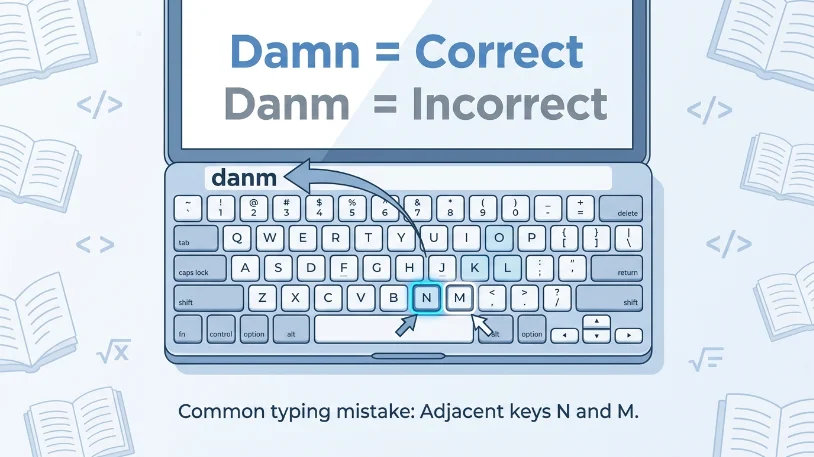
“Damn” is the correct English word, while “danm” is usually a spelling mistake. People often type “danm” by accident because the letters are close on a keyboard. Understanding the difference helps improve writing, communication, and grammar accuracy.
You type a quick message, hit send, and only then notice it: “danm.” Was it supposed to be “damn”? It’s one of the most common typing mistakes in English—and one that catches both learners and native speakers alike.
At first glance, danm and damn look almost identical. Since the M and N keys sit next to each other on a keyboard, it’s easy to swap them when typing quickly. That’s why the misspelling appears so often in text messages, social media posts, comments, and even professional writing.
Here’s the key fact: “damn” is a legitimate English word, while “danm” is simply a typo. It isn’t recognized as a standard English word in dictionaries or grammar guides.
Although the mistake seems minor, using the wrong spelling can make your writing look less polished. Whether you’re writing an email, completing a school assignment, publishing a blog post, or creating SEO content, correct spelling helps build credibility and ensures your message is clear.
In this comprehensive guide, you’ll learn the real difference between danm or damn, discover why the typo happens so often, see the correct usage with practical examples, avoid common mistakes, test your understanding with simple exercises, and pick up easy memory tricks so you’ll never confuse the two again.
Quick Answer About Danm or Damn
| Word | Correct or Incorrect | Meaning |
|---|---|---|
| Damn | Correct | Used to express anger, surprise, frustration, or emphasis |
| Danm | Incorrect | Usually a typing or spelling mistake |
Simple Answer
If you are confused between danm or damn, always choose damn.
“Danm” is simply a typo in most situations.
What Does “Damn” Mean?
Definition of Damn
“Damn” is an English expression used to show:
- Anger
- Surprise
- Frustration
- Disappointment
- Admiration in casual speech
It can be used as:
- An interjection
- A verb
- An adjective in informal English
Examples of Damn in Sentences
- Damn, I forgot my keys.
- That movie was damn good.
- He was damn tired after work.
- Damn, that hurts.
In modern English, “damn” is common in casual conversation, but some people still consider it mildly offensive.
What Does “Danm” Mean?
Is Danm a Real Word?
No.
“Danm” is not a standard English word.
Most dictionaries do not recognize it as correct English.
Why Do People Type Danm?
The mistake usually happens because:
- People type too fast
- “M” and “N” are close on keyboards
- Mobile autocorrect fails sometimes
- Users do not proofread messages
Why People Confuse Danm or Damn
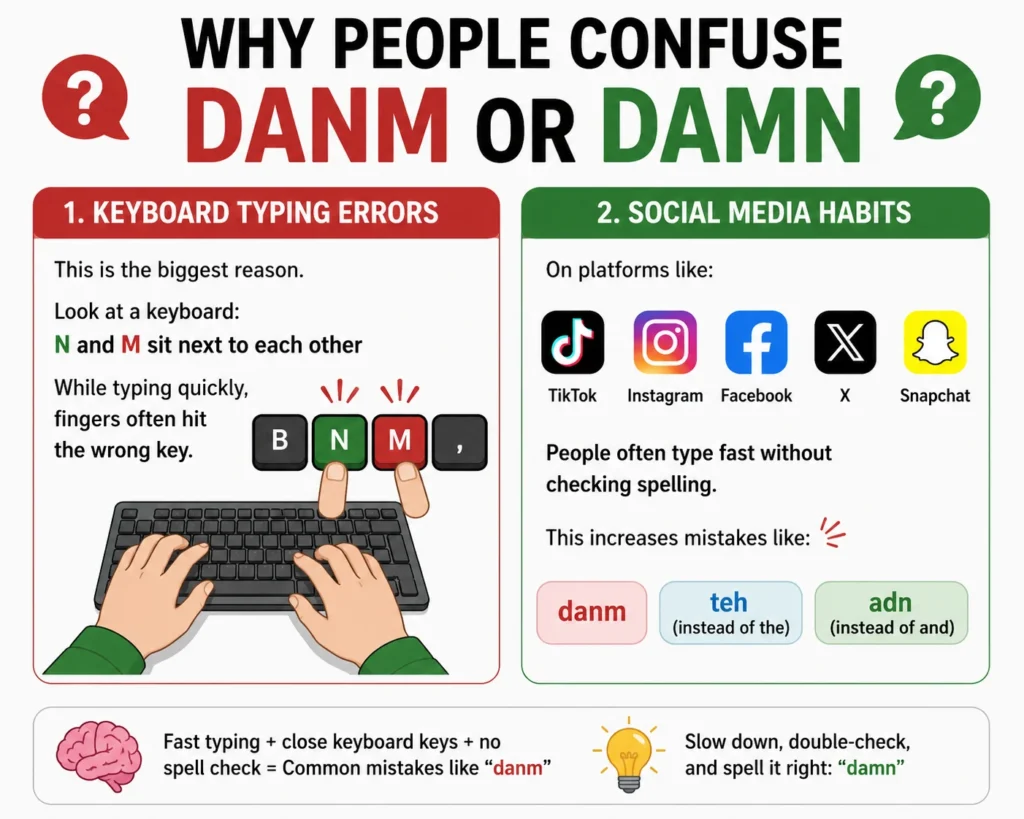
Keyboard Typing Errors
This is the biggest reason.
Look at a keyboard:
- N and M sit next to each other
While typing quickly, fingers often hit the wrong key.
Social Media Habits
On platforms like:
- TikTok
- X
- Snapchat
People often type fast without checking spelling.
This increases mistakes like:
- danm
- teh instead of the
- adn instead of and
Informal Internet Language
Sometimes users intentionally misspell words online for style or humor.
But professionally, “danm” is still incorrect.
Grammar Rules for Damn
Damn as an Interjection
Used to express emotion.
Examples:
- Damn, that scared me.
- Damn, this food is amazing.
Damn as an Adjective
Used informally for emphasis.
Examples:
- It’s a damn hot day.
- That was a damn good performance.
Damn as a Verb
Less common in modern casual English.
Examples:
- He damned the decision.
- They damned the policy publicly.
Advantages of Using Correct Spelling
Better Communication
Correct spelling makes your writing easier to understand.
Professional Impression
Using “damn” correctly instead of “danm” helps in:
- Emails
- Blogs
- School work
- Content writing
Better SEO and Content Quality
Search engines prefer well-written content.
Too many spelling mistakes can:
- Reduce readability
- Lower trust
- Hurt user experience
Disadvantages of Spelling Mistakes
Confusion
Readers may stop and reread incorrect words.
Poor Impression
Frequent typos can make writing look careless.
Lower Credibility
In professional settings, spelling errors reduce authority.
Real-World Examples of Danm or Damn
Example in Text Messaging
Incorrect:
Danm, I missed the bus.
Correct:
Damn, I missed the bus.
Example in Social Media
Incorrect:
Danm this game is hard.
Correct:
Damn, this game is hard.
Example in Professional Writing
Incorrect:
Danm, the project failed.
Correct alternative:
Unfortunately, the project failed.
Professional writing usually avoids words like “damn.”
Regional and Global Usage
American English
“Damn” is commonly used in casual speech.
British English
Also widely understood and used informally.
Formal English Worldwide
In schools, offices, and formal writing, people usually avoid using “damn” because it may sound rude.
Common Mistakes People Make
Writing Danm Instead of Damn
This is the most common error.
Correct:
- Damn
Incorrect:
- Danm
Using Damn in Formal Writing
While grammatically correct, it may sound unprofessional.
Instead of:
Damn, the results were bad.
Use:
The results were disappointing.
Overusing Damn
Using the word too often weakens writing quality.
How to Remember the Correct Spelling
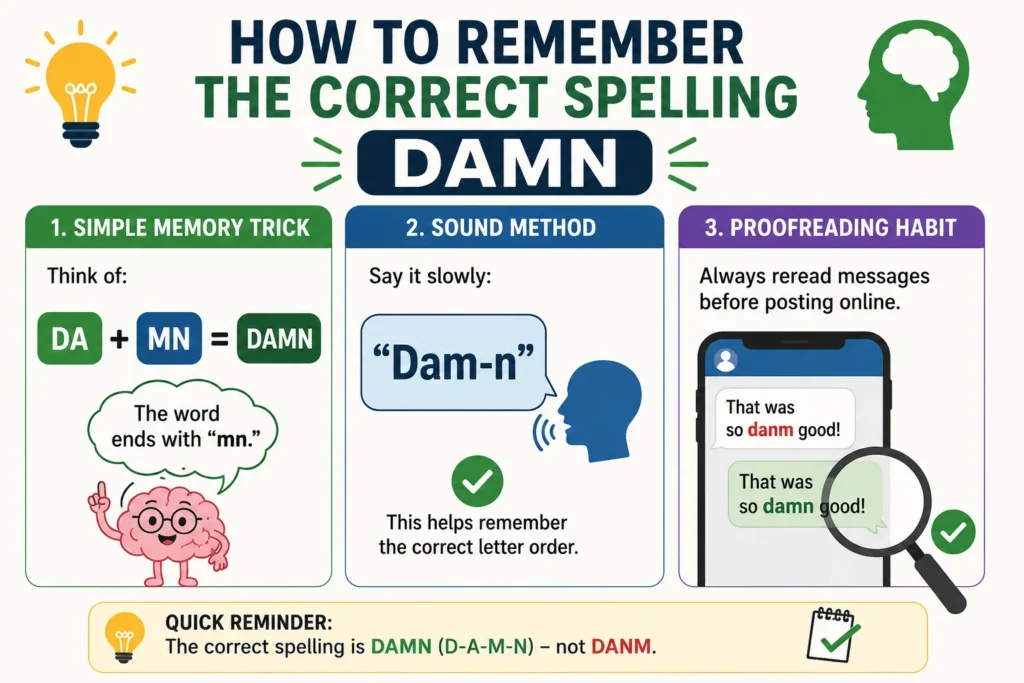
Simple Memory Trick
Think of:
“DA” + “MN”
The word ends with “mn.”
Sound Method
Say it slowly:
“Dam-n”
This helps remember the correct letter order.
Proofreading Habit
Always reread messages before posting online.
Related Word Comparisons
Danm vs Damn vs Darn
| Word | Correct | Tone |
|---|---|---|
| Danm | No | Typo |
| Damn | Yes | Strong informal |
| Darn | Yes | Softer and polite |
Damn vs Darn
“Darn” is often used as a polite replacement for “damn.”
Examples:
- Darn, I forgot my wallet.
- Damn, I forgot my wallet.
Exercises With Answers
Exercise 1
Choose the correct spelling:
A. Danm
B. Damn
Answer: B. Damn
Exercise 2
Which sentence is correct?
A. Danm, that was scary.
B. Damn, that was scary.
Answer: B. Damn, that was scary.
Exercise 3
Is “danm” a real English word?
Answer: No.
Exercise 4
Which word is more polite?
A. Damn
B. Darn
Answer: B. Darn
Exercise 5
Correct the sentence:
Danm this coffee is hot.
Answer:
Damn this coffee is hot.
FAQs About Danm or Damn
Is danm a real word?
No, “danm” is usually a spelling mistake of “damn.”
Which is correct: danm or damn?
“Damn” is the correct English spelling.
Why do people type danm instead of damn?
It usually happens because of fast typing or keyboard mistakes.
Can I use damn in professional writing?
It is better to avoid “damn” in formal or professional situations.
Is damn considered a bad word?
It is considered mildly offensive by some people, depending on context.
What is a polite alternative to damn?
You can use:
- Darn
- Oh no
- Unfortunately
Does autocorrect change damn to danm?
Sometimes typing errors happen before autocorrect fixes them.
Is damn common in spoken English?
Yes, especially in casual conversation and entertainment.
Can spelling mistakes affect SEO?
Yes. Too many spelling mistakes can reduce content quality and user trust.
How can I avoid typing danm?
Type slowly and proofread your writing before posting.
Conclusion
The confusion between danm or damn is very common, especially online. However, the answer is simple: “damn” is the correct word, while “danm” is usually just a typing mistake.
Understanding this small difference can improve your writing quality, communication, and professionalism. Whether you are posting on social media, writing a blog, or sending an email, correct spelling always creates a better impression.
It is also important to know when to use the word. “Damn” works in casual conversations, but in formal writing, softer alternatives may sound more professional.
The easiest way to avoid the mistake is simple:
- Slow down while typing
- Proofread your text
- Remember the correct letter order
Small spelling improvements can make a big difference in how people understand your writing.

Victoria Lane is a grammar-focused writer at GramBrix.com, passionate about helping readers master the rules of language. She provides clear explanations and practical examples that make writing more accurate, polished and confident.