Last Updated on June 14, 2026
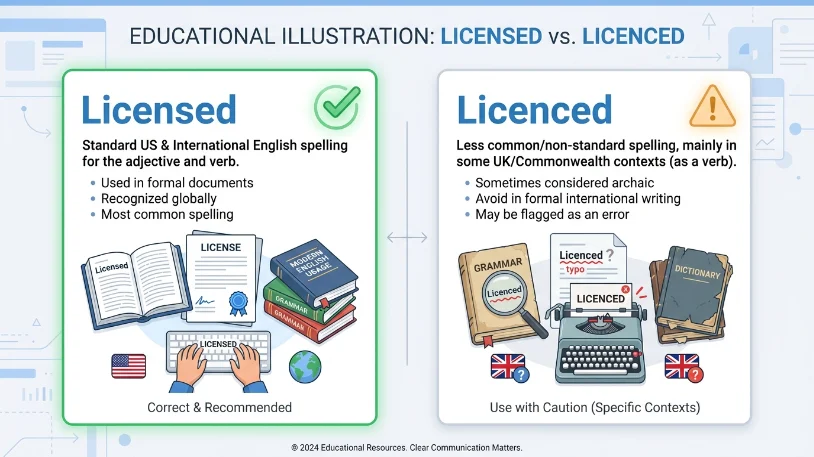
“Licensed” and “licenced” are both English words, but they are used differently depending on the region and grammar style. In American English, “licensed” is the correct spelling for both noun and verb forms, while British English often uses “licence” as a noun and “license/licensed” as the verb form.
Many English learners get confused between “licensed” and “licenced.” At first glance, both words look correct. They sound the same. They even appear in professional writing, websites, and legal documents. So naturally, people wonder which spelling should actually be used.
The confusion mostly comes from the difference between American English and British English. Some countries follow one spelling style, while others follow another. On top of that, the noun and verb forms can also change depending on the grammar rules.
This matters more than people think. Using the wrong spelling in resumes, business documents, websites, or legal content can make writing look unprofessional. It can also affect SEO, academic writing, and brand credibility.
In this guide, you will learn the real difference between licensed or licenced, when to use each one, common mistakes people make, and simple tricks to remember the correct spelling easily.
Quick Answer / Overview
| Word | Correct Usage | Region |
|---|---|---|
| Licensed | Correct in American English | USA, Canada |
| Licenced | Rarely used and usually incorrect in modern usage | Very uncommon |
Simple Answer
- “Licensed” is the standard and widely accepted spelling.
- “Licenced” is generally considered incorrect in modern English writing.
What Does “Licensed” Mean?
“Licensed” means officially permitted, approved, or authorized to do something.
It is commonly used for:
- Drivers
- Doctors
- Businesses
- Software
- Contractors
Examples
- She is a licensed doctor.
- This software is fully licensed.
- Only licensed drivers can operate the vehicle.
In these examples, “licensed” shows legal permission or certification.
What Does “Licenced” Mean?
“Licenced” is an uncommon spelling variation mostly seen because of confusion with British English grammar patterns.
In modern English:
- “Licensed” is preferred almost everywhere.
- “Licenced” is rarely accepted by professional editors.
Many grammar tools even flag “licenced” as a spelling mistake.
Why People Confuse Licensed or Licenced
British vs American English
This is the biggest reason for confusion.
In British English:
- “Licence” is usually the noun
- “License” is the verb
Example:
- I have a driving licence.
- The company will license the product.
But when converted into the adjective or past tense form, “licensed” is still the common spelling.
That’s why:
- Licensed ✔
- Licenced ✘
Licensed vs Licence vs License
Understanding the Full Difference
| Word | Part of Speech | Common Region |
|---|---|---|
| Licence | Noun | British English |
| License | Verb | British English |
| License | Noun + Verb | American English |
| Licensed | Adjective/Past Tense | Both |
| Licenced | Rare/Usually Incorrect | Rare |
When to Use “Licensed”
Professional Usage
Use “licensed” when talking about:
- Certified professionals
- Approved businesses
- Legal permissions
- Authorized products
Examples
Healthcare
- He is a licensed surgeon.
Driving
- She is a licensed driver.
Business
- This is a licensed insurance company.
Technology
- The software is licensed for commercial use.
Advantages of Using the Correct Spelling
Better Professional Impression
Correct spelling makes writing look polished and trustworthy.
Improved SEO Performance
Using the correct keyword helps search engines understand content better.
For example:
- “licensed contractor”
- “licensed electrician”
- “licensed software”
These are far more common search terms than “licenced.”
Stronger Academic and Business Writing
Correct grammar improves:
- Emails
- Reports
- Applications
- Websites
Common Mistakes
Using “Licenced” Everywhere
Many people assume British English requires “licenced.” That is usually incorrect.
Correct:
- Licensed plumber
Incorrect:
- Licenced plumber
Mixing Licence and License Incorrectly
Incorrect:
- I got my driving license in the UK.
Better British English:
- I got my driving licence in the UK.
Assuming Search Engines Ignore Spelling
Google understands variations, but the standard spelling still performs better.
Real-World Examples
Job Applications
If you write:
- “licensed nurse”
It looks professional and correct.
But writing:
- “licenced nurse”
May appear as a spelling error to recruiters.
Business Websites
Most companies use:
- licensed services
- licensed products
- licensed dealer
Because it matches common search behavior.
Legal Documents
Legal and government documents almost always prefer “licensed.”
Regional Usage Around the World
United States
American English uses:
- license
- licensed
United Kingdom
British English uses:
- licence (noun)
- license (verb)
But still commonly uses:
- licensed
Canada and Australia
These countries mostly follow British rules, but “licensed” remains the dominant spelling.
Related Grammar Concepts
Practice vs Practise
British English:
- Practice = noun
- Practise = verb
American English:
- Practice = both
This is similar to:
- Licence
- License
Advice vs Advise
- Advice = noun
- Advise = verb
These word pairs confuse learners in the same way.
Exercises With Answers
Exercise 1
Which spelling is correct?
- Licensed electrician
- Licenced electrician
Answer:
Licensed electrician ✔
Exercise 2
Choose the correct British noun form:
- Licence
- License
Answer:
Licence ✔
Exercise 3
Fill in the blank:
“She is a fully ______ pharmacist.”
Answer:
licensed
Exercise 4
Which version is most accepted globally?
Answer:
Licensed
Tips to Remember the Correct Spelling
Think About Common Usage
If you see:
- licensed doctor
- licensed software
- licensed contractor
Repeated everywhere online, that’s usually the safest choice.
Remember This Simple Rule
- Licence = noun in British English
- License = verb
- Licensed = almost always correct
Use Grammar Tools
Tools like Grammarly usually recommend “licensed.”
FAQs
Is licensed or licenced correct?
“Licensed” is the correct and widely accepted spelling in modern English.
Why do people write licenced?
People confuse it with the British noun “licence.”
Is licenced wrong in British English?
In most modern professional writing, “licensed” is still preferred.
Which spelling should I use?
Use “licensed” because it has much higher search volume and recognition.
Do Google and grammar tools accept licenced?
Some tools may recognize it, but many flag it as incorrect or uncommon.
What is the difference between licence and licensed?
“Licence” is usually a noun in British English, while “licensed” describes someone officially approved.
Is licensed American or British English?
It is used in both American and British English.
Can I use licenced in formal writing?
It is better to avoid it because many readers consider it incorrect.
Why is licensed more common online?
Because it is the globally accepted standard spelling.
How do professionals spell licensed?
Most professionals, companies, and legal organizations use “licensed.”
Conclusion
The confusion between licensed or licenced mainly comes from British and American spelling rules. But in modern usage, “licensed” is the safer and more professional choice almost everywhere.
Whether you are writing a resume, business website, blog article, or legal document, using “licensed” helps your writing look cleaner and more credible. It also matches what most readers expect to see online.
The word “licenced” still appears occasionally, but it is uncommon and often treated as a spelling mistake. That’s why many editors, grammar tools, and SEO experts recommend avoiding it.
If you want a simple rule to remember, use this:
- Licence = noun in British English
- License = verb
- Licensed = correct adjective or past tense form
Keeping this distinction clear will improve your writing and help you communicate more professionally.

Kevin Brooks is a grammar specialist at GramBrix.com, dedicated to helping readers understand language rules with clarity and confidence. He simplifies complex grammar concepts through practical examples and easy explanations.