Last Updated on July 10, 2026
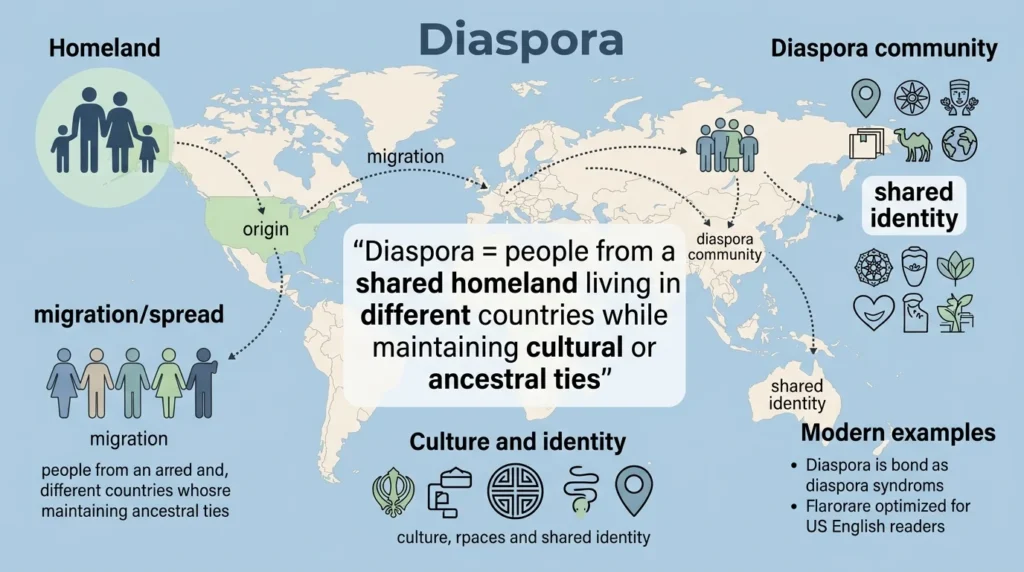
Diaspora means the movement, spread, or living of a group of people outside their original homeland, often while maintaining cultural, emotional, or family ties to that place. It can describe both the people themselves and the global communities formed after migration, displacement, or relocation.
If you’ve seen the word diaspora in news articles, history books, social media discussions, university essays, or conversations about identity, migration, and culture, you might be wondering what it actually means in plain English.
The short version is this: diaspora refers to people from a shared homeland who are living in different parts of the world, often while staying connected to their roots, culture, language, traditions, or family history.
But the full diaspora meaning goes much deeper than a simple dictionary definition. It can describe migration, exile, cultural identity, belonging, community, memory, and the experience of living between more than one place. In modern US English, the word is used in academic writing, journalism, politics, pop culture, online conversations, and everyday speech—especially when talking about immigrant communities and global identities.
In this guide, you’ll learn:
- the exact meaning of diaspora
- how to pronounce and use it correctly
- the difference between diaspora, migration, immigrant community, and exile
- reallife examples and chatstyle usage
- how the word appears on social platforms and in media
- alternative meanings and common misunderstandings
- when not to use the word
- FAQs people actually search for
If you want a clear, complete, USEnglish explanation of diaspora meaning, this article covers the full picture.
Quick Answer Box
| Item | Explanation |
| Word | Diaspora |
| Basic meaning | A group of people from the same homeland living in different countries or regions outside that homeland |
| Can also mean | The spread or scattering of those people across the world |
| Common contexts | Migration, culture, identity, history, politics, religion, race, ethnicity, global communities |
| Tone | Formal to semiformal; common in journalism, education, cultural discussions, and thoughtful online conversations |
| Used for | Communities with shared roots, ancestry, or homeland ties |
| Example | “The Pakistani diaspora in the US has built strong community networks while staying connected to Pakistan.” |
| Not exactly the same as | immigrant, refugee, exile, traveler, expat |
| Platform usage | News, TikTok commentary, identity discussions on X, academic posts, cultural community pages, YouTube explainers |
| Core idea | People living away from their ancestral or national homeland but still linked to it in some way |
What Does Diaspora Mean?
Diaspora is a noun used to describe a population of people who have spread or live outside their original homeland, while still having some connection to that homeland through ancestry, culture, language, religion, memory, politics, family, or identity.
You’ll often hear it in sentences like:
- “The African diaspora has influenced music, art, and politics around the world.”
- “The South Asian diaspora in the United States is incredibly diverse.”
- “She writes about the experience of growing up in the diaspora.”
- “Diaspora communities often preserve traditions in new ways.”
So when someone asks for the diaspora meaning, there are really two closely related meanings:
- The scattering or spread of a people from their original homeland
- The people or communities living outside that homeland
Both meanings are correct, and context tells you which one is intended.
Simple definition in everyday English
In plain US English, diaspora means:
people from the same homeland or ancestry who now live in many different places outside that homeland, often while still identifying with it
That homeland might be a country, region, ethnic homeland, ancestral land, or cultural origin point.
Very short version
If you need the fastest possible answer:
- Diaspora = a global community living away from its original homeland
- It can refer to where people have spread and the people in those communities
Full Definition of Diaspora
To really understand diaspora meaning, it helps to unpack what is built into the word.
Diaspora is not just about moving somewhere else. It usually carries a sense of collective identity and connection. It often suggests that the people involved are part of a wider community with a shared origin.
Core elements of diaspora
A group is often described as a diaspora when several of these elements are present:
- Shared homeland or origin
The people trace their roots to the same country, territory, region, or ancestral place. - Living outside that homeland
Members of the group now live in one or more different countries or regions. - A continuing sense of connection
That connection might be cultural, emotional, linguistic, religious, political, historical, or familybased. - Community identity across borders
People may see themselves as part of a broader global community, not just isolated migrants. - Memory, heritage, and belonging
Diaspora often involves remembering where one’s family came from and negotiating identity in a new place.
A more precise definition
A more complete definition would be:
Diaspora refers to the dispersion of a people from their ancestral or national homeland and the communities they form abroad, especially when those communities maintain a real or symbolic connection to their place of origin.
Is diaspora always about forced displacement?
No. That’s one of the biggest misunderstandings.
Some diasporas are deeply tied to forced displacement, slavery, war, persecution, colonization, or expulsion. Others are shaped by labor migration, education, marriage, economic opportunity, family reunification, or voluntary relocation.
So the word can include both:
- forced movement
- voluntary migration
- mixed histories across generations
That’s why context matters so much.
Where the Word Diaspora Comes From
The word diaspora comes from Greek, from a root meaning to scatter or spread across.
Historically, the term was often associated with the Jewish Diaspora, referring to Jewish communities living outside the ancient land of Israel/Judea after dispersal and exile across different periods of history. Over time, the word expanded and is now used much more broadly.
Today, you’ll see diaspora used in discussions of many communities, such as:
- the African diaspora
- the Indian diaspora
- the Pakistani diaspora
- the Chinese diaspora
- the Armenian diaspora
- the Irish diaspora
- the Palestinian diaspora
- the Caribbean diaspora
- the Korean diaspora
- the Lebanese diaspora
In modern English, the word no longer belongs to one community only. It has become a broader term for discussing people, migration, identity, and transnational belonging.
Diaspora Meaning in Simple Words
If the formal definitions feel heavy, here’s the idea in simpler language.
Imagine a group of people whose families come from the same homeland. Over time, they move to different countries—maybe the US, Canada, the UK, Australia, the Gulf, or elsewhere. Even though they live in different places now, they still share food, language, customs, music, religion, values, stories, and family ties connected to the original homeland.
That global network can be called a diaspora.
Example in simple terms
If someone says:
“She grew up in the Pakistani diaspora in New York.”
It usually means:
- her family roots are in Pakistan
- she lives outside Pakistan
- she’s part of a community connected to Pakistani culture, identity, or heritage abroad
It doesn’t necessarily mean she was born in Pakistan. She could be firstgeneration, secondgeneration, or even thirdgeneration and still be part of the diaspora.
Context and Usage of Diaspora
The meaning of diaspora becomes clearer when you see how it is actually used. The word appears in several major contexts, and each one adds a slightly different shade of meaning.
Historical and Political Context
In history and politics, diaspora often refers to a people dispersed from a homeland because of major events such as:
- war
- colonization
- slavery
- persecution
- partition
- expulsion
- state collapse
- economic crisis
In this context, diaspora can carry emotional weight. It may imply loss, displacement, survival, or a long relationship with exile and return.
Example:
- “The Armenian diaspora preserved cultural memory across generations.”
- “The Palestinian diaspora spans multiple countries and political histories.”
Here, the word is not just demographic. It carries history.
Cultural and Identity Context
In cultural conversations, diaspora often refers to identity formation outside the homeland.
People in the diaspora may ask questions like:
- How much of my parents’ culture do I keep?
- Am I American, Pakistani, Nigerian, Lebanese, or both?
- What language do I speak at home versus in public?
- What traditions matter to me?
- What does “home” mean if I’ve never lived in my family’s country of origin?
In this context, diaspora is often about belonging, hybridity, identity, and cultural negotiation.
Example:
- “Her film explores the South Asian diaspora and the pressure of balancing tradition with independence.”
- “Diaspora writers often explore memory, migration, and identity.”
Community and Social Context
In everyday conversation, diaspora may simply describe a community abroad.
Example:
- “Chicago has a large South Asian diaspora.”
- “The Nigerian diaspora in Houston has strong business and cultural networks.”
In this use, the tone is more descriptive and social than historical.
Academic and Media Context
In universities, think pieces, journalism, and research, diaspora is a common term because it is more precise than just saying “people from X country abroad.”
Why? Because diaspora can capture:
- shared history
- crossborder identity
- cultural continuity
- political ties
- transnational networks
- intergenerational belonging
That’s why you’ll often see phrases like:
- diaspora politics
- diaspora communities
- diaspora literature
- diaspora identity
- diaspora studies
- diaspora networks
- diaspora engagement
- diaspora youth
RealLife Examples of Diaspora Meaning
The easiest way to understand a word is to see it in real use. Below are several natural examples showing how diaspora works in different contexts.
Example Sentences
- “The Indian diaspora has played a major role in tech, medicine, and business in the United States.”
- “Many artists from the African diaspora explore themes of identity, migration, and memory.”
- “He grew up in the Korean diaspora and visited Seoul for the first time as an adult.”
- “The Lebanese diaspora has communities across North America, South America, Europe, and West Africa.”
- “Diaspora communities often create cultural festivals to keep traditions alive.”
- “Her research focuses on language loss in immigrant and diaspora families.”
- “The documentary examines how the Caribbean diaspora shaped music in London and New York.”
- “People in the diaspora may feel connected to a homeland they’ve never physically lived in.”
RealLife Conversation Examples
Below are five realistic dialoguestyle examples showing how someone might use diaspora in natural English.
Conversation Example 1: Identity and Family Background
Ava: Are you firstgeneration American?
Mina: Yeah, my parents moved here from Iran.
Ava: Do you feel more American or Iranian?
Mina: Honestly, both. I grew up in the Iranian diaspora, so it’s kind of a mix.
What diaspora means here:
Mina is talking about being part of an Iranianorigin community living outside Iran while still connected to that culture.
Conversation Example 2: News and Politics
Jordan: Why do they keep saying “the Sudanese diaspora” in this article?
Taylor: They mean Sudanese communities living outside Sudan, especially people still connected to what’s happening there.
What diaspora means here:
The term refers to Sudaneseorigin communities abroad who may still be emotionally, politically, or financially connected to Sudan.
Conversation Example 3: University Class Discussion
Professor: This novel is a classic work of diaspora literature.
Student: Because the main character is living between two cultures?
Professor: Exactly. It explores migration, memory, language, and belonging.
What diaspora means here:
Diaspora is tied to literature about displacement, migration, and identity across homelands.
Conversation Example 4: Social Media Caption
Caption: “Diaspora kids know the struggle of translating for your parents at appointments 😭”
What diaspora means here:
The speaker is referring to children of immigrant or transnational families who grow up between cultures and often take on adult responsibilities.
Conversation Example 5: Community Event
Friend 1: What’s this festival for?
Friend 2: It’s celebrating Caribbean food, music, and art from across the diaspora.
Friend 1: So it’s not just one country?
Friend 2: Right—it includes people with Caribbean roots living in different places.
What diaspora means here:
The word points to a broader cultural community spread across countries.
PlatformSpecific Meaning of Diaspora
The word diaspora doesn’t mean something completely different on each platform, but the tone, emphasis, and style of use can change a lot depending on where you see it.
Diaspora on TikTok
On TikTok, diaspora often appears in identitybased content, humor, family culture, language jokes, and “you know if you know” community posts.
Common examples:
- “Diaspora kids will understand this.”
- “Growing up in the desi diaspora be like…”
- “African diaspora fashion appreciation.”
- “Things only Arab diaspora girls get.”
On TikTok, diaspora often signals:
- shared cultural experiences
- funny family habits
- codeswitching
- food, music, and language references
- generational differences between parents and kids
- tension between tradition and modern life
What it usually implies on TikTok
The creator is often saying:
- “I’m part of a global cultural community”
- “This is a very specific immigrant or secondgen experience”
- “People from this background will relate”
Diaspora on X or Twitterstyle discussion
On X, diaspora is commonly used in political, social, and cultural conversations.
Examples:
- “The diaspora needs to stop romanticizing what’s happening back home.”
- “Diaspora voices matter in this conversation too.”
- “There’s a real divide between people on the ground and people in the diaspora.”
Here the word can be used in serious debates about:
- homeland politics
- activism
- identity policing
- representation
- who gets to speak on cultural issues
- differences between locals and overseas communities
Tone on X
The tone can be:
- analytical
- political
- emotional
- critical
- communitycentered
Sometimes it’s supportive. Sometimes it’s confrontational.
Diaspora on Instagram
On Instagram, diaspora often shows up in captions, creator bios, community pages, and visual storytelling.
Examples:
- “Celebrating Black diaspora art and design.”
- “Stories from the South Asian diaspora.”
- “Fashion inspired by the Somali diaspora.”
- “Recipes from the Filipino diaspora kitchen.”
Instagram usage often highlights:
- aesthetics
- food
- heritage
- fashion
- language
- family stories
- cultural pride
- identity storytelling
Diaspora on YouTube
On YouTube, diaspora often appears in:
- documentaries
- commentary videos
- identity discussions
- vlogs about family background
- explainers on migration and culture
- reaction videos about “going back home” for the first time
Typical video themes:
- “What it’s like growing up in the Nigerian diaspora”
- “Diaspora identity crisis explained”
- “Why diaspora communities preserve culture differently”
- “Visiting my parents’ homeland for the first time”
Diaspora on Reddit
On Reddit, the word often appears in deeper, more personal discussions.
Examples:
- “Anyone else from the Pakistani diaspora struggle with language loss?”
- “How do you explain diaspora identity to people who don’t get it?”
- “Do diaspora communities become more conservative than people back home?”
The Reddit tone is often:
- reflective
- identityfocused
- honest
- nuanced
- sometimes messy, but very real
Diaspora in News and Journalism
In journalism, the word is often used in a formal and precise way.
Examples:
- “The Haitian diaspora has mobilized aid efforts.”
- “The Ethiopian diaspora remains deeply engaged in national politics.”
- “Candidates are courting diaspora voters and donors.”
In news writing, diaspora can highlight:
- remittances
- political influence
- migration trends
- lobbying
- humanitarian support
- crossborder activism
Different Types of Diaspora Usage
Not every use of diaspora focuses on the same thing. Here are the most common ways the term functions in realworld English.
Diaspora as People
Sometimes it refers directly to the people.
Example:
“The Pakistani diaspora in the US is growing.”
Meaning: Pakistaniorigin communities living in the US.
Diaspora as a Process of Dispersal
Sometimes it refers to the historical spread itself.
Example:
“The diaspora began after political upheaval.”
Meaning: the movement or scattering of that population.
Diaspora as Identity
Sometimes it describes a lived identity.
Example:
“She writes from a diaspora perspective.”
Meaning: her work reflects the experience of living outside an ancestral homeland while remaining connected to it.
Diaspora as a Cultural Space
Sometimes it refers to the cultural world created by dispersed communities.
Example:
“Diaspora music blends influences from multiple homes.”
Meaning: cultural production shaped by migration, memory, and hybrid identity.
Alternative Meanings and Closely Related Terms
To understand diaspora meaning fully, it helps to compare it with related words people often confuse with it.
Diaspora vs Immigrant
An immigrant is a person who moves to another country to live there.
Diaspora is broader. It usually refers to a whole community or population with shared origins living outside a homeland.
Example
- Immigrant: “My father immigrated to the US in 1998.”
- Diaspora: “Our family is part of the Bangladeshi diaspora in New Jersey.”
One person can be an immigrant. A whole transnational community can be a diaspora.
Diaspora vs Expat
An expat usually refers to someone living outside their home country, often temporarily or for work. In everyday use, it’s frequently associated with professionals relocating abroad.
Diaspora is different because it usually involves:
- deeper communal identity
- historical roots
- family and ancestry
- longterm settlement
- cultural continuity across generations
An expat might not identify as part of a diaspora at all.
Diaspora vs Refugee
A refugee is someone forced to leave their country because of war, persecution, or danger, and who has a specific legal or humanitarian context.
A diaspora may include refugees, but it is not limited to refugees. It can also include:
- labor migrants
- students who settled abroad
- descendants of migrants
- communities formed over generations
Diaspora vs Exile
Exile often emphasizes being forced away from home and unable to return safely or freely.
Diaspora is broader. It can include exile, but it doesn’t always imply forced banishment.
Diaspora vs Migration
Migration is the movement of people from one place to another.
Diaspora is what can result from migration over time when a dispersed community forms and maintains some shared identity or connection.
Diaspora vs Community Abroad
“Community abroad” is a simple descriptive phrase.
“Diaspora” usually adds layers of:
- shared origin
- collective memory
- cultural continuity
- transnational identity
- historical meaning
Related Terms and NLP Variations
If you’re researching diaspora meaning, you’ll often see these related words and semantic variations around it.
Common related terms
- dispersed community
- overseas community
- transnational community
- global community
- migrant community
- immigrant community
- ethnic community abroad
- people living outside their homeland
- descendants of migrants
- overseas population
- homelandconnected community
Academic and media variations
- diaspora identity
- diaspora politics
- diaspora literature
- diaspora studies
- diaspora communities
- diasporic identity
- diasporic culture
- diasporic memory
- transnational belonging
- postmigration identity
- homeland attachment
- cultural retention abroad
Useful synonym note
There is no perfect oneword synonym for diaspora in every context.
Depending on the sentence, the closest alternatives may be:
- dispersed community
- global community
- overseas community
- migrant population
- ethnic community abroad
But in many cases, diaspora is still the most precise word because it carries historical and cultural meaning that those simpler terms may miss.
Emotional and Social Meaning of Diaspora
One reason this word matters so much is that it often carries an emotional dimension, not just a factual one.
For many people, diaspora is about more than location. It can be about:
- feeling connected to a place you left
- feeling connected to a place your parents left
- missing a homeland you barely know
- trying to preserve language and traditions
- feeling “between” cultures
- being told you’re too foreign in one place and not authentic enough in another
- creating a version of home in a new country
- holding memory through food, music, religion, and family rituals
That’s why diaspora often appears in conversations about:
- identity
- belonging
- alienation
- assimilation
- intergenerational tension
- nostalgia
- pride
- cultural survival
Example of emotional usage
When someone says:
“Being in the diaspora is complicated.”
They may mean:
- “I don’t fully fit into one national identity”
- “I’m carrying family history from somewhere else”
- “I’m balancing multiple worlds”
- “Home is emotionally layered for me”
So the word can be factual, but it can also be deeply personal.
Misinterpretations of Diaspora
Because diaspora is a serious and layered term, it’s often misunderstood. Here are the most common mistakes.
Misinterpretation 1: Diaspora just means “anyone living abroad”
Not exactly.
A person living abroad for a short job assignment is not automatically part of a diaspora in the meaningful sense people usually intend. Diaspora typically suggests a shared origin plus a broader community, continuity, or identity connection.
Misinterpretation 2: Diaspora always means forced exile
Also not true.
Some diasporas are rooted in trauma and forced displacement. Others are shaped by work, education, family migration, trade, or mixed migration patterns over time.
Misinterpretation 3: Diaspora only applies to firstgeneration migrants
No. Secondgeneration, thirdgeneration, and later generations can still be part of a diaspora if that community identity and connection remain meaningful.
Misinterpretation 4: Diaspora means the same thing as race or ethnicity
Not quite.
A diaspora can overlap with race, ethnicity, nationality, religion, or language—but it is not identical to any one of those categories. It usually refers to a people dispersed from a homeland and the communities they form elsewhere.
Misinterpretation 5: Diaspora communities are culturally identical to the homeland
Not at all.
Diaspora communities often evolve differently from people in the homeland. They may preserve older traditions, mix cultures, lose some language, create new food habits, or develop very different politics and social norms.
How to Use Diaspora Correctly
If you want to use the word naturally and accurately, these patterns help.
Common sentence patterns
“The [group] diaspora”
Examples:
- the Indian diaspora
- the African diaspora
- the Armenian diaspora
- the Somali diaspora
- the Caribbean diaspora
“In the diaspora”
Examples:
- “She grew up in the diaspora.”
- “Many people in the diaspora still send money home.”
- “Language retention varies across families in the diaspora.”
“Diaspora community” or “diaspora communities”
Examples:
- “The city has a large Ethiopian diaspora community.”
- “Diaspora communities often create cultural associations.”
“Diaspora identity”
Examples:
- “The film explores diaspora identity and belonging.”
- “He writes about Black diaspora identity in Europe.”
How to Respond or Reply When Someone Uses Diaspora
If someone uses the word in conversation and you’re not sure how to respond, your reply depends on the context.
If they’re using it factually
Them: “There’s a large Pakistani diaspora in Chicago.”
You could reply:
- “That makes sense—Chicago has a lot of South Asian communities.”
- “Do you mean people with Pakistani roots living there?”
- “I’ve seen that term in articles, but not always in casual conversation.”
If they’re using it emotionally
Them: “Growing up in the diaspora can feel complicated.”
You could reply:
- “Yeah, I can imagine that comes with a lot of identity stuff.”
- “Do you mean balancing family culture with where you live now?”
- “That makes sense—feeling connected to more than one place can be a lot.”
If you want clarification without sounding awkward
Try:
- “When you say diaspora, are you talking about the wider community abroad?”
- “Do you mean people from that background living outside the homeland?”
- “Are you using it in the cultural sense or the historical sense?”
When Not to Use the Word Diaspora
Even though diaspora is useful, it’s not the right word in every situation.
Don’t use it for random travel or temporary relocation
If someone is just:
- studying abroad for one semester
- traveling longterm
- working in another country temporarily
- moving without any broader community or homeland context
then diaspora may not be the best fit.
Don’t use it just to sound more academic
Sometimes “immigrant community,” “people living abroad,” or “overseas citizens” is clearer than diaspora—especially if the audience is not familiar with the term.
Be careful if the historical context is sensitive
Some communities have specific histories of trauma, expulsion, enslavement, statelessness, or war. Using diaspora casually without understanding that context can sound careless.
Don’t assume everyone identifies with the label
Some people strongly identify as part of a diaspora. Others don’t. A person may prefer:
- immigrant
- secondgeneration
- hyphenated identity
- ethnic identity
- national identity
- simply “American”
So it’s smart not to force the term onto someone’s identity if they don’t use it for themselves.
Usage Tips for Natural US English
If your goal is to sound natural in American English while using diaspora correctly, these tips help.
Use it when talking about a broader community, not just one individual
Natural:
- “The Nigerian diaspora in Atlanta is really active.”
Less natural:
- “My cousin is a diaspora.”
Why? Because diaspora usually refers to a collective or a condition of dispersed community, not a label you use as a singular noun for one person in casual speech.
Pair it with a group, homeland, or community reference
Examples:
- “the Pakistani diaspora”
- “diaspora communities from the Caribbean”
- “South Asian diaspora identity”
- “artists from the African diaspora”
Match the tone to the context
Formal / article / classroom / journalism
- “The Armenian diaspora maintained strong cultural institutions abroad.”
Casual but informed
- “A lot of diaspora kids relate to that kind of pressure.”
Know that it can sound thoughtful or academic
That’s not a bad thing. Just be aware that diaspora is a bit more conceptheavy than everyday words like “immigrant” or “community.”
Diaspora in US English vs General Global Usage
Because this article is optimized for a US audience, it’s worth noting how the word commonly lands in American English.
In the US, diaspora often appears in discussions of:
- immigrant identity
- race and ethnicity
- college and university culture
- political organizing
- media representation
- food and culture
- religion and community networks
- children of immigrants
- international solidarity and activism
In American conversations, you might hear phrases like:
- “diaspora aunties”
- “diaspora politics”
- “diaspora food”
- “diaspora identity crisis”
- “diaspora Twitter”
- “diaspora art”
- “diaspora media”
These are not all equally formal, but they show how the word has moved from academic and historical use into mainstream cultural conversation.
Expanded Examples of Diaspora in Different Contexts
Below are more examples to show how flexible the word can be.
In a school essay
“The novel explores the emotional experience of diaspora by showing a family that migrates to the United States but continues to carry memories, rituals, and grief from the homeland.”
In a news article
“The country’s diaspora has raised millions in remittances and relief funds after the floods.”
In a cultural review
“This album reflects the sounds of the Black diaspora, blending African, Caribbean, and American influences.”
In a family conversation
“My parents still mostly spend time with people from the same diaspora because it feels familiar.”
In a social post
“Being in the diaspora means your parents say ‘we’re going home’ and you’re like… which home 😭”
In a political discussion
“There’s tension between local activists and some diaspora voices over who gets to define the movement.”
In a food context
“Diaspora cooking often changes recipes based on what ingredients are available in the new country.”
Edge Cases: When Diaspora Meaning Gets Complicated
Language gets messy in real life, so here are a few edge cases where people may disagree about usage.
Can someone be part of a diaspora if they were born in the US?
Yes. If they belong to a community with roots in another homeland and maintain some connection—through family, culture, religion, language, identity, or community—they may describe themselves as part of that diaspora.
Can diaspora include people who have never visited the homeland?
Yes. Physical travel is not required. Diaspora can be inherited through family history and cultural belonging.
Can a diaspora lose language and still be a diaspora?
Yes. Language loss does not automatically erase diaspora identity. Communities change over generations.
Can one person belong to more than one diaspora identity?
Sometimes, yes. For example, someone with mixed heritage or a family history shaped by multiple migrations may relate to more than one diaspora experience.
Is “diasporic” the same as diaspora?
Not exactly, but they’re closely related.
- Diaspora is usually the noun.
- Diasporic is the adjective.
Examples:
- “the Somali diaspora”
- “diasporic literature”
- “diasporic identity”
- “diasporic art”
FAQ:
What does diaspora mean in simple words?
In simple words, diaspora means a group of people from the same homeland or ancestry who live in different places outside that homeland while still having some connection to it.
Does diaspora mean immigrant?
Not exactly. An immigrant is an individual who moves to another country. Diaspora usually refers to a broader community of people with shared roots living outside their homeland.
Is diaspora a negative word?
No. It’s generally a neutral word, but it can carry emotional or historical weight depending on the community and context. For some groups, it may be tied to trauma, displacement, or exile. For others, it may emphasize community, pride, and cultural connection.
What is an example of diaspora?
A common example is the Indian diaspora in the United States—people of Indian origin living in the US, including immigrants and later generations who maintain cultural, family, or social ties to India.
Can diaspora refer to secondgeneration people?
Yes. A person can be secondgeneration or thirdgeneration and still be part of a diaspora if they remain connected to the community, identity, or heritage of that homeland.
What is the difference between diaspora and exile?
Exile usually emphasizes forced removal or banishment. Diaspora is broader and can include voluntary migration, forced displacement, or generations of global settlement.
Is diaspora only used for countries?
Not always. It can refer to people connected to a region, ethnic homeland, ancestral land, or cultural origin, not just a modern nationstate.
What does “diaspora kids” mean online?
“Diaspora kids” usually refers to children of immigrant or transnational families growing up outside their parents’ homeland, often balancing multiple cultures, languages, and expectations.
Is diaspora formal or casual English?
It leans formal to semiformal, but it’s now common in online cultural conversations too. You’ll see it in journalism, academia, social media captions, identity discussions, and community posts.
What is the adjective form of diaspora?
The adjective form is diasporic.
Example: “She studies diasporic literature and transnational identity.”
Conclusion
The clearest way to understand diaspora meaning is this:
Diaspora refers to people from a shared homeland who live outside that homeland, often across multiple countries, while still maintaining some form of connection to their roots, culture, history, family, or identity.
Depending on context, it can mean:
- the scattering or spread of a people from a homeland
- the communities formed abroad
- the identity and lived experience of those communities across generations
It’s a word you’ll see in history, politics, literature, social media, migration studies, and everyday conversations about belonging and culture. It can describe large global populations, specific cultural communities, or the deeply personal experience of growing up between worlds.
So if someone asks, “What does diaspora mean?”, the best plainEnglish answer is:
It means a community of people living outside their original homeland but still connected to it through ancestry, culture, identity, or shared history.
Once you understand that core idea, the rest of the word’s usage starts to click—whether you’re reading an article about the African diaspora, hearing someone talk about diaspora identity on TikTok, or trying to explain what it means to grow up in a family whose idea of home stretches across borders.

Justin Powell is a writer at GramBrix.com who focuses on grammar, clarity and effective communication, helping readers strengthen their language skills.