Last Updated on July 31, 2026
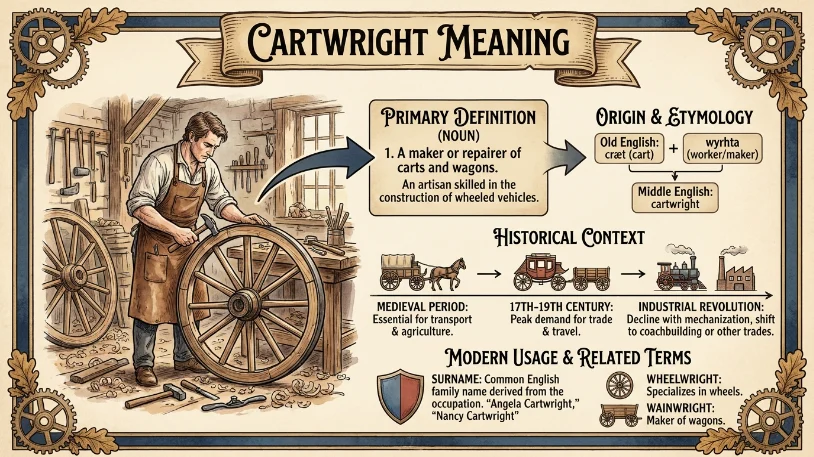
A cartwright is a skilled craftsman who builds and repairs carts and wagons, derived from the Old English words “cart” and “wright” (maker). This occupational surname dates back to medieval England, with records showing Richard le Cartwricht in Gloucestershire in 1197. The term appears in historical documents including the Domesday Book and remains relevant today as both a surname and a reference to traditional wheelwright craftsmanship .
Have you ever wondered about the Cartwright meaning or why this surname appears in historical records, family histories, and old English texts? While you may not hear the word cartwright in everyday conversations today, it carries important historical significance connected to traditional craftsmanship, medieval occupations, and English surname origins.
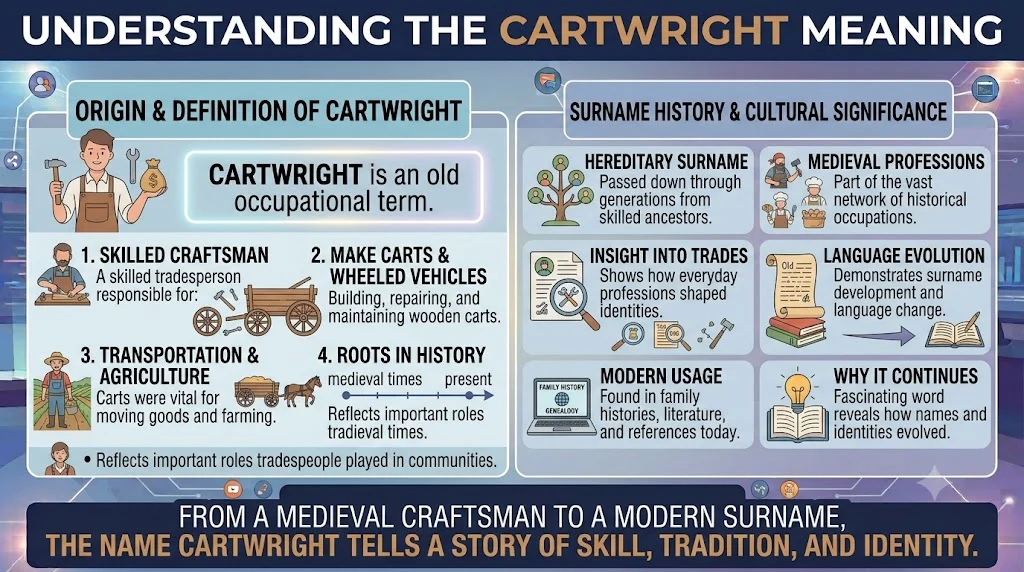
The Cartwright meaning comes from an old occupational term referring to a person who made carts and other wheeled vehicles. If you’re searching for what does Cartwright mean, the answer is rooted in history: a cartwright was a skilled craftsman responsible for building, repairing, and maintaining wooden carts used for transportation and agriculture. Over time, this occupation became a hereditary surname passed down through generations.
Understanding the Cartwright definition requires looking at both its literal meaning and its cultural background. Like many English surnames derived from occupations, Cartwright reflects the important role skilled tradespeople played in medieval communities. Learning to define Cartwright provides insight into historical professions, surname development, and the evolution of the English language.
Today, the name Cartwright can still be found in family histories, genealogy research, literature, and modern references. Whether you’re exploring your ancestry, studying historical occupations, or simply curious about unusual English words, understanding the meaning of Cartwright reveals how everyday professions shaped the names and identities of generations.
In this comprehensive guide, you’ll discover the complete Cartwright meaning, its origin, historical background, occupational significance, surname history, modern usage, cultural references, related terms, and why this fascinating word continues to have a place in the English language.
Quick Answer Box
| Aspect | Details |
|---|---|
| Meaning | A maker or repairer of carts and wagons |
| Word Origin | Old English “cræt” (cart) + “wyrhta” (maker/builder) |
| Parts of Speech | Noun |
| Pronunciation | /ˈkɑːrtˌraɪt/ (KART-rite) |
| Historical Context | Medieval England, essential rural trade |
| Primary Usage | Surname, historical trade reference |
| Synonyms | Wagon maker, carriage builder, vehicle craftsman |
What Does Cartwright Mean?
A cartwright is, in its most basic sense, a tradesperson who constructs and repairs carts and other wheeled vehicles. The word is a compound of the older term “cart” and the word “wright,” which historically meant a person who makes or repairs things .
The “wright” portion of the word is particularly significant. In old English, a wright wasn’t just any maker they were skilled craftsmen who worked with tools and materials to create functional items. You might recognize this suffix in other familiar words like “playwright” (a maker of plays), “wheelwright” (a maker of wheels), or “shipwright” (a builder of ships). The cartwright specialized specifically in the construction and maintenance of carts, which were essential for transportation and agriculture before the rise of motorized vehicles .
Historical Context
During medieval times, carts and wagons were vital to everyday life. They transported goods to market, moved crops from fields, and were essential for longdistance travel. Without functional carts, trade would stagnate, and communities would struggle to survive. This made the cartwright an indispensable member of any community, akin to how a modern auto mechanic is essential for a town with few public transportation options.
A cartwright’s work wasn’t just about nailing wooden boards together. They had to understand the properties of wood, metalworking (often serving as a blacksmith as well), and the mechanics of axles and wheels. The role combined the skills of a carpenter, a wheelwright, and sometimes even a smithy to create a robust, balanced, and durable vehicle .
Full Definition and Etymology
Formal Definition
Cartwright (noun): A workman who makes and repairs carts and wagons .
Etymological Breakdown
The word “cartwright” enters the English language in the early 15th century. Etymologists trace the name to two distinct sources :
- Cart: from Old English cræt, which refers to a two-wheeled vehicle or wagon.
- Wright: from Old English wyrhta, meaning “maker,” “builder,” or “craftsman.”
Interestingly, the surname predates the use of the word as a common noun. Records indicate that the name existed as a surname in the late 13th century before the occupational term became standardized in written English around the early 1400s .
Origin of the Cartwright Surname
The name Cartwright is a classic example of an English occupational surname, one of the most common categories of surnames in English-speaking countries. Occupational surnames were given to individuals based on their profession, allowing communities to identify people by what they did for a living .
Historical Records
The earliest recorded appearance of the Cartwright surname dates back to the late 12th century. A Richard le Cartwricht is mentioned in the Pipe Rolls of Gloucestershire in 1197. The Pipe Rolls were a series of financial records kept by the English Crown, and their existence shows that the Cartwright family had already established itself as a recognizable lineage by that time .
By 1273, the Hundred Rolls (a census of England) record a Robert le Cartwright in Cambridgeshire. The prevalence of the name in different areas of England suggests that the cartwright profession was common across the country, not limited to one region .
The name even appears in the Domesday Book of 1086, though not in the modern spelling. In this landmark census commissioned by William the Conqueror, individuals are recorded with the titles “Cartuarius” or “Carectarius,” which are Latin equivalents of “cartwright” .
The Meaning of the Surname Today
Today, the surname Cartwright is fairly common in English-speaking countries, especially in the United States, the United Kingdom, Canada, and Australia. As a surname, it carries the historical association with skilled craftsmanship, reliability, and the essential role of transportation in community development.
Many people with the surname Cartwright may be unaware of the specific craft their ancestors practiced, but the name serves as a constant link to a medieval trade that was foundational to society.
Context & Usage
Modern Usage
In modern times, you’re most likely to encounter the word “cartwright” in one of three contexts:
- As a Surname: By far the most common usage today. If you meet someone named Cartwright, their ancestors likely built or repaired carts in medieval England.
- In Historical or Fictional Contexts: Historical novels or period dramas might reference a cartwright. For instance, in the classic Western series “Bonanza,” the patriarch is Ben Cartwright . The surname can be an intentional link to a rural, rugged, or down to earth identity.
- In Living History and Niche Trades: There are still active cartwrights in communities that practice traditional crafts or in living history museums where historical trades are demonstrated to the public.
Synonyms and Related Terms
The word “cartwright” is often used interchangeably with similar but slightly distinct terms:
| Term | Primary Focus | Relationship to Cartwright |
|---|---|---|
| Wheelwright | Making and repairing wheels. | A cartwright may make wheels, but a wheelwright focuses solely on the wheel itself. The two trades often overlapped. |
| Wainwright | Making wagons (especially farm wagons). | Wagon-making is a related but distinct trade. “Wain” is an older term for a large open wagon. |
| Carriage Builder | Making horse-drawn carriages for people. | Cartwrights often focused on utilitarian carts for goods, while carriage builders made passenger vehicles. |
| Blacksmith | Working with iron and metal. | A cartwright often needed blacksmithing skills for metal parts, but a blacksmith is a more general metalworker. |
Real-Life Examples of Cartwright
Let’s look at how “cartwright” appears in different contexts:
Example 1: Surname Usage
“John Cartwright is a renowned novelist, known for his works on historical fiction” .
Example 2: Historical Trade
The town’s cartwright was kept busy repairing wagons damaged on the rocky roads that led to the mines.
Example 3: Modern Niche Usage
“At the county fair, the local historical society set up a demonstration by a master cartwright who showed how wooden wheels were assembled without nails.”
Example 4: Fictional Reference
“In the classic Western series ‘Bonanza,’ Ben Cartwright was the patriarch of the Cartwright family who ran a large ranch” .
Example 5: Casual Reference
“His grandpa was a cartwright back in the old country—he could fix any wooden cart you brought to his workshop.”
Platform Specific Meaning
While “cartwright” doesn’t have a platform-specific definition in the way internet slang terms do (like “LOL” or “GOAT”), its usage can vary slightly depending on the platform or context where you encounter it:
Family History Websites
On genealogy sites like Ancestry or FamilySearch, “Cartwright” is treated as a key search term. Users are looking for the surname’s origin, migration patterns, and historical records .
Social Media (Twitter/X, Facebook, etc.)
Here, you’re most likely to find “Cartwright” as a name. People with the surname, or fans of the Bonanza series, may tag each other or use the name in discussions.
Niche Historical Forums
On forums dedicated to history or traditional crafts, “cartwright” will appear in discussions about medieval trades, tools, and practices. Users might ask for advice on restoring antique carts or debate the historical accuracy of specific construction techniques.
Pop Culture Forums
Given that the Cartwright surname is associated with notable figures like the legendary “Bonanza” patriarch, pop culture forums may use “Cartwright” to discuss the show, the actors, or their legacies .
Alternative Meanings
While the primary meaning of “cartwright” is straightforward, it’s helpful to understand its variations:
As a Surname
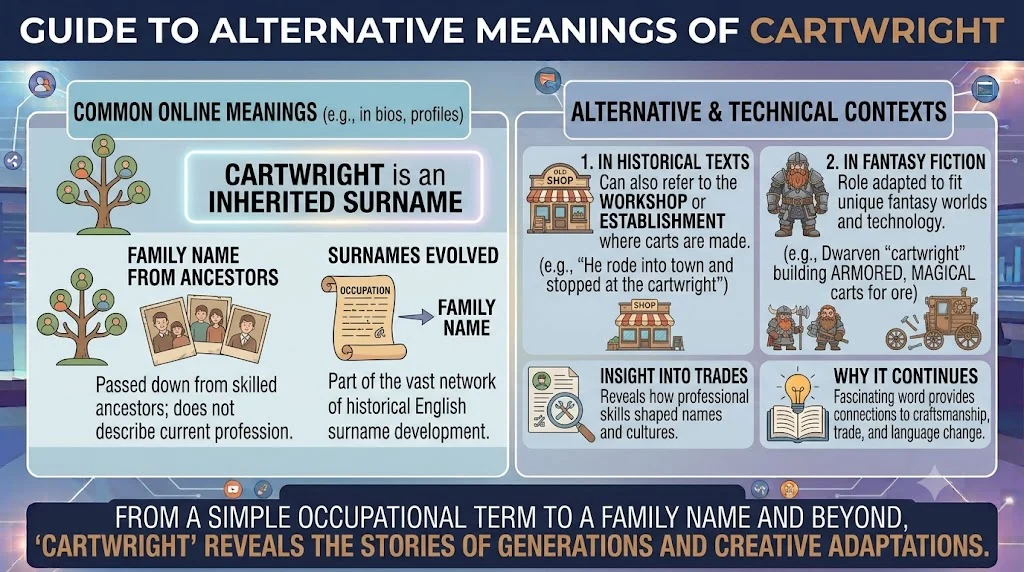
This is the most common alternative usage. The name isn’t literally describing what the person does today; it’s a family name inherited from ancestors.
In Historical Texts
In a historical context, “cartwright” can also refer to the workshop or establishment where carts are made. For example, “He rode into town and stopped at the cartwright” meaning he stopped at the cartwright’s shop.
In Fantasy Fiction
In fantasy settings, the role of the cartwright might be adapted to fit the technology of the world. For example, in a story about dwarven craftsmen, a “cartwright” might build heavily armored, magical carts for transporting ore through dangerous tunnels.
Related Terms and NLP Variations
The word “cartwright” connects to several related terms and has some interesting lexical relationships:
Semantic Variations
- Wright: The root term, meaning any skilled craftsman.
- Cart: The object being built or repaired.
- Carpenter: A more general term for a woodworker, though not specifically for carts.
Lexical Relationships
- Synonym: Wagon maker, carriage builder.
- Hypernyms: Wright, craftsman, tradesman.
- Hyponyms: There is no specific sub-category of cartwright, as the trade itself is a specialization.
How to Respond or Reply
If you encounter a conversation where “Cartwright” is mentioned, your response should depend on the context.
If Someone Is Talking About Their Surname
They might say: “My last name is Cartwright.”
Appropriate responses:
- “Oh, that’s a great occupational name! That means your ancestors were cart makers, right?
- “I love that name. It’s got a really strong historical feel to it.”
- “That’s a cool name. Do you know much about your family history?”
If Someone Is Referring to a Historical Trade
They might say: “In medieval villages, the cartwright was one of the most important people.”
Appropriate responses:
- “That makes sense. Everyone needed carts for farming and trade.”
- “I read that they had to be both carpenters and blacksmiths. That’s a lot of skill.”
- “It’s wild to think that before cars, that was a vital job. Now nobody even knows what a cartwright is.”
Misinterpretations
Given that “cartwright” is an uncommon word today, it is sometimes misheard or misunderstood. Common misinterpretations include:
- Cartwright vs. Cart Ride: A novice might mistakenly hear the name as “cart ride,” possibly misunderstanding it as an activity.
- Spelling Confusion: People sometimes misremember the spelling as “Cartright” or “Cartwrighte.”
- Assumption of a Modern Job: Some may mistakenly assume the job exists in a modern industrial form, whereas it is a historical or niche trade.
- Confusion with “Cartographer”: This is another uncommon, “cart-” word, meaning a mapmaker. The two are entirely unrelated but can occasionally be confused.
When NOT to Use It
While “cartwright” is a cool and historically rich word, it has a limited scope of usage. You should avoid using it in the following contexts:
- Modern General Conversation: Unless you’re in a specific niche (living history, genealogy, etc.), using “cartwright” to refer to a mechanic or a woodworker will likely cause confusion.
- Informal Slang: It’s not a slang term. Using it as a substitute for “craftsman” in everyday speech would sound forced and archaic.
- Technical Writing: While it has a place in history texts, in modern technical writing about vehicles, you’d use terms like “mechanic,” “automotive technician,” or “fabricator.”
Usage Tips
Pronunciation
The word is pronounced with two clear syllables: KART-rite . It rhymes with “night.”
In Writing
When writing about the historical trade, it’s a good idea to briefly define it the first time you use it, unless you are writing for an audience that is already well-versed in historical trades.
- Good: “The cartwright, or cart-maker, would begin his day by inspecting the wheel’s rim.”
- Avoid: “The cartwright’s rim was cracked.” (Unless context is already established).
FAQs
What is a cartwright?
A cartwright is a skilled craftsman who builds and repairs carts and wagons. The term comes from Old English, combining “cart” with “wright,” meaning “maker .
Is Cartwright a common surname?
Yes, Cartwright is a fairly common English surname. It is an occupational name given to cart-makers in medieval times. Records of the name date back to the 12th century .
What’s the difference between a cartwright and a wheelwright?
A cartwright builds and repairs the entire cart, while a wheelwright specializes specifically in making and repairing wheels. In practice, the trades often overlapped, but the distinction is in the scope of the work.
What is the origin of the last name Cartwright?
The surname originates from medieval England. It is derived from the profession of building and repairing carts. The word combines Old English “cræt” for cart and “wyrhta” for builder .
How do you pronounce Cartwright?
Cartwright is pronounced as “KART-rite” .
Is a cartwright the same as a blacksmith?
No, but the trades are related. A blacksmith works primarily with iron and metal. A cartwright often needed blacksmithing skills to make metal components for carts, but their primary work was with wood. The cartwright built the cart’s frame, while a smithy might craft the nails and axle bands.
Where did the Cartwright family come from?
The Cartwright family name is rooted in medieval England, appearing in historical records such as the Pipe Rolls of Gloucestershire and the Hundred Rolls of Cambridgeshire .
Are there cartwrights today?
Yes, there are still practicing cartwrights, though they are rare. They usually work in living history museums, historical restoration, or in communities that use traditional horse-drawn transport.
What is a synonym for cartwright?
Synonyms for cartwright include wagon maker, carriage builder, and vehicle craftsman .
What is the female version of Cartwright?
There is no specific female version. Historically, the trade was performed by men, so the name is gender-neutral in modern usage. If used as a surname, it is unisex. If referring to the trade, “cartwright” is the term regardless of the practitioner’s gender.
Conclusion
The meaning of cartwright is a fascinating window into the past. It is a simple, concrete term a maker of carts that carries centuries of history within its syllables. Understanding this word connects us to the medieval era’s social and economic structures, where skilled craftsmen were vital to the survival and success of their communities.
From its origins as a surname recorded in the Domesday Book to its appearance in popular culture with the Cartwright family of Bonanza, the word has persisted through the ages . While its primary use today is as a surname, the word “cartwright” remains a perfect example of how language evolves while holding onto the threads of history. It reminds us that our names often tell the stories of our ancestors, their trades, and the world they lived in.
So, the next time you hear the name Cartwright or encounter it in a book or family tree, you’ll know exactly what it means and the rich heritage it represents.

Kevin Brooks is a grammar specialist at GramBrix.com, dedicated to helping readers understand language rules with clarity and confidence. He simplifies complex grammar concepts through practical examples and easy explanations.