Last Updated on August 8, 2026
Dissent means to disagree with an opinion, decision, belief, or majority view. It can be used as a noun (“her dissent was noted”) or a verb (“I dissent from that decision”). The word is common in everyday discussion, politics, law, school, and workplace conversations when someone openly expresses disagreement.
If you’ve seen the word dissent in a news article, classroom discussion, legal case, workplace email, or political debate, you might be wondering what it actually means in plain English. The short version is simple: dissent meaning refers to disagreement especially open, expressed disagreement with an accepted opinion, decision, policy, or majority position.
Many people search for meaning of dissent or dissent meaning in English because the word often appears in formal contexts. While dissent does mean disagreement, it usually carries the additional idea of speaking up against a dominant view, challenging a decision, or formally expressing a different opinion.
For example:
- A judge may write a dissenting opinion in a court case.
- An employee may respectfully dissent from a proposed policy.
- Citizens may express dissent against a government decision.
This is why the word frequently appears in legal, political, academic, and social discussions.
Understanding dissenting meaning is also important. Dissenting describes a person, opinion, or action that expresses disagreement with a majority view. In legal settings, a dissenting opinion is an opinion written by a judge who disagrees with the court’s majority decision.
The word can appear in different grammatical forms:
- Dissent – base form
- Dissents – third-person singular form
- Dissented – past tense
- Dissenting – present participle or adjective
Because of this, people often search for dissents meaning and dissented meaning when encountering these forms in articles or official documents.
Another common question is i dissent meaning. When someone says, “I dissent,” they are formally stating that they disagree with a proposal, opinion, decision, or conclusion.
You may also see searches such as d i s s e n t meaning, which simply refer to the word dissent written letter by letter for clarification.
According to major English dictionaries and legal references, dissent plays an important role in democratic societies, academic inquiry, workplace discussions, and judicial systems because it allows alternative viewpoints to be expressed and considered.
Many users also look for translations such as dissent meaning in Urdu or dissent meaning in Tamil. While translations vary by language, the core idea remains the same: expressing disagreement with an accepted opinion, decision, or authority.
In this guide, you’ll learn:
- The complete dissent meaning
- The meaning of dissent in everyday and formal English
- How dissent differs from disagree, protest, and object
- Real-world examples and sentence usage
- Legal and political meanings
- Common misunderstandings
- Platform-style examples and reply strategies
- Frequently asked questions
By the end, you’ll understand exactly how dissent is used in conversation, writing, law, politics, education, and professional communication.
Quick Answer Box
| Element | Explanation |
| Word | Dissent |
| Basic meaning | A disagreement with an idea, decision, belief, or majority opinion |
| Part of speech | Noun and verb |
| As a noun | “There was dissent in the group.” |
| As a verb | “I dissent from that conclusion.” |
| Tone | Formal to semiformal; often serious, thoughtful, or institutional |
| Common contexts | Politics, law, workplace discussions, school debates, social issues, public opinion |
| Simple example | “One judge wrote a dissent because she disagreed with the court’s decision.” |
| Closest plainEnglish idea | Openly disagreeing, especially with the majority or official view |
| Common feeling behind it | Resistance, objection, independence of thought, principled disagreement |
What Does Dissent Mean?
At its core, dissent means to disagree openly with an opinion, decision, or group position.
You’ll usually see it in situations where there is:
- a majority opinion
- an official decision
- a common belief
- a group consensus
- a rule or policy
- a public position that someone challenges
So while disagree can be casual and broad, dissent often sounds more deliberate. It suggests that someone is taking a stand against a prevailing view rather than just having a minor difference of opinion.
Simple definition of dissent
Dissent = expressed disagreement with an accepted, official, or majority opinion.
Examples:
- “Several employees voiced dissent about the new office policy.”
- “The senator expressed dissent from the party’s position.”
- “A dissenting judge argued that the ruling was unfair.”
- “Student dissent grew after the rule change.”
Dissent in very plain English
If you want the easiest possible explanation:
- If most people say yes and one person says no, that can be dissent.
- If a court makes a decision and one judge writes why they disagree, that is dissent.
- If a government introduces a policy and citizens publicly oppose it, that can be described as dissent.
- If a team meeting ends with general agreement but one member formally objects, that may be dissent.
So the word is not just about disagreement in your head. It usually involves visible disagreement—spoken, written, or otherwise expressed.
Full Definition of Dissent
The word dissent can be used in two main grammatical ways:
- As a noun
Meaning: disagreement or opposition to a prevailing idea or decision- “There was dissent within the committee.”
- “Her dissent was respectful but firm.”
- As a verb
Meaning: to disagree or withhold agreement- “I dissent from the majority opinion.”
- “Two members dissented during the vote.”
Dictionarystyle definition
A clean dictionarystyle definition would be:
Dissent is the act of holding or expressing opinions that differ from those commonly, officially, or majority accepted.
Core ingredients of the meaning
The word usually includes at least one of these ideas:
Open disagreement
The disagreement is not hidden. It is spoken, written, voted, published, or otherwise expressed.
Contrast with a majority or authority
Dissent often happens against:
- a group decision
- an official rule
- a leader’s statement
- a court’s ruling
- a political party’s position
- a social norm
Deliberate opposition
Dissent can imply that the disagreement matters enough to be stated clearly, sometimes even at personal risk.
Independent thinking
The word can also suggest that the person is not simply following the crowd.
Dissent Meaning in Different Contexts
The meaning of dissent stays rooted in disagreement, but the tone changes depending on the setting. This is important because the same word can sound academic in one sentence, political in another, and legal in a third.
Context & Usage
Dissent in everyday conversation
In normal everyday English, dissent is less common than disagree, but it still appears when someone wants to sound more precise, formal, or serious.
Example:
- “There was some dissent in the family about where to spend the holidays.”
This doesn’t just mean people had random opinions. It suggests there was noticeable disagreement inside the group.
Dissent in politics
In politics, dissent often refers to public disagreement with government policy, party positions, laws, or leaders.
Examples:
- “Political dissent increased after the controversial law was passed.”
- “The journalist was known for dissent against the administration.”
- “Public dissent forced lawmakers to revisit the proposal.”
In this context, dissent may involve:
- speeches
- protests
- essays
- petitions
- voting against one’s party
- criticism of government decisions
Dissent in law
This is one of the most important uses of the word.
In a legal setting, dissent often refers to a dissenting opinion—an opinion written by a judge who disagrees with the majority ruling in a case.
Example:
- “Justice Marshall wrote a powerful dissent.”
A dissenting opinion explains why the judge believes the majority got the law, reasoning, or result wrong. These dissents can become highly influential over time, even if they did not win the case at that moment.
Dissent in the workplace
In work settings, dissent refers to disagreement with a proposal, decision, management plan, policy, or strategy.
Examples:
- “Constructive dissent can improve decisionmaking.”
- “The manager allowed room for dissent during the planning session.”
- “Several team members expressed dissent about the timeline.”
In healthy organizations, dissent can be valuable because it helps identify risks, weak assumptions, or overlooked consequences.
Dissent in education and academia
In schools, universities, and academic discussion, dissent often means reasoned disagreement with an argument, interpretation, theory, or institutional policy.
Examples:
- “Students were encouraged to dissent respectfully during the seminar.”
- “Scholarly dissent is part of intellectual progress.”
Here, dissent is often seen as a sign of critical thinking rather than disrespect.
Dissent in religion or social values
Dissent can also describe disagreement with religious institutions, community traditions, or social expectations.
Examples:
- “Her essay examined dissent within the church.”
- “The movement gave voice to cultural dissent.”
In these settings, the word may carry emotional weight because it involves identity, belonging, and tradition.
The Emotional Meaning Behind Dissent
Although dissent is not an emotional word by itself, it often carries emotional and social undertones. When someone dissents, they may be feeling:
- concern
- frustration
- moral conviction
- intellectual disagreement
- discomfort with group pressure
- courage to challenge the majority
- commitment to fairness or truth
That’s why the word often sounds stronger than I don’t agree. A person who dissents may be saying, in effect:
- “I can’t support this.”
- “I think this is wrong.”
- “I believe the majority is mistaken.”
- “I need my disagreement to be on record.”
- “I’m not comfortable staying silent.”
So the emotional layer of dissent is often about principled disagreement, not just preference.
Dissent vs Similar Words
A big part of understanding dissent meaning is knowing how it differs from nearby words. These words overlap, but they are not identical.
Related Terms / NLP Variations
Dissent vs disagree
Disagree is the broad, everyday term.
Dissent is more formal and often involves disagreement with a majority, authority, or official position.
- “I disagree with your movie review.” → casual, ordinary
- “I dissent from the board’s final decision.” → formal, stronger, more institutional
Dissent vs object
Object often means to express opposition to a specific action, statement, or proposal.
Dissent is broader and can reflect a larger difference in viewpoint.
- “I object to that comment.” → immediate opposition to a specific thing
- “She dissented from the final recommendation.” → broader disagreement with the outcome
Dissent vs protest
Protest is usually more public and active. It often includes demonstrations, signs, marches, or organized resistance.
Dissent can include protest, but it doesn’t have to. Someone can dissent quietly in writing, in a meeting, or in a court opinion.
Dissent vs oppose
Oppose means to be against something.
Dissent usually highlights the act of expressing disagreement within a context where another view is dominant.
Dissent vs rebel
Rebel suggests active resistance, defiance, or refusal to obey.
Dissent can be calmer, more intellectual, and more procedural.
Dissent vs criticism
Criticism is evaluation or pointing out faults.
Dissent is specifically disagreement with a view, decision, or authority.
Common Forms of the Word
To use the word naturally, it helps to know its most common forms.
Dissent (noun)
- “There was dissent among voters.”
- “Her dissent was thoughtful and well argued.”
Dissent (verb)
- “I respectfully dissent.”
- “Two members dissented from the decision.”
Dissenting (adjective/participle)
- “A dissenting voice”
- “The dissenting judge wrote separately.”
Dissenter (noun)
- “He became a wellknown dissenter within the movement.”
Dissenting opinion (legal phrase)
- A written opinion by a judge who disagrees with the majority ruling.
RealLife Examples of Dissent
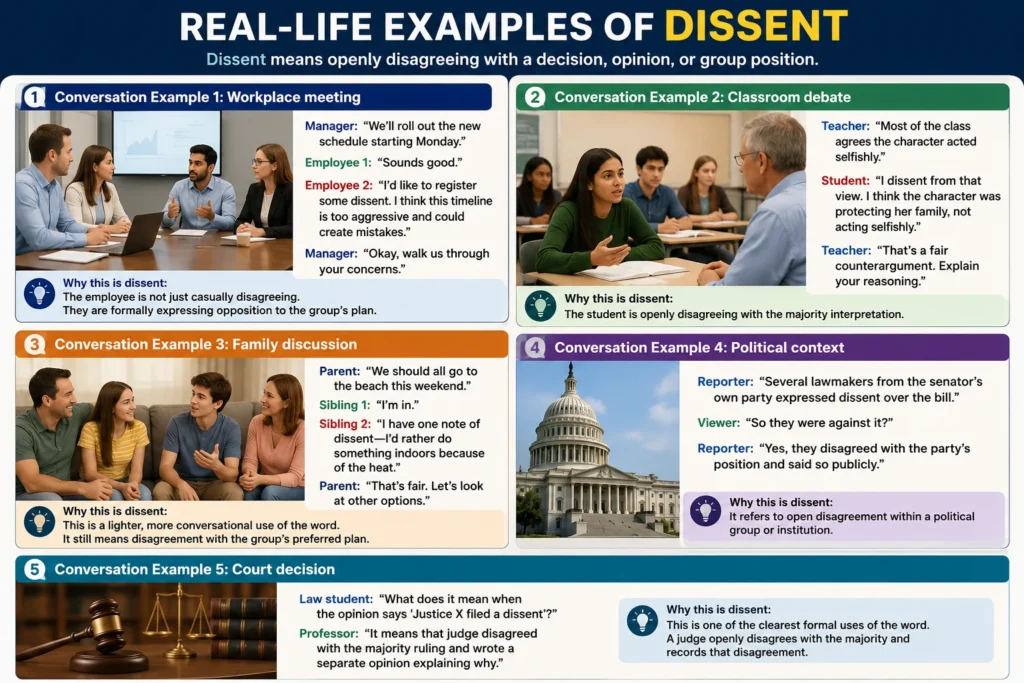
The best way to understand dissent meaning is to see it in realistic use. Below are natural examples from everyday life, school, work, law, and online discussion.
RealLife Examples
Conversation Example 1: Workplace meeting
Manager: “We’ll roll out the new schedule starting Monday.”
Employee 1: “Sounds good.”
Employee 2: “I’d like to register some dissent. I think this timeline is too aggressive and could create mistakes.”
Manager: “Okay, walk us through your concerns.”
Why this is dissent:
The employee is not just casually disagreeing. They are formally expressing opposition to the group’s plan.
Conversation Example 2: Classroom debate
Teacher: “Most of the class agrees the character acted selfishly.”
Student: “I dissent from that view. I think the character was protecting her family, not acting selfishly.”
Teacher: “That’s a fair counterargument. Explain your reasoning.”
Why this is dissent:
The student is openly disagreeing with the majority interpretation.
Conversation Example 3: Family discussion
Parent: “We should all go to the beach this weekend.”
Sibling 1: “I’m in.”
Sibling 2: “I have one note of dissent—I’d rather do something indoors because of the heat.”
Parent: “That’s fair. Let’s look at other options.”
Why this is dissent:
This is a lighter, more conversational use of the word. It still means disagreement with the group’s preferred plan.
Conversation Example 4: Political context
Reporter: “Several lawmakers from the senator’s own party expressed dissent over the bill.”
Viewer: “So they were against it?”
Reporter: “Yes, they disagreed with the party’s position and said so publicly.”
Why this is dissent:
It refers to open disagreement within a political group or institution.
Conversation Example 5: Court decision
Law student: “What does it mean when the opinion says ‘Justice X filed a dissent’?”
Professor: “It means that judge disagreed with the majority ruling and wrote a separate opinion explaining why.”
Why this is dissent:
This is one of the clearest formal uses of the word.
More Example Sentences Using Dissent
Here are additional sentence examples to make the word feel natural:
- “There was growing dissent inside the company after the layoffs.”
- “She voiced her dissent respectfully during the meeting.”
- “The article explores artistic dissent during times of censorship.”
- “One board member dissented from the final vote.”
- “Public dissent became impossible to ignore.”
- “He is known for dissenting whenever he thinks the group is rushing.”
- “The judge’s dissent later influenced future legal thinking.”
- “Not every disagreement counts as serious dissent.”
- “Internal dissent can help an organization avoid bad decisions.”
- “The student newspaper published essays of dissent against the rule.”
PlatformSpecific Meaning and Usage Style
The word dissent is not really internet slang in the way words like cap, ratio, or ghosting are. It’s a standard English word with formal roots. Still, people encounter it on different platforms, and the tone can shift slightly depending on where it appears.
PlatformSpecific Meaning
News websites and political commentary
On news platforms, dissent often refers to:
- opposition inside a political party
- disagreement with government policy
- criticism of leaders
- public resistance to a decision
- legal dissent in court cases
Examples:
- “Internal dissent is growing among party leaders.”
- “The ruling triggered public dissent nationwide.”
- “The justice’s dissent was widely shared online.”
Tone: serious, political, institutional
X, Threads, and opinionheavy social platforms
On social media, people may use dissent in a more rhetorical way:
- “Any dissent gets labeled as negativity.”
- “I’m not attacking the idea; I’m offering dissent.”
- “Healthy dissent is part of a real conversation.”
Here the word can signal:
- independence of thought
- pushback against popular takes
- resistance to echo chambers
- disagreement with a viral opinion
Tone: intellectual, argumentative, socially aware
Redditstyle discussion forums
In longform discussion spaces, dissent often appears when someone wants to sound more precise than “I disagree.”
Examples:
- “My one dissent is that the ending wasn’t earned.”
- “I’ll offer a bit of dissent here: I think the company made the right call.”
- “There was a lot of dissent in the comments about the ranking.”
Tone: analytical, debateoriented, community discussion style
Workplace chat tools like Slack or Teams
In professional chat environments, dissent can be used carefully to signal respectful disagreement without sounding aggressive.
Examples:
- “I want to offer some constructive dissent on the launch date.”
- “I’m aligned with the goal, but I dissent on the current execution plan.”
- “Before we finalize, I think we should invite dissenting views.”
Tone: professional, diplomatic, structured
Classroom forums and academic writing
In education settings, dissent is often tied to debate, analysis, and critical thinking.
Examples:
- “My essay presents a dissenting interpretation of the novel.”
- “Scholarly dissent is essential for progress.”
- “The student’s dissent from the standard reading was well supported.”
Tone: formal, academic, thoughtful
Alternative Meanings of Dissent
For most readers, the main meaning is the one that matters: disagreement with a prevailing view. Still, it helps to know what people may mean in different contexts.
Alternative Meanings
Formal disagreement in a vote or decision
Example:
- “Three committee members recorded their dissent.”
Written disagreement in a legal opinion
Example:
- “The dissent argued that the law violated equal protection.”
Public resistance to power or authority
Example:
- “The regime tried to silence dissent.”
Intellectual disagreement with dominant thinking
Example:
- “Scientific dissent can challenge weak assumptions.”
These are not separate dictionary meanings so much as different applications of the same core idea.
Dissent in Legal English
Because the word is especially common in law, this deserves its own section.
What is a dissenting opinion?
A dissenting opinion is a written opinion by a judge who disagrees with the majority’s decision in a case.
If a court has multiple judges, the majority decides the result. But a judge who disagrees can write a dissent explaining:
- why the majority’s legal reasoning is flawed
- why the law was interpreted incorrectly
- why the outcome is unjust or dangerous
- what decision should have been reached instead
Why legal dissents matter
A dissent doesn’t change the result of the case immediately, but it can still be powerful. It may:
- influence future judges
- shape public debate
- become important in law school and scholarship
- guide later changes in the law
- preserve an alternative interpretation for the future
So when people ask for the dissent meaning in legal news, it usually refers to a judge’s formal disagreement with the majority opinion.
How to Respond When Someone Expresses Dissent
Sometimes people aren’t asking what the word means in a dictionary sense—they want to know how to respond when someone dissents in a conversation, meeting, class, or group setting.
How to Respond / Reply
If the dissent is respectful and constructive
A good response might be:
- “Thanks for raising that.”
- “Can you walk me through your concerns?”
- “I see where you’re coming from.”
- “Let’s make sure we consider that perspective.”
- “What alternative would you suggest?”
This shows that dissent is being treated as useful input rather than disloyalty.
If you want to disagree without escalating conflict
You can reply with:
- “I understand the concern, though I see it differently.”
- “That’s a fair dissenting view, but here’s why I support the decision.”
- “I appreciate the pushback. My reasoning is…”
- “We may disagree on the conclusion, but your concern is valid.”
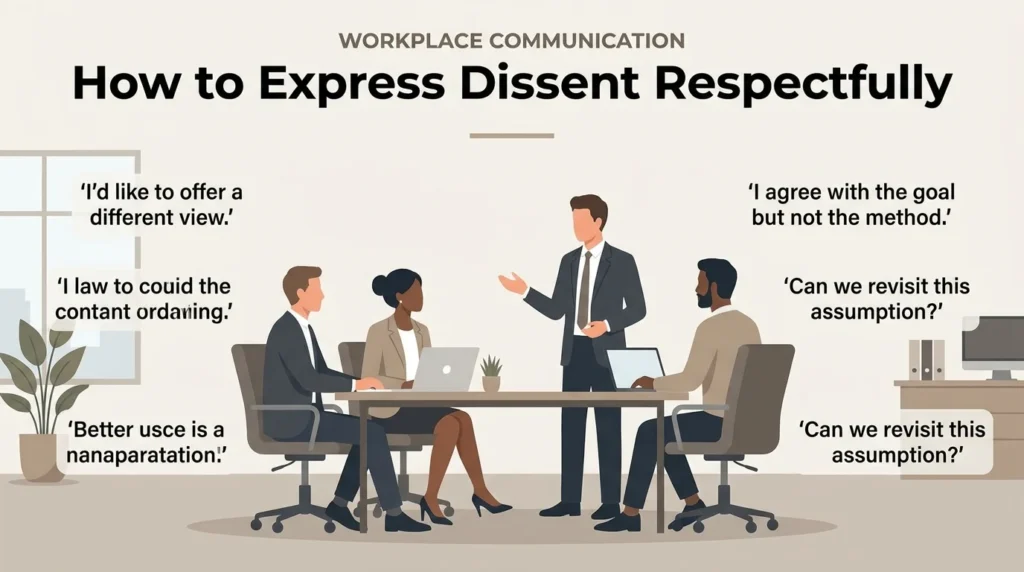
If you are the one expressing dissent
You can say:
- “I’d like to offer a dissenting perspective.”
- “I’m not fully aligned with the current recommendation.”
- “I respectfully dissent from that conclusion.”
- “I agree with the goal, but I disagree with the method.”
- “Before we finalize, I want to flag one area of dissent.”
These are especially useful in professional or academic contexts.
Misinterpretations of Dissent
Because the word sounds formal, people sometimes misunderstand it. Here are the most common mistakes.
Misinterpretations
Mistake 1: Thinking dissent means anger
Not necessarily. A person can dissent calmly, politely, and thoughtfully.
Mistake 2: Thinking dissent always means rebellion
No. Dissent can be smallscale and procedural:
- one judge disagreeing with a ruling
- one employee challenging a timeline
- one student offering a different interpretation
Mistake 3: Treating dissent as disrespect
Dissent can be disrespectful if delivered badly, but the word itself does not mean rude behavior. In many healthy systems, dissent is necessary.
Mistake 4: Using dissent for tiny personal preferences
You can use it lightly in conversation, but it may sound too formal for something trivial.
For example:
- “I dissent from pineapple on pizza” is understandable, but playful or dramatic.
- “I disagree about the toppings” sounds more natural in casual speech.
Mistake 5: Confusing dissent with descent
These words sound similar but mean very different things.
- Dissent = disagreement
- Descent = movement downward, family lineage, or origin
Examples:
- “She wrote a dissent.” = She wrote a disagreement.
- “The plane began its descent.” = The plane moved downward.
When Not to Use the Word Dissent
Although it’s a useful word, dissent is not always the best fit.
When NOT to Use It
In very casual conversation
If you’re talking with friends about lunch plans, disagree may sound more natural than dissent.
Less natural:
- “I dissent from tacos.”
More natural:
- “I’d rather not do tacos.”
When there is no clear opposing view
Dissent usually makes the most sense when there is a position, majority, or decision to dissent from.
When you just mean criticism, not disagreement
If someone is analyzing weaknesses in an idea but not necessarily rejecting it, critique or criticism may fit better.
When you mean refusal to obey
If the emphasis is on breaking rules rather than disagreeing, words like defy, resist, or rebel may be more accurate.
Usage Tips for Sounding Natural
Usage Tips
Use dissent when the disagreement matters
The word works best when the disagreement is meaningful, not tiny.
Use it when there is a group, authority, or official position
That’s where the word feels most natural:
- court
- committee
- board
- government
- class
- organization
- public debate
Use “dissenting” as an adjective for style and clarity
Examples:
- dissenting opinion
- dissenting voice
- dissenting view
- dissenting member
Use “respectfully dissent” in formal settings
This is common in law, academia, and professional communication.
Don’t overuse it in basic conversation
The word is correct, but it can sound stiff if every disagreement becomes “dissent.”
Five More Natural Dialogue Scenarios
To make the word even clearer, here are additional realistic minidialogues.
Scenario 1: Team strategy discussion
Lead: “We’ll cut the testing phase to save time.”
Analyst: “I need to voice some dissent there. Cutting testing could create bigger delays later.”
Lead: “Good point—what’s the minimum testing window you’d keep?”
Scenario 2: Student group project
Student A: “Let’s submit the first draft asis.”
Student B: “I dissent. The conclusion is still weak and we haven’t checked the citations.”
Student C: “Yeah, I think we need one more pass too.”
Scenario 3: Social media debate
Post: “Anyone who doesn’t love this remake has no taste.”
Commenter: “Offering a little dissent here: the visuals were great, but the script felt rushed.”
Reply: “That’s fair. I liked it overall, but I get that criticism.”
Scenario 4: Family financial discussion
Parent: “We should buy the cheaper option now.”
Adult child: “I respectfully dissent. The more expensive model may save money over time because it lasts longer.”
Parent: “Okay, show me the numbers.”
Scenario 5: Civic discussion
Council member: “The proposal passed 6–1.”
Resident: “Who was the one dissenting vote?”
Council member: “A member who felt the environmental review was incomplete.”
Common Phrases With Dissent
Here are expressions you’ll often see with the word:
- voice dissent
- express dissent
- open dissent
- public dissent
- political dissent
- internal dissent
- dissenting opinion
- dissenting voice
- dissenting view
- record dissent
- suppress dissent
- allow dissent
- respectful dissent
- constructive dissent
Example sentences with these phrases
- “The company should allow constructive dissent before making major changes.”
- “Open dissent within the cabinet surprised analysts.”
- “Her dissenting opinion was later praised.”
- “The board recorded one dissenting vote.”
- “The policy triggered public dissent.”
Related Terms and Semantic Variations
If someone searches dissent meaning, they may also be looking for related words or alternate phrasings. Here’s a semantic map of close expressions.
Close meaning variations
- disagreement
- objection
- opposition
- pushback
- resistance
- nonconformity
- protest
- refusal to agree
- counterposition
- contrary opinion
More formal or specialized related terms
- dissenting opinion
- minority view
- formal objection
- principled opposition
- ideological resistance
- institutional disagreement
- civil dissent
- political opposition
Similar phrases in plain English
- “speak against”
- “push back on”
- “take issue with”
- “not go along with”
- “refuse to support”
- “challenge the majority view”
Is Dissent Positive or Negative?
This is a common hiddenintent question because people often want to know the tone of the word, not just the definition.
The answer: dissent is neutral by definition, but its emotional tone depends on context.
Positive or valuable uses of dissent
Dissent can be healthy when it:
- prevents groupthink
- protects fairness
- exposes weak reasoning
- defends rights
- improves a decision
- encourages critical thinking
Negative or tense uses of dissent
Dissent may be viewed negatively when it:
- blocks action without substance
- becomes disruptive for the sake of disruption
- is expressed disrespectfully
- is treated as disloyalty in rigid systems
So the word itself isn’t automatically good or bad. It often depends on why the person is dissenting and how they express it.
Why Dissent Matters in Communication
Understanding the dissent meaning is useful because the word describes something important in human communication: the right or willingness to disagree.
In relationships, teams, classrooms, courts, and democracies, dissent matters because it can:
- challenge bad decisions
- create accountability
- surface overlooked information
- protect minority perspectives
- strengthen final outcomes when handled well
Without room for dissent, groups often become less thoughtful and more fragile. Everyone may appear aligned on the surface, but important concerns go unspoken.
FAQs
What does dissent mean in simple words?
In simple words, dissent means disagreement, especially when someone openly disagrees with a group decision, official opinion, or majority view.
Is dissent the same as disagree?
Not exactly. Disagree is broader and more casual. Dissent is more formal and often implies disagreement with an authority, majority, or official decision.
What is a dissenting opinion?
A dissenting opinion is a legal opinion written by a judge who disagrees with the majority decision in a court case.
Can dissent be used as a verb?
Yes. Example: “I dissent from the committee’s conclusion.” It means I disagree with it.
Can dissent be used as a noun?
Yes. Example: “There was dissent within the department.” Here it means disagreement or opposition.
Is dissent a negative word?
Not necessarily. It can be neutral, positive, or negative depending on context. Constructive dissent can improve decisions, while hostile dissent can create conflict.
What’s the difference between dissent and protest?
Dissent is disagreement, often expressed in speech, writing, voting, or opinion. Protest is usually more public and active, such as demonstrating against something.
What does political dissent mean?
Political dissent means disagreement with government actions, policies, laws, leaders, or dominant political positions.
What does dissent mean in a workplace?
In a workplace, dissent usually means open disagreement with a plan, policy, timeline, decision, or leadership approach—often expressed in a meeting, memo, or discussion.
Is dissent formal English?
Yes, it is generally more formal than everyday words like disagree or not agree. However, it still appears often in news, law, politics, academia, and professional settings.
Conclusion
The simplest way to understand dissent meaning is this: dissent means openly disagreeing with an opinion, decision, rule, or majority view. It can be used as both a noun and a verb, and it often appears in contexts where the disagreement matters—such as law, politics, education, workplace decisions, and public debate.
- If someone says there was dissent in a meeting, they mean people expressed opposition. If a judge writes a dissent, that judge disagrees with the court’s majority ruling. If citizens show political dissent, they are voicing disagreement with government or policy. And if a student offers a dissenting view, they are challenging the common interpretation rather than simply going along with it.
The key idea is not just disagreement in private, but expressed disagreement that stands apart from the dominant view. That’s what makes the word so useful. It captures not only what someone thinks, but also the fact that they chose to say, write, or record that disagreement.
Once you know that, the word becomes much easier to recognize and use naturally. Whether you encounter it in a Supreme Court article, a team meeting, a political speech, a class debate, or a thoughtful online discussion, dissent almost always points back to the same central meaning: a voiced difference of opinion against the prevailing position.

Justin Powell is a writer at GramBrix.com who focuses on grammar, clarity and effective communication, helping readers strengthen their language skills.