Last Updated on June 14, 2026
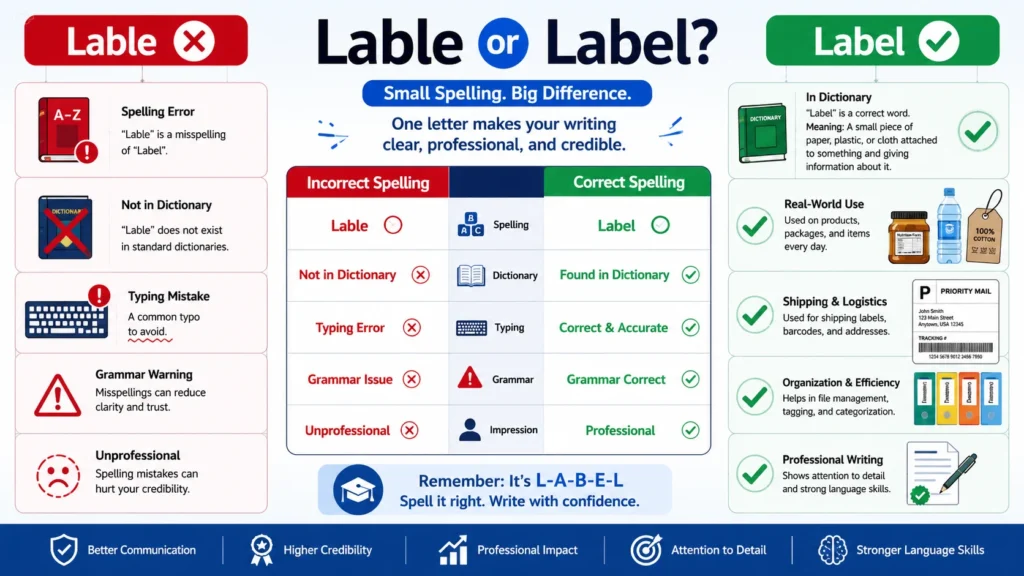
Label is the correct spelling in modern English. Lable is a common misspelling and is generally considered incorrect in professional, academic, and business writing. If you are unsure whether to use lable or label, always choose label.
Many English words cause confusion because they look similar or sound alike. One common example is lable or label. People often see both spellings online and wonder which one is correct.
The good news is that the answer is simple. Label is the correct spelling. Lable is a spelling mistake that appears when the letters are accidentally reversed.
This confusion happens because English spelling is not always predictable. When people write quickly, they may type “lable” instead of “label.” Spell checkers often catch this error, but it can still appear in emails, reports, websites, and social media posts.
Understanding the difference between lable or label is important for students, professionals, writers, and business owners. Using the correct spelling improves credibility, communication, and professionalism.
In this guide, you will learn the meaning of label, why people confuse the two spellings, real-world examples, common mistakes, exercises, FAQs, and practical tips for remembering the correct form.
Quick Answer
| Word | Correct? | Meaning |
|---|---|---|
| Label | ✅ Yes | A tag, description, sticker, or classification |
| Lable | ❌ No | Misspelling of label |
Incorrect spelling: Lable
Example
✅ Please put a label on the package.
❌ Please put a lable on the package.
What Does Label Mean?
A label is a word with several related meanings.
It can refer to:
- A sticker or tag attached to an item
- A description given to a person or thing
- Information printed on a product
- A category or classification
- A company that produces music or products
Examples
- Read the label before using the medicine.
- The teacher placed a label on each folder.
- Some people dislike being given a label.
- The singer signed with a major record label.
In all these cases, label is the correct spelling.
Why Do People Confuse Lable and Label?
The confusion usually happens because of letter order.
The word label follows this pattern:
la + bel = label
Many writers accidentally switch the final letters and write:
la + ble = lable
This type of mistake is called a letter transposition error.
Similar Examples
| Correct | Common Misspelling |
|---|---|
| Label | Lable |
| Friend | Freind |
| Receive | Recieve |
| Separate | Seperate |
| Believe | Beleive |
The brain often recognizes words by shape rather than exact letter order. This makes transposition errors common.
Definition of Label in Different Contexts
The word label can have different meanings depending on context.
Physical Label
A tag attached to an object.
Example
- The shipping label contains the address.
Product Label
Information printed on packaging.
Example
- Check the food label for nutrition facts.
Social Label
A category assigned to people.
Example
- He does not like the label of “troublemaker.”
Business Label
A company brand or organization.
Example
- The artist joined a new music label.
Computer Label
A name assigned to a file, button, or data field.
Example
- Click the label next to the input box.
Origin of the Word Label
The word label has a long history.
It entered English through older French forms and eventually came to mean a tag, strip, or identifying marker.
Over time, its meaning expanded to include:
- Identification
- Classification
- Branding
- Description
Today, label is used in business, education, technology, psychology, marketing, and everyday communication.
The spelling has remained label, not lable.
Lable or Label in American and British English
Unlike some words that differ between regions, label is spelled the same in both American and British English.
American English
✅ Label
Example
- Print the label before shipping.
British English
✅ Label
Example
- Attach a label to the parcel.
There is no regional spelling variation.
| Region | Correct Spelling |
|---|---|
| United States | Label |
| United Kingdom | Label |
| Canada | Label |
| Australia | Label |
| New Zealand | Label |
| India | Label |
The spelling lable is incorrect everywhere.
Label as a Noun
Most often, label functions as a noun.
Examples
- The label fell off the bottle.
- Read the label carefully.
- Every file needs a label.
- The product label contains instructions.
Common Noun Uses
| Type | Example |
|---|---|
| Product | Food label |
| Shipping | Mailing label |
| Clothing | Clothing label |
| Organization | Record label |
| Category | Social label |
Label as a Verb
Label can also be a verb.
When used as a verb, it means to identify, tag, or classify something.
Examples
- Please label the boxes.
- Scientists label samples before testing.
- Do not label people unfairly.
- Teachers often label classroom materials.
Verb Forms
| Form | Word |
|---|---|
| Base Verb | Label |
| Present Participle | Labeling (US) / Labelling (UK) |
| Past Tense | Labeled (US) / Labelled (UK) |
| Past Participle | Labeled (US) / Labelled (UK) |
Label in Everyday Life
The word appears almost everywhere.
Shopping
Labels show prices and product details.
Example
- The label shows the item’s cost.
Healthcare
Medicine labels provide dosage instructions.
Example
- Follow directions on the label.
Education
Teachers use labels for organization.
Example
- Every drawer has a label.
Technology
Software uses labels for menus and buttons.
Example
- The field label explains what information to enter.
Business
Companies use labels for branding and packaging.
Example
- The label includes the company logo.
Advantages and Disadvantages of Using Labels
The word label can refer to classification. In this sense, labels have both benefits and drawbacks.
Advantages
Easy Organization
Labels help people find items quickly.
Better Communication
Labels provide information at a glance.
Faster Identification
People can recognize products and categories easily.
Improved Efficiency
Businesses use labels to manage inventory.
Disadvantages
Oversimplification
Labels may ignore complexity.
Stereotyping
People can be unfairly categorized.
Misunderstanding
Incorrect labels can create confusion.
Bias
Labels sometimes influence judgment.
Comparison Table: Lable vs Label
| Feature | Lable | Label |
|---|---|---|
| Correct spelling | ❌ No | ✅ Yes |
| Found in dictionaries | ❌ No | ✅ Yes |
| Accepted in formal writing | ❌ No | ✅ Yes |
| Used in education | ❌ No | ✅ Yes |
| Used in business | ❌ No | ✅ Yes |
| Used in publishing | ❌ No | ✅ Yes |
| Recommended spelling | ❌ No | ✅ Yes |
The comparison clearly shows that label is the only correct choice.
Real World Examples of Label
Here are examples from daily life.
Product Packaging
- Read the label before opening the container.
Shipping Industry
- Print the shipping label and attach it securely.
School Environment
- Place a label on your notebook.
Medical Setting
- Every medicine bottle requires a clear label.
Office Organization
- The folders are arranged by label.
Music Industry
- The artist signed with an independent label.
Common Mistakes When Using Label
Many writers make similar errors.
Writing Lable Instead of Label
❌ Lable
✅ Label
Forgetting to Proofread
❌ The lable is missing.
✅ The label is missing.
Incorrect Verb Forms
❌ The boxes were label.
✅ The boxes were labeled.
Incorrect British and American Forms
American English:
✅ Labeled
British English:
✅ Labelled
Both are correct depending on regional style.
How to Remember the Correct Spelling
Simple memory tricks can help.
Think of Bell
The second part of the word sounds like “bell.”
La + bell = label
This makes it easier to remember.
Read More
Seeing the correct spelling repeatedly strengthens memory.
Use Spell Check
Most writing tools automatically identify “lable” as an error.
Practice Writing
Write the word correctly several times.
Example:
- Label
- Label
- Label
- Label
Repetition helps create habit.
Label in Digital Technology
The word label is widely used in technology.
User Interface Design
Labels explain buttons and fields.
Example
- Enter your name in the field labeled “Full Name.”
Programming
Labels can identify sections of code.
Example
- The programmer added a label for navigation.
Data Analysis
Labels help classify information.
Example
- Each category has its own label.
Machine Learning
Data labels help train algorithms.
Example
- Images need accurate labels before training begins.
Related Concepts and Comparisons
Label vs Tag
| Label | Tag |
|---|---|
| Often permanent | Often temporary |
| Descriptive | Categorizing |
| Common on products | Common online |
Example
- Product label
- Blog tag
Label vs Sticker
| Label | Sticker |
|---|---|
| Provides information | Mainly decorative or informative |
| Often identifies something | May or may not identify something |
Label vs Brand
| Label | Brand |
|---|---|
| Can identify a product | Represents company identity |
| More specific | Broader concept |
Label vs Category
| Label | Category |
|---|---|
| Name assigned | Group itself |
| Identifies | Organizes |
Professional Importance of Correct Spelling
Correct spelling affects credibility.
In Business
Customers trust professional communication.
In Education
Teachers and examiners expect accurate spelling.
In Marketing
Errors reduce brand credibility.
In Publishing
Mistakes may affect reader confidence.
Using label instead of lable shows attention to detail.
Exercises With Answers
Exercise 1
Choose the correct word.
- Please attach the _____ to the package.
- The product _____ contains ingredients.
- Every folder needs a _____.
Answers
- Label
- Label
- Label
Exercise 2
Find the mistake.
- The lable is torn.
- Read the lable carefully.
- This lable shows the price.
Answers
- The label is torn.
- Read the label carefully.
- This label shows the price.
Exercise 3
Fill in the blanks.
- The medicine ______ includes dosage instructions.
- Please ______ the boxes before moving them.
- The artist joined a new record ______.
Answers
- label
- label
- label
Exercise 4
True or False
- Lable is the correct spelling.
- Label can be a noun.
- Label can be a verb.
- Label is accepted in both British and American English.
Answers
- False
- True
- True
- True
FAQs
Is label or lable correct?
Label is correct. Lable is a misspelling and should be avoided in all forms of writing.
Why do people write lable instead of label?
People often reverse the letters by mistake. This is a common typing and spelling error.
Is lable a real English word?
No. Most dictionaries do not recognize lable as a standard English word.
Is label correct in American English?
Yes. Label is the standard spelling in American English.
Is label correct in British English?
Yes. Label is also the standard spelling in British English.
Can label be used as a verb?
Yes. You can label boxes, products, files, or categories.
What is the plural form of label?
The plural form is labels.
Example: The labels were printed yesterday.
What does a product label contain?
A product label may include ingredients, instructions, warnings, pricing, and manufacturer information.
How can I remember the correct spelling of label?
Think of the word as la + bell = label. This memory trick helps prevent writing “lable.”
Should I correct lable to label in professional documents?
Yes. Always replace lable with label in business, academic, legal, and professional writing.
Is label used in technology?
Yes. Software, programming, machine learning, databases, and user interface design frequently use labels.
Can label refer to people?
Yes. A label can describe a category assigned to a person, although some people dislike being labeled.
Conclusion
The debate over lable or label has a simple answer: label is the correct spelling, while lable is an error caused by reversing letters. Whether you are writing an email, creating product packaging, organizing files, developing software, or preparing academic work, using the correct spelling matters.
A label can serve many purposes. It can identify products, organize information, classify data, describe people or objects, and support communication in both physical and digital environments. Because the word is used so often, mastering its spelling is important for clear and professional writing.
If you ever hesitate between lable or label, remember that dictionaries, style guides, businesses, schools, and publishers all recognize label as the standard form. Proofread your work, use spell-check tools, and practice the word regularly.
The best professional recommendation is simple: always use label and avoid lable. Doing so improves accuracy, credibility, and communication in every type of writing.

Justin Powell is a writer at GramBrix.com who focuses on grammar, clarity and effective communication, helping readers strengthen their language skills.