Last Updated on August 12, 2026
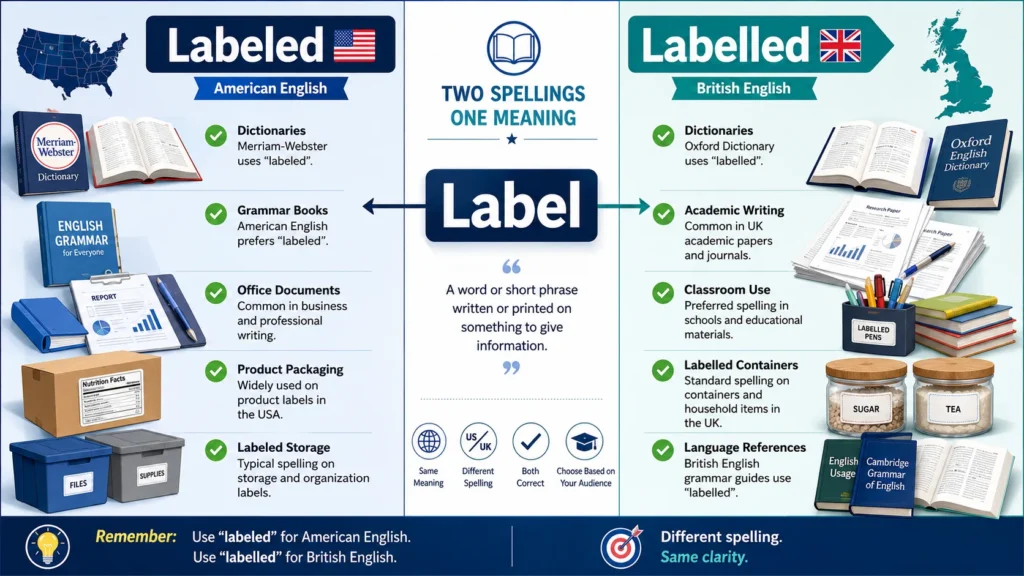
Labeled and labelled are both correct spellings of the same word. The difference depends on the version of English you use: labeled is preferred in American English, while labelled is preferred in British, Canadian, Australian, and other Commonwealth English varieties. The meaning and pronunciation remain exactly the same.
Have you ever typed labeled and stopped to wonder, “Should it be labelled instead?” You are not alone. This small spelling difference often confuses students, professionals, bloggers, and even experienced writers. The good news is simple: both “labeled” and “labelled” are correct spellings. The difference mainly comes down to regional English.
Labeled is the preferred spelling in American English, while labelled is more common in British English and other varieties that follow British spelling conventions. Both forms come from the verb label, meaning to attach a name, description, or category to something.
In this guide, we will explain labeled vs labelled with clear examples, spelling rules, regional usage, common mistakes, and practical tips. You will also learn which spelling to choose for academic writing, business communication, websites, and everyday English.
Quick Answer
If you need a quick answer, here it is:
| Version | Preferred Region |
|---|---|
| Labeled | United States |
| Labelled | United Kingdom |
| Labelled | Canada |
| Labelled | Australia |
| Labelled | New Zealand |
| Labelled | South Africa |
Both spellings mean exactly the same thing.
Example
American English:
The package was labeled correctly.
British English:
The package was labelled correctly.
The meaning does not change.
What Does Labeled or Labelled Mean?
The words labeled and labelled are the past tense and past participle forms of the verb label.
The verb label means:
- To attach a tag or sticker to something
- To identify something
- To classify something
- To describe a person, object, or idea
Examples
The scientist labeled each sample carefully.
The teacher labeled the classroom supplies.
The company labeled its products with safety warnings.
The media labelled the athlete a future champion.
In all these examples, the word indicates identification or classification.
Why Are There Two Spellings?
The difference comes from regional spelling rules.
American English and British English often spell certain words differently.
Examples
| American English | British English |
|---|---|
| Labeled | Labelled |
| Traveled | Travelled |
| Modeled | Modelled |
| Canceled | Cancelled |
| Fueled | Fuelled |
American English usually uses a single “l” before adding a suffix such as -ed.
British English often doubles the final “l” before adding the suffix.
This pattern explains why both labeled and labelled exist.
Understanding the Spelling Rule
To understand the difference better, let’s look at the base word.
Base word:
Label
Past tense:
Labeled or Labelled
Present participle:
Labeling or Labelling
Noun:
Label
American English Pattern
American English usually does not double the final “l.”
| Base Word | American Form |
|---|---|
| Label | Labeled |
| Label | Labeling |
| Travel | Traveled |
| Travel | Traveling |
British English Pattern
British English typically doubles the final “l.”
| Base Word | British Form |
|---|---|
| Label | Labelled |
| Label | Labelling |
| Travel | Travelled |
| Travel | Travelling |
This is simply a spelling convention.
Definition of Label
Before deciding between labeled or labelled, it helps to understand the word label itself.
Label as a Noun
A label is a piece of information attached to something.
Examples:
The bottle had a label showing the ingredients.
Read the label before using the product.
Label as a Verb
To label means to identify or classify.
Examples:
They labeled every storage box.
The researcher labelled each specimen.
Labeled or Labelled in Different Contexts
Product Packaging
American English:
The bottles were labeled clearly.
British English:
The bottles were labelled clearly.
Education
American English:
The teacher labeled every folder.
British English:
The teacher labelled every folder.
Science
American English:
Each sample was labeled with a number.
British English:
Each sample was labelled with a number.
Business
American English:
The files were labeled according to department.
British English:
The files were labelled according to department.
The context does not affect the spelling choice. Only regional preference matters.
Regional Usage Around the World
English varies from country to country.
United States
American dictionaries strongly prefer labeled.
Examples:
The package was labeled incorrectly.
Every chart was labeled properly.
United Kingdom
British dictionaries prefer labelled.
Examples:
The documents were labelled alphabetically.
The boxes were labelled for storage.
Canada
Canadian English often follows British spelling conventions.
Therefore, labelled is commonly used.
Australia and New Zealand
These countries generally prefer British spelling.
Therefore, labelled is standard.
International Business
Many international companies choose one style guide and use it consistently.
For example:
- A U.S. company may use labeled worldwide.
- A U.K. company may use labelled worldwide.
Consistency is more important than choosing one spelling over the other.
Labeled vs Labelled Comparison Table
| Feature | Labeled | Labelled |
|---|---|---|
| Correct Spelling | Yes | Yes |
| Meaning | Same | Same |
| Pronunciation | Same | Same |
| American English | Preferred | Less common |
| British English | Less common | Preferred |
| Canadian English | Less common | Preferred |
| Australian English | Less common | Preferred |
| Formal Writing | Correct | Correct |
Advantages and Disadvantages
Advantages of Using Labeled
- Preferred in the United States
- Matches American style guides
- Familiar to American readers
- Common in U.S. business writing
Disadvantages of Using Labeled
- May look unusual to British readers
- Not preferred in many Commonwealth countries
Advantages of Using Labelled
- Preferred in British English
- Matches Commonwealth spelling standards
- Common in academic and professional writing outside the U.S.
Disadvantages of Using Labelled
- May appear unusual to American audiences
- Often corrected by American spell-check tools
Real World Examples
Let’s look at how the word appears in everyday situations.
Example 1: School
American English:
The teacher labeled each student’s notebook.
British English:
The teacher labelled each student’s notebook.
Example 2: Warehouse
American English:
Every shelf was labeled clearly.
British English:
Every shelf was labelled clearly.
Example 3: Healthcare
American English:
The medication was labeled with dosage instructions.
British English:
The medication was labelled with dosage instructions.
Example 4: Research
American English:
Researchers labeled all test samples.
British English:
Researchers labelled all test samples.
Labeled or Labelled in Academic Writing
Academic institutions often require consistency.
If your university follows American English:
Use labeled.
If your university follows British English:
Use labelled.
Example
American style:
The figures were labeled sequentially.
British style:
The figures were labelled sequentially.
Always follow your institution’s style guide.
Labeled or Labelled in Digital Writing
Digital content often reaches a global audience.
This creates a choice.
Option One
Use the spelling preferred by your target audience.
Option Two
Use one style consistently throughout the content.
For example:
A U.S. blog should use labeled throughout.
A U.K. blog should use labelled throughout.
Avoid switching between both versions in the same article unless discussing spelling differences.
Common Mistakes
Many writers make mistakes when using labeled or labelled.
Mixing Styles
Incorrect:
The package was labeled correctly, and all boxes were labelled carefully.
Better:
Choose one style and stay consistent.
Using the Wrong Audience Standard
Incorrect for American publication:
The package was labelled correctly.
Preferred:
The package was labeled correctly.
Inconsistent Editing
Sometimes spell-check software changes only part of a document.
Always review the final version carefully.
Commonly Confused Words
Writers who struggle with labeled or labelled often encounter similar spelling differences.
Traveled vs Travelled
American: Traveled
British: Travelled
Modeled vs Modelled
American: Modeled
British: Modelled
Canceled vs Cancelled
American: Canceled
British: Cancelled
Fueled vs Fuelled
American: Fueled
British: Fuelled
These follow the same regional pattern.
Practical Writing Tips
Know Your Audience
Ask:
Who will read my content?
If the audience is American, use labeled.
If the audience is British, use labelled.
Follow a Style Guide
Examples:
- AP Style
- Chicago Manual of Style
- Oxford Style Guide
These guides help maintain consistency.
Use Spell Check Carefully
Spell-check programs often default to one language setting.
Check whether your software uses:
- American English
- British English
Stay Consistent
Once you choose a spelling style, use it throughout the document.
Exercises With Answers
Exercise 1
Choose the preferred American English spelling.
- The package was ______ correctly.
- Every sample was ______ carefully.
- The files were ______ alphabetically.
Answers:
- Labeled
- Labeled
- Labeled
Exercise 2
Choose the preferred British English spelling.
- The equipment was ______ properly.
- Every box was ______ for shipping.
- The documents were ______ by category.
Answers:
- Labelled
- Labelled
- Labelled
Exercise 3
Identify the style.
Sentence:
The shelves were labelled clearly.
Answer:
British English.
Exercise 4
Identify the style.
Sentence:
The chart was labeled accurately.
Answer:
American English.
Exercise 5
Correct the inconsistency.
Original:
The folders were labeled neatly, and the boxes were labelled clearly.
Correct American version:
The folders were labeled neatly, and the boxes were labeled clearly.
Correct British version:
The folders were labelled neatly, and the boxes were labelled clearly.
Related Concepts and Comparisons
Label vs Tag
A label often contains information.
A tag may simply identify something.
Example:
A clothing label shows size and washing instructions.
A luggage tag identifies ownership.
Label vs Categorize
To label means to assign a name.
To categorize means to place into a group.
Example:
The researcher labeled each sample.
The researcher categorized the samples by type.
Label vs Describe
A label is usually short.
A description is often detailed.
Example:
Label:
“Fragile”
Description:
“This item contains delicate glass components.”
When Should You Use Labeled?
Use labeled when:
- Writing for an American audience
- Following American style guides
- Creating U.S. business documents
- Publishing in American media
Example Sentences
The report was labeled confidential.
Every section was labeled correctly.
The boxes were labeled by department.
When Should You Use Labelled?
Use labelled when:
- Writing for British readers
- Following Commonwealth English conventions
- Publishing in the UK, Australia, or New Zealand
- Following British academic standards
Example Sentences
The containers were labelled clearly.
Each file was labelled correctly.
The evidence was labelled carefully.
FAQs
Is labeled or labelled correct?
Yes. Both labeled and labelled are correct spellings. The choice depends on whether you use American or British English.
Which is more common, labeled or labelled?
Globally, both are common. In the United States, labeled is more common. In the United Kingdom and many Commonwealth countries, labelled is preferred.
Why does British English use labelled?
British spelling rules often double the final “l” before adding endings like -ed and -ing, creating forms such as labelled and labelling.
Why does American English use labeled?
American English usually avoids doubling the final “l” in words like label, resulting in labeled and labeling.
Should I use labeled or labelled in academic writing?
Use whichever spelling matches your institution’s style guide. Consistency is essential.
Is labelled wrong in the United States?
No. Americans understand it, but labeled is generally preferred and expected.
Is labeled wrong in the United Kingdom?
No. British readers understand it, but labelled is considered the standard spelling.
What is the difference between labeled and labelled?
There is no difference in meaning or pronunciation. The difference is only regional spelling preference.
How do I know which spelling to choose?
Look at your audience. Use labeled for American readers and labelled for British and Commonwealth readers.
Do labeled and labelled have the same pronunciation?
Yes. Both spellings are pronounced exactly the same way.
Conclusion
The debate over labeled or labelled is not about right versus wrong. Both spellings are correct, accepted, and widely used throughout the English-speaking world. The real difference lies in regional preference.
If you write for an American audience, labeled is usually the best choice. If you write for readers in the United Kingdom, Canada, Australia, New Zealand, or other Commonwealth countries, labelled is generally preferred.
The meaning, pronunciation, and function of the word remain identical regardless of spelling. What matters most is consistency. Choose one style and use it throughout your document, article, report, or website.
Professional writers, businesses, educators, and students all benefit from understanding these regional spelling differences. By matching your spelling to your audience and following a consistent style guide, you can make your writing appear polished, credible, and professional.
The next time you see labeled or labelled, you’ll know that both are correct and exactly when to use each one.
Discover more Articles:
- Mustang vs Camaro: Key Differences Explained Clearly For 2026
- Memrise vs Duolingo Comparison Guide 2026: Which Language App Is Better for You?

Kevin Brooks is a grammar specialist at GramBrix.com, dedicated to helping readers understand language rules with clarity and confidence. He simplifies complex grammar concepts through practical examples and easy explanations.