
Last Updated on August 11, 2026
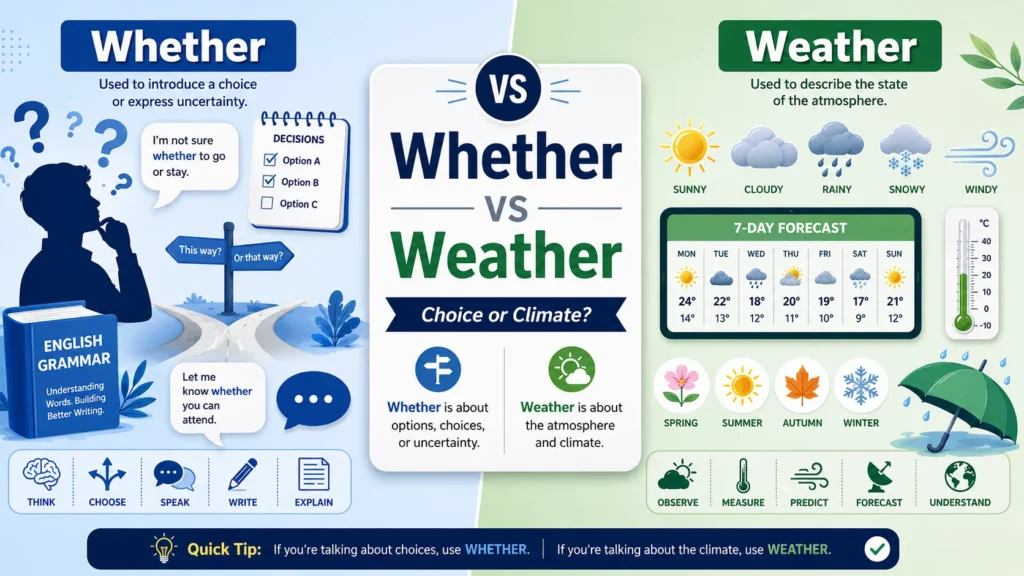
Whether and weather sound alike but have different meanings. Whether is used when discussing choices, possibilities, or alternatives, while weather refers to atmospheric conditions such as rain, sunshine, wind, or snow. Understanding the difference helps improve both writing and speaking accuracy.
Many English words sound the same but have different meanings. These words often confuse learners and even native speakers. One of the most common examples is whether or weather.
At first glance, the two words look and sound almost identical. The only difference is one letter. Yet their meanings are completely different. Using the wrong word can change the meaning of a sentence and make writing appear less professional.
Imagine writing, “I don’t know weather I should go.” Most readers will understand what you mean, but the sentence is technically incorrect. The correct word is whether because you are talking about a choice, not the climate outside.
Learning the difference between whether and weather is simple once you understand what each word means and how it is used. This guide explains both words in plain English. You will learn definitions, examples, common mistakes, regional usage, practical exercises, and helpful memory tricks. By the end, you will be able to use whether and weather confidently in everyday conversation, academic writing, business communication, and professional documents.
Quick Answer
The difference between whether and weather is simple:
| Word | Meaning | Example |
|---|---|---|
| Whether | Expresses a choice, possibility, or alternative | I don’t know whether he will come. |
| Weather | Refers to atmospheric conditions | The weather is sunny today. |
Easy Memory Trick
- Whether contains the word “if” in meaning.
- Weather relates to rain, wind, snow, clouds, and sunshine.
Example:
- I am not sure whether I should travel.
- The weather may be rainy tomorrow.
What Does Whether Mean?
Whether is a conjunction used to introduce alternatives, choices, possibilities, or uncertainty.
It often means:
- If
- Either option
- Regardless of which option
Examples of Whether
- I don’t know whether she will call.
- Tell me whether you agree.
- We are deciding whether to move.
- I am unsure whether the project will succeed.
- The company must determine whether the investment is worthwhile.
In each example, there is uncertainty or a choice involved.
Whether in Questions
Whether commonly appears in indirect questions.
Examples:
- She asked whether I was ready.
- He wondered whether the meeting was canceled.
- They discussed whether the plan should continue.
What Does Weather Mean?
Weather refers to the condition of the atmosphere at a particular place and time.
Weather includes:
- Rain
- Snow
- Sunshine
- Wind
- Clouds
- Temperature
- Storms
Examples of Weather
- The weather is beautiful today.
- Cold weather is expected this weekend.
- We canceled the picnic because of the weather.
- The forecast predicts rainy weather tomorrow.
- Severe weather can affect travel plans.
Unlike whether, weather is usually a noun.
Whether or Weather: Side by Side Comparison
| Feature | Whether | Weather |
|---|---|---|
| Part of Speech | Conjunction | Noun |
| Meaning | Choice or possibility | Atmospheric conditions |
| Related To | Decisions and alternatives | Climate and nature |
| Example | I wonder whether he left. | The weather is hot today. |
| Can Replace “If” | Often yes | No |
| Refers to Rain or Sunshine | No | Yes |
Why People Confuse Whether and Weather
Several factors contribute to the confusion.
They Sound Alike
Whether and weather are homophones.
Homophones are words that sound the same but have different meanings and spellings.
Examples:
- Whether
- Weather
Because pronunciation is nearly identical, people often choose the wrong spelling when writing.
Spell Check May Not Catch Errors
Both words are correctly spelled English words.
For example:
- Incorrect: I don’t know weather to stay.
- Correct: I don’t know whether to stay.
A spelling checker may not flag the mistake because “weather” is a valid word.
Fast Typing Causes Errors
Writers often focus on ideas rather than spelling. As a result, whether and weather are commonly mixed up in emails, articles, and social media posts.
How to Remember the Difference
Simple memory tricks can help.
Whether Equals Choice
Think of whether whenever there is a decision.
Example:
- Whether I go or stay.
There are two options.
Weather Equals Atmosphere
Think of weather whenever discussing:
- Rain
- Wind
- Clouds
- Snow
- Temperature
Example:
- The weather is sunny.
Letter Association Trick
The word weather contains “ea.”
Think:
- Earth
- Environment
- Atmosphere
All relate to weather.
Common Uses of Whether
Whether appears in many sentence structures.
Whether…Or
This structure presents alternatives.
Examples:
- Whether you win or lose, keep trying.
- Whether it rains or shines, we will continue.
- Whether he agrees or not, the project will proceed.
Whether to
Examples:
- I need to decide whether to buy the car.
- She is considering whether to apply.
- They discussed whether to expand the business.
Whether or Not
Examples:
- Attend whether or not you receive confirmation.
- We will proceed whether or not they approve.
- Success depends on effort whether or not conditions are perfect.
Common Uses of Weather
Weather is used in many contexts.
Daily Conversations
Examples:
- The weather is pleasant today.
- What is the weather forecast?
- We enjoy warm weather.
Travel Planning
Examples:
- Check the weather before traveling.
- Bad weather delayed the flight.
- Mountain weather changes quickly.
Agriculture
Farmers depend heavily on weather conditions.
Examples:
- Dry weather affected crops.
- Wet weather improved soil moisture.
- Extreme weather caused damage.
Real World Examples of Whether and Weather
Understanding real situations helps reinforce the difference.
At Work
Correct:
- We need to decide whether to launch the product.
Incorrect:
- We need to decide weather to launch the product.
During Travel
Correct:
- The weather may affect our schedule.
Incorrect:
- The whether may affect our schedule.
At School
Correct:
- Students discussed whether uniforms should be mandatory.
Correct:
- The weather forced the school to close.
Advantages and Disadvantages of Learning the Difference
Advantages
Better Writing
Correct word choice improves professionalism.
Stronger Communication
Readers understand your meaning immediately.
Improved Academic Performance
Grammar accuracy is important in essays and exams.
Greater Confidence
You can write emails and reports with fewer mistakes.
Disadvantages of Confusing Them
Miscommunication
The wrong word can confuse readers.
Lower Professional Credibility
Grammar errors may create a poor impression.
Reduced Clarity
Sentences become harder to understand.
Regional and Global Usage
Whether and weather are used throughout the English-speaking world.
American English
Americans use both words in the same way as other English speakers.
Examples:
- Whether we proceed depends on funding.
- The weather is hot in Arizona.
British English
British English follows identical usage rules.
Examples:
- We are unsure whether the train will arrive.
- The weather is rainy in Manchester.
Australian English
The meanings remain unchanged.
Examples:
- Check the weather forecast.
- We need to decide whether to continue.
International English
English learners worldwide encounter these words because they appear frequently in:
- Education
- Business
- Travel
- News
- Literature
Whether vs If
Many learners wonder if whether and if are interchangeable.
Sometimes they are.
Examples Where Both Work
- I don’t know whether he is coming.
- I don’t know if he is coming.
Both are acceptable.
Examples Where Whether Is Better
- I don’t know whether or not he is coming.
- The question is whether we should invest.
Using “if” in these situations can sound awkward.
Quick Rule
Use whether when discussing alternatives or choices.
Use if mainly for conditions.
Whether and Weather in Literature
Authors frequently use both words.
Whether Example
- She wondered whether her decision was correct.
The focus is uncertainty.
Weather Example
- The stormy weather matched his mood.
The focus is atmospheric conditions.
Writers often use weather symbolically to reflect emotions.
Examples:
- Sunny weather represents happiness.
- Stormy weather represents conflict.
- Foggy weather represents uncertainty.
Common Mistakes and Corrections
Here are some of the most common errors.
| Incorrect | Correct |
|---|---|
| I don’t know weather to go. | I don’t know whether to go. |
| Tell me weather you agree. | Tell me whether you agree. |
| The whether is nice today. | The weather is nice today. |
| Bad whether delayed the flight. | Bad weather delayed the flight. |
| Weather or not we succeed, we tried. | Whether or not we succeed, we tried. |
Practice Exercises
Exercise 1
Choose whether or weather.
- I wonder _____ she will attend.
- The _____ is getting colder.
- We must decide _____ to continue.
- Stormy _____ delayed the event.
- She asked _____ I was ready.
Answers
- Whether
- Weather
- Whether
- Weather
- Whether
Exercise 2
Fill in the blank.
- The _____ forecast predicts rain.
- I am unsure _____ he received the message.
- Hot _____ can be dangerous.
- We discussed _____ to hire more staff.
- Cold _____ affected the crops.
Answers
- Weather
- Whether
- Weather
- Whether
- Weather
Exercise 3
Identify the Error
- I don’t know weather she called.
- Whether conditions are severe today.
- The weather was beautiful.
- Tell me weather you agree.
- Rainy whether caused delays.
Answers
- Whether
- Weather
- Correct
- Whether
- Weather
Related Word Comparisons
Many English learners confuse similar pairs.
Affect vs Effect
- Affect = influence
- Effect = result
Their vs There vs They’re
- Their = possession
- There = location
- They’re = they are
Then vs Than
- Then = time
- Than = comparison
Accept vs Except
- Accept = receive
- Except = excluding
Like whether and weather, these words require attention to context.
Advanced Understanding of Whether
As your English improves, you will see whether used in more complex writing.
Formal Writing
Examples:
- Researchers examined whether the treatment was effective.
- The board considered whether expansion was financially viable.
Academic Writing
Examples:
- The study explored whether sleep affects memory.
- Scientists investigated whether climate change influenced migration.
Legal Writing
Examples:
- The court must determine whether the evidence is admissible.
- The judge considered whether the contract was valid.
Advanced Understanding of Weather
Weather also appears in specialized fields.
Meteorology
Meteorology is the scientific study of weather.
Topics include:
- Temperature
- Pressure
- Humidity
- Storm systems
- Forecasting
Aviation
Pilots constantly monitor weather conditions.
Factors include:
- Visibility
- Wind speed
- Turbulence
- Storm activity
Marine Navigation
Ships rely on weather forecasts for safety.
Whether or Weather in Everyday Communication
You will likely use these words regularly.
Email Example
- Please confirm whether you can attend.
Travel Example
- The weather forecast predicts rain.
School Example
- Students debated whether homework should be reduced.
Family Example
- We are deciding whether to move next year.
Outdoor Event Example
- The weather may affect attendance.
FAQs
What is the difference between whether or weather?
Whether refers to choices or uncertainty. Weather refers to atmospheric conditions such as rain, sunshine, or snow.
Can whether and weather be used interchangeably?
No. Although they sound alike, whether and weather have completely different meanings.
How do I remember whether or weather?
Think of whether as a decision word and weather as a climate word.
Is weather a noun?
Yes. Weather is usually a noun referring to atmospheric conditions.
Is whether a conjunction?
Yes. Whether is a conjunction used to introduce alternatives or uncertainty.
Can whether be replaced with if?
Sometimes. In many situations, whether and if are similar, but whether is preferred when discussing alternatives.
What does “whether or not” mean?
It means regardless of the outcome or choice involved.
Why do people confuse whether or weather?
They are homophones. They sound almost identical but have different meanings and spellings.
How is weather used in professional writing?
Weather is commonly used in reports, travel updates, agriculture, aviation, and scientific communication.
How is whether used in business communication?
Whether often appears in decisions, proposals, evaluations, and strategic discussions.
Conclusion
The confusion between whether or weather is common because both words sound almost the same. However, their meanings are very different. Whether is used when discussing choices, alternatives, possibilities, or uncertainty. Weather refers to atmospheric conditions such as rain, wind, sunshine, snow, and temperature.
A simple way to remember the difference is to associate whether with decisions and weather with the environment. Whenever you are choosing between options, use whether. Whenever you are talking about climate conditions, use weather.
Learning this distinction improves writing quality, communication skills, and professional credibility. It also helps prevent common grammar mistakes that spell checkers may miss. Practice with examples, review the exercises in this guide, and pay attention to context when writing. With regular use, choosing the correct word will become automatic.
Mastering small differences like whether and weather is an important step toward stronger, clearer, and more confident English communication.
Discover More Article:
- Snuck or Sneaked | Which Past Tense Is Correct?
- Benefitting or Benefiting | Which Spelling Is Correct?

Victoria Lane is a grammar-focused writer at GramBrix.com, passionate about helping readers master the rules of language. She provides clear explanations and practical examples that make writing more accurate, polished and confident.